Goddess Annapurna: Story, Significance, Temple, Puja, Festivals & Annapurna Ashtakam
Goddess Annapurna is revered in Hinduism as the divine mother of food, nourishment, abundance, and compassion. She is regarded as a form of Goddess Parvati, the consort of Lord Shiva, and is especially associated with Kashi (Varanasi), where she is worshipped as Annapurna Devi, the goddess who nourishes all living beings.
The name Annapurna comes from two Sanskrit words: Anna, meaning food or nourishment, and Purna, meaning complete, full, or abundant. Together, Annapurna represents the fullness of food, nourishment, and the compassionate abundance necessary for life.
Her worship teaches an important spiritual principle: food is sacred, feeding others is an act of seva, and nourishment is essential for both worldly life and spiritual pursuit.
In this comprehensive guide, discover the story of Goddess Annapurna, her appearance, significance, connection with Lord Shiva, famous temples, festivals, puja rituals, Annapurna Ashtakam, mantras, and frequently asked questions.
Who Is Goddess Annapurna?
Goddess Annapurna is a revered manifestation of Adi Shakti and Goddess Parvati, worshipped as the divine source of food, nourishment, sustenance, and abundance. In Hindu tradition, she is the mother who ensures that living beings receive the food necessary to survive and flourish.
She is particularly important in Shaiva and Shakta traditions, where food is not viewed merely as physical sustenance but as a sacred gift of the Divine Mother.
Goddess Annapurna is commonly associated with:
| Attribute | Significance |
|---|---|
| Divine Identity | Form of Goddess Parvati |
| Primary Domain | Food, nourishment and abundance |
| Sacred City | Kashi (Varanasi) |
| Consort | Lord Shiva |
| Main Symbols | Pot or bowl of food and serving ladle |
| Spiritual Teaching | Food is sacred and feeding others is seva |
| Associated Qualities | Compassion, generosity, prosperity and sustenance |
The goddess is often described as the one who gives food without discrimination. Her worship reminds devotees that no spiritual or worldly activity can continue without the basic nourishment required by the body.
Meaning of the Name Annapurna
The name Annapurna is derived from Sanskrit:
| Sanskrit Word | Meaning |
|---|---|
| Anna (अन्न) | Food, grain or nourishment |
| Purna (पूर्ण) | Full, complete or abundant |
Therefore, Annapurna means “the one who is full of food” or “the goddess of abundant nourishment.”
The name also carries a deeper spiritual meaning. Food represents life, energy, and the material foundation that allows a person to pursue knowledge, dharma, and spiritual realization.
In Hindu tradition, food is often respected as Anna Brahma, expressing the sacred nature of nourishment and its connection with the Divine.
Why Is Goddess Annapurna Worshipped?
Devotees worship Goddess Annapurna to express gratitude for food and to seek blessings for nourishment, household well-being, generosity, and abundance.
Her worship is traditionally associated with the following intentions:
- Protection from food scarcity and hunger.
- Abundance of food grains in the household.
- Gratitude for the nourishment received from nature.
- Blessings for farmers and those involved in food production.
- Cultivation of generosity and compassion.
- Peace and prosperity in family life.
- Development of detachment and spiritual wisdom.
- Encouragement to perform annadan, or the charitable distribution of food.
It is important to understand that Hindu devotional traditions describe these as spiritual beliefs and blessings, rather than scientifically guaranteed outcomes.
Appearance and Symbolism of Annapurna Devi
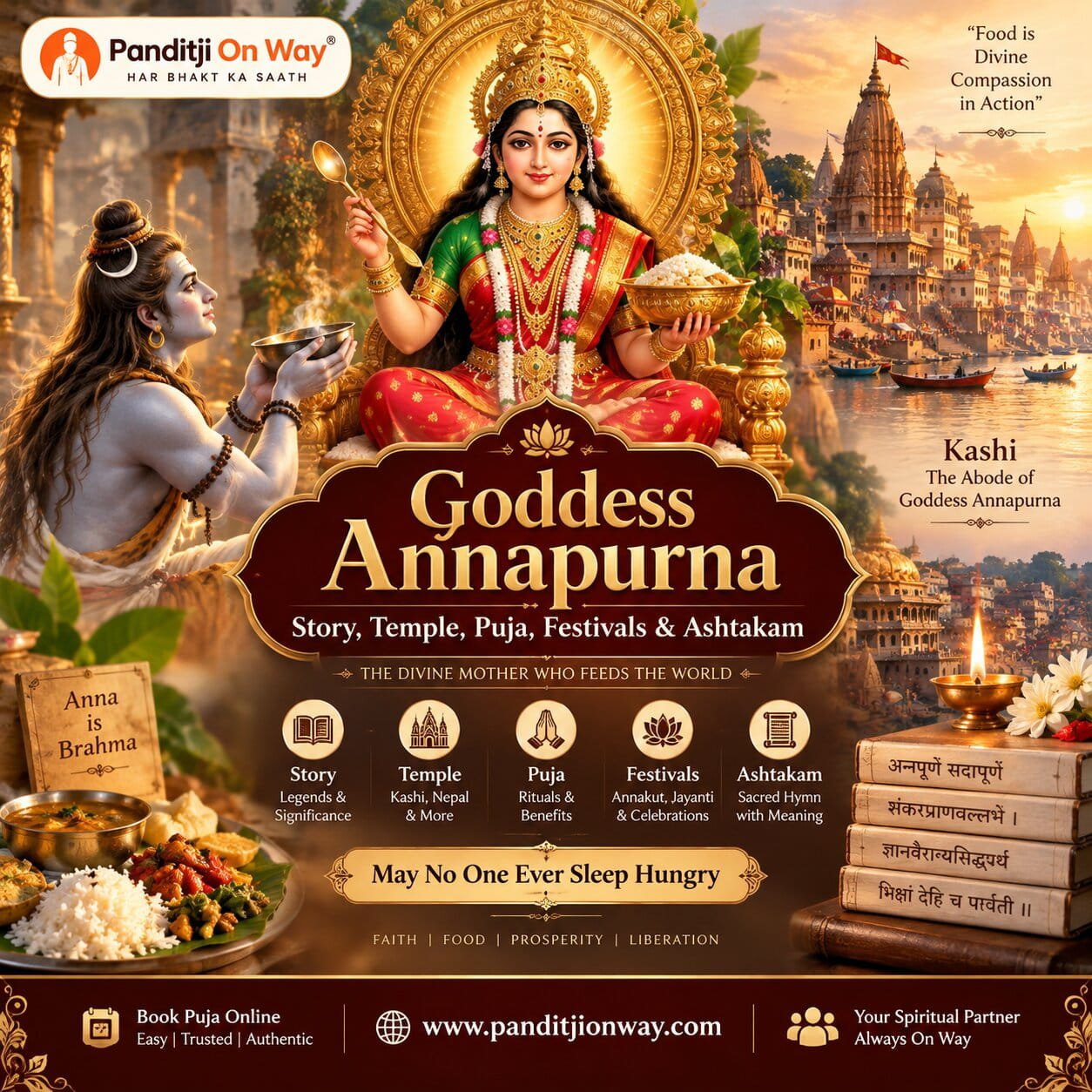
Goddess Annapurna is generally depicted as a beautiful, benevolent goddess seated on a throne or lotus-like seat. Her iconography varies according to regional traditions, temple customs, and artistic representations.
She is often shown with:
- A radiant, moon-like face.
- Three eyes, symbolizing divine awareness.
- Beautiful garments and ornaments.
- A vessel, bowl, or pot filled with food.
- A spoon or ladle used to distribute nourishment.
- Two or, in some depictions, four arms.
What Do the Bowl and Ladle Represent?
The bowl or pot of food symbolizes the abundance and sacredness of nourishment. The ladle or serving spoon represents the goddess’s act of giving and feeding.
Together, these objects communicate a central message:
The Divine Mother does not merely possess abundance; she shares it for the welfare of all beings.
Symbolism of Annapurna Devi
| Symbol | Spiritual Meaning |
|---|---|
| Food-filled vessel | Abundance, sustenance and life |
| Ladle or spoon | Generosity and selfless giving |
| Three eyes | Divine knowledge and awareness |
| Jewelry and ornaments | Divine prosperity and auspiciousness |
| Seated posture | Stability, grace and maternal protection |
Goddess Annapurna and Goddess Parvati
Goddess Annapurna is traditionally regarded as a form of Goddess Parvati, the divine consort of Lord Shiva. Parvati represents Prakriti, or the dynamic power of nature, while Annapurna emphasizes the nourishing aspect of that divine power.
In this form, the Mother Goddess is not primarily represented as a warrior or destroyer of evil. Instead, she appears as the compassionate provider who sustains creation.
This aspect of Parvati highlights the idea that:
Creation requires nourishment, and nourishment is itself a divine function.
Story of Goddess Annapurna: When Parvati Withdrew Food
One of the most widely narrated legends of Goddess Annapurna is connected with Lord Shiva’s statement that the material world is an illusion, or Maya.
According to this traditional story, Lord Shiva explained that the world and its material experiences are temporary. Goddess Parvati, who represents nature and the material foundation of existence, challenged the idea that the material world could simply be dismissed as insignificant.
To demonstrate the importance of nourishment, Parvati withdrew from the world, and food became unavailable.
What Happened When Food Disappeared?
The withdrawal of food caused immense suffering across the three worlds. According to the legend:
- The earth became barren.
- Food supplies disappeared.
- Living beings experienced hunger.
- The balance of life was disrupted.
- The gods and humans realized the importance of nourishment.
The story emphasizes that although spiritual knowledge is essential, the physical body also requires food to function.
Parvati Appears as Annapurna in Kashi
Moved by the suffering of living beings, Goddess Parvati manifested in Kashi, now known as Varanasi, in the form of Annapurna Devi.
She established a divine kitchen and began distributing food to those in need. Her act of feeding the world became a symbol of maternal compassion and selfless service.
Lord Shiva eventually came to her with a begging bowl. In the traditional narrative, he recognized that the body requires nourishment to support the pursuit of knowledge and liberation.
Goddess Annapurna then offered food to Shiva.
Spiritual Meaning of the Story
The legend is not simply about hunger. It conveys a philosophical teaching:
The material and spiritual dimensions of life are interconnected.
The body is the vehicle through which a person performs dharma, seeks knowledge, practices meditation, and pursues liberation. Food therefore has a sacred role in human existence.
Second Legend: The Lesson Given to the Trimurti
Another traditional account describes a dispute among the Trimurti—Lord Brahma, Lord Vishnu, and Lord Shiva—regarding their respective importance.
According to this version of the legend, Goddess Mahadevi decided to demonstrate the essential role of Shakti in sustaining creation. She withdrew, and the world experienced famine and scarcity.
As food became unavailable:
- Rituals and yajnas were disrupted.
- The gods became weakened.
- Living beings suffered.
- The importance of the sustaining power of nature became clear.
Lord Vishnu is said to have directed Lord Shiva toward a woman in Kashi who was distributing food. Shiva recognized that the woman was the Divine Mother herself.
He approached her as a mendicant and requested food. Goddess Annapurna then fed Shiva and declared her connection with Kashi.
What Does This Legend Teach?
The story illustrates that:
- Creation cannot continue without nourishment.
- Shakti is essential to the functioning of the universe.
- Food is a sacred necessity, not something to be taken for granted.
- Giving food is one of the most compassionate forms of service.
These legends are part of the broader devotional storytelling tradition surrounding Annapurna Devi. Their details may vary across regional texts and oral traditions.
Relationship Between Annapurna Devi and Lord Shiva
The relationship between Goddess Annapurna and Lord Shiva is one of the most meaningful aspects of her worship.
Lord Shiva represents consciousness, asceticism, and spiritual wisdom, while Annapurna represents nourishment, nature, and the sustaining power of Shakti.
In many depictions, Shiva stands before Annapurna with a begging bowl, receiving food from her.
This image conveys a profound teaching:
Even the pursuit of spiritual knowledge depends on the nourishment provided by the Divine Mother.
The Annapurna-Shiva relationship is therefore not one of superiority in a worldly sense. It symbolizes the inseparable relationship between Shiva and Shakti, consciousness and energy, and spiritual aspiration and material sustenance.
Goddess Annapurna in Kashi, Varanasi


Kashi, also known as Varanasi or Banaras, is one of the most sacred cities in Hinduism and is closely associated with Goddess Annapurna.
In the religious traditions of Kashi, Annapurna Devi is revered as the divine mother who nourishes the city and its inhabitants. She is closely connected with Lord Vishwanath, the form of Lord Shiva worshipped in Kashi.
The city is often described as a place where the Divine Mother provides food and compassion to all who seek her blessings.
Why Is Annapurna Devi Important in Kashi?
Kashi is associated with Annapurna because:
- She is traditionally believed to have manifested there.
- She is worshipped as the nourishing Mother of the city.
- Her temple is located near the sacred Kashi Vishwanath Temple complex.
- Food distribution and annadan are important expressions of her worship.
- Her presence symbolizes the connection between nourishment and liberation.
The devotional belief that no one should go hungry in Kashi reflects the city’s longstanding association with charity, hospitality, and feeding pilgrims.
Annapurna Temple Near Kashi Vishwanath


The Annapurna Devi Temple in Varanasi is one of the most important shrines dedicated to the goddess. It is situated in the vicinity of the famous Kashi Vishwanath Temple, making it an important stop for pilgrims visiting the sacred city.
The temple is especially associated with the worship of Annapurna as the goddess of food and abundance.
Annapurna Temple: Quick Facts
| Detail | Information |
|---|---|
| Temple Name | Annapurna Devi Temple |
| Location | Kashi (Varanasi), Uttar Pradesh, India |
| Nearby Landmark | Kashi Vishwanath Temple |
| Presiding Deity | Goddess Annapurna |
| Religious Importance | Worship of nourishment, abundance and divine motherhood |
| Pilgrimage Connection | Often visited alongside Kashi Vishwanath |
| Special Association | Annadan and the sacred food tradition of Kashi |
Travel note: Temple entry rules, darshan timings, special puja access, and festival arrangements can change. Pilgrims should verify current details through official temple or local authority channels before visiting.
Annapurna Temple and Food Distribution
The Annapurna tradition is strongly connected with annadan, the offering or distribution of food. Devotees may participate in charitable feeding as an expression of gratitude and service.
The exact arrangements and availability of food distribution may vary by date, temple administration, and festival occasion.
Famous Annapurna Temples in India
Although Kashi is among the most prominent centers of Annapurna worship, the goddess is revered in many parts of India.

1. Annapurna Devi Temple, Varanasi, Uttar Pradesh
The Annapurna Devi Temple in Kashi is one of the most renowned shrines dedicated to the goddess. Its association with Lord Vishwanath and the sacred traditions of Varanasi makes it especially significant for pilgrims.
2. Annapoorneshwari Temple, Horanadu, Karnataka
The Sri Annapoorneshwari Temple at Horanadu, in Karnataka, is another major center of Annapurna worship. The temple is widely known for its tradition of offering meals to devotees.
The goddess is worshipped here as Annapoorneshwari, the divine provider of food and nourishment.
Location: Horanadu, Chikkamagaluru district, Karnataka, India.
Official temple website: Verify the current official temple website before publishing a direct booking or travel link.
3. Annapurna Temples in Other Regions
Annapurna Devi is also worshipped in household shrines, Shakti temples, Shiva temples, and regional temples across India. Her worship is especially common where traditions of food offerings, annadan, and household prosperity are prominent.
Goddess Annapurna in Nepal
Goddess Annapurna is also revered in Nepal, where she is associated with abundance, prosperity, nourishment, and the divine feminine.
In Kathmandu, the goddess is particularly connected with Asan, a historic marketplace and cultural center known for its temples and religious traditions.

Annapurna Temple in Asan, Kathmandu
The Annapurna shrine in Asan is traditionally described as a pagoda-style temple associated with the worship of the goddess. The local religious culture reflects a rich blend of Hindu and Buddhist traditions.
In some Newar traditions, Annapurna is associated with forms and qualities connected to prosperity, wisdom, protection, and abundance.
Annapurna and the Himalayan Mountain Range
The famous Annapurna mountain range in Nepal is named after Annapurna Devi. The name reflects the region’s deep connection with Hindu religious and cultural traditions.
The Annapurna massif is also internationally known for its dramatic Himalayan landscapes and mountaineering history.
Annapurna Festivals in India and Nepal
Goddess Annapurna is worshipped during several festivals and religious observances. The dates may vary according to regional calendars and lunar calculations.
Major Festivals Associated with Annapurna Devi
| Festival | Significance |
|---|---|
| Annapurna Jayanti | Observance dedicated to the manifestation and worship of Annapurna Devi |
| Annakut | Offering of a large variety of food to the Divine |
| Navratri | Worship of the various forms of Shakti, including Annapurna |
| Akshaya Tritiya | Associated with certain traditional accounts of Annapurna’s manifestation |
| Annapurna Jatra, Nepal | Local festival tradition associated with Annapurna worship in Kathmandu |
Festival dates should be verified using the relevant regional Hindu calendar for the year in question.
Annapurna Jayanti: Date, Significance and Puja
Annapurna Jayanti is a religious observance dedicated to Goddess Annapurna. It is traditionally associated with the Purnima (full moon) Tithi of the Margashirsha month in many North Indian calendar traditions.
However, the precise date can vary according to the lunar calendar, regional traditions, and whether the calendar follows Amanta or Purnimanta month calculations.
When Is Annapurna Jayanti Celebrated?
| Detail | Information |
|---|---|
| Festival | Annapurna Jayanti |
| Traditional Tithi | Margashirsha Purnima |
| Calendar Basis | Hindu lunar calendar |
| Main Deity | Goddess Annapurna |
| Primary Focus | Gratitude for food, nourishment and abundance |
| Common Practices | Puja, fasting according to personal tradition, food offerings and annadan |
SEO and accuracy recommendation: If publishing a yearly article such as “Annapurna Jayanti 2026,” calculate the date using a reliable Panchang and clearly mention the location and calendar system.
Annapurna Jayanti Puja
Devotees may perform the following practices:
- Clean the puja area and kitchen.
- Place an image or idol of Goddess Annapurna.
- Light a diya and offer incense.
- Offer flowers, fruits, grains, and cooked food.
- Recite Annapurna mantras or Annapurna Ashtakam.
- Pray for nourishment and the welfare of all beings.
- Donate food or feed people in need.
Fasting practices differ by family and tradition. Devotees should follow their customary practices and personal health needs.
Annakut Festival and Annapurna Devi
Annakut, meaning “mountain of food,” is a festival in which devotees prepare and offer a wide variety of food items to the Divine.
It is especially associated with the day following Diwali in many Hindu traditions, although customs vary among communities.
The festival expresses:
- Gratitude for the harvest.
- Reverence for food.
- Celebration of abundance.
- Community participation.
- The principle that food should be shared.
In Kashi and other regions where Annapurna is worshipped, Annakut carries special significance because of the goddess’s association with nourishment and food distribution.
Why Is Food Offered During Annakut?
Food is offered as naivedya, or sacred offering, before being distributed as prasad. The practice reflects the belief that food becomes spiritually blessed when offered with devotion and shared respectfully.
How to Worship Goddess Annapurna at Home
Goddess Annapurna can be worshipped at home with a simple and sincere puja. A grand ritual is not necessary for every devotee; cleanliness, gratitude, devotion, and the intention to share food are central to her worship.
Simple Annapurna Puja Vidhi
Step 1: Clean the Puja Space
Clean the place of worship and, traditionally, the kitchen as well. The kitchen is especially important because Annapurna is associated with food and nourishment.
Step 2: Place the Goddess’s Image or Idol
Place an image or idol of Goddess Annapurna on a clean altar.
Step 3: Light a Diya
Light a ghee or oil lamp and offer incense if customary.
Step 4: Offer Food Grains and Naivedya
Offer rice, wheat, fruits, sweets, or freshly prepared sattvic food according to family tradition.
Step 5: Recite a Mantra
Chant a simple Annapurna mantra or recite the Annapurna Ashtakam.
Step 6: Pray for Nourishment and Compassion
Ask for the welfare of your family, the abundance of food, and the strength to help those experiencing hunger.
Step 7: Share the Prasad
Distribute the offered food among family members or share food with others.
Annapurna Puja: Important Principle
The most meaningful offering to Annapurna Devi is not only ritual worship but also respecting food and ensuring that it is not wasted.
Annapurna Puja Samagri List
The following items are commonly used for a simple Annapurna puja. Requirements may vary by regional and family tradition.
| Puja Item | Purpose |
|---|---|
| Image or idol of Goddess Annapurna | Focus of worship |
| Clean cloth | For the altar |
| Diya and oil or ghee | Light offering |
| Incense | Traditional worship |
| Flowers | Devotional offering |
| Rice or grains | Symbol of nourishment |
| Fruits | Naivedya |
| Sweets or cooked food | Food offering |
| Water in a kalash | Purification and auspiciousness |
| Kumkum and turmeric | Traditional puja items |
| Betel leaves and nuts | Optional, according to tradition |
| Annapurna Ashtakam text | Prayer recitation |
Annapurna Mantra
One of the widely recited Annapurna mantras is:
Annapurna Mantra in Sanskrit
अन्नपूर्णे सदापूर्णे शङ्करप्राणवल्लभे।
ज्ञानवैराग्यसिद्ध्यर्थं भिक्षां देहि च पार्वति॥
Annapurna Mantra Transliteration
Annapurne Sadapurne Shankara Prana Vallabhe
Jnana Vairagya Siddhyartham Bhiksham Dehi Cha Parvati
Annapurna Mantra Meaning
“O Goddess Annapurna, who is ever full and complete, beloved of Lord Shankara, O Parvati, grant me the alms of knowledge and detachment.”
This prayer is significant because it asks not only for food but also for jnana (knowledge) and vairagya (detachment).
Sri Annapurna Ashtakam
Sri Annapurna Ashtakam is a revered Sanskrit hymn dedicated to Goddess Annapurna. It is traditionally associated with prayer for nourishment, compassion, knowledge, and spiritual welfare.
The refrain of the hymn asks the Mother Annapurna to grant alms through her compassionate grace.
Annapurna Ashtakam: Opening Verse
नित्यानन्दकरी वराभयकरी सौन्दर्यरत्नाकरी
निर्धूताखिलघोरपावनकरी प्रत्यक्षमाहेश्वरी।
प्रालेयाचलवंशपावनकरी काशीपुराधीश्वरी
भिक्षां देहि कृपावलम्बनकरी माताऽन्नपूर्णेश्वरी॥
Transliteration
Nityanandakari Varabhayakari Saundarya Ratnakari
Nirdhutakhila Ghora Pavanakari Pratyaksha Maheshwari
Praleyachala Vamsha Pavanakari Kashipura Adhishwari
Bhiksham Dehi Kripavalambanakari Mata Annapurneshwari.
Meaning
“O Mother Annapurna, bestower of eternal bliss, giver of blessings and protection, embodiment of beauty, purifier, and presiding goddess of Kashi, grant us alms through your compassionate grace.”
The Famous Closing Prayer
अन्नपूर्णे सदापूर्णे
शङ्करप्राणवल्लभे।
ज्ञानवैराग्यसिद्ध्यर्थं
भिक्षां देहि च पार्वति॥
This closing verse is particularly popular among devotees because it connects the nourishment of the body with the pursuit of spiritual wisdom.
Why Recite Annapurna Ashtakam?
Devotees traditionally recite the hymn to:
- Express gratitude for food.
- Seek the goddess’s blessings.
- Cultivate humility and devotion.
- Pray for knowledge and detachment.
- Remember the sacredness of nourishment.
- Develop compassion toward those in need.
Textual note: Different published versions of the Annapurna Ashtakam may vary in verse ordering, transliteration, punctuation, and wording. For religious publication, use a verified Sanskrit source and maintain one consistent recension.
Spiritual Significance of Annapurna Worship
Goddess Annapurna represents much more than material abundance. Her worship contains several important spiritual teachings.
1. Food Is Sacred
Food sustains the body and supports every activity, including prayer, study, meditation, and service. Annapurna worship encourages devotees to treat food with reverence.
2. Giving Is Greater Than Hoarding
The goddess is depicted distributing food rather than merely possessing it. This symbolizes generosity and the responsibility to share resources.
3. Material and Spiritual Life Are Connected
The story of Shiva receiving food from Annapurna illustrates that spiritual aspiration does not eliminate the body’s basic needs.
4. Nourishment Is an Expression of Motherhood
Annapurna’s image reflects the universal idea of the mother as one who feeds, protects, and cares for her children.
5. Hunger Is a Human Concern
Her worship encourages awareness of hunger and the importance of feeding those who are vulnerable.
Goddess Annapurna and the Importance of Annadan
Annadan, or the charitable distribution of food, is one of the most respected forms of seva in Hindu traditions.
The word can be understood as:
- Anna — food
- Dana — giving or charity
Annadan is especially associated with Annapurna Devi because food is central to her divine identity.
Why Is Annadan Considered Important?
Annadan is valued because it:
- Directly addresses hunger.
- Expresses compassion.
- Encourages community service.
- Honors the sacredness of food.
- Promotes equality and hospitality.
- Transforms devotion into practical action.
How Can Devotees Practice Annapurna Seva?
Devotees may:
- Feed family members with gratitude.
- Donate food grains to those in need.
- Support community kitchens.
- Offer meals at temples or charitable organizations.
- Avoid unnecessary food waste.
- Share nutritious food respectfully and safely.
The most meaningful practice is to combine devotion with genuine care for others.
Annapurna Devi: Key Facts at a Glance
| Question | Answer |
|---|---|
| Who is Goddess Annapurna? | A form of Goddess Parvati and the goddess of food and nourishment. |
| What does Annapurna mean? | “Full of food,” “complete nourishment,” or “abundant food.” |
| Who is Annapurna’s husband? | Lord Shiva. |
| Where is Annapurna Devi mainly worshipped? | Kashi (Varanasi), India, among many other places. |
| What does she hold? | A food-filled vessel or bowl and a ladle in many depictions. |
| What is her main teaching? | Food is sacred, and feeding others is an act of compassion. |
| Which festival is associated with her? | Annapurna Jayanti and Annakut, among other observances. |
| What is her famous prayer? | Sri Annapurna Ashtakam. |
| What is annadan? | The charitable distribution of food. |
Frequently Asked Questions About Goddess Annapurna
1. Who is Goddess Annapurna?
Goddess Annapurna is a form of Goddess Parvati worshipped as the goddess of food, nourishment, abundance, and compassion. She is especially revered in Kashi, or Varanasi.
2. What is the meaning of Annapurna?
Annapurna is derived from the Sanskrit words Anna, meaning food or nourishment, and Purna, meaning full, complete, or abundant. The name signifies abundant nourishment.
3. Is Annapurna Devi a form of Goddess Parvati?
Yes. In Hindu tradition, Annapurna Devi is regarded as a nourishing manifestation of Goddess Parvati, the consort of Lord Shiva.
4. Why is Goddess Annapurna associated with Lord Shiva?
Annapurna is associated with Shiva through traditional legends in which Shiva receives food from her. The story symbolizes the importance of nourishment for the body and the interconnection of Shiva and Shakti.
5. Where is the famous Annapurna Temple located?
The famous Annapurna Devi Temple is located in Kashi, or Varanasi, Uttar Pradesh, near the sacred Kashi Vishwanath Temple.
6. What does Goddess Annapurna hold in her hands?
She is commonly depicted holding a vessel or bowl filled with food in one hand and a ladle or spoon in the other, symbolizing nourishment and generosity.
7. When is Annapurna Jayanti celebrated?
Annapurna Jayanti is traditionally observed on Margashirsha Purnima in many Hindu calendar traditions. The exact date changes annually and should be checked using a reliable regional Panchang.
8. What is the Annapurna mantra?
A widely recited mantra is:
अन्नपूर्णे सदापूर्णे शङ्करप्राणवल्लभे।
ज्ञानवैराग्यसिद्ध्यर्थं भिक्षां देहि च पार्वति॥
It is a prayer to Goddess Annapurna for knowledge, detachment, and divine nourishment.
9. What is Annapurna Ashtakam?
Annapurna Ashtakam is a Sanskrit devotional hymn dedicated to Goddess Annapurna. It praises her compassion, beauty, abundance, and role as the presiding goddess of Kashi.
10. What is the significance of annadan?
Annadan means donating or distributing food. It is considered an important form of seva because it directly supports people in need and reflects the compassionate nature of Goddess Annapurna.
11. Can Goddess Annapurna be worshipped at home?
Yes. Devotees can worship Annapurna Devi at home by keeping her image or idol, offering food grains or cooked food, reciting her mantra, and practicing gratitude and food sharing.
12. Is Annapurna Devi worshipped in Nepal?
Yes. Annapurna is worshipped in Nepal, particularly in Kathmandu’s Asan area, where she is associated with local Hindu and Newar religious traditions.
13. Is the Annapurna mountain named after the goddess?
Yes. The Annapurna mountain range in Nepal is traditionally named after Goddess Annapurna.
14. What is the main message of Goddess Annapurna?
The central message of Annapurna worship is that food is sacred, nourishment sustains life, and abundance should be shared with compassion and humility.
Conclusion
Goddess Annapurna is one of the most compassionate manifestations of the Divine Mother in Hinduism. As the goddess of food, nourishment, and abundance, she reminds devotees that every meal is a gift and that feeding others is a sacred act.
Her association with Kashi, her relationship with Lord Shiva, the legends of her manifestation, and the tradition of annadan all convey the same timeless teaching:
Life depends on nourishment, and true abundance becomes meaningful when it is shared.
Worshipping Annapurna Devi is therefore not limited to offering food before an idol. It also means respecting food, avoiding waste, helping those who are hungry, and cultivating gratitude for the natural and divine forces that sustain life.
May Goddess Annapurna bless every home with nourishment, compassion, wisdom, and abundance.

Devotees who wish to perform Annapurna Devi Puja can explore online puja booking services through Panditji on Way, a platform for arranging Hindu religious ceremonies and spiritual services.
Incredible India – Official tourism information for Varanasi and Indian pilgrimage destinations
Uttar Pradesh Tourism – Kashi, Varanasi and temple tourism information
Karnataka Tourism – Horanadu and Karnataka pilgrimage information
Nepal Tourism Board – Annapurna region and Nepal cultural tourism
Who is Goddess Annapurna?
Goddess Annapurna is a form of Goddess Parvati worshipped in Hinduism as the goddess of food, nourishment, abundance, and compassion. She is especially revered in Kashi, or Varanasi, where she is associated with the sacred tradition of feeding and serving devotees.
Author/Publisher
Published by: Panditji on Way
Website: Panditji on Way
Editorial category: Hindu Gods & Goddesses / Hindu Festivals / Puja & Rituals