Goddess Durga: The Complete Guide to Maa Durga, Her Story, Forms, Symbols, Mantras, Worship & Spiritual Significance
Discover Goddess Durga’s story, meaning, nine forms, symbolism, weapons, Durga Puja, Navratri worship, powerful mantras, and spiritual significance.
Goddess Durga: The Divine Mother of Strength, Protection & Justice
Goddess Durga, also known as Maa Durga, Durga Devi, or Adi Shakti, is one of the most revered goddesses in Hinduism. She represents divine strength, courage, protection, compassion, and the triumph of righteousness over evil.
The name Durga is traditionally associated with the Sanskrit word Durgā, which is commonly interpreted as “she who removes difficulties” or “the one who is difficult to approach or overcome.” In devotional traditions, Maa Durga is regarded as the compassionate Divine Mother who protects devotees from fear, suffering, injustice, and spiritual obstacles.
She is worshipped in many forms throughout India and around the world, especially during Navratri, Durga Puja, and other Shakti festivals. Her powerful imagery—riding a lion or tiger, holding divine weapons, and blessing devotees—symbolizes the strength required to overcome both external challenges and inner negativity.
Quick Answer: Goddess Durga is a principal manifestation of Shakti, the divine feminine power in Hinduism. She symbolizes courage, protection, compassion, and the victory of dharma over adharma. Her most famous legend is the defeat of the buffalo demon Mahishasura.
Who Is Goddess Durga?
Goddess Durga is worshipped as the Divine Mother, protector of the universe, and embodiment of Shakti. In Shakta traditions, she is considered the supreme divine power, while in other Hindu traditions she is revered as a powerful manifestation of Parvati, Devi, or Adi Shakti.
Durga’s role extends beyond the destruction of evil. She is also associated with:
- Protection from fear and adversity
- Courage and inner strength
- Compassion and maternal love
- Justice and righteous action
- Spiritual awakening
- Removal of obstacles
- Preservation of cosmic balance
The word Shakti refers to divine energy or power. Goddess Durga represents the active, dynamic force through which creation, preservation, transformation, and protection take place.
For devotees, Maa Durga is not only a warrior goddess but also a loving mother who offers refuge and guidance.
Meaning of the Name Durga
The Sanskrit name Durgā (दुर्गा) has several traditional interpretations.
| Term | Meaning or Association |
|---|---|
| Durga | The invincible or unconquerable one |
| Durgatinashini | One who removes suffering and difficulties |
| Shakti | Divine feminine power |
| Devi | Goddess or divine being |
| Jagadamba | Mother of the universe |
| Mahishasuramardini | Slayer of Mahishasura |
| Bhavani | Source and mother of existence |
| Adi Shakti | Primordial divine energy |
In devotional understanding, the name Durga expresses the belief that divine grace can help devotees cross difficult circumstances and overcome spiritual and worldly challenges.
The Legend of Goddess Durga and Mahishasura
One of the most celebrated stories associated with Maa Durga is her battle with Mahishasura, the powerful buffalo demon.
According to the Devi Mahatmya, a revered section of the Markandeya Purana, Mahishasura received a boon that made him extremely difficult to defeat. Empowered by his strength, he attacked the gods and disrupted the balance of the universe.
Unable to overcome him individually, the gods united their divine energies. From this collective radiance emerged a magnificent and powerful goddess—Durga.
Each deity is traditionally described as offering her a weapon or divine attribute:
- Shiva – Trishula, or trident
- Vishnu – Sudarshana Chakra
- Indra – Vajra, or thunderbolt
- Varuna – Conch
- Agni – Spear or fiery power
- Vayu – Bow and arrows
- Himalaya – Lion as her vehicle, in many retellings
- Other deities – Additional divine weapons and ornaments
Durga confronted Mahishasura in a fierce battle. After a prolonged struggle, she defeated and killed him, restoring balance and freeing the gods and the world from his tyranny.
Spiritual Meaning of the Mahishasura Story
The battle is understood not only as a cosmic event but also as a spiritual allegory.
| Symbol | Spiritual Interpretation |
|---|---|
| Mahishasura | Ego, arrogance, ignorance, and uncontrolled desire |
| Durga | Divine wisdom, courage, and righteous power |
| Weapons | Different virtues and spiritual strengths |
| The battle | The struggle between dharma and adharma |
| Victory | Triumph of truth and divine consciousness |
The story teaches that evil, arrogance, and injustice can be overcome when courage, wisdom, unity, and righteousness come together.
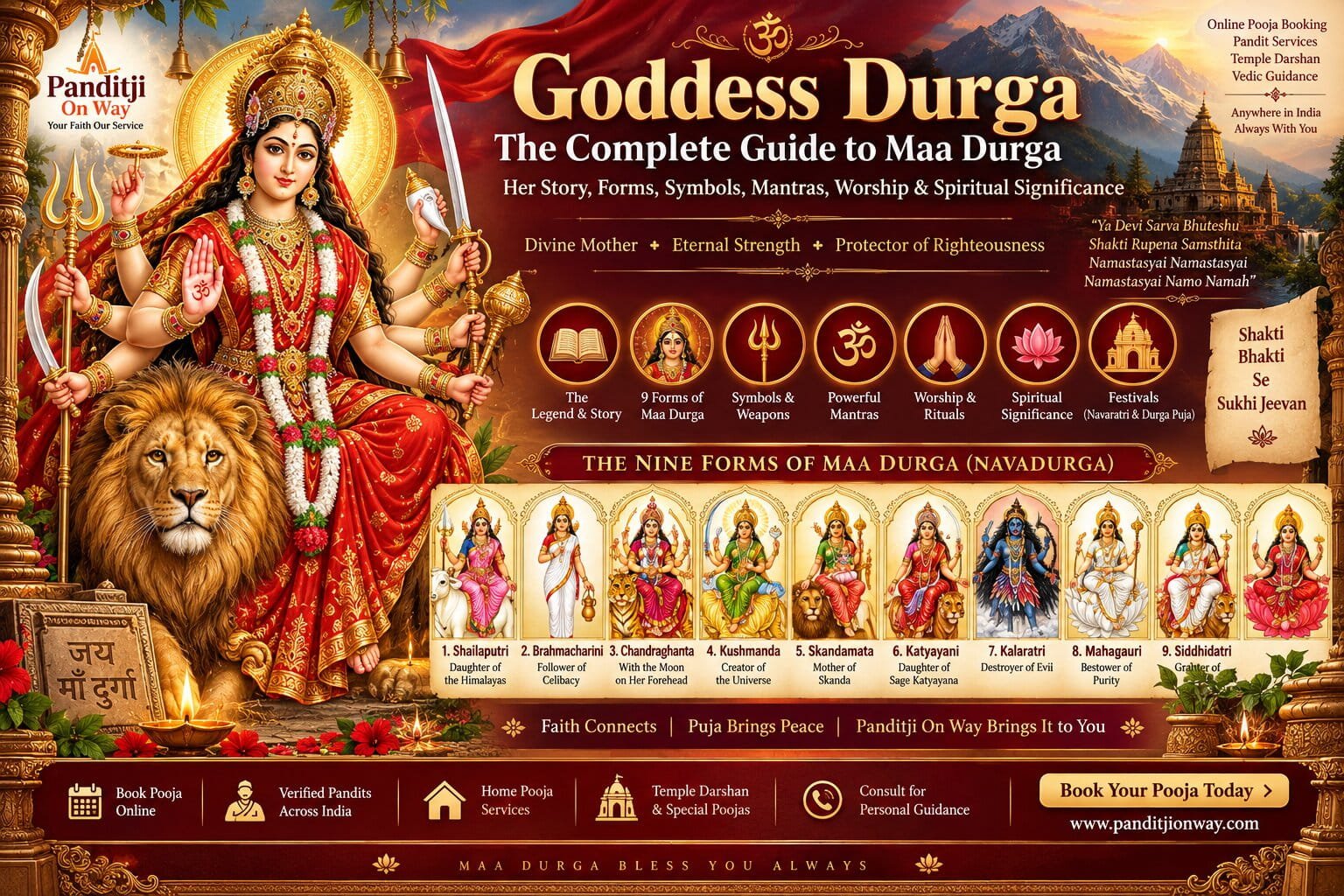
Goddess Durga in Hindu Scriptures
Goddess Durga is described and praised in several Hindu scriptures and devotional traditions. Among the most important texts associated with her worship are:
1. Devi Mahatmya
The Devi Mahatmya, also known as Durga Saptashati or Chandi Path, is one of the most important scriptures dedicated to the Divine Mother. It forms part of the Markandeya Purana and narrates the glory of Devi through stories involving Madhu-Kaitabha, Mahishasura, Shumbha, and Nishumbha.
2. Devi Bhagavata Purana
The Devi Bhagavata Purana presents Devi as the supreme divine reality and explores the many manifestations of Shakti.
3. Devi Upanishads and Shakta Texts
Various Shakta scriptures describe the goddess as the source of divine consciousness, cosmic energy, and spiritual liberation.
4. Durga Suktam
The Durga Suktam, found in the Vedic tradition, is widely recited for protection, spiritual strength, and the removal of difficulties.
Recommended Authoritative Scripture Reference
For readers interested in exploring the original tradition, consider linking to a reliable translation or scholarly edition of the Devi Mahatmya rather than relying only on unsourced summaries.
How Is Goddess Durga Depicted?
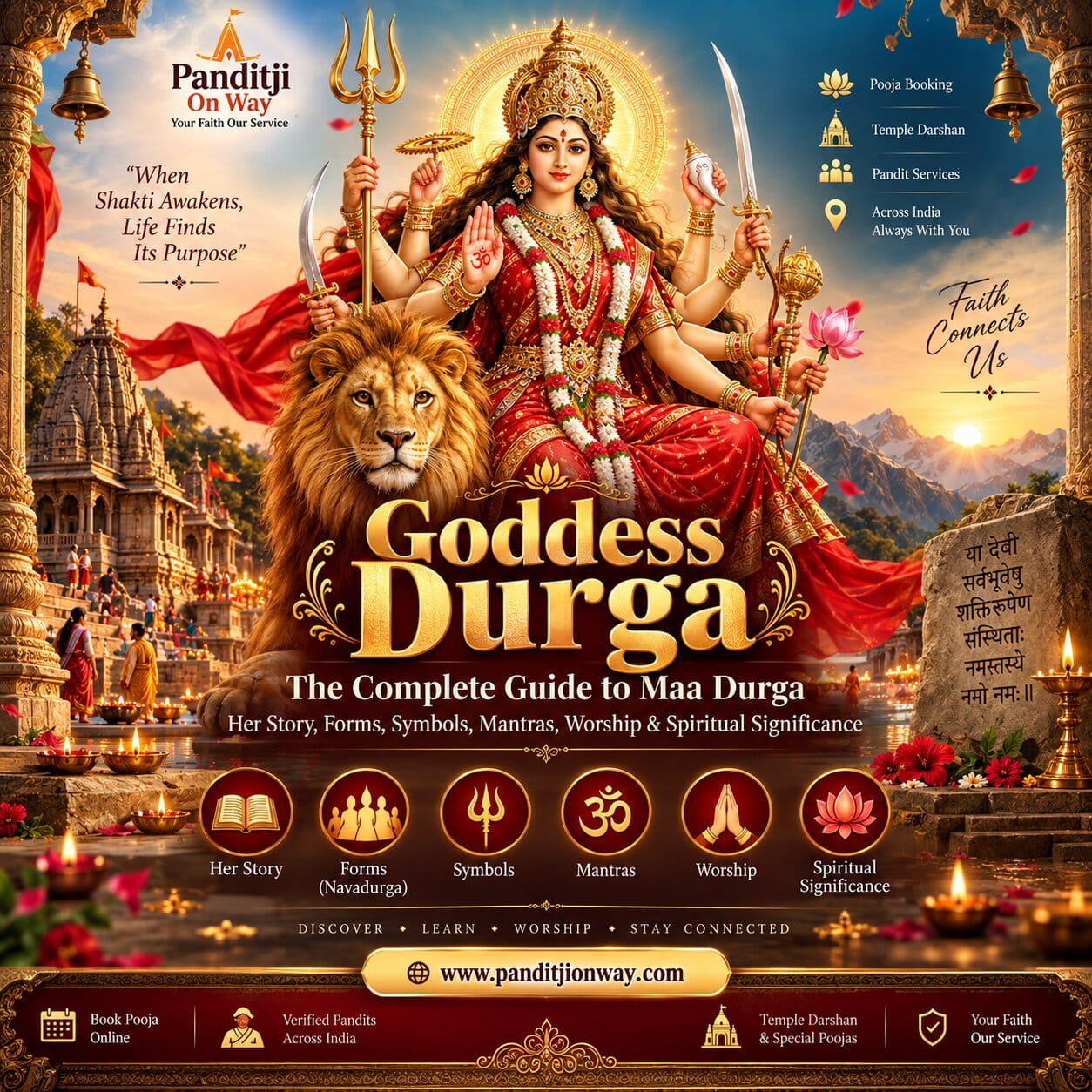
Maa Durga is commonly portrayed as a radiant goddess dressed in red or richly decorated garments, seated on or riding a lion or tiger. She often has eight, ten, or eighteen arms, depending on the artistic and regional tradition.
Her iconography conveys important spiritual teachings.
Symbolism of Goddess Durga’s Appearance
| Element | Symbolic Meaning |
|---|---|
| Red clothing | Strength, action, courage, and divine energy |
| Lion or tiger | Power, determination, and mastery over fear |
| Multiple arms | Divine ability to protect and act in all directions |
| Weapons | The destruction of ignorance, injustice, and negativity |
| Lotus | Spiritual purity and awakening |
| Third eye | Higher knowledge, insight, and divine awareness |
| Abhaya Mudra | Fearlessness and protection |
| Peaceful expression | Compassion, balance, and maternal grace |
| Crown and ornaments | Divine sovereignty and spiritual magnificence |
What Do Goddess Durga’s Weapons Symbolize?
The weapons held by Maa Durga represent the combined strength of divine virtues. They are not merely instruments of warfare; they symbolize the qualities required to overcome ignorance, fear, injustice, and inner weaknesses.
| Weapon or Attribute | Traditional Association | Symbolic Meaning |
|---|---|---|
| Trishula | Lord Shiva | Balance, destruction of negativity, and the three fundamental qualities |
| Sudarshana Chakra | Lord Vishnu | Righteousness, time, and the destruction of ignorance |
| Conch | Divine tradition | Sacred sound, purity, and spiritual awakening |
| Bow and arrows | Divine warrior symbolism | Focus, discipline, and purposeful action |
| Sword | Divine power | Knowledge that cuts through ignorance |
| Thunderbolt | Indra | Strength, determination, and spiritual firmness |
| Lotus | Goddess Durga | Purity, beauty, and spiritual growth |
| Shield | Warrior symbolism | Protection and resilience |
| Bell | Ritual and Shakta traditions | Awakening consciousness and dispelling negativity |
The exact list of weapons varies across scriptures, regional traditions, and artistic representations.
Why Does Goddess Durga Ride a Lion or Tiger?
The lion or tiger associated with Maa Durga represents power, courage, willpower, and determination.
The animal also symbolizes the instinctive and aggressive forces within life. Durga’s ability to ride or master it is interpreted as the control of fear, anger, pride, and uncontrolled impulses.
In this sense, the image teaches devotees that true strength is not simply physical power—it is the ability to direct power toward righteous and compassionate action.
Why Does Goddess Durga Have Multiple Arms?
Goddess Durga is often depicted with eight or ten arms, although some forms have more.
The multiple arms symbolize her ability to protect, guide, and act in every direction. They also represent the many divine powers necessary to maintain balance and defeat evil.
Eight or Ten Arms: What Do They Represent?
- Protection from all directions
- Multiple forms of divine strength
- Wisdom and action working together
- The many responsibilities of the Divine Mother
- The unity of divine powers
The number of arms may differ depending on the form of Durga and the artistic tradition.
The Meaning of Goddess Durga’s Three Eyes
Maa Durga is often depicted with three eyes, a feature she shares with several major Hindu deities.
The three eyes are traditionally associated with:
| Eye | Symbolic Association |
|---|---|
| Left eye | Moon, desire, and nurturing energy |
| Right eye | Sun, action, and vitality |
| Third eye | Fire, wisdom, and higher consciousness |
The third eye represents the ability to see beyond ordinary perception and recognize deeper spiritual truth.
The Nine Forms of Goddess Durga: Navadurga
During Navratri, devotees worship the nine principal forms of Goddess Durga, collectively known as Navadurga.
Each form represents a distinct aspect of Shakti and carries its own spiritual significance.
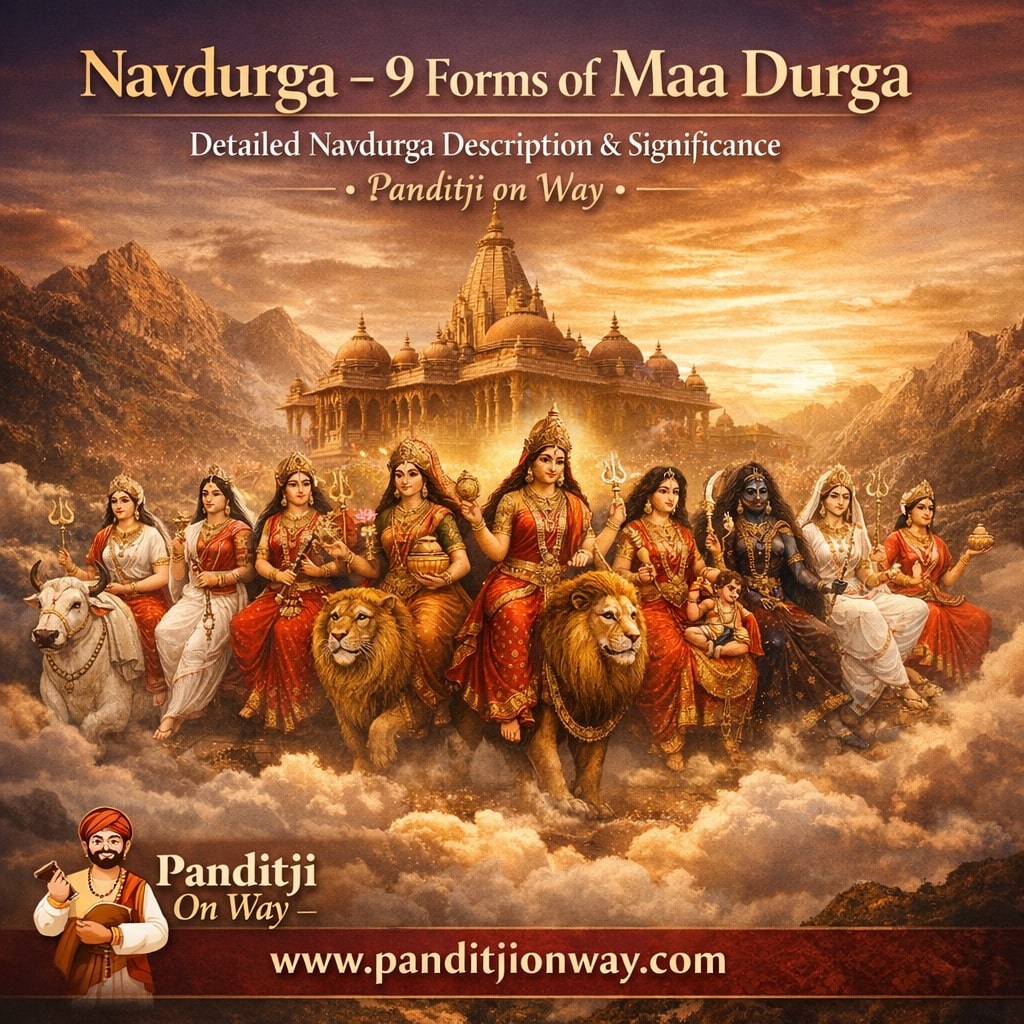
Navadurga Names and Significance Table
| Day | Form of Durga | Meaning / Significance |
|---|---|---|
| Day 1 | Shailaputri | Daughter of the Himalayas; symbolizes stability and devotion |
| Day 2 | Brahmacharini | Embodiment of penance, discipline, and spiritual dedication |
| Day 3 | Chandraghanta | Associated with courage, peace, and the removal of fear |
| Day 4 | Kushmanda | Associated with cosmic creation, vitality, and nourishment |
| Day 5 | Skandamata | Mother of Skanda; represents maternal love and protection |
| Day 6 | Katyayani | Warrior form associated with courage and the destruction of evil |
| Day 7 | Kalaratri | Fierce form associated with protection and the removal of darkness |
| Day 8 | Mahagauri | Symbolizes purity, peace, and spiritual cleansing |
| Day 9 | Siddhidatri | Associated with spiritual accomplishments, wisdom, and divine grace |
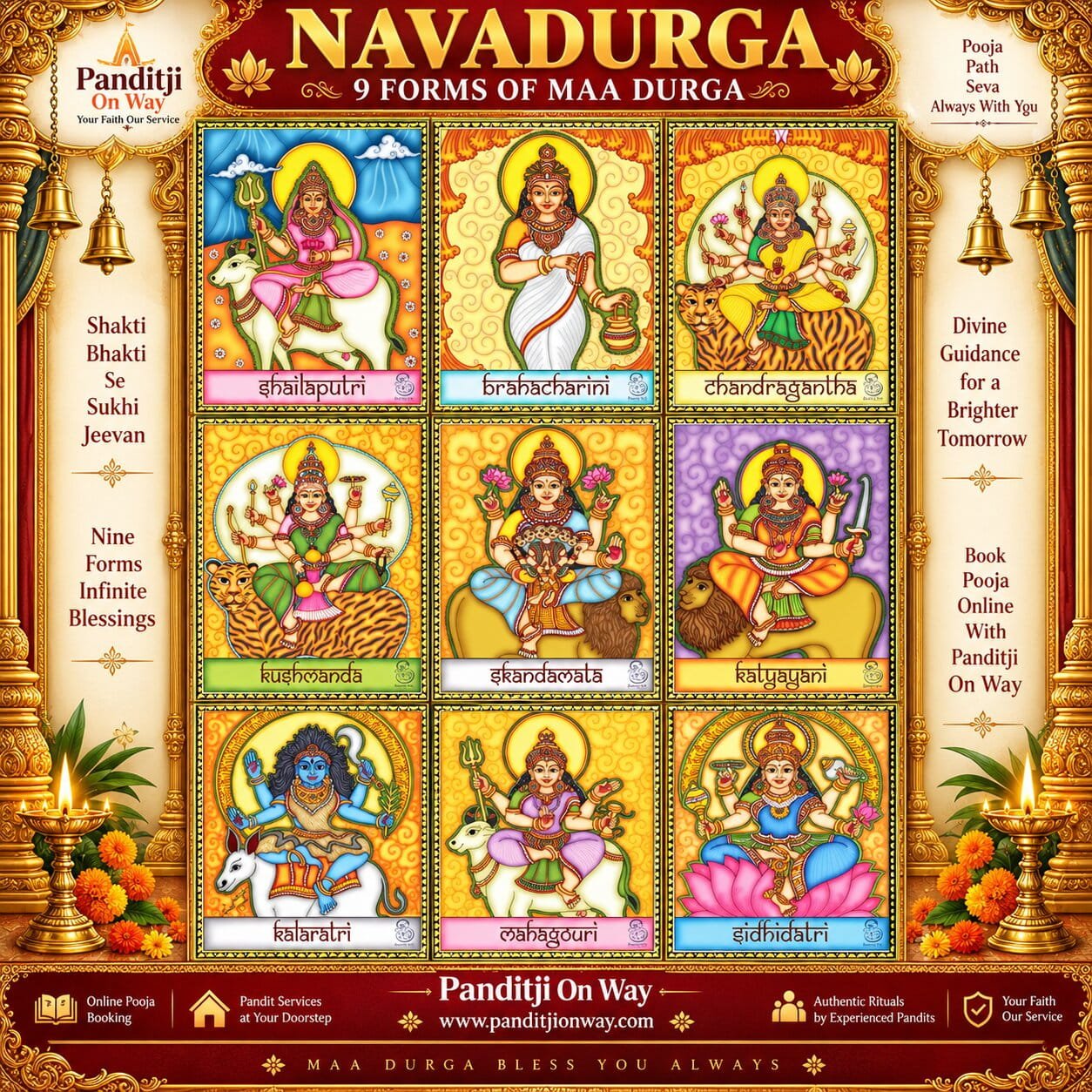
Why Are the Nine Forms Worshipped?
The nine forms of Durga represent different stages and qualities of spiritual development, including:
- Faith
- Discipline
- Courage
- Creativity
- Compassion
- Righteous action
- Fearlessness
- Purity
- Spiritual wisdom
The exact rituals, offerings, colors, and regional customs associated with each form may vary.
Goddess Durga and Navratri
Navratri is one of the most important festivals dedicated to Goddess Durga. The word means “nine nights,” during which devotees worship different forms of Shakti.
The festival is observed in several forms across India:
- Sharad Navratri – The most widely celebrated Navratri, usually occurring in September or October
- Chaitra Navratri – Celebrated in March or April
- Gupta Navratri – Observed in certain Shakta and Tantric traditions
- Magha and Ashadha Navratri – Observed in specific regional and spiritual traditions
During Navratri, devotees may observe fasting, perform daily puja, recite Durga Saptashati, chant mantras, organize devotional gatherings, and participate in cultural celebrations.
Navratri Worship Practices
| Practice | Purpose |
|---|---|
| Kalash Sthapana | Beginning the sacred worship |
| Daily Durga Puja | Devotion and prayer |
| Durga Saptashati Path | Recitation of sacred scripture |
| Mantra Japa | Concentration and spiritual practice |
| Fasting | Discipline and devotion |
| Kanya Puja | Honoring the feminine divine |
| Havan | Traditional fire offering |
| Bhajan and Garba | Devotional and cultural celebration |
Note: Ritual procedures can vary by family tradition, region, sampradaya, and priestly guidance.
Durga Puja: History, Meaning & Celebration
Durga Puja is a major Hindu festival celebrating the victory of Goddess Durga over Mahishasura. It is especially prominent in West Bengal, Assam, Odisha, Tripura, Bihar, Jharkhand, and among Bengali communities across the world.
The festival combines religious worship, artistic expression, community gatherings, cultural programs, and elaborate deity installations.
Major Days of Durga Puja
| Day | Significance |
|---|---|
| Mahalaya | Invocation and beginning of the festive devotional period |
| Shashti | Traditional welcoming and ceremonial commencement |
| Saptami | Formal worship and rituals |
| Ashtami | One of the most significant days of worship |
| Navami | Continued worship and offerings |
| Dashami | Immersion ceremony and farewell to the deity |
The dates of Durga Puja change each year according to the Hindu lunar calendar and regional observances.
Durga Puja Around the World
Durga Puja is celebrated not only in India but also by Hindu and Bengali communities in countries such as:
- United States
- United Kingdom
- Canada
- Australia
- Singapore
- Bangladesh
- Nepal
- United Arab Emirates
Goddess Durga and Shakti
In Hindu philosophy, Shakti is the divine energy that enables creation, preservation, transformation, and liberation.
Goddess Durga is one of the most powerful expressions of this divine feminine principle. She is often understood as:
- The protective power of the universe
- The energy behind righteous action
- The mother who nurtures and protects
- The force that removes ignorance
- The power that restores cosmic balance
In Shakta traditions, Devi is not considered merely an accompanying deity but is revered as the supreme reality itself.
The relationship between Shiva and Shakti is often explained philosophically: Shiva represents pure consciousness, while Shakti represents the dynamic power through which consciousness becomes active in the universe.
Goddess Durga’s Relationship with Other Deities
Goddess Durga is worshipped in many forms and is closely associated with several important Hindu deities.
| Deity / Form | Relationship or Association |
|---|---|
| Parvati | In many traditions, Durga is understood as a powerful form of Parvati |
| Kali | A fierce manifestation of Devi associated with time and destruction of evil |
| Lakshmi | Associated with prosperity and abundance |
| Saraswati | Associated with wisdom, knowledge, and learning |
| Ganesha | Frequently worshipped alongside Durga during Durga Puja |
| Kartikeya / Skanda | Associated with divine courage and warfare |
| Lalita Tripurasundari | A major form of the Divine Mother in Shakta traditions |
| Mahishasuramardini | Durga as the slayer of Mahishasura |
Different Hindu traditions may explain the relationship between these forms differently. They are often understood as diverse manifestations of the same divine feminine power.
Powerful Goddess Durga Mantras
Devotees chant Durga mantras for devotion, spiritual focus, courage, protection, and inner peace. Mantra practice should be approached with sincerity and respect for the tradition.
1. Durga Beej Mantra
ॐ दुं दुर्गायै नमः।
Om Dum Durgayai Namah.
Meaning: Salutations to Goddess Durga, the divine power who protects and removes difficulties.
2. Durga Gayatri Mantra
ॐ कात्यायनाय विद्महे
कन्याकुमारि धीमहि।
तन्नो दुर्गिः प्रचोदयात्॥
Om Katyayanaya Vidmahe
Kanyakumari Dhimahi
Tanno Durgih Prachodayat.
Meaning: May we meditate upon the divine power of Katyayani. May Goddess Durga inspire and guide our minds.
Mantra wording and pronunciation may vary across textual and regional traditions.
3. Durga Suktam
The Durga Suktam is a Vedic prayer traditionally recited for protection, spiritual strength, and guidance through difficulties. It is often included in Vedic worship and fire rituals.
4. Argala Stotram and Devi Mahatmya Recitation
Devotees may also recite:
- Argala Stotram
- Keelaka Stotram
- Devi Kavacham
- Durga Saptashati
- Durga Chalisa
- Mahishasura Mardini Stotram
For formal recitation, pronunciation and ritual procedures should be learned from a knowledgeable teacher or priest.
How to Worship Goddess Durga at Home
A simple home puja can be performed with devotion, cleanliness, and a peaceful state of mind. Ritual details vary according to family tradition and regional practice.
Simple Maa Durga Puja Vidhi
| Step | Worship Practice |
|---|---|
| 1 | Clean the puja space and bathe before worship |
| 2 | Place an image or murti of Maa Durga respectfully |
| 3 | Light a diya and incense, if customary |
| 4 | Offer flowers, especially red flowers where traditionally appropriate |
| 5 | Offer fruits, sweets, or other sattvic naivedya |
| 6 | Chant a Durga mantra or recite a devotional prayer |
| 7 | Perform aarti |
| 8 | Offer prayers for wisdom, protection, peace, and righteous conduct |
Common Offerings to Goddess Durga
- Red flowers
- Fruits
- Sweets
- Coconut
- Betel leaves and nuts, where customary
- Kumkum
- Rice
- Durva or other offerings according to tradition
- Seasonal and regional naivedya
Offerings differ according to the form of Devi, local customs, and the specific puja being performed.
Why Do Devotees Worship Goddess Durga?
Devotees worship Maa Durga for many spiritual and devotional reasons. Her worship is traditionally associated with seeking divine guidance, courage, protection, and the strength to overcome difficulties.
Common Spiritual Intentions
- Seeking protection from fear and adversity
- Developing courage and self-confidence
- Overcoming negative habits
- Praying for family well-being
- Seeking peace and emotional strength
- Developing discipline and devotion
- Removing spiritual obstacles
- Cultivating compassion and righteousness
It is important to understand that religious worship is a spiritual practice, not a guarantee of a particular material outcome.
Goddess Durga’s Spiritual Message for Modern Life
The teachings associated with Maa Durga remain meaningful in contemporary life.
| Modern Challenge | Lesson Associated with Durga |
|---|---|
| Fear | Develop courage and faith |
| Injustice | Stand for righteousness |
| Anger | Direct energy toward constructive action |
| Ego | Practice humility and self-awareness |
| Confusion | Seek wisdom and clarity |
| Adversity | Remain resilient and disciplined |
| Conflict | Balance strength with compassion |
| Negativity | Cultivate spiritual awareness |
Maa Durga’s image reminds devotees that strength and compassion are not opposites. True power is most meaningful when it protects the vulnerable and serves dharma.
Difference Between Durga, Kali, Parvati & Lakshmi
Goddess Durga is connected with several forms of Devi, but each has distinct iconography, stories, and devotional emphasis.
| Goddess | Main Association |
|---|---|
| Durga | Protection, courage, justice, and victory over evil |
| Kali | Time, transformation, destruction of ignorance, and liberation |
| Parvati | Divine motherhood, love, fertility, and the consort of Shiva |
| Lakshmi | Prosperity, abundance, fortune, and well-being |
| Saraswati | Knowledge, wisdom, music, and learning |
| Annapurna | Nourishment, food, and sustenance |
| Lalita Tripurasundari | Beauty, divine consciousness, and Shakta theology |
In many traditions, these are understood as different manifestations of the one Divine Mother.
Where Is Goddess Durga Worshipped?
Maa Durga is worshipped throughout India and in Hindu communities worldwide. Some regions are especially known for major Durga-related festivals and temples.
Important Durga Worship Regions
| Region | Popular Tradition |
|---|---|
| West Bengal | Durga Puja |
| Assam | Shakti worship and Durga Puja |
| Odisha | Durga Puja and Shakta traditions |
| Bihar | Navratri and Durga worship |
| Jharkhand | Durga Puja and Shakti festivals |
| Uttar Pradesh | Navratri, Durga temples, and devotional worship |
| Himachal Pradesh | Various Devi temple traditions |
| Gujarat | Navratri, Garba, and Durga worship |
| Maharashtra | Navratri and Devi festivals |
| Karnataka | Mysuru Dasara and Devi worship |
| Tamil Nadu | Navaratri Golu and Shakti traditions |
| Andhra Pradesh & Telangana | Bathukamma and Devi-related traditions |
| Nepal | Dashain and Durga worship |
| Global Hindu communities | Navratri, Durga Puja, and temple worship |
Goddess Durga Temples & Sacred Places
Many temples across India are dedicated to Durga or her various forms. Some are especially prominent pilgrimage destinations.
Famous Temples Associated with Devi Worship
| Temple | Location | Principal Deity / Tradition |
|---|---|---|
| Vaishno Devi Temple | Katra, Jammu and Kashmir, India | Vaishno Devi, a revered manifestation of Shakti |
| Durga Kund Temple | Varanasi, Uttar Pradesh, India | Goddess Durga |
| Chamundeshwari Temple | Mysuru, Karnataka, India | Goddess Chamundeshwari |
| Naina Devi Temple | Bilaspur district, Himachal Pradesh, India | Goddess Naina Devi |
| Kamakhya Temple | Guwahati, Assam, India | Goddess Kamakhya, a major Shakta tradition |
| Jwala Ji Temple | Kangra district, Himachal Pradesh, India | Goddess Jwala |
| Mundeshwari Devi Temple | Kaimur, Bihar, India | Goddess Mundeshwari |
| Mansa Devi Temple | Haridwar, Uttarakhand, India | Goddess Mansa Devi |
Travel note: Temple timings, entry rules, festival arrangements, and accommodation availability can change. Verify details through official temple or tourism sources before planning a visit.
Book a Pandit for Maa Durga Puja with Panditji On Way
Performing Maa Durga Puja, Navratri Puja, Durga Saptashati Path, Durga Havan, or other Shakti rituals with proper traditional guidance can help families conduct worship according to their chosen customs.
Panditji On Way is an online pooja booking platform that helps devotees connect with priests for Hindu religious ceremonies and devotional services.
Durga-Related Puja Services
Depending on availability and location, devotees may seek assistance with:
- Maa Durga Puja
- Navratri Puja
- Durga Saptashati Path
- Durga Havan
- Chandi Path
- Durga Ashtami Puja
- Kanya Puja guidance
- Griha Shanti Puja
- Shakti-related devotional ceremonies
- Festival puja arrangements
Panditji on way:
Book a Pandit for Durga Puja with Panditji On Way
Frequently Asked Questions About Goddess Durga
1. Who is Goddess Durga?
Goddess Durga is a principal manifestation of Shakti, the divine feminine power in Hinduism. She is worshipped as the protector of the universe and symbolizes strength, courage, compassion, justice, and the victory of dharma over evil. Her most famous legend describes her defeat of the buffalo demon Mahishasura.
2. What does the name Durga mean?
The name Durga comes from Sanskrit and is traditionally associated with meanings such as “the invincible one,” “she who removes difficulties,” or “the one who is difficult to overcome.” In devotional traditions, Maa Durga is believed to help devotees cross hardships and overcome fear and negativity.
3. Why is Goddess Durga worshipped?
Goddess Durga is worshipped for spiritual strength, protection, courage, peace, and guidance. Devotees also pray to her for the removal of obstacles, family well-being, and the ability to overcome injustice and personal difficulties through righteous action.
4. Who is Mahishasura, and why did Durga kill him?
Mahishasura is a buffalo demon described in the Devi Mahatmya. After gaining extraordinary power, he threatened the gods and disrupted cosmic order. Goddess Durga emerged from the combined divine energies of the gods and defeated him, symbolizing the triumph of righteousness over arrogance and evil.
5. What are the nine forms of Goddess Durga?
The nine forms of Durga, known as Navadurga, are Shailaputri, Brahmacharini, Chandraghanta, Kushmanda, Skandamata, Katyayani, Kalaratri, Mahagauri, and Siddhidatri. These forms are worshipped during the nine days of Navratri.
6. What is the most powerful mantra of Goddess Durga?
One widely recited Durga mantra is “Om Dum Durgayai Namah.” It is traditionally chanted as a devotional prayer to Maa Durga for protection and spiritual strength. The meaning, pronunciation, and practice should be approached respectfully according to the devotee’s tradition.
7. What is the Durga Beej Mantra?
The commonly recited Durga Beej Mantra is:
ॐ दुं दुर्गायै नमः।
Om Dum Durgayai Namah.
It is a short devotional mantra dedicated to Goddess Durga and is often used in personal prayer and mantra japa.
8. Why does Goddess Durga ride a lion?
The lion represents power, courage, willpower, and determination. Goddess Durga riding or mastering the lion symbolizes the control of fear and instinctive forces and the use of strength for righteous purposes.
9. Why does Goddess Durga have eight or ten hands?
The multiple arms of Maa Durga symbolize her ability to protect and act in every direction. They also represent the combined divine powers and virtues required to overcome evil, ignorance, and adversity.
10. What do Goddess Durga’s weapons represent?
Durga’s weapons symbolize divine qualities such as wisdom, discipline, courage, protection, righteous action, and the destruction of ignorance. Different weapons are associated with different deities and may vary across artistic and scriptural traditions.
11. What is the difference between Durga Puja and Navratri?
Navratri is a nine-night festival dedicated to different forms of Shakti, especially the Navadurga. Durga Puja is a major festival celebrating Goddess Durga’s victory over Mahishasura and is particularly prominent in eastern India. In some regions, the traditions overlap during the autumn festival season.
12. When is Durga Puja celebrated?
Durga Puja is generally celebrated during the Hindu lunar month of Ashwin, usually in September or October. The exact dates change annually according to the lunar calendar and regional observances.
13. Can Goddess Durga be worshipped at home?
Yes. Devotees can worship Maa Durga at home with a clean puja space, an image or murti, flowers, a diya, offerings, prayers, and a Durga mantra. More elaborate rituals should be performed according to family tradition or with guidance from a qualified priest.
14. Which flowers are offered to Goddess Durga?
Red flowers are commonly offered to Maa Durga because red is associated with Shakti, courage, and divine energy. The appropriate flowers may vary according to the specific form of Devi, local tradition, and the puja being performed.
15. What is Durga Saptashati?
Durga Saptashati, also known as the Devi Mahatmya or Chandi Path, is a sacred text of 700 verses traditionally dedicated to Goddess Durga. It narrates the glory of Devi and her victories over powerful forces of evil.
16. Is Goddess Durga the same as Parvati?
In many Hindu traditions, Goddess Durga is understood as a powerful manifestation of Parvati or the Divine Mother. However, theological interpretations differ among traditions. In Shakta worship, Durga may also be revered as the supreme form of Devi herself.
17. What is the spiritual significance of Goddess Durga?
Goddess Durga symbolizes the inner strength needed to overcome fear, ego, ignorance, injustice, and adversity. Her worship encourages courage, discipline, compassion, wisdom, and the pursuit of dharma.
18. What is Durga Gayatri Mantra?
A commonly recited Durga Gayatri Mantra is:
ॐ कात्यायनाय विद्महे
कन्याकुमारि धीमहि।
तन्नो दुर्गिः प्रचोदयात्॥
Om Katyayanaya Vidmahe
Kanyakumari Dhimahi
Tanno Durgih Prachodayat.
It is a prayer seeking divine guidance and inspiration from Goddess Durga.
19. What is the significance of Durga Ashtami?
Durga Ashtami is an important day of worship during Navratri and Durga Puja. Devotees may perform special prayers, recitations, offerings, and in some traditions, Kanya Puja. Customs differ across regions and families.
20. How can I book a Pandit for Durga Puja?
You can explore Durga Puja and Hindu ceremony booking services through Panditji On Way, an online pooja booking platform. Visit www.panditjionway.com to explore available services, locations, and booking options.
People Also Ask: Goddess Durga
What is Goddess Durga famous for?
Goddess Durga is famous for defeating Mahishasura and representing the victory of good over evil. She is also revered as the Divine Mother, protector, and embodiment of Shakti.
What is the story behind Goddess Durga?
The central story of Durga describes her emergence from the combined energies of the gods to defeat Mahishasura, a powerful demon who had threatened the cosmic order.
What is the symbol of Goddess Durga?
The lion or tiger, multiple arms, divine weapons, lotus, red clothing, and third eye are among the most recognized symbols of Goddess Durga.
Which day is dedicated to Goddess Durga?
Tuesday and Friday are commonly associated with Devi worship in many traditions, while Navratri and Durga Ashtami are especially important occasions for worshipping Maa Durga. Customs vary by region and family tradition.
What should I offer to Goddess Durga?
Common offerings include flowers, fruits, sweets, coconut, kumkum, rice, and other items prescribed by the devotee’s tradition or puja procedure.
What is the benefit of chanting Durga Mantra?
Devotees traditionally chant Durga mantras to cultivate faith, courage, concentration, spiritual strength, and a sense of protection. Benefits are understood within a devotional and spiritual context rather than as guaranteed outcomes.
Authoritative External Links & References
| Resource | Why It Is Useful | Link |
|---|---|---|
| Encyclopaedia Britannica | Background on Hinduism and related religious traditions | Britannica |
| Oxford Reference | Religious and cultural reference material | Oxford Reference |
| Internet Sacred Text Archive | Public-domain translations and religious texts | Sacred Texts |
| GRETIL | Academic resource for Indian textual studies | GRETIL |
| Digital Library of India / Internet Archive | Historical religious publications and texts | Internet Archive |
| Incredible India | Official Indian tourism information for cultural destinations | Incredible India |
Featured Image Alt Text:
Goddess Durga riding a lion with divine weapons, symbolizing strength and protection
Image File Name:
goddess-durga-story-forms-mantras-worship.jpg
Image Title:
Goddess Durga – Story, Forms, Mantras and Worship
Image Caption:
Goddess Durga, the Divine Mother and embodiment of Shakti, symbolizes courage, protection, and the victory of dharma over evil.
Final Conclusion
Goddess Durga is revered as the Divine Mother who embodies strength, protection, courage, compassion, and the triumph of righteousness. Her victory over Mahishasura represents the eternal struggle between dharma and adharma, while her many forms and symbols offer devotees a deeper understanding of divine power.
From Navratri and Durga Puja to daily mantra chanting and home worship, Maa Durga continues to inspire millions of people across India and the world. Her message remains timeless: true strength is guided by wisdom, compassion, courage, and righteousness.
For devotees seeking traditional assistance with Durga Puja, Navratri rituals, Havan, or other Hindu ceremonies, Panditji On Way provides an online platform to explore pooja booking services.
Explore Puja Services:
Visit Panditji On Way – Online Pooja Booking