Narak Chaturdashi 2026: Date, Shubh Muhurat, Abhyanga Snan, Puja Vidhi, Significance, Stories & Celebrations in India
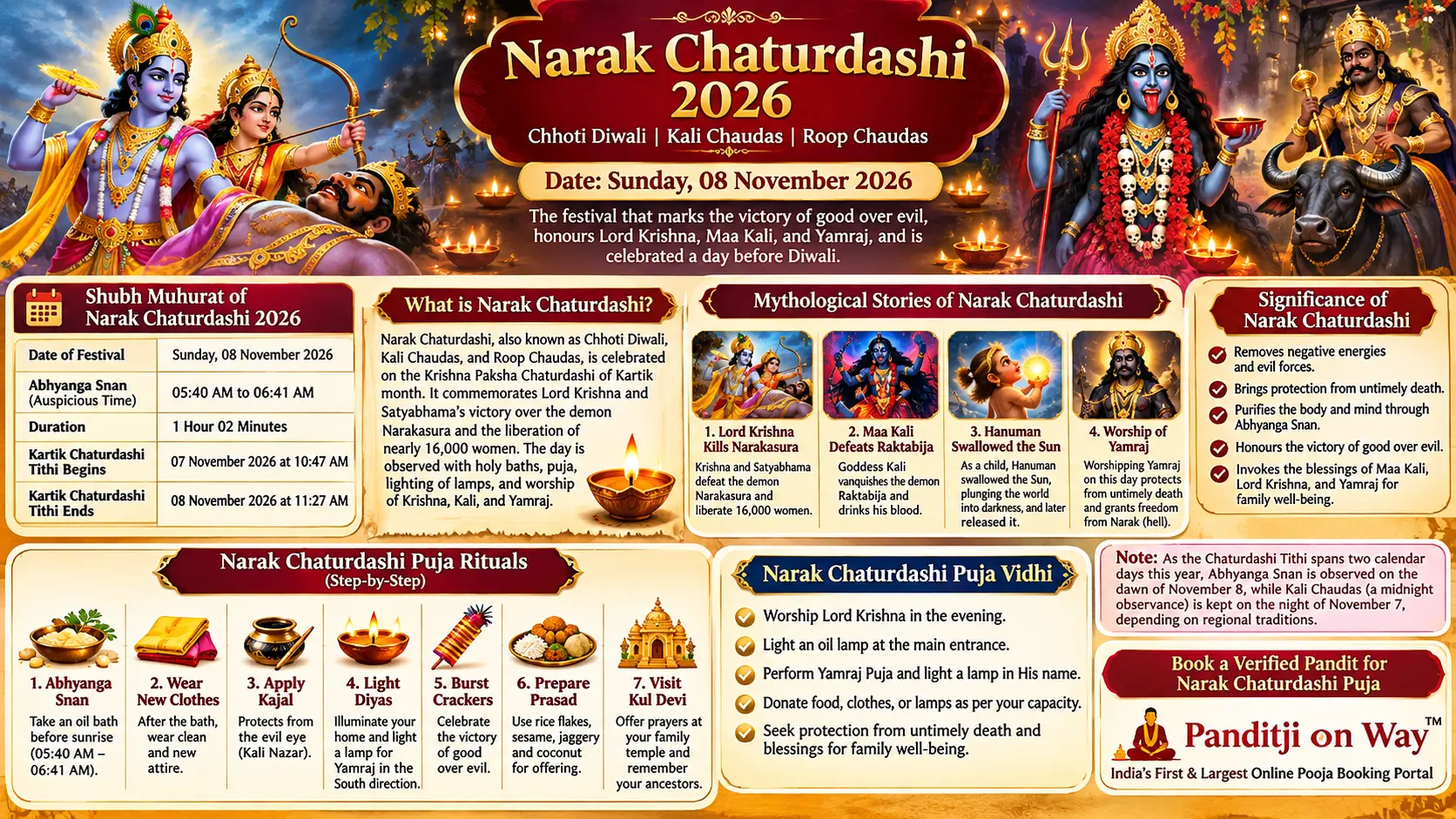
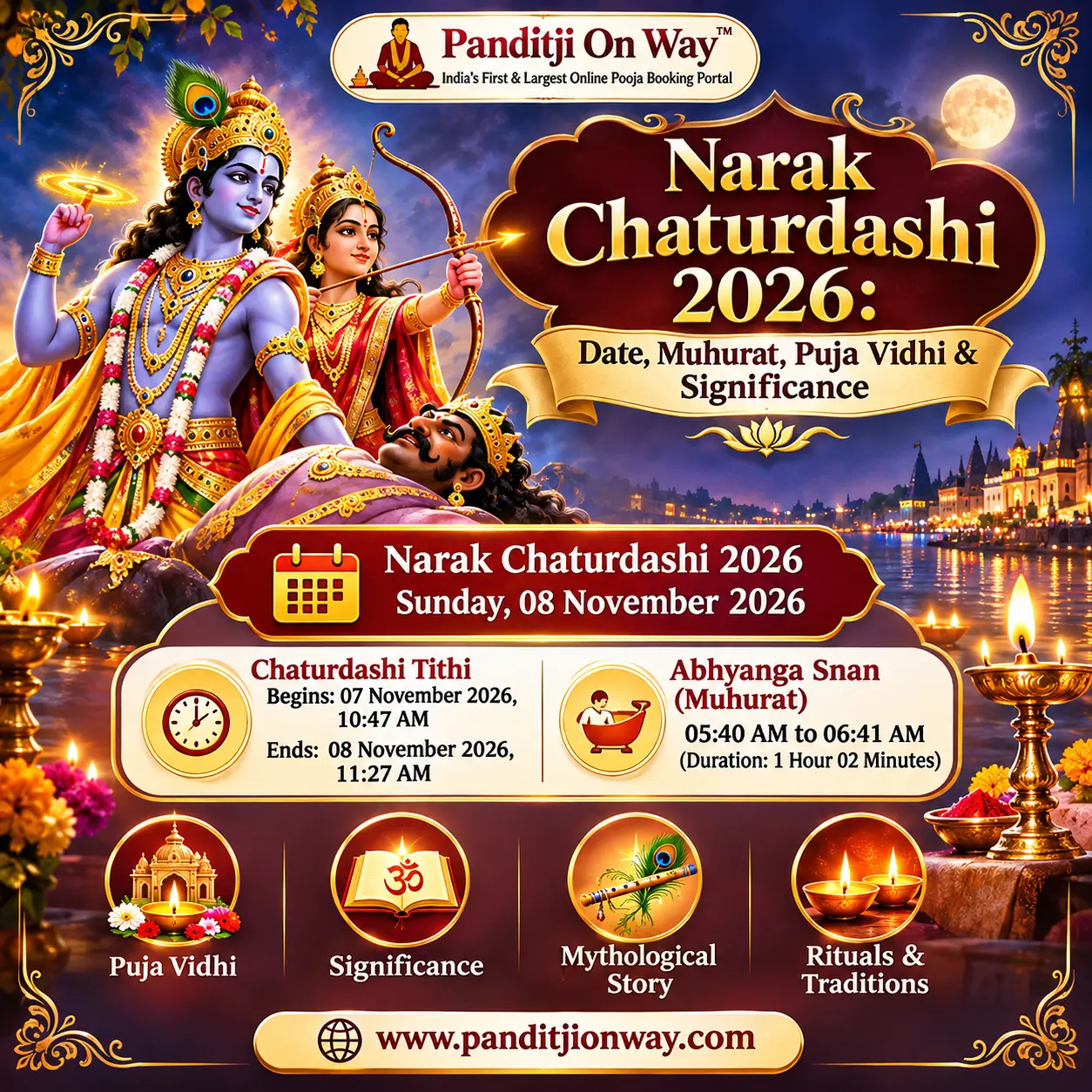
Narak Chaturdashi 2026 will be observed on Sunday, 8 November 2026. Also known as Chhoti Diwali, Kali Chaudas, and Roop Chaudas, this important Hindu festival is celebrated during Krishna Paksha Chaturdashi of the Kartik lunar month. The festival commemorates Lord Krishna’s victory over the demon Narakasura and symbolizes the triumph of good over evil.
One of the most important rituals of Narak Chaturdashi is Abhyanga Snan, a traditional pre-dawn bath with oil and herbal ubtan. Devotees also worship Lord Krishna, Goddess Kali, Lord Hanuman, and Yamraj according to their family and regional traditions. Lighting diyas, performing Deep Daan, preparing traditional sweets, and praying for family well-being are other important customs.
In 2026, the Chaturdashi Tithi begins on 7 November and ends on 8 November. Therefore, the pre-dawn Abhyanga Snan will take place on 8 November, while certain Kali Chaudas night-time observances are associated with the evening of 7 November.
Let’s explore the Narak Chaturdashi 2026 date, city-wise auspicious timings, religious significance, mythological stories, puja samagri, step-by-step puja vidhi, and the best places in India to experience Diwali celebrations.
Narak Chaturdashi 2026: Date and Important Details
| Festival Details | Information |
|---|---|
| Festival Name | Narak Chaturdashi 2026 |
| Other Names | Chhoti Diwali, Kali Chaudas, Roop Chaudas, Naraka Nivaran Chaturdashi |
| Date | Sunday, 8 November 2026 |
| Hindu Month | Kartik |
| Paksha | Krishna Paksha |
| Tithi | Chaturdashi |
| Chaturdashi Begins | 7 November 2026, 10:47 AM |
| Chaturdashi Ends | 8 November 2026, 11:27 AM |
| Main Morning Ritual | Abhyanga Snan |
| Main Deity | Lord Krishna |
| Other Deities | Goddess Kali, Lord Hanuman and Lord Yamraj |
| Main Rituals | Oil Bath, Deep Daan, Yam Deepam and Puja |
| Festival Significance | Victory of good over evil |
Important: Hindu festival dates are determined by lunar tithi and local sunrise, not simply by the English calendar date. Different regions may follow different ritual traditions.
Shubh Muhurat of Narak Chaturdashi 2026 Puja
The most important morning ritual of Narak Chaturdashi is Abhyanga Snan. Traditionally, devotees take this sacred bath before sunrise, during the prescribed pre-dawn period.
The Chaturdashi Tithi starts on Saturday, 7 November, and continues until Sunday, 8 November 2026. The morning bath is therefore observed on Sunday.
Narak Chaturdashi 2026 Tithi and Muhurat
| Muhurat / Tithi | Date and Time |
|---|---|
| Krishna Chaturdashi Begins | 7 November, 10:47 AM |
| Krishna Chaturdashi Ends | 8 November, 11:27 AM |
| Narak Chaturdashi | 8 November 2026 |
| Abhyanga Snan in Mumbai | 5:45 AM – 6:42 AM |
| Abhyanga Snan Duration in Mumbai | 57 minutes |
Note: The Abhyanga Snan timing above is for Mumbai, Maharashtra. It is not a universal Indian timing. For example, the corresponding published timing for Pune is 5:40 AM to 6:37 AM. New Delhi and other cities have different timings according to their local sunrise and moonrise. Always check the location-specific Panchang before performing the ritual.
Why Are 7 and 8 November Both Associated With Narak Chaturdashi?
In 2026, Krishna Chaturdashi begins at 10:47 AM on 7 November and ends at 11:27 AM on 8 November.
Some regional Kali Chaudas observances take place on the night of 7 November, while the pre-dawn Abhyanga Snan is observed on 8 November.
These are different ritual observances associated with the same lunar tithi. Devotees should follow their family traditions and the local Panchang for the appropriate puja.
What Is Narak Chaturdashi?
Narak Chaturdashi is an important Hindu festival celebrated during the Krishna Paksha Chaturdashi of Kartik month, shortly before or alongside the main Diwali celebrations, depending on the lunar calendar.
The word Narak means hell, while Chaturdashi refers to the fourteenth lunar day. The festival is associated with the destruction of Narakasura, a powerful demon defeated by Lord Krishna with the assistance of his wife Satyabhama.
According to Hindu mythology, Narakasura imprisoned thousands of women and created suffering across the three worlds. Lord Krishna defeated the demon and liberated the captives. His victory became a symbol of freedom, righteousness, courage, and the destruction of evil.
The festival is also called:
- Chhoti Diwali: Because it is traditionally observed as part of the Diwali festival celebrations.
- Kali Chaudas: A regional observance associated with Goddess Kali and the removal of negativity.
- Roop Chaudas: A day associated with personal purification, beauty, cleanliness, and Abhyanga Snan.
- Naraka Nivaran Chaturdashi: A name associated with overcoming the suffering and fear symbolized by Naraka.
On this occasion, families clean their homes, take an early morning bath, light oil lamps, worship their deities, and pray for health, prosperity, and protection.
Significance of Narak Chaturdashi 2026
Narak Chaturdashi has great religious, spiritual, and cultural significance in Hinduism. The festival represents the victory of divine power over evil and encourages people to remove darkness from their lives.
1. Victory of Lord Krishna Over Narakasura
The most important significance of Narak Chaturdashi is Lord Krishna’s victory over Narakasura. This event symbolizes the destruction of arrogance, injustice, cruelty, and negative tendencies.
2. Importance of Abhyanga Snan
Abhyanga Snan is a traditional ritual bath performed before sunrise. Devotees apply oil and herbal ubtan before bathing.
It symbolizes purification, renewal, cleanliness, and the beginning of Diwali celebrations with a positive mindset.
3. Worship of Lord Yamraj
Some Hindu traditions observe Yam Deep Daan on this occasion. Devotees light an oil lamp in the name of Yamraj, the deity associated with death and righteousness.
The lamp is traditionally placed toward the south direction, which is associated with Yamraj. Families pray for the long life, safety, and well-being of their loved ones.
4. Worship of Goddess Kali
Kali Chaudas is particularly important in parts of Gujarat and western India. Devotees worship Goddess Kali and pray for protection from evil, fear, and negative influences.
5. Lighting Diyas and Deep Daan
Lighting diyas represents the victory of light over darkness. Families decorate entrances, courtyards, balconies, and prayer areas with traditional earthen lamps.
6. Importance of Inner Purification
Beyond external cleanliness, Narak Chaturdashi reminds people to overcome anger, greed, jealousy, ego, and harmful thoughts.
The festival encourages spiritual awareness, compassion, discipline, and positive living.
Mythological Stories Related to Narak Chaturdashi
Several religious legends are associated with Narak Chaturdashi. These stories explain the festival’s origin and its connection with Lord Krishna, Goddess Kali, Lord Hanuman, and Yamraj.
1. Lord Krishna’s Victory Over Narakasura
According to the Bhagavata Purana and other Hindu mythological traditions, Narakasura was a powerful demon who ruled Pragjyotishapura.
He was also known as Bhaumasura and was associated with the earth goddess Bhudevi. Over time, Narakasura became arrogant and began troubling the gods and innocent people.
He captured thousands of women and kept them imprisoned. He also seized valuable possessions belonging to celestial beings.
Unable to tolerate his cruelty, the gods approached Lord Krishna and requested his help.
Lord Krishna decided to defeat Narakasura. His wife Satyabhama accompanied him in the battle, riding with him on Garuda.
Before reaching Narakasura, Krishna defeated the demon Mura and overcame several obstacles protecting the demon’s kingdom.
A fierce battle followed between Lord Krishna and Narakasura. According to a popular version of the legend, Satyabhama played a crucial role in the demon’s defeat, fulfilling the condition associated with his death.
Finally, Narakasura was killed, and the imprisoned women were liberated.
After the victory, Lord Krishna restored peace and righteousness. The event came to symbolize the destruction of evil and the triumph of divine justice.
It is traditionally believed that the people celebrated this victory by lighting lamps, giving rise to the Deep Daan tradition associated with Narak Chaturdashi.
2. Goddess Kali and the Story of Raktabija
Another popular legend associated with Kali Chaudas is the story of Goddess Kali and the demon Raktabija.
According to the Devi Mahatmya tradition, Raktabija possessed a powerful boon. Whenever a drop of his blood fell on the ground, another demon identical to him would emerge.
During the battle between the divine forces and the demons, Raktabija became extremely difficult to defeat because every drop of his blood created another opponent.
To overcome this challenge, Goddess Kali manifested in her fierce form.
She spread her tongue and consumed the blood before it could touch the ground, preventing new demons from emerging. With the help of the divine forces, she ultimately defeated Raktabija.
This legend represents the victory of divine feminine energy over destructive forces.
In some regional traditions, Goddess Kali is worshipped during Kali Chaudas for protection, courage, and spiritual strength.
3. Lord Hanuman and the Story of the Sun
Another story associated with Hanuman worship tells of an incident from his childhood.
According to the popular legend, young Hanuman saw the rising Sun and mistook it for a delicious fruit.
He flew toward the Sun and swallowed it, causing darkness to spread throughout the world.
The gods became concerned because the absence of sunlight disrupted the natural order. Lord Indra attempted to stop Hanuman using his Vajra.
The incident led to Hanuman receiving divine blessings and protection from various gods.
This story highlights Hanuman’s extraordinary strength, innocence, devotion, and divine powers.
In certain regional traditions, devotees worship Lord Hanuman on Kali Chaudas to seek courage, protection, and relief from fear.
This Hanuman legend is a regional devotional association rather than the principal origin story of Narak Chaturdashi.
4. Worship of Yamraj and the Tradition of Yam Deep Daan
Lord Yamraj is regarded as the deity of death and righteousness in Hindu mythology.
According to traditional beliefs, offering a lamp to Yamraj and praying for family well-being is an auspicious practice during the Diwali period.
Some communities light fourteen oil lamps on Narak Chaturdashi and place them in different areas of the house.
A lamp may also be placed facing the south direction, which is traditionally associated with Yamraj.
This ritual is known as Yam Deep Daan or Yama Deepam in different traditions.
Devotees pray for protection from untimely death, family safety, and the well-being of their loved ones.
The number of lamps and the exact ritual procedure can vary between communities.
Narak Chaturdashi Puja Vidhi 2026: Step-by-Step Rituals
Devotees can perform Narak Chaturdashi Puja at home according to their family customs and regional traditions.
The following is a general worship procedure.
Step 1: Wake Up Before Sunrise
Wake up early in the morning, preferably during the prescribed Abhyanga Snan Muhurat.
Clean the bathing area and prepare the necessary materials for the ritual bath.
Step 2: Perform Abhyanga Snan
Apply suitable oil to the body before bathing. Traditional ubtan may be prepared using herbal ingredients, turmeric, gram flour, and other customary ingredients.
Take a bath before sunrise during the appropriate local muhurat.
Abhyanga Snan symbolizes physical and spiritual purification.
Step 3: Wear Clean or New Clothes
After bathing, wear clean and preferably traditional clothes.
Prepare the home temple and arrange flowers, incense, lamps, and puja materials.
Step 4: Worship Lord Krishna
Offer flowers, sandalwood, tulsi leaves where appropriate, fruits, sweets, and other customary offerings to Lord Krishna.
Recite Krishna mantras and remember his victory over Narakasura.
Step 5: Worship Goddess Kali
Devotees following Kali Chaudas traditions can worship Goddess Kali with flowers, incense, lamps, and suitable offerings.
Pray for courage, protection, and the removal of negative tendencies.
Step 6: Perform Yam Deep Daan
Light a traditional oil lamp in the name of Lord Yamraj.
In many traditions, the lamp is placed toward the south direction. Follow the method prescribed by your family priest.
Step 7: Light Diyas Around the House
Light earthen lamps at the entrance, courtyard, balcony, and other appropriate places.
Keep lamps away from flammable materials and never leave burning lamps unattended.
Step 8: Offer Prasad and Perform Aarti
Prepare traditional sweets and prasad. Offer them to the deities and perform the aarti according to family customs.
Distribute prasad among family members.
Step 9: Donate and Help Others
Charity, food donation, and helping people in need are considered auspicious activities during the Diwali period.
Narak Chaturdashi 2026 Puja Samagri List
Devotees should arrange the puja materials before beginning the rituals.
| Puja Samagri | Purpose |
|---|---|
| Earthen Diyas | Deep Daan |
| Mustard Oil or Ghee | Lighting lamps |
| Cotton Wicks | Diyas |
| Flowers | Deity worship |
| Incense Sticks | Puja |
| Camphor | Aarti |
| Sandalwood Paste | Tilak and worship |
| Turmeric | Traditional puja |
| Kumkum | Tilak |
| Fruits | Bhog |
| Sweets | Prasad |
| Tulsi Leaves | Krishna worship, where appropriate |
| Ubtan Ingredients | Abhyanga Snan |
| Clean Clothes | After the ritual bath |
| Puja Thali | Worship arrangements |
The exact list may vary according to the deity being worshipped and local customs.
Narak Chaturdashi 2026 Rituals and Traditions
1. Abhyanga Snan
Abhyanga Snan is one of the most important rituals of Narak Chaturdashi.
Devotees traditionally massage their bodies with oil and apply ubtan before taking a bath before sunrise.
The practice represents purification, freshness, and spiritual renewal.
2. Wearing New Clothes
After the sacred bath, families wear clean or new clothes.
People prepare their homes for the remaining Diwali festivities and welcome the occasion with happiness.
3. Applying Kajal
In some communities, applying kajal is associated with Roop Chaudas.
Traditionally, it is believed to protect against the evil eye. This is a cultural belief rather than a scientifically established protective effect.
4. Lighting Diyas
Families light earthen lamps around their homes, entrances, courtyards, and prayer areas.
The lamps represent hope, knowledge, and the victory of good over evil.
5. Bursting Firecrackers
Some families traditionally celebrate with fireworks.
However, people should consider air quality, noise pollution, fire safety, and the impact on children, elderly people, animals, and people with respiratory sensitivities.
Eco-friendly celebrations and traditional diyas are meaningful alternatives.
6. Preparing Traditional Prasad
Families prepare sweets and regional delicacies for the occasion.
Common offerings may include rice flakes, sesame seeds, jaggery, coconut, and other traditional ingredients.
The food traditions vary across India.
7. Visiting the Kuldevi Temple
In some families, devotees visit their ancestral temples and worship their Kuldevi or Kuldevta.
People seek blessings for family prosperity, harmony, and protection.
8. Remembering Ancestors
Some communities follow traditional practices of offering food or prayers in remembrance of ancestors during the Diwali period.
These rituals vary according to family and regional customs.
Difference Between Narak Chaturdashi, Chhoti Diwali, Kali Chaudas and Roop Chaudas
Although these names are often used interchangeably, they emphasize different aspects of the festival.
| Name | Meaning and Significance |
|---|---|
| Narak Chaturdashi | Commemorates Lord Krishna’s victory over Narakasura |
| Chhoti Diwali | Refers to the smaller Diwali celebration before the main festival |
| Kali Chaudas | Associated with Goddess Kali and regional protection rituals |
| Roop Chaudas | Associated with Abhyanga Snan, beauty, cleanliness, and purification |
| Naraka Nivaran Chaturdashi | Associated with overcoming suffering and negative tendencies |
The precise customs and importance attached to each name differ between Indian regions.
How Is Narak Chaturdashi Celebrated in Different Parts of India?
Narak Chaturdashi is celebrated in different ways throughout India. Regional traditions influence the worship practices, food, lamps, and local festivities.
1. Maharashtra
In Maharashtra, Abhyanga Snan is an especially important part of Narak Chaturdashi.
Families wake up before sunrise, apply oil and ubtan, and take a traditional bath. After bathing, people wear new clothes and prepare festive food.
Traditional lamps are lit, and families celebrate the occasion with sweets and prayers.
Important locations for experiencing Maharashtra’s Diwali traditions include Mumbai, Pune, Nashik, and Nagpur.
2. Gujarat
In Gujarat, the festival is widely associated with Kali Chaudas.
Devotees worship Goddess Kali and follow regional traditions involving prayers, lamps, and protective rituals.
Ahmedabad, Vadodara, Surat, and Rajkot are important cities to explore Gujarat’s Diwali culture.
3. Uttar Pradesh
In Uttar Pradesh, Narak Chaturdashi is associated with the Diwali celebrations and the worship of Lord Krishna.
Mathura and Vrindavan have particular religious importance because of their connection with Lord Krishna.
Varanasi is also known for its traditional Ganga Aarti and Deep Daan celebrations during the Diwali period.
4. Rajasthan
Rajasthan celebrates the Diwali festival with decorated homes, traditional lamps, sweets, and family gatherings.
Jaipur is particularly famous for its festive markets, illuminated streets, and decorative lighting.
Other destinations include Udaipur, Jodhpur, and Pushkar.
5. West Bengal
In West Bengal, Kali Puja is an important part of the Diwali period.
Devotees worship Goddess Kali through elaborate rituals, decorations, offerings, and prayers.
Kolkata is especially well known for its Kali Puja celebrations.
6. South India
In several South Indian communities, Naraka Chaturdashi is associated with the early morning oil bath and the story of Lord Krishna’s victory over Narakasura.
Families prepare traditional sweets and savoury dishes, wear new clothes, and celebrate with prayers and lamps.
Chennai, Bengaluru, Hyderabad, and Mysuru offer opportunities to experience different regional Diwali traditions.
Best Places to Experience Diwali and Narak Chaturdashi Celebrations in India
India offers many beautiful destinations for experiencing the religious and cultural atmosphere of Diwali.
The following locations are particularly meaningful for devotees and travellers.
| Place | State | Religious and Cultural Significance |
|---|---|---|
| Mathura | Uttar Pradesh | Associated with Lord Krishna and Krishna Janmabhoomi |
| Vrindavan | Uttar Pradesh | Krishna temples and devotional celebrations |
| Varanasi | Uttar Pradesh | Ganga Aarti, traditional Deep Daan and riverfront celebrations |
| Ayodhya | Uttar Pradesh | Associated with Lord Rama and the return to Ayodhya |
| Jaipur | Rajasthan | Illuminated markets, decorated buildings and traditional Diwali festivities |
| Udaipur | Rajasthan | Lakeside festive atmosphere and illuminated heritage locations |
| Kolkata | West Bengal | Famous for Goddess Kali worship and Kali Puja |
| Mumbai | Maharashtra | Cultural celebrations, temples and family festivities |
| Pune | Maharashtra | Traditional Abhyanga Snan and Maharashtrian Diwali customs |
| Ahmedabad | Gujarat | Kali Chaudas and Gujarati Diwali traditions |
| Hyderabad | Telangana | Regional Diwali traditions and temple celebrations |
| Mysuru | Karnataka | Traditional festive culture and heritage atmosphere |
Travel tip: Festival programmes, temple schedules, entry arrangements, and special events may change each year. Check the official temple or tourism website before travelling.
Spiritual Benefits and Lessons of Narak Chaturdashi
Narak Chaturdashi is not only a festival of lamps and celebrations. It also teaches important spiritual values.
- Victory over evil: The story of Narakasura teaches that arrogance, injustice, and cruelty ultimately lead to destruction.
- Importance of purity: Abhyanga Snan represents cleanliness and the renewal of the body and mind.
- Faith and devotion: Worshipping Lord Krishna and other deities encourages spiritual discipline and devotion.
- Respect for family: Yam Deep Daan represents prayers for the safety and well-being of family members.
- Inner transformation: The festival encourages people to overcome negative thoughts and develop positive qualities.
- Charity and kindness: Helping others and donating food are meaningful ways to celebrate the Diwali season.
Book a Pandit for Narak Chaturdashi Puja with Panditji On Way
Performing Narak Chaturdashi Puja according to traditional customs can make the festival more meaningful for devotees and their families.
However, many families may not know the correct puja procedure, the required samagri, the mantras, or the appropriate muhurat for their city.
Panditji On Way is an online puja booking platform that helps devotees find pandits for Hindu religious ceremonies and Vedic rituals.
Whether you need a pandit for Narak Chaturdashi Puja, Kali Puja, Yam Deep Daan, or other Diwali-related religious ceremonies, you can explore the available services through Panditji On Way.
Puja and Religious Services Available Through Panditji On Way
- Narak Chaturdashi Puja
- Kali Puja
- Yam Deep Daan
- Lakshmi Puja
- Ganesh Puja
- Satyanarayan Swamy Vratam
- Griha Pravesh Puja
- Vastu Shanti Puja
- Havan and Jaap
- Hindu Wedding Rituals
- Telugu Pandit and Priest Services
Locations Served
Panditji On Way focuses on connecting devotees with pandits for religious ceremonies, particularly in Arizona.
Families can explore services for:
- Phoenix
- Scottsdale
- Mesa
- Chandler
- Gilbert
- Tempe
- Glendale
- Peoria
- Other nearby Arizona communities, subject to service availability.
Celebrate Narak Chaturdashi with devotion and traditional Vedic rituals.
Visit Panditji On Way to explore available pandit booking services.
Frequently Asked Questions About Narak Chaturdashi 2026
1. When is Narak Chaturdashi in 2026?
Narak Chaturdashi will be celebrated on Sunday, 8 November 2026. It is also known as Chhoti Diwali, Kali Chaudas, and Roop Chaudas. The festival commemorates Lord Krishna’s victory over the demon Narakasura.
2. What is the Abhyanga Snan Muhurat for Narak Chaturdashi 2026?
The Abhyanga Snan Muhurat varies according to location. In Mumbai, Maharashtra, the published timing is 5:45 AM to 6:42 AM on 8 November 2026. Devotees should check their city’s Panchang for the accurate local timing.
3. What time does Chaturdashi Tithi begin and end in 2026?
According to the cited Panchang timings, Krishna Chaturdashi begins at 10:47 AM on 7 November 2026 and ends at 11:27 AM on 8 November 2026. These are Indian local calendar timings for the stated Panchang calculation.
4. Why is Narak Chaturdashi celebrated?
Narak Chaturdashi is celebrated to commemorate Lord Krishna’s victory over Narakasura. The demon’s defeat symbolizes the victory of good over evil, justice over injustice, and light over darkness.
5. Is Narak Chaturdashi the same as Chhoti Diwali?
Yes. Narak Chaturdashi is popularly known as Chhoti Diwali in many parts of India. It is observed as an important part of the five-day Diwali festival and is associated with lamps, purification, and the victory of Lord Krishna over Narakasura.
6. Why is Narak Chaturdashi also called Kali Chaudas?
It is called Kali Chaudas in several western Indian traditions because of its association with Goddess Kali. Devotees worship the goddess and pray for courage, protection, and the removal of negative influences.
7. Why is Narak Chaturdashi called Roop Chaudas?
Narak Chaturdashi is called Roop Chaudas because of the tradition of Abhyanga Snan and personal cleansing. Applying oil and herbal ubtan before the bath is associated with beauty, freshness, and purification.
8. Who killed Narakasura?
According to Hindu mythology, Lord Krishna killed Narakasura with the assistance of his wife Satyabhama. The event is celebrated as the triumph of divine power and righteousness over evil.
9. How many women were freed by Lord Krishna from Narakasura?
According to popular Hindu mythology, Lord Krishna liberated approximately 16,000 women who had been imprisoned by Narakasura. Some scriptural traditions give different numbers, including 16,100.
10. Why do people light 14 diyas on Narak Chaturdashi?
In certain regional traditions, people light fourteen diyas during the Diwali period as part of customary worship and Deep Daan. The lamps may be placed around the home, with a special lamp dedicated to Yamraj. The number and placement of lamps vary by community.
11. Why is Yamraj worshipped on Narak Chaturdashi?
Yamraj is the Hindu deity associated with death and righteousness. Devotees offer lamps and prayers to seek protection, long life, and the well-being of their families. This practice is commonly associated with Yam Deep Daan.
12. In which direction should the Yam Deepak be placed?
According to many traditional customs, the Yam Deepak is placed facing the south direction because south is associated with Lord Yamraj. The exact placement should follow family and regional traditions.
13. Can we perform Narak Chaturdashi Puja at home?
Yes. Devotees can perform Narak Chaturdashi Puja at home by taking an early morning bath, worshipping Lord Krishna, lighting diyas, offering flowers and prasad, and performing Yam Deep Daan according to their customs.
14. Which God is worshipped on Narak Chaturdashi?
Lord Krishna is the principal deity associated with Narak Chaturdashi because of his victory over Narakasura. Goddess Kali, Lord Hanuman, and Lord Yamraj are also worshipped in certain regional traditions.
15. What should we do on Narak Chaturdashi?
Devotees traditionally perform Abhyanga Snan, wear clean clothes, worship Lord Krishna, light earthen lamps, offer prayers to Yamraj, prepare prasad, and donate food or other necessities to people in need.
16. Is Kali Puja performed on Narak Chaturdashi?
In certain regional traditions, particularly those associated with Kali Chaudas, Goddess Kali is worshipped during the Diwali period. The exact date and timing of Kali Puja may differ according to regional Panchang and local customs.
17. What is the difference between Narak Chaturdashi and Diwali?
Narak Chaturdashi commemorates Lord Krishna’s victory over Narakasura and is associated with Abhyanga Snan and Deep Daan. Diwali is primarily associated with the worship of Goddess Lakshmi and Lord Ganesha, prosperity, and the celebration of light.
In 2026, Narak Chaturdashi and Lakshmi Puja fall on the same calendar date in some Panchang calculations, owing to the Chaturdashi and Amavasya tithi timings.
18. What is the importance of Abhyanga Snan?
Abhyanga Snan is a traditional oil bath performed before sunrise. It symbolizes physical cleanliness, spiritual purification, and a fresh beginning. It is one of the most important rituals of Narak Chaturdashi.
19. Where is Narak Chaturdashi celebrated in India?
Narak Chaturdashi is celebrated throughout India. Maharashtra, Gujarat, Rajasthan, Uttar Pradesh, Karnataka, Telangana, and West Bengal have distinctive regional customs. Mathura, Vrindavan, Varanasi, Jaipur, Mumbai, Pune, and Kolkata are notable destinations for experiencing Diwali traditions.
20. Can I book a pandit for Narak Chaturdashi Puja online?
Yes. Devotees can explore online pandit booking services through Panditji On Way for Hindu religious ceremonies, including Diwali-related pujas, subject to location and service availability. Visit https://www.panditjionway.com/ to explore the available services.
Conclusion: Celebrate Narak Chaturdashi 2026 With Faith and Devotion
Narak Chaturdashi 2026, observed on Sunday, 8 November, is an important occasion that celebrates the victory of Lord Krishna over Narakasura and reminds devotees of the importance of righteousness, purity, courage, and positivity.
From performing Abhyanga Snan before sunrise to lighting diyas, worshipping Lord Krishna, offering Yam Deep Daan, and following regional Kali Chaudas traditions, every ritual carries a meaningful spiritual message.
As families prepare for Diwali, Narak Chaturdashi offers an opportunity to remove negativity, strengthen family bonds, help those in need, and welcome happiness and prosperity.
Celebrate this auspicious occasion with devotion and traditional Hindu rituals. For pandit booking and Vedic puja services, explore Panditji On Way – Your Online Puja Booking Partner.
Website: https://www.panditjionway.com/
- Google Search Central – https://developers.google.com/search/docs/fundamentals/creating-helpful-content
- Srimad Bhagavatam, Canto 10, Chapter 59 – https://vedabase.io/en/library/sb/10/59/
- Incredible India – https://www.incredibleindia.gov.in/
- Ministry of Culture, Government of India – https://indiaculture.gov.in/