

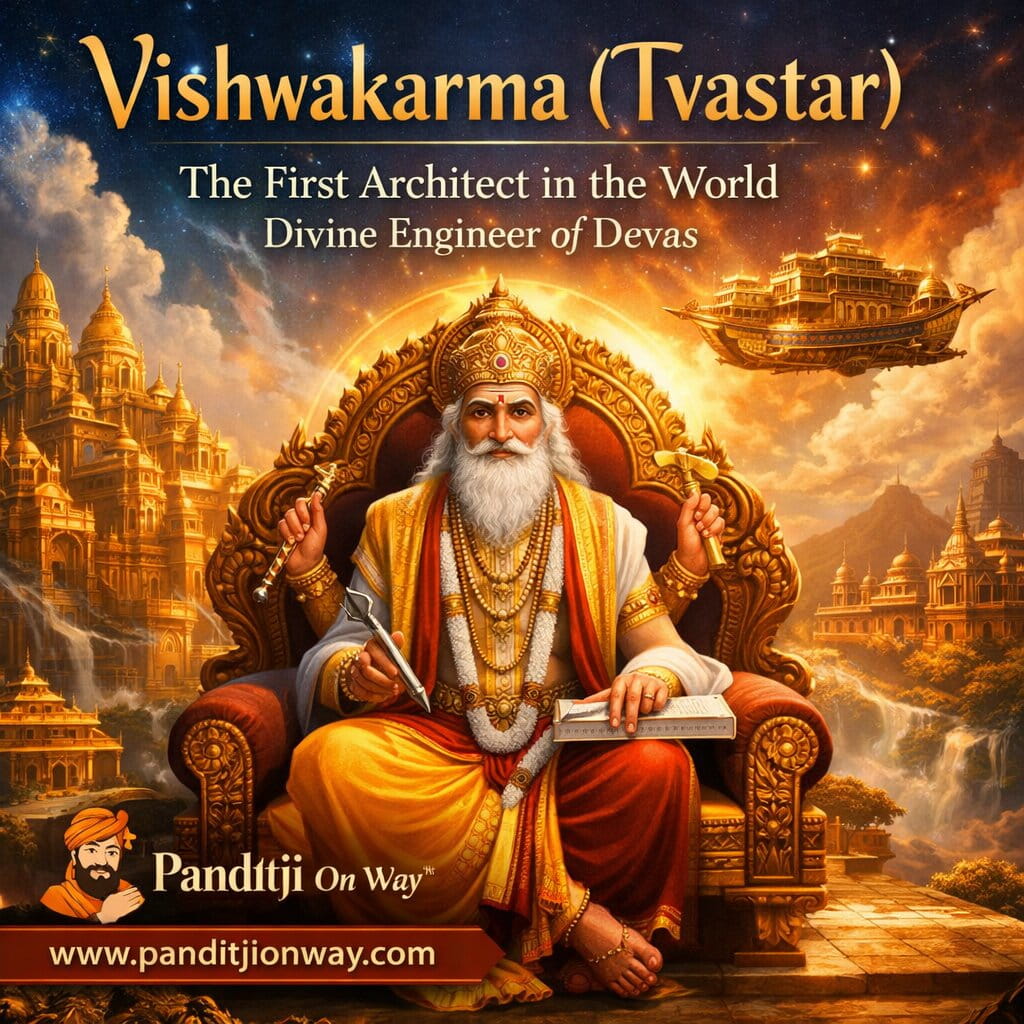
Vishwakarma (Tvastar): The First Architect in the World | Divine Engineer of Devas
Lord Vishwakarma, also known as Tvastar, is revered as the first architect, engineer, and master craftsman of the universe. From Satya Yuga to Dwapara Yuga, he designed celestial cities, divine weapons, flying aircraft, and cosmic structures that continue to amaze devotees and scholars alike.
He is worshipped as the Divine Architect of the Devas, and Vishwakarma Jayanti is celebrated by craftsmen, engineers, mechanics, architects, industrial workers, and artists across India.
Vishwakarma in the Rig Veda (Rig Veda 10.82.2)
The Rig Veda describes Vishwakarma as the Creator, Arranger, and Supreme Supervisor of the universe:
वि॒श्वक॑र्मा॒ विम॑ना॒ आद्विहा॑या धा॒ता वि॑धा॒ता प॑र॒मोत सं॒दृक् ।
तेषा॑मि॒ष्टानि॒ समि॒षा म॑दन्ति॒ यत्रा॑ सप्तऋ॒षीन्प॒र एक॑मा॒हुः ॥
Meaning:
Vishwakarma, of comprehensive mind and supreme greatness, is all-pervading. He is the creator, arranger, and supreme overseer. In him, the desires of beings are fulfilled.
This verse establishes Vishwakarma as a cosmic architect and divine intelligence behind creation.

Origin of Vishwakarma
The origin of Vishwakarma varies across scriptures:
- Nirukta & Brahmanas – Son of Bhuwana
- Mahabharata – Son of Vasu Prabhasa and Yoga Siddha
- Puranas – Son of Vastu or Brahma
He is also described as Svayambhu (self-born) in certain traditions.
Consorts and Offspring
Different texts mention different family details:
- Vamana Purana – Married celestial nymph Ghritachi
- Father of:
- Barhishmati
- Samjna (wife of Surya Deva)
- Chitrangada
- Five sons (varied references)
- As Tvastar, father of Vishvarupa
- Ramayana – Father of Nala, the engineer who helped build Ram Setu
Iconography of Lord Vishwakarma
Western & Northern India
- Elderly, wise man
- Four arms
- White beard
- Seated on throne
- Vahana: Hamsa (Swan) – linking him to Brahma
Eastern India (Jharkhand, West Bengal)
- Young, muscular form
- Black mustache
- Sometimes associated with elephant vahana
- Always holding architectural tools
Architectural Marvels of Vishwakarma: Divine Engineering Across Yugas
Lord Vishwakarma, also known as Tvastar, is credited in Hindu scriptures as the celestial architect responsible for designing some of the most magnificent cities, weapons, vehicles, and cosmic structures across Satya, Treta, and Dwapara Yugas. His creations symbolize not only artistic brilliance but also advanced engineering concepts far ahead of their time.
Below are the most extraordinary architectural and technological marvels attributed to Vishwakarma.
1️⃣ Golden Lanka – The Fortified City of Treta Yuga
Valmiki Ramayana (6.3.11) describes Lanka’s mighty gates:
दृढ बद्ध कवाटानि महापरिघवन्ति च |
चत्वारि विपुलान्यस्या द्वाराणि सुमहान्ति ||
Primary Source: Valmiki Ramayana (Yuddha Kanda)
Lanka, originally built by Vishwakarma, was one of the most technologically advanced cities described in ancient literature.
Key Architectural Features:
- Constructed primarily of gold and precious metals
- Massive fortified gates with strong locking beams
- Multi-layered defensive walls
- Watchtowers and guarded entrances
- A centrally located royal citadel
The Ramayana describes Ravana’s palace as:
- One yojana (approx. 13 km) in height
- One yojana in length
- Half a yojana in breadth
This indicates planned urban architecture, symmetrical design, and centralized city planning — concepts similar to modern fortified capitals.
Engineering Significance:
- Use of metallic infrastructure
- Advanced urban defense systems
- Centralized administrative complex
- Elevated citadel for strategic advantage
Lanka represents the earliest scriptural reference to large-scale fortified urban planning.
2️⃣ Pushpaka Vimana – The First Described Aircraft
Primary Source: Valmiki Ramayana (Yuddha Kanda 6.121)
Valmiki Ramayana (6.121.8):
अह्ना त्वां प्रापयिष्यामि ताम् पुरीं पार्थिवात्मज ||
Pushpaka Vimana was a divine aerial vehicle crafted by Vishwakarma for Kubera and later used by Ravana and Lord Rama.
Described Capabilities:
- Self-moving aircraft (no visible driver mechanism)
- Capable of flying in any direction
- Ability to hover mid-air
- Adjustable size based on passengers
- Could become invisible
- Covered ~2110 km (Lanka to Ayodhya) in a single day
Structural Design (as per descriptions):
- Built of gold
- Adorned with precious gems
- Multi-deck structure
- Luxurious seating and chambers
Pushpaka Vimana is one of the earliest literary references to controlled aerial transport, autonomous mobility, and dynamic size adjustment — ideas comparable to modern aerospace concepts.
3️⃣ Dwaraka – The Crystal and Emerald City of Dwapara Yuga
Primary Source: Srimad Bhagavatam 10.69
When Lord Krishna decided to establish his capital away from constant invasions, Vishwakarma constructed the magnificent city of Dwaraka.
Architectural Highlights:
- 900,000 royal palaces
- Crystal and silver structures
- Emerald and sapphire wall inlays
- Coral pillars embedded with Vaidurya gems
- Pearl canopies
- Ivory-crafted furniture
- Jewel-studded lighting systems
Urban Design Features:
- Structured marketplaces
- Temple complexes
- Lakes filled with lotuses
- Residential quarters for 16,000 queens
- Advanced drainage and layout planning
Dwaraka symbolizes advanced coastal urban planning and aesthetic perfection combined with spiritual symbolism.
4️⃣ Indra’s Vajra – The Thunderbolt Weapon
Primary Source: Rig Veda 1.32
Vishwakarma crafted the Vajra, the weapon used by Indra to defeat Vritra.
Design Description:
- Club-like structure
- Ribbed spherical head
- Lightning symbolism
- Indestructible composition
Engineering Symbolism:
- Energy concentration
- Impact force amplification
- Structural reinforcement via ribbing
The Vajra represents controlled energy discharge — conceptually linked to lightning and electromagnetic force.
5️⃣ Sudarshan Chakra – The Rotational Energy Weapon
Vishwakarma is credited in later traditions with crafting the Sudarshan Chakra of Lord Vishnu.
Structural Features:
- Circular disc form
- 108 serrated edges
- Razor-sharp perimeter
- Rotational energy mechanism
- Fiery, radiant appearance
Functional Description:
- Travels across vast cosmic distances instantly
- Returns automatically to the wielder
- Cuts through any material
It symbolizes rotational energy, precision targeting, and unstoppable force.
6️⃣ Flying Chariots of the Devas
Vishwakarma designed celestial vehicles for various gods:
- Vishnu’s divine chariot
- Shiva’s Pinaka-equipped war chariot
- Indra’s Airavata-mounted royal transport
These chariots were described as:
- Sky-traveling
- Mountain-crossing
- Sea-traversing
- Jewel-adorned and gold-framed
They symbolize early conceptualization of advanced transportation systems.
7️⃣ Reduction of Surya’s Energy
According to Puranic legends, Vishwakarma reduced the intense heat of Surya (Sun God) to make it bearable for his daughter Samjna.
The extracted solar energy was used to craft:
- Sudarshan Chakra
- Shiva’s Trishul
- Kubera’s weapons
- Indra’s Vajra
This suggests advanced knowledge of energy transformation and controlled energy utilization.
Engineering Principles Reflected in Vishwakarma’s Creations
Across scriptures, Vishwakarma’s work reflects:
- Structural symmetry
- Centralized urban planning
- Defensive fortification
- Advanced metallurgy
- Energy harnessing
- Aerodynamics (conceptual)
- Coastal architecture
- Multi-level palatial design
His creations symbolize the harmony between science, spirituality, and aesthetics.
Why Vishwakarma’s Architecture Still Matters Today
Lord Vishwakarma represents:
- Sacred geometry
- Vastu principles
- Structural integrity
- Innovation guided by dharma
- Divine intelligence in craftsmanship
He is worshipped not only as a deity but as the embodiment of:
- Architecture
- Engineering
- Design
- Technology
- Creativity
Vishwakarma, the divine architect of Hinduism, designed Lanka, Dwaraka, Pushpaka Vimana, Sudarshan Chakra, and Indra’s Vajra across different Yugas. His creations reflect advanced concepts of urban planning, metallurgy, aerodynamics, and cosmic engineering.
Vishwakarma Jayanti
Vishwakarma Puja is celebrated when the Sun transits from Simha Rashi (Leo) to Kanya Rashi (Virgo), usually on 16th, 17th, or 18th September.
Who Celebrates?
- Engineers
- Architects
- Factory workers
- Mechanics
- Industrial laborers
- Artisans
- Musicians
- Technicians
On this day:
- Tools and machinery are worshipped
- Factories install Vishwakarma idols
- Special puja is performed for prosperity
Vishwakarma Puja Mantra
ॐ आधार शक्तपे नम:,
ॐ कूमयि नम:,
ॐ अनन्तम नम:,
ॐ पृथिव्यै नम:।
Meaning: I bow to the foundation power, the infinite creator, and Mother Earth.
Lord Vishwakarma is the divine architect in Hinduism, credited with building Lanka, Dwaraka, Pushpaka Vimana, and Indra’s Vajra. He is described in the Rig Veda as the universal creator and is worshipped annually on Vishwakarma Jayanti by engineers and craftsmen.
Why Vishwakarma is Called the First Architect in the World
- Designed divine cities across Yugas
- Engineered celestial weapons
- Built aircraft (Pushpaka Vimana)
- Constructed underwater and golden cities
- Described as universal creator in Rig Veda
He represents the union of spirituality and engineering brilliance.
Vishwakarma is the divine architect of the universe in Hinduism, described in the Rig Veda as the creator and cosmic engineer who built Lanka, Dwaraka, Pushpaka Vimana, Sudarshan Chakra, and Indra’s Vajra. He is worshipped annually on Vishwakarma Jayanti by engineers and craftsmen across India.
Frequently Asked Questions About Lord Vishwakarma
1. Who is Vishwakarma in Hinduism?
Vishwakarma, also known as Tvastar, is the divine architect and master craftsman of the universe in Hinduism. He is described in the Rig Veda as the creator, arranger, and supervisor of cosmic design. He built celestial cities, divine weapons, flying chariots, and palaces for gods across different Yugas.
2. Why is Vishwakarma called the first architect in the world?
Vishwakarma is called the first architect because ancient scriptures credit him with designing Lanka, Dwaraka, Pushpaka Vimana, Sudarshan Chakra, and Indra’s Vajra. His engineering feats are described in the Rig Veda, Ramayana, Mahabharata, and Bhagavatam, making him the earliest recorded divine architect.
3. Is Vishwakarma mentioned in the Rig Veda?
Yes, Vishwakarma is mentioned in Rig Veda 10.82, where he is described as the all-pervading creator, arranger, and supreme supervisor. The hymn presents him as the cosmic intelligence responsible for universal structure and divine craftsmanship.
4. Did Vishwakarma build Lanka?
Yes, according to the Ramayana, Vishwakarma built the golden city of Lanka. It featured massive fortified gates, golden palaces, and Ravana’s grand citadel. Lanka is described as one of the most architecturally advanced cities of Treta Yuga.
5. Who created Pushpaka Vimana?
Pushpaka Vimana was crafted by Lord Vishwakarma. It was a divine flying vehicle made of gold and precious gems. The Ramayana describes it as capable of flying in any direction, changing size, hovering mid-air, and covering long distances within a single day.
6. Did Vishwakarma create the Sudarshan Chakra?
Yes, Vishwakarma is believed to have crafted the Sudarshan Chakra of Lord Vishnu. The weapon is described as a rotating, fiery disc with sharp edges capable of destroying any enemy instantly and traveling across vast cosmic distances.
7. Who made Indra’s Vajra?
Indra’s Vajra, the thunderbolt weapon used to defeat Vritra, was created by Vishwakarma. The Rig Veda describes Vajra as an indestructible weapon symbolizing lightning, divine power, and cosmic authority.
8. Who are Vishwakarma’s children?
Scriptures mention that Vishwakarma had daughters including Samjna (wife of Surya), Barhishmati, and Chitrangada. In the Ramayana, he is described as the father of Nala, the engineer who helped build Ram Setu.
9. When is Vishwakarma Jayanti celebrated?
Vishwakarma Jayanti is celebrated every year in September, usually on 16th, 17th, or 18th September, when the Sun transits from Simha Rashi (Leo) to Kanya Rashi (Virgo). It is widely observed by engineers, artisans, mechanics, and industrial workers.
10. Why is Vishwakarma worshipped by engineers and workers?
Vishwakarma is worshipped as the divine patron of architecture, engineering, machinery, and craftsmanship. On Vishwakarma Puja, tools, machines, factories, and workplaces are blessed for prosperity, safety, and professional success.
11. What is the meaning of Vishwakarma?
The name Vishwakarma comes from Sanskrit where “Vishwa” means universe and “Karma” means creator or action. Together, Vishwakarma means “Creator of the Universe” or “Universal Architect,” signifying his role as the divine engineer behind cosmic structure and celestial architecture.
12. Is Vishwakarma the creator of Brahma, Vishnu, and Mahesh?
Some traditions, especially Vishwakarma Purana, regard Vishwakarma as the supreme creator who manifested the trinity—Brahma, Vishnu, and Mahesh (Shiva). However, interpretations vary across scriptures, and in many texts he is described as the architect serving the Devas.
13. What is the difference between Vishwakarma and Tvastar?
Tvastar is the Vedic name associated with divine craftsmanship and cosmic creation. In later Puranic traditions, Tvastar and Vishwakarma are often considered the same deity, both representing the celestial architect and master craftsman of the gods.
14. Who built Dwaraka city?
According to the Srimad Bhagavatam, the magnificent city of Dwaraka, where Lord Krishna resided, was designed by Vishwakarma. The city had crystal palaces, emerald decorations, coral pillars, and golden interiors, making it one of the most advanced cities of Dwapara Yuga.
15. How advanced was Pushpaka Vimana according to scriptures?
Pushpaka Vimana is described in the Ramayana as a self-moving aerial vehicle capable of flying in any direction, hovering mid-air, becoming invisible, and adjusting its size. It reportedly covered the distance between Lanka and Ayodhya in a single day.
16. Did Vishwakarma reduce Surya’s energy?
Yes, according to Puranic legends, Vishwakarma reduced the intense heat and radiance of Surya (Sun God) to make him bearable. The excess solar energy was then used to create powerful divine weapons, including the Sudarshan Chakra and other celestial instruments.
17. What are the main symbols of Lord Vishwakarma?
Lord Vishwakarma is commonly depicted holding tools such as a measuring scale, rope, water pot, and architectural instruments. These symbolize precision, creativity, engineering knowledge, and divine craftsmanship.
18. Why is Vishwakarma Puja important for factories and industries?
Vishwakarma Puja is important for factories and industries because he is considered the patron deity of machinery, engineering, and craftsmanship. Worshipping him is believed to bring workplace safety, prosperity, increased productivity, and success in technical professions.
19. Which Yugas did Vishwakarma contribute to?
Vishwakarma’s creations are described across multiple Yugas:
- Satya Yuga – Divine cosmic structures
- Treta Yuga – Lanka and Pushpaka Vimana
- Dwapara Yuga – Dwaraka city
This shows his presence throughout ancient Hindu cosmology.
20. Is Vishwakarma worshipped across India?
Yes, Vishwakarma is widely worshipped in North, East, and parts of South India. States like West Bengal, Jharkhand, Bihar, Odisha, Uttar Pradesh, and Rajasthan celebrate Vishwakarma Puja with special devotion, especially among artisans and engineers.
21. What is the spiritual significance of Vishwakarma?
Spiritually, Vishwakarma represents divine intelligence, creativity, discipline, and structured thinking. He symbolizes the union of science and spirituality, reminding devotees that skill, precision, and dedication are sacred qualities.
22. What is the mantra for Vishwakarma Puja?
A commonly recited mantra during Vishwakarma Puja is:
ॐ आधार शक्तपे नमः।
ॐ अनन्ताय नमः।
ॐ पृथिव्यै नमः।
This mantra invokes foundation energy, infinite creative power, and blessings of Mother Earth for stability and success.
23. Is Vishwakarma related to Vastu Shastra?
Yes, Vishwakarma is closely associated with Vastu Shastra, the ancient Indian science of architecture and spatial harmony. He is considered the divine source of sacred geometry, structural balance, and cosmic alignment in construction.
24. Why is Vishwakarma called the engineer of the gods?
Vishwakarma is called the engineer of the gods because he designed their palaces, weapons, chariots, and flying vehicles. His craftsmanship supported major divine events described in the Rig Veda, Ramayana, Mahabharata, and Bhagavatam.
25. How can I perform Vishwakarma Puja at home or office?
Vishwakarma Puja can be performed by installing his idol or image, decorating tools and machines, chanting mantras, offering flowers, incense, and sweets, and performing a proper Sankalp. For complete Vedic rituals, devotees often book experienced pandits.
👉 Book authentic Vishwakarma Puja at: www.panditjionway.com
Book Vishwakarma Puja with Expert Pandits
If you are planning Vishwakarma Puja for your factory, office, or industrial space, book experienced Vedic Pandits through:
We provide:
- Complete Vishwakarma Puja Vidhi
- Corporate & Factory Puja
- Customized Sankalp
- On-site or Online Puja
Panditji on Way – Trusted Spiritual Services Across India.