

Shri Vishnu Shodasha Nama Stotram: 16 Names of Lord Vishnu, Meaning, Benefits, When to Chant & Complete Lyrics
Read Shri Vishnu Shodasha Nama Stotram in Sanskrit with English meaning, 16 names of Lord Vishnu, chanting method, benefits, significance, timings and FAQ.
Shri Vishnu Shodasha Nama Stotram is a powerful Sanskrit prayer dedicated to Lord Vishnu, the preserver of the universe in Hindu tradition. The word Shodasha means sixteen, while Nama means names. This stotram describes sixteen names of Lord Vishnu and explains which name devotees traditionally remember during different situations such as illness, meals, sleep, marriage, travel, danger, dreams and important activities.
For devotees looking for the Vishnu Shodasha Nama Stotram lyrics in Sanskrit, meaning, benefits, correct chanting time and significance, this guide provides the complete text along with a simple explanation.
Panditji on Way is the First and Largest Online Pooja Booking Portal, helping devotees connect with qualified pandits and arrange traditional Hindu puja and religious services.

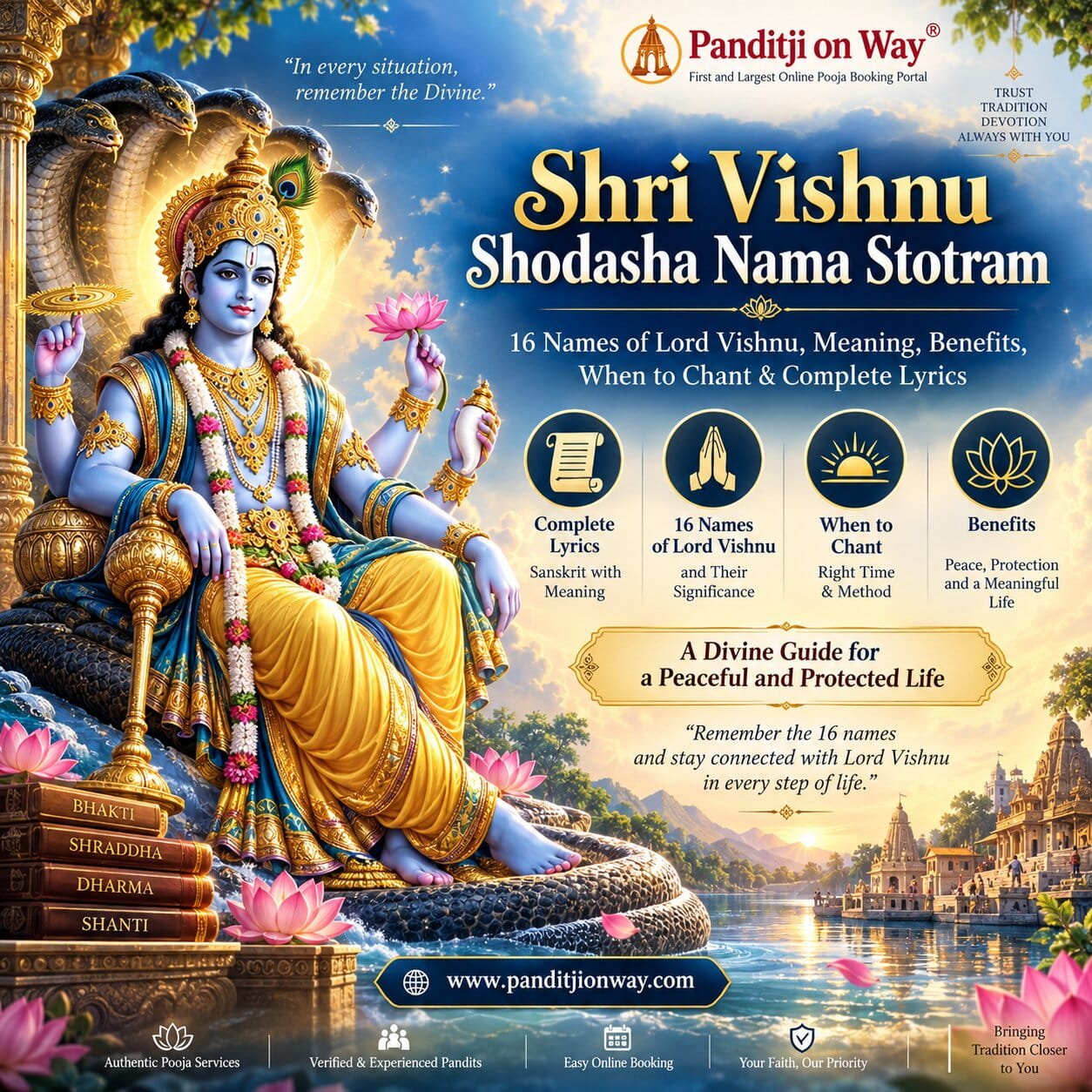
Shri Vishnu Shodasha Nama Stotram
॥ श्रीविष्णोः षोडशनामस्तोत्रम् ॥
औषधे चिन्तयेद्विष्णुं भोजने च जनार्दनम्।
शयने पद्मनाभं च विवाहे च प्रजापतिम्॥१॥
युद्धे चक्रधरं देवं प्रवासे च त्रिविक्रमम्।
नारायणं तनुत्यागे श्रीधरं प्रियसङ्गमे॥२॥
दुःस्वप्ने स्मर गोविन्दं सङ्कटे मधुसूदनम्।
कानने नारसिंहं च पावके जलशायिनम्॥३॥
जलमध्ये वराहं च पर्वते रघुनन्दनम्।
गमने वामनं चैव सर्वकार्येषु माधवम्॥४॥
षोडशैतानि नामानि प्रातरुत्थाय यः पठेत्।
सर्वपापविनिर्मुक्तो विष्णुलोके महीयते॥५॥
॥ इति श्रीविष्णोः षोडशनामस्तोत्रं सम्पूर्णम् ॥
Vishnu Shodasha Nama Stotram Meaning in English
The stotram associates a particular name or form of Lord Vishnu with different circumstances of daily life.
| Situation | Name of Lord Vishnu | Meaning / Significance |
|---|---|---|
| During illness or taking medicine | Vishnu | Remember Lord Vishnu while taking medicine |
| During meals | Janardana | Remember Janardana before or during भोजन |
| Before sleeping | Padmanabha | Remember Padmanabha at bedtime |
| During marriage | Prajapati | Remember Prajapati during विवाह |
| During conflict or battle | Chakradhara | Remember the wielder of the Sudarshana Chakra |
| During travel away from home | Trivikrama | Remember Trivikrama while travelling |
| At the time of leaving the body | Narayana | Remember Narayana at life’s final moment |
| During association with one’s beloved | Shridhara | Remember Shridhara |
| After a frightening dream | Govinda | Remember Govinda after a bad dream |
| During difficulty or crisis | Madhusudana | Remember Madhusudana in संकट |
| In a forest or wilderness | Narasimha | Remember Lord Narasimha for protection |
| Near fire | Jalashayi | Remember Vishnu as the one who rests upon the cosmic waters |
| In water | Varaha | Remember Varaha |
| On mountains | Raghunandana | Remember Lord Rama, the delight of the Raghu lineage |
| While going or travelling | Vamana | Remember Vamana |
| During all important activities | Madhava | Remember Madhava in every undertaking |
What Is Vishnu Shodasha Nama Stotram?
Vishnu Shodasha Nama Stotram is a short devotional hymn consisting of sixteen names of Lord Vishnu. Rather than simply listing names, the prayer connects each name with a particular circumstance.
The central idea is constant remembrance of the Divine. Whether a person is eating, sleeping, travelling, facing difficulties or beginning an important task, the stotram encourages remembrance of Lord Vishnu.
The prayer concludes by stating that a person who recites these sixteen names after rising in the morning becomes free from sins and is honoured in Vishnu’s abode.

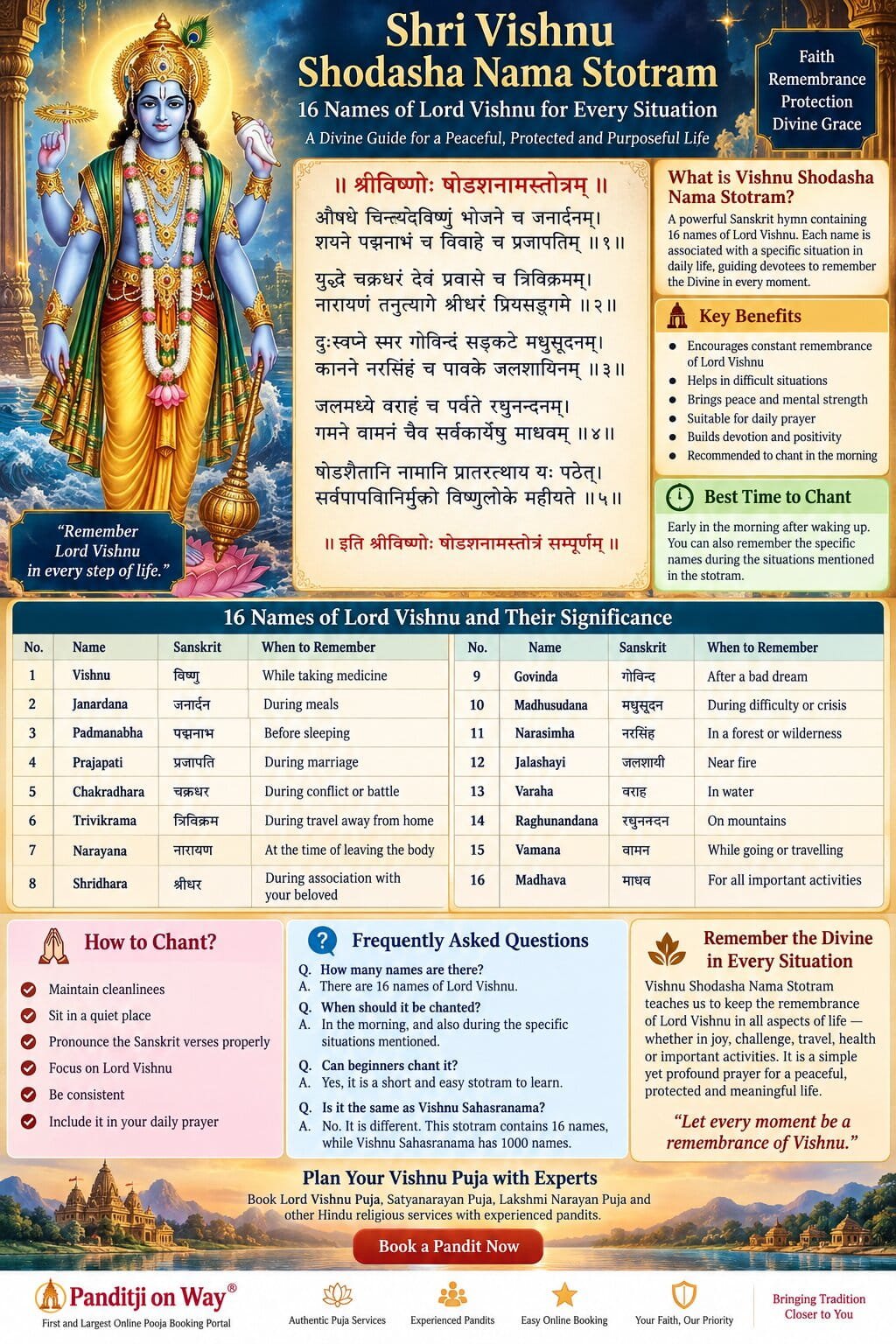
16 Names of Lord Vishnu in Shodasha Nama Stotram
The sixteen names mentioned in the stotram are:
- Vishnu
- Janardana
- Padmanabha
- Prajapati
- Chakradhara
- Trivikrama
- Narayana
- Shridhara
- Govinda
- Madhusudana
- Narasimha
- Jalashayi
- Varaha
- Raghunandana
- Vamana
- Madhava
These names represent different manifestations, qualities and theological associations of Lord Vishnu.
Vishnu Shodasha Nama Stotram: Name and Situation Table
For quick reference, devotees can use the following table.
| No. | Vishnu Name | Sanskrit | When to Remember |
|---|---|---|---|
| 1 | Vishnu | विष्णु | While taking medicine |
| 2 | Janardana | जनार्दन | During meals |
| 3 | Padmanabha | पद्मनाभ | Before sleeping |
| 4 | Prajapati | प्रजापति | During marriage |
| 5 | Chakradhara | चक्रधर | During battle or conflict |
| 6 | Trivikrama | त्रिविक्रम | During travel away from home |
| 7 | Narayana | नारायण | At the time of leaving the body |
| 8 | Shridhara | श्रीधर | During प्रिय-संगम |
| 9 | Govinda | गोविन्द | After a bad dream |
| 10 | Madhusudana | मधुसूदन | During संकट or difficulty |
| 11 | Narasimha | नरसिंह | In a forest or wilderness |
| 12 | Jalashayi | जलशायी | Near fire |
| 13 | Varaha | वराह | In water |
| 14 | Raghunandana | रघुनन्दन | On mountains |
| 15 | Vamana | वामन | While going/travelling |
| 16 | Madhava | माधव | For all important activities |
Vishnu Shodasha Nama Stotram Benefits
Devotional traditions associate the recitation of Vishnu’s names with spiritual remembrance, mental steadiness and devotion.
1. Encourages remembrance of Lord Vishnu
The stotram makes remembrance of Vishnu part of everyday activities rather than limiting devotion to formal पूजा.
2. Suitable for daily prayer
Because the prayer is relatively short, devotees can include it in their morning prayer routine.
3. Provides a devotional practice during difficult situations
The verses specifically mention situations involving sankata, travel, frightening dreams, illness and other circumstances, making the stotram especially meaningful during challenging moments.
4. Strengthens devotion
Regular recitation can serve as a simple way of developing a consistent spiritual routine.
5. Creates a positive morning routine
The final verse specifically describes reciting the sixteen names after waking in the morning.
Important note about religious benefits
The benefits described in traditional stotra literature are spiritual and devotional beliefs. They should not be interpreted as a substitute for medical treatment, professional advice or practical safety measures.
When Should You Chant Vishnu Shodasha Nama Stotram?
The concluding verse recommends reciting the sixteen names after getting up in the morning.
A simple daily routine can be:
- Wake up and freshen yourself.
- Sit comfortably in a clean and peaceful place.
- Remember Lord Vishnu.
- Recite the Vishnu Shodasha Nama Stotram.
- Meditate briefly on Lord Vishnu.
- Begin your daily activities.
Devotees may also recite or remember the relevant Vishnu name according to the situation described in the stotram.
How to Chant Vishnu Shodasha Nama Stotram?
There is no need to make the practice unnecessarily complicated.
Recommended approach
Cleanliness: Bathe or wash your face and hands before prayer if possible.
Place: Sit in a clean and quiet location.
Posture: Maintain a comfortable, steady posture.
Pronunciation: Try to pronounce the Sanskrit verses accurately.
Focus: Concentrate on Lord Vishnu rather than simply rushing through the words.
Regularity: Consistency is more useful for a devotional practice than occasional mechanical recitation.
Vishnu Shodasha Nama Stotram in Hindi
श्रीविष्णु षोडशनाम स्तोत्रम् भगवान विष्णु के सोलह नामों का स्मरण कराने वाला स्तोत्र है। इसमें बताया गया है कि जीवन की अलग-अलग परिस्थितियों में भगवान विष्णु के किस नाम का स्मरण करना शुभ माना जाता है।
औषधि लेते समय विष्णु, भोजन के समय जनार्दन, सोते समय पद्मनाभ, विवाह के समय प्रजापति, युद्ध या संघर्ष के समय चक्रधर, प्रवास के समय त्रिविक्रम, देह त्याग के समय नारायण और प्रिय के संग श्रीधर का स्मरण बताया गया है।
दुःस्वप्न आने पर गोविंद, संकट में मधुसूदन, वन में नृसिंह, अग्नि के समीप जलशायी, जल के बीच वराह, पर्वत पर रघुनंदन, गमन के समय वामन और सभी कार्यों में माधव का स्मरण करने का उल्लेख मिलता है।
Vishnu Shodasha Nama: Why Are There 16 Names?
The Sanskrit word षोडश (Shodasha) means sixteen. The stotram therefore focuses on sixteen names of Lord Vishnu.
Each name highlights a particular aspect of Vishnu’s divine identity and is associated in the hymn with a particular circumstance.
This makes the stotram different from a simple Vishnu Namavali: it gives devotees a practical framework for remembering Vishnu throughout different parts of life.
Significance of the Names of Lord Vishnu
Vishnu
The name Vishnu is traditionally associated with the all-pervading Divine. In the stotram, this name is remembered while taking medicine.
Janardana
Janardana is a well-known name of Lord Vishnu and Krishna. The stotram associates it with भोजन.
Padmanabha
Padmanabha means the one from whose navel the lotus is described as arising. The name is recommended at bedtime.
Prajapati
Prajapati is associated with the lordship of created beings and is mentioned in connection with marriage.
Chakradhara
Chakradhara means the bearer of the Chakra, referring to Lord Vishnu’s Sudarshana Chakra.
Trivikrama
Trivikrama refers to the divine form associated with Vishnu’s three great strides. The stotram connects this name with travel away from home.
Narayana
Narayana is one of the most important names of Lord Vishnu and is particularly associated in the verse with the final stage of life.
Shridhara
Shridhara means the bearer or possessor of Shri, referring to Lakshmi. The stotram associates this name with प्रिय-संगम.
Govinda
Govinda is a celebrated name of Vishnu and Krishna. The stotram recommends remembering Govinda after a frightening dream.
Madhusudana
Madhusudana means the destroyer of Madhu and is associated with remembering Vishnu during संकट.
Narasimha
Narasimha is the half-man, half-lion incarnation of Vishnu. The stotram associates this name with being in a forest.
Jalashayi
Jalashayi refers to the Divine resting upon the cosmic waters. The stotram mentions this name in connection with fire.
Varaha
Varaha is Vishnu’s boar incarnation, traditionally associated with rescuing the Earth. The name appears in the verse concerning water.
Raghunandana
Raghunandana means the delight of the Raghu lineage and refers to Lord Rama.
Vamana
Vamana is the dwarf incarnation of Vishnu who is central to the famous Bali narrative. The stotram associates Vamana with movement or going.
Madhava
Madhava is another important name of Lord Vishnu. The final practical instruction is to remember Madhava in all activities.
Vishnu Shodasha Nama Stotram for Daily Life
One of the most interesting aspects of this prayer is that it connects spirituality with ordinary activities.
| Daily Situation | Name to Remember |
|---|---|
| Taking medicine | Vishnu |
| Eating food | Janardana |
| Going to sleep | Padmanabha |
| Marriage | Prajapati |
| Facing conflict | Chakradhara |
| Travelling away from home | Trivikrama |
| End of life | Narayana |
| प्रिय-संगम | Shridhara |
| Bad dream | Govinda |
| Difficult situation | Madhusudana |
| Forest/wilderness | Narasimha |
| Near fire | Jalashayi |
| In water | Varaha |
| Mountain | Raghunandana |
| Going/travelling | Vamana |
| Any important work | Madhava |
Vishnu Mantra and Stotra for Protection and Devotion
Many devotees include Vishnu stotras and mantras in their daily पूजा. Vishnu Shodasha Nama Stotram is particularly distinctive because it does not focus on only one circumstance.
Instead, it repeatedly directs the mind toward the Divine during:
- health-related situations,
- भोजन,
- sleep,
- marriage,
- travel,
- संकट,
- frightening dreams,
- wilderness,
- water,
- mountains and
- important activities.
This makes it a concise prayer for continuous remembrance of Lord Vishnu.
Can Vishnu Shodasha Nama Stotram Be Chanted Every Day?
Yes. The concluding verse specifically mentions morning recitation after waking up.
Devotees who already have a daily Vishnu पूजा routine can include this stotram alongside other prayers such as Vishnu Sahasranama, Vishnu Ashtottara Shatanama Stotram or other Vishnu stotras according to their tradition.
Is Vishnu Shodasha Nama Stotram Suitable for Beginners?
Yes. It is a relatively short stotram and can be learned gradually.
Beginners can start by:
- Learning the Sanskrit pronunciation.
- Understanding the meaning of each verse.
- Reciting one verse at a time.
- Gradually memorising all five verses.
- Incorporating it into their morning prayer.
The goal should be sincere remembrance rather than simply completing the recitation quickly.
Vishnu Shodasha Nama Stotram for Travel
The stotram mentions two travel-related circumstances:
प्रवासे च त्रिविक्रमम् — during travel away from home, remember Trivikrama.
गमने वामनं चैव — while going/moving, remember Vamana.
Therefore, devotees may include these names in their personal prayer before beginning a journey.
For actual travel safety, however, traditional prayer should complement—not replace—ordinary precautions such as following traffic laws, checking weather and carrying necessary documents and medicines.
Vishnu Shodasha Nama Stotram for Difficult Times
The third verse contains:
दुःस्वप्ने स्मर गोविन्दं
सङ्कटे मधुसूदनम्।
The verse instructs devotees to remember Govinda after a bad dream and Madhusudana during संकट.
This is one reason the stotram is commonly valued as a short prayer for remembrance during unsettling circumstances.
Morning Vishnu Prayer
If you want to create a simple morning Vishnu prayer routine, you can follow this sequence:
| Step | Practice |
|---|---|
| 1 | Wake up and maintain cleanliness |
| 2 | Sit peacefully before your पूजा space |
| 3 | Remember Lord Vishnu |
| 4 | Recite Vishnu Shodasha Nama Stotram |
| 5 | Meditate on Vishnu’s form or name |
| 6 | Offer your prayers |
| 7 | Begin your daily responsibilities |
Vishnu Shodasha Nama Stotram and Pooja
Devotees who wish to perform a traditional Lord Vishnu Puja, Vishnu-related homa, Satyanarayan Puja or other Hindu religious ceremony can consult an experienced pandit for the appropriate विधि according to their family and regional tradition.
Panditji on Way provides online access to pooja-booking services, allowing devotees to arrange traditional Hindu पूजा services.
Internal-link opportunities for Panditji on Way:
- Lord Vishnu Puja
- Satyanarayan Puja
- Vishnu Sahasranama
- Vishnu Ashtottara Shatanama
- Ekadashi Puja
- Lakshmi Narayan Puja
- Griha Pravesh Puja
- Online Puja Booking
- Pandit Booking
Authoritative External References
For Sanskrit, Hindu religious and scriptural research.
Useful external resources include:
- Sanskrit documents and texts — GRETIL
- Internet Sacred Text Archive
- Encyclopaedia Britannica — Vishnu
Frequently Asked Questions — Vishnu Shodasha Nama Stotram
What is Vishnu Shodasha Nama Stotram?
Vishnu Shodasha Nama Stotram is a Sanskrit devotional hymn containing sixteen names of Lord Vishnu. Each name is associated with a particular situation such as भोजन, sleep, marriage, travel, संकट and other circumstances.
How many names are there in Vishnu Shodasha Nama Stotram?
There are sixteen names of Lord Vishnu in the stotram. Shodasha means sixteen.
Which Vishnu name should be remembered while taking medicine?
The stotram says to remember Vishnu while taking medicine.
Which name of Vishnu should be remembered while eating?
The stotram associates Janardana with भोजन.
Which Vishnu name should be remembered before sleeping?
Before sleeping, the stotram recommends remembering Padmanabha.
Which Vishnu name is associated with marriage?
The stotram associates Prajapati with विवाह.
Which Vishnu name should be remembered during travel?
The stotram mentions Trivikrama during प्रवास and Vamana during गमन.
Which Vishnu name should be remembered during संकट?
The stotram says to remember Madhusudana during संकट.
Which Vishnu name should be remembered after a bad dream?
The verse says:
दुःस्वप्ने स्मर गोविन्दम्
Therefore, Govinda is the name associated with a दुःस्वप्न.
Which Vishnu name is associated with forests?
The stotram associates Narasimha with being in a forest or wilderness.
Which Vishnu name should be remembered in water?
The stotram mentions Varaha in connection with being in water.
Which Vishnu name should be remembered on a mountain?
The stotram associates Raghunandana, referring to Lord Rama, with mountains.
Which Vishnu name is recommended for all activities?
The final practical instruction associates Madhava with all activities.
What is the best time to chant Vishnu Shodasha Nama Stotram?
The concluding verse specifically mentions morning recitation after waking up. Devotees may also remember the relevant names throughout the day.
Can women chant Vishnu Shodasha Nama Stotram?
There is no need to assume that a short Vishnu devotional prayer is restricted to one gender. Devotees should follow any specific family, sampradaya or priestly tradition they observe.
Can Vishnu Shodasha Nama Stotram be chanted without knowing Sanskrit?
Yes. Beginners can learn the pronunciation gradually while also understanding the meaning of the verses.
Is Vishnu Shodasha Nama Stotram the same as Vishnu Sahasranama?
No. They are different prayers. Vishnu Shodasha Nama Stotram contains sixteen names, whereas Vishnu Sahasranama is the famous hymn of one thousand names of Lord Vishnu.
Vishnu Shodasha Nama Stotram — Quick Answer
Vishnu Shodasha Nama Stotram is a Sanskrit hymn containing 16 names of Lord Vishnu. The stotram recommends remembering different names in different situations: Vishnu while taking medicine, Janardana while eating, Padmanabha before sleeping, Prajapati during marriage, Chakradhara during conflict, Trivikrama while travelling, Govinda after a bad dream, Madhusudana during संकट and Madhava for all activities. The concluding verse recommends reciting these sixteen names in the morning.
Key Takeaways
- Shodasha means sixteen.
- The stotram contains 16 names of Lord Vishnu.
- Each name is connected with a particular circumstance.
- Morning recitation is specifically mentioned in the concluding verse.
- Madhava is associated with remembrance during all activities.
- Govinda is remembered after a bad dream.
- Madhusudana is remembered during संकट.
- Padmanabha is remembered before sleep.
- Janardana is remembered during meals.
- Trivikrama is associated with travel away from home.
- Narasimha is associated with the forest.
- Varaha is associated with water.
Conclusion
Shri Vishnu Shodasha Nama Stotram offers a simple yet meaningful way to keep the remembrance of Lord Vishnu connected with everyday life. Its sixteen names cover a wide range of situations—from taking medicine and eating food to sleeping, travelling, facing difficulties and beginning important activities.
For devotees, the deeper message of the stotram is not merely memorising sixteen names, but cultivating a habit of remembrance, faith and devotion throughout the day.
If you are planning a Vishnu Puja, Satyanarayan Puja, Lakshmi Narayan Puja or another traditional Hindu पूजा, Panditji on Way — the First and Largest Online Pooja Booking Portal — can help you arrange the required puja services with a pandit according to the ceremony you wish to perform.