

Vishnu Ashtottarashatanama Stotram | 108 Names of Lord Vishnu with Sanskrit, Meaning, Benefits & Puja Vidhi
Vishnu Ashtottarashatanama Stotram with Sanskrit text, 108 names of Lord Vishnu, meanings, benefits, chanting method, Ekadashi significance, puja vidhi and FAQs.
Vishnu Ashtottarashatanama Stotram is a sacred hymn dedicated to Lord Vishnu containing His 108 divine names and descriptions. These names glorify Lord Vishnu as Narayana, Vasudeva, Krishna, Madhava, Govinda, Trivikrama, Janardana, Purushottama and in several other divine forms.
Devotees traditionally recite Vishnu’s sacred names during daily worship and on spiritually significant occasions such as Ekadashi. The practice is regarded as a form of devotion, remembrance and contemplation of Lord Vishnu.
Panditji on Way, an online puja booking platform offering pandit, puja, havan, jaap and religious services, presents this detailed guide to the Vishnu Ashtottarashatanama Stotram, including the Sanskrit text, 108 names, meanings, spiritual significance, chanting procedure, suitable occasions and frequently asked questions.
Panditji on Way – Online Puja & Pandit Booking
Vishnu Ashtottarashatanama Stotram at a Glance
| Topic | Details |
|---|---|
| Stotram | Shri Vishnu Ashtottarashatanama Stotram |
| Deity | Lord Vishnu |
| Number of Names | 108 |
| Sanskrit Name | श्रीविष्ण्वष्टोत्तरशतनामस्तोत्रम् |
| Main Tradition | Vaishnava devotional worship |
| Commonly Recited | Daily puja, Ekadashi and Vishnu worship |
| Language | Sanskrit |
| Main Purpose | Devotion, remembrance and praise of Lord Vishnu |
| Related Names | Narayana, Krishna, Vasudeva, Madhava, Govinda, Keshava and others |
| Suitable For | Daily spiritual practice and devotional recitation |
| Recommended Approach | Recite with concentration, cleanliness and devotion |

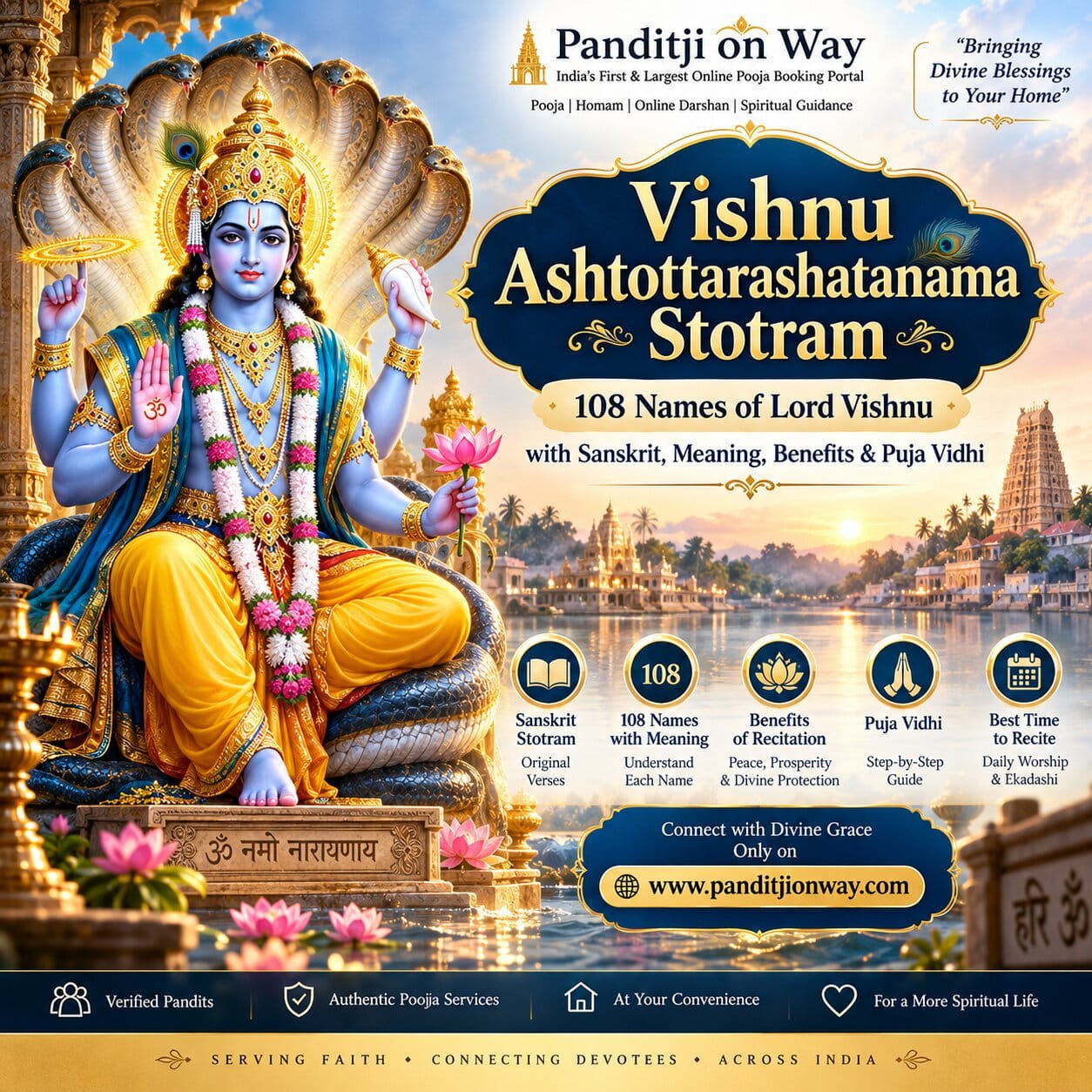
What Is Vishnu Ashtottarashatanama Stotram?
The word Ashtottarashatanama means a collection of 108 names. Therefore, Vishnu Ashtottarashatanama Stotram refers to a devotional hymn that praises Lord Vishnu through 108 sacred names and attributes.
Each name represents a particular quality, manifestation, relationship, divine activity or philosophical aspect associated with Lord Vishnu.
For example:
- Vishnu – the all-pervading Lord
- Lakshmipati – the Lord of Goddess Lakshmi
- Krishna – the divine form of Krishna
- Vaikuntha – associated with Vaikuntha, the divine abode
- Narayana – the supreme divine refuge
- Padmanabha – the Lord associated with the lotus arising from His navel
- Hrishikesha – the Lord of the senses
- Govinda – a celebrated name of Lord Vishnu/Krishna
- Janardana – the Lord worshipped and invoked by devotees
- Purushottama – the Supreme Person
- Achyuta – the infallible and unchanging Lord
- Mukunda – the giver of liberation
- Bhaktavatsala – the one who is affectionate toward devotees
- Prahladaparipalaka – the protector of Prahlada
The 108-name tradition allows devotees to contemplate many dimensions of Vishnu while reciting the stotram.
Shri Vishnu Ashtottarashatanama Stotram in Sanskrit
॥ अथ श्रीविष्ण्वष्टोत्तरशतनामस्तोत्रम् ॥
॥ ध्यानम् ॥
वेत्तारं वेदपुरुषं यज्ञेशं यज्ञवाहकम्।
चक्रपाणिं गदापाणिं शंखपाणिं नरोत्तमम्॥1॥
दामोदरं दमोपेतं केशवं केशिसूदनम्।
वरेण्यं वरदं विष्णुं आश्रये वसुदेवजम्॥2॥
॥ स्तोत्रम् ॥
विष्णुर्लक्ष्मीपतिः कृष्णो वैकुण्ठो गरुडध्वजः।
परब्रह्म जगन्नाथो वासुदेवस्त्रिविक्रमः॥3॥
दैत्यान्तको मधुरिपुस्तार्क्ष्यवाहः सनातनः।
नारायणः पद्मनाभो हृषीकेशः सुधाप्रदः॥4॥
माधवः पुण्डरीकाक्षः स्थितिकर्ता परात्परः।
वनमाली यज्ञरूपः चक्रपाणिर्गदाधरः॥5॥
उपेन्द्रः केशवो हंसः समद्रमथनो हरिः।
गोविन्दो ब्रह्मजनकः कैटभासुरमर्दनः॥6॥
श्रीधरः कामजनकः तथा शेषश्चतुर्भुजः।
पाञ्चजन्यधरः श्रीमान् शार्ङ्गपाणिर्जनार्दनः॥7॥
पीतांबरधरो देवः सूर्यचन्द्रविलोचनः।
मत्स्यरूपः कूर्मतनुः क्रोडरूपो नृकेसरी॥8॥
वामनो भार्गवो रामो बली कल्की हयाननः।
विश्वंभरः शिशुमारः श्रीकरः कपिलो ध्रुवः॥9॥
दत्तात्रेयोऽच्युतोऽनन्तो मुकुन्दो दधिवामनः।
धन्वन्तरिः श्रीनिवासः प्रद्युम्नः पुरुषोत्तमः॥10॥
श्रीवत्सकौस्तुभधरो मुरारातिरधोक्षजः।
ऋषभो मोहिनीरूपधरः सङ्कर्षणः प्रभुः॥11॥
क्षीराब्धिशायी भूतात्माऽनिरुद्धो भक्तवत्सलः।
नरो गजेन्द्रवरदस्त्रिधामा भूतभावनः॥12॥
श्वेतद्वीपेषु वास्तव्यः सूर्यमण्डलमध्यगः।
सनकादिमुनिध्येयो भगवान् शङ्करप्रियः॥13॥
नीलकान्तो धराकान्तो वेदात्मा बादरायणः।
भागीरथीजन्मभूमिपादपद्मः सतां प्रभुः॥14॥
स्वभूर्विभुर्घनश्यामो जगत्कारणमव्ययम्।
बुद्धावतारः शान्तात्मा लीलामानुषविग्रहः॥15॥
दामोदरो विराड्रूपो भूतभव्यभवत्प्रभुः।
आदिदेवो देवदेवः प्रह्लादपरिपालकः॥16॥
इति नाम्नां शतं विष्णोः पुण्यमायुष्यवर्धनम्।
श्रीकीर्तिपुष्टिदं वंश्यं पठेद्भक्तियुतो नरः॥17॥
॥ इति श्रीविष्णोरष्टोत्तरशतनामस्तोत्रं सम्पूर्णम् ॥
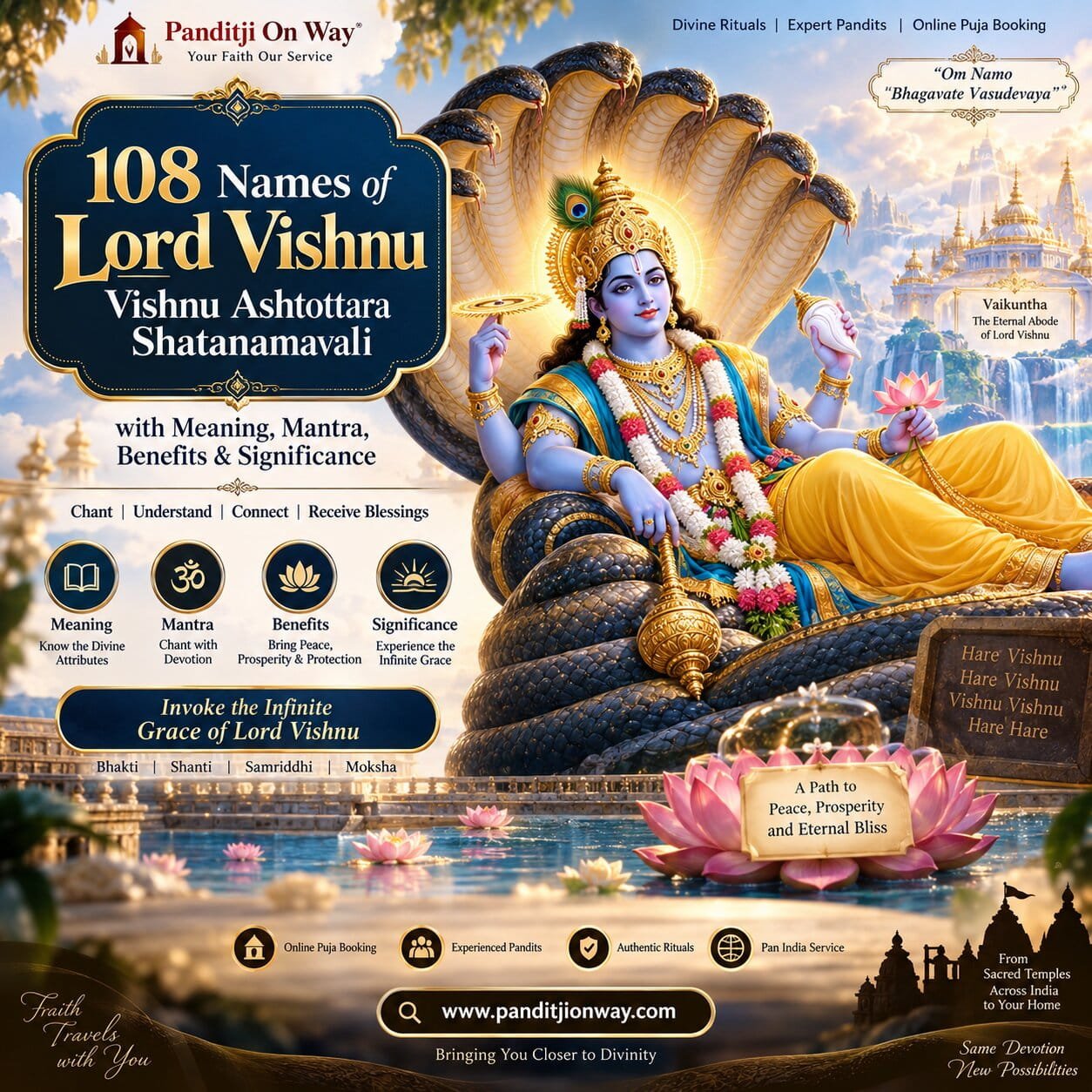
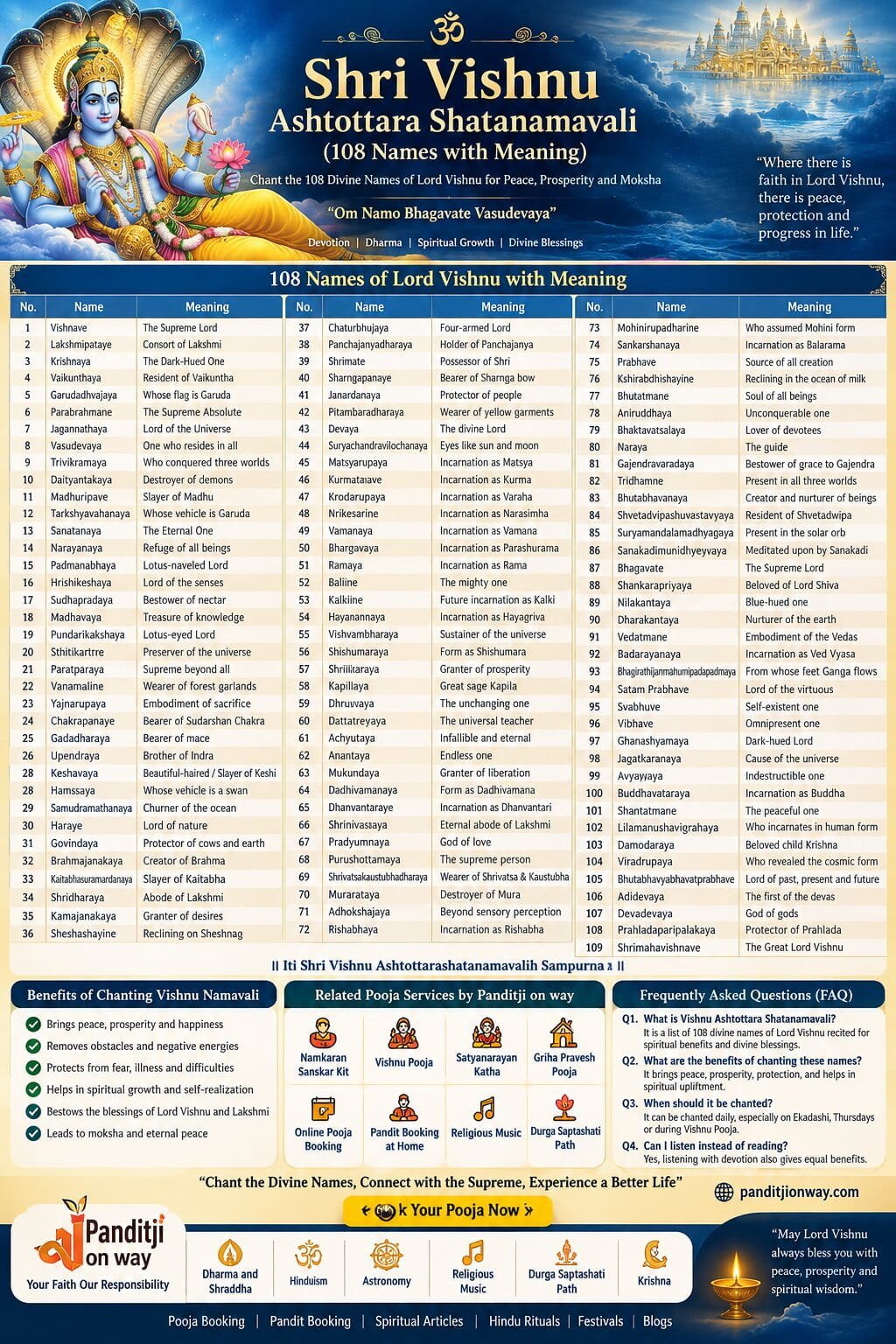
108 Names of Lord Vishnu with Meaning
The following table makes the Vishnu Ashtottarashatanama tradition easier to understand and study. The names in this table are based on the Vishnu name tradition represented in the supplied stotram.
| No. | Name of Lord Vishnu | Sanskrit | Simple Meaning |
|---|---|---|---|
| 1 | Vishnu | विष्णु | The all-pervading Lord |
| 2 | Lakshmipati | लक्ष्मीपतिः | Lord of Goddess Lakshmi |
| 3 | Krishna | कृष्णः | The divine dark-hued Lord |
| 4 | Vaikuntha | वैकुण्ठः | Lord associated with Vaikuntha |
| 5 | Garudadhvaja | गरुडध्वजः | He whose emblem is Garuda |
| 6 | Parabrahma | परब्रह्म | The Supreme Reality |
| 7 | Jagannatha | जगन्नाथः | Lord of the universe |
| 8 | Vasudeva | वासुदेवः | The divine indwelling Lord |
| 9 | Trivikrama | त्रिविक्रमः | He who traversed the three worlds |
| 10 | Daityantaka | दैत्यान्तकः | Destroyer of the forces of evil |
| 11 | Madhuripu | मधुरिपुः | Destroyer of Madhu |
| 12 | Tarkshyavaha | तार्क्ष्यवाहः | He who rides Garuda |
| 13 | Sanatana | सनातनः | The eternal one |
| 14 | Narayana | नारायणः | Supreme divine refuge |
| 15 | Padmanabha | पद्मनाभः | He associated with the lotus from His navel |
| 16 | Hrishikesha | हृषीकेशः | Lord of the senses |
| 17 | Sudhaprada | सुधाप्रदः | Bestower of divine nectar |
| 18 | Madhava | माधवः | A revered name of Vishnu |
| 19 | Pundarikaksha | पुण्डरीकाक्षः | Lotus-eyed Lord |
| 20 | Sthitikarta | स्थितिकर्ता | Sustainer of creation |
| 21 | Paratpara | परात्परः | Supreme beyond the supreme |
| 22 | Vanamali | वनमाली | Bearer of the forest-flower garland |
| 23 | Yajnarupa | यज्ञरूपः | Whose form is identified with yajna |
| 24 | Chakrapani | चक्रपाणिः | Bearer of the Sudarshana Chakra |
| 25 | Gadadhara | गदाधरः | Bearer of the mace |
| 26 | Upendra | उपेन्द्रः | Divine form born as the younger brother of Indra |
| 27 | Keshava | केशवः | A celebrated name of Vishnu |
| 28 | Hamsa | हंसः | The divine swan form |
| 29 | Samudramathana | समुद्रमथनः | Associated with the churning of the ocean |
| 30 | Hari | हरिः | Remover of suffering and worldly bondage |
| 31 | Govinda | गोविन्दः | A revered name of Vishnu/Krishna |
| 32 | Brahmajanaka | ब्रह्मजनकः | Source or father of Brahma |
| 33 | Kaitabhasuramardana | कैटभासुरमर्दनः | Destroyer of the demon Kaitabha |
| 34 | Sridhara | श्रीधरः | Bearer of Sri, Goddess Lakshmi |
| 35 | Kamajanaka | कामजनकः | Source of divine desire and creation |
| 36 | Shesha | शेषः | The divine Shesha form |
| 37 | Chaturbhuja | चतुर्भुजः | Four-armed Lord |
| 38 | Panchajanyadhara | पाञ्चजन्यधरः | Bearer of the Panchajanya conch |
| 39 | Sriman | श्रीमान् | Possessor of divine splendour and prosperity |
| 40 | Sharngapani | शार्ङ्गपाणिः | Bearer of the Sharnga bow |
| 41 | Janardana | जनार्दनः | Lord worshipped and invoked by people |
| 42 | Pitambaradhara | पीतांबरधरः | Wearer of yellow garments |
| 43 | Deva | देवः | The divine Lord |
| 44 | Suryachandravilochana | सूर्यचन्द्रविलोचनः | Whose eyes are symbolically associated with the Sun and Moon |
| 45 | Matsyarupa | मत्स्यरूपः | The Fish incarnation |
| 46 | Kurmatanuh | कूर्मतनुः | The Tortoise incarnation |
| 47 | Krodarupa | क्रोडरूपः | The Boar incarnation |
| 48 | Nrikesari | नृकेसरी | Narasimha, the Man-Lion form |
| 49 | Vamana | वामनः | The Vamana incarnation |
| 50 | Bhargava | भार्गवः | Associated with Parashurama |
| 51 | Rama | रामः | Lord Rama |
| 52 | Bali | बली | The powerful divine form |
| 53 | Kalki | कल्की | The future Kalki incarnation |
| 54 | Hayaanana | हयाननः | Horse-faced divine form |
| 55 | Vishvambhara | विश्वंभरः | Sustainer of the universe |
| 56 | Shishumara | शिशुमारः | Divine cosmic form associated with Shishumara |
| 57 | Shrikara | श्रीकरः | Bestower of auspiciousness and prosperity |
| 58 | Kapila | कपिलः | The revered Kapila form |
| 59 | Dhruva | ध्रुवः | The steadfast and eternal one |
| 60 | Dattatreya | दत्तात्रेयः | The revered Dattatreya form |
| 61 | Achyuta | अच्युतः | The infallible and unchanging Lord |
| 62 | Ananta | अनन्तः | The infinite one |
| 63 | Mukunda | मुकुन्दः | Giver of liberation |
| 64 | Dadhivamana | दधिवामनः | A Vamana form associated with curd |
| 65 | Dhanvantari | धन्वन्तरिः | Divine form associated with Ayurveda and healing tradition |
| 66 | Srinivasa | श्रीनिवासः | Abode of Goddess Sri |
| 67 | Pradyumna | प्रद्युम्नः | A celebrated divine form |
| 68 | Purushottama | पुरुषोत्तमः | The Supreme Person |
| 69 | Shrivatsakaustubhadhara | श्रीवत्सकौस्तुभधरः | Bearer of Sri Vatsa and Kaustubha |
| 70 | Murarati | मुरारातिः | Enemy of the demon Mura |
| 71 | Adhokshaja | अधोक्षजः | The transcendental Lord beyond ordinary perception |
| 72 | Rishabha | ऋषभः | The excellent and exalted one |
| 73 | Mohinirupadhara | मोहिनीरूपधरः | Bearer of the Mohini form |
| 74 | Sankarshana | सङ्कर्षणः | The divine Sankarshana form |
| 75 | Prabhu | प्रभुः | The powerful Supreme Lord |
| 76 | Kshirabdhishayi | क्षीराब्धिशायी | Reclining upon the ocean of milk |
| 77 | Bhutatma | भूतात्मा | Inner Self of beings |
| 78 | Aniruddha | अनिरुद्धः | The unconquerable divine form |
| 79 | Bhaktavatsala | भक्तवत्सलः | Affectionate toward devotees |
| 80 | Nara | नरः | The divine Nara form |
| 81 | Gajendrvarada | गजेन्द्रवरदः | Bestower of grace upon Gajendra |
| 82 | Tridhama | त्रिधामा | Lord associated with the three divine abodes |
| 83 | Bhutabhavana | भूतभावनः | Nurturer and sustainer of beings |
| 84 | Shvetadvipeshavasthita | श्वेतद्वीपेषु वास्तव्यः | Dweller in Shvetadvipa |
| 85 | Suryamandalamadhyaga | सूर्यमण्डलमध्यगः | Present in the centre of the solar sphere |
| 86 | Sanakadimunidhyeya | सनकादिमुनिध्येयः | Meditated upon by sages such as Sanaka |
| 87 | Bhagavan | भगवान् | The Supreme Lord possessing divine attributes |
| 88 | Shankarpriya | शङ्करप्रियः | Dear to Shankara |
| 89 | Neelakanta | नीलकान्तः | The blue-hued Lord |
| 90 | Dharakanta | धराकान्तः | Beloved Lord of the Earth |
| 91 | Vedatma | वेदात्मा | Essence and spirit of the Vedas |
| 92 | Badarayana | बादरायणः | The revered Badarayana/Vyasa association |
| 93 | Bhagirathijanmabhumipadapadma | भागीरथीजन्मभूमिपादपद्मः | Whose lotus feet are associated with the sacred source of the Ganga |
| 94 | Satamprabhu | सतां प्रभुः | Lord of the virtuous |
| 95 | Svabhuh | स्वभूः | Self-existent |
| 96 | Vibhu | विभुः | All-pervading and mighty |
| 97 | Ghanashyama | घनश्यामः | Dark like a rain cloud |
| 98 | Jagatkarana | जगत्कारणम् | Cause of the universe |
| 99 | Avyaya | अव्ययम् | Imperishable |
| 100 | Buddhavatara | बुद्धावतारः | The Buddha incarnation |
| 101 | Shantatma | शान्तात्मा | Peaceful in nature |
| 102 | Lilamanushavigraha | लीलामानुषविग्रहः | One who assumes a human form for divine play |
| 103 | Damodara | दामोदरः | A celebrated name of Vishnu/Krishna |
| 104 | Viradrupa | विराड्रूपः | Possessor of the cosmic form |
| 105 | Bhutabhavyabhavatprabhu | भूतभव्यभवत्प्रभुः | Lord of past, present and future |
| 106 | Adideva | आदिदेवः | Primordial Lord |
| 107 | Devadeva | देवदेवः | God of gods |
| 108 | Prahladaparipalaka | प्रह्लादपरिपालकः | Protector of Prahlada |
The broader Vishnu 108-name tradition also exists in different textual versions, including versions associated with the Padma Purana, so readers should not assume that every Vishnu Ashtottara Shatanamavali found online contains exactly the same sequence. Vishnu 108 Names – Padma Purana Tradition

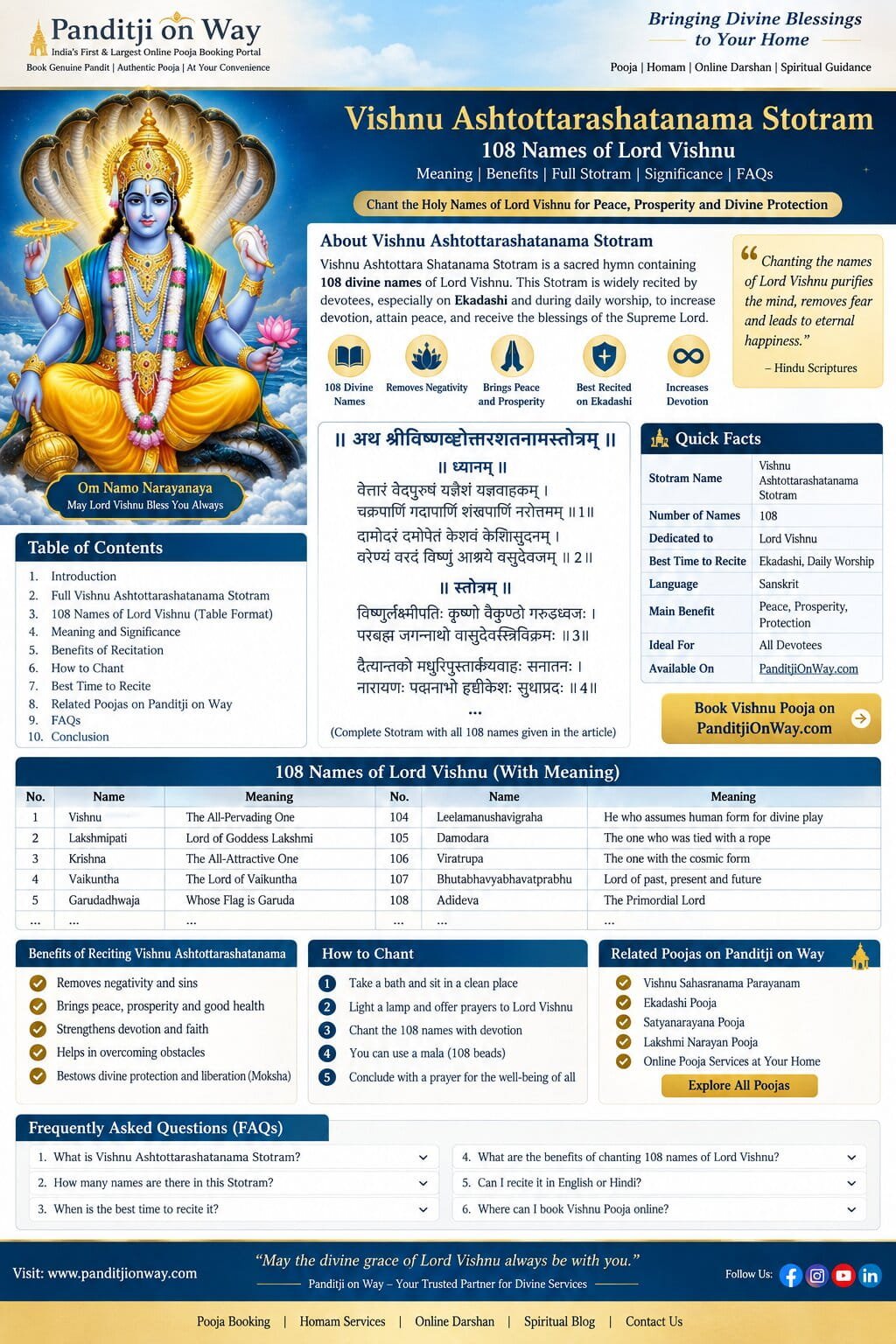
Vishnu Ashtottarashatanama Stotram Meaning
The central idea of Vishnu Ashtottarashatanama Stotram is remembrance of Lord Vishnu through His many divine names.
The stotram describes Vishnu as the Supreme Reality, protector of devotees, sustainer of the universe, bearer of divine weapons, source of creation and the Lord who manifests in different forms whenever divine intervention is required.
The names also connect Vishnu with several important forms and traditions, including:
- Narayana
- Vasudeva
- Krishna
- Rama
- Vamana
- Narasimha
- Matsya
- Kurma
- Varaha
- Parashurama
- Kalki
- Dhanvantari
- Mohini
- Buddha
- Aniruddha
- Sankarshana
- Pradyumna
Thus, the stotram is not simply a list of names. It provides a devotional overview of Vishnu’s many forms, qualities and divine activities.
Spiritual Significance of the 108 Names of Lord Vishnu
The number 108 has a special place in many Hindu devotional practices. Vishnu’s 108 names provide devotees with a structured way to remember and praise the Lord.
The spiritual significance of reciting the names can be understood through several aspects.
1. Cultivating devotion
Repeated remembrance of divine names can help a devotee maintain attention on the chosen deity.
2. Developing concentration
Recitation provides a fixed spiritual practice that can encourage mental discipline and concentration.
3. Remembering Vishnu’s divine forms
The names refer to different manifestations, attributes and stories connected with Lord Vishnu.
4. Supporting daily worship
The stotram can be incorporated into a personal Vishnu puja or devotional routine.
5. Ekadashi worship
Vishnu-related devotional practices are especially associated with Ekadashi in many Hindu traditions. The Vishnu Ashtottarashatanama tradition is also commonly presented as suitable for Ekadashi recitation.
What Are the Benefits of Chanting Vishnu Ashtottarashatanama Stotram?
Devotees recite Vishnu Ashtottarashatanama Stotram as a form of bhakti and spiritual remembrance.
Traditional devotional understanding associates Vishnu nama smarana with:
| Spiritual Practice | Devotional Significance |
|---|---|
| Reciting 108 names | Remembering different forms and attributes of Vishnu |
| Daily chanting | Developing consistency in spiritual practice |
| Ekadashi recitation | Strengthening Vishnu-centered devotional observance |
| Morning prayer | Beginning the day with remembrance of the divine |
| Evening prayer | Ending the day with reflection and devotion |
| Vishnu puja | Supporting the worship of Lord Vishnu |
| Family recitation | Creating a shared devotional practice |
| Festival worship | Enhancing the spiritual atmosphere of Vishnu-related observances |
These should be understood as traditional spiritual and devotional benefits, rather than medical or scientifically guaranteed outcomes.
When Should You Chant Vishnu Ashtottarashatanama Stotram?
There is no need to restrict the stotram to only one day.
It may be included in a regular devotional routine according to one’s tradition and personal practice.
Recommended occasions
Daily Puja
Devotees who regularly worship Lord Vishnu can include the 108 names in their daily prayer.
Ekadashi
Ekadashi is one of the most widely observed days for Vishnu devotion. The stotram can be recited during an Ekadashi vrata or puja.
Vishnu-related Festivals
The names may also be incorporated into devotional worship during occasions associated with Lord Vishnu and His incarnations.
Special Family Puja
Families can recite the names together as part of a home puja.
Before Vishnu Puja
The stotram can be used as part of a longer Vishnu devotional sequence.
How to Chant Vishnu Ashtottarashatanama Stotram
A simple devotional procedure can be followed.
| Step | Puja Practice |
|---|---|
| 1 | Bathe and wear clean clothes |
| 2 | Clean the puja area |
| 3 | Place an image or murti of Lord Vishnu |
| 4 | Light a diya |
| 5 | Offer water and flowers according to your tradition |
| 6 | Mentally remember Lord Vishnu |
| 7 | Recite the dhyana verses |
| 8 | Recite the Vishnu Ashtottarashatanama Stotram |
| 9 | Meditate quietly after recitation |
| 10 | Offer your prayer and conclude the puja |
The most important element is sincere devotion and attentive recitation.
Vishnu Ashtottarashatanama Puja Samagri
For a simple home Vishnu puja, devotees may use commonly available puja items according to their family tradition.
| Puja Item | Purpose |
|---|---|
| Lord Vishnu image or murti | Focus of worship |
| Diya | Offering of light |
| Incense/dhoop | Traditional devotional offering |
| Flowers | Pushpa offering |
| Tulsi leaves | Traditionally important in Vishnu worship |
| Water | Offering and purification |
| Chandan | Traditional worship offering |
| Akshata | Rice offering |
| Fruits | Naivedya |
| Sweets | Naivedya |
| Panchamrit | Used in applicable puja traditions |
| Bell | Traditional puja element |
| Mala | Counting or devotional chanting |
The exact samagri can vary according to the particular Vishnu puja tradition being followed.
For complete puja arrangements, devotees can explore the puja services and samagri options available through Panditji on Way.
Explore Puja Services on Panditji on Way
Vishnu Ashtottarashatanama Stotram and Ekadashi
Ekadashi is traditionally associated with Lord Vishnu and is observed through fasting, prayer, nama japa, katha and other devotional practices.
Many devotees use Ekadashi as an opportunity to increase their remembrance of Lord Vishnu.
Vishnu Ashtottarashatanama Stotram can therefore be included in an Ekadashi devotional routine alongside:
- Vishnu mantra japa
- Vishnu Sahasranama
- Bhagavad Gita reading
- Vishnu puja
- Hari nama sankirtana
- Meditation
- Charity and devotional activities
For accurate Ekadashi dates and tithi information, readers can consult an established Panchang source.
Vishnu Ashtottarashatanama Stotram reference and 108 names
Difference Between Vishnu Ashtottarashatanama Stotram and Vishnu Sahasranama
These two devotional texts are related to Lord Vishnu but are not the same.
| Feature | Vishnu Ashtottarashatanama | Vishnu Sahasranama |
|---|---|---|
| Number | 108 names | 1,000 names |
| Length | Relatively shorter | Much longer |
| Main Purpose | Recitation of 108 names | Recitation of 1,000 names |
| Daily Practice | Convenient for shorter worship | Requires more time |
| Ekadashi | Suitable for Vishnu devotion | Widely used in Vishnu worship |
| Learning | Easier to memorise | Larger text to study |
A devotee may choose either according to their time, tradition and spiritual practice.
Panditji on Way also offers Vishnu Sahasranam Path as one of its devotional services.
Vishnu Sahasranam Path – Panditji on Way
Why Are There Different Lists of 108 Names of Lord Vishnu?
One important point for readers searching online is that there is not necessarily one universally identical list titled “108 Names of Vishnu.”
Different textual traditions can contain different sequences and names.
For example, published references include a Vishnu Ashtottara Shatanamavali associated with the Padma Purana as well as other Vishnu 108-name traditions.
Therefore, when comparing two websites, readers should check:
- The textual tradition being followed.
- The Sanskrit source.
- Whether the page presents a Stotram or Namavali.
- Whether the names are from the same recension.
- Whether the source is clearly identified.
This is especially important for devotional texts because variations can occur across traditions.
Vishnu Ashtottarashatanama Stotram: Important Names to Know
Om Vishnave Namah
Vishnu refers to the all-pervading Lord.
Om Narayanaya Namah
Narayana is one of the most important names associated with Lord Vishnu and represents the divine refuge and Supreme Lord.
Om Vasudevaya Namah
Vasudeva is prominently associated with Krishna and Vishnu and expresses the divine presence.
Om Madhavaya Namah
Madhava is a revered name of Vishnu and Krishna.
Om Govindaya Namah
Govinda is a celebrated name of Lord Krishna/Vishnu.
Om Hrishikeshaya Namah
Hrishikesha means the Lord of the senses.
Om Achyutaya Namah
Achyuta expresses the idea of the infallible and unchanging Lord.
Om Mukundaya Namah
Mukunda is traditionally understood as the giver of liberation.
Om Purushottamaya Namah
Purushottama means the Supreme Person and is a major theological name of Vishnu.
Om Bhaktavatsalaya Namah
Bhaktavatsala expresses the Lord’s loving relationship with His devotees.
Vishnu Ashtottarashatanama Stotram for Daily Puja
For a simple daily practice, a devotee can follow this sequence:
Morning
- Bathe and prepare for worship.
- Sit in a clean and peaceful place.
- Light a diya.
- Remember Lord Vishnu.
- Recite the dhyana verses.
- Recite the 108 names.
- Sit quietly for a few moments.
- Offer your personal prayer.
The practice does not need to be unnecessarily complicated. Regularity, understanding and devotion are more important than performing an elaborate routine without attention.
Can Women and Men Chant Vishnu Ashtottarashatanama Stotram?
In general devotional practice, Vishnu’s names are recited by devotees as part of prayer and nama smarana.
However, specific ritual rules can differ between families, sampradayas, temples and particular puja traditions. When performing a formal ritual, it is appropriate to follow the guidance of the priest or tradition being observed.
Can Children Chant the 108 Names of Lord Vishnu?
Yes, families can introduce children to Vishnu’s names in an age-appropriate manner.
Parents may begin with a few names such as:
- Vishnu
- Narayana
- Govinda
- Madhava
- Keshava
- Krishna
- Achyuta
- Mukunda
Once the child becomes comfortable with pronunciation, the complete 108-name stotram can be introduced.
This can also become a meaningful family devotional practice.
Vishnu Ashtottarashatanama Stotram Pronunciation Tips
Sanskrit pronunciation can require practice.
Readers should avoid rushing through the verses. A slower and clearer recitation is generally more useful for learning.
Important points include:
- Read each Sanskrit word carefully.
- Pay attention to long and short vowels.
- Avoid changing the meaning by combining words incorrectly.
- Listen to a reliable traditional recitation where available.
- Learn difficult names separately.
- Practise one verse at a time.
When the purpose is devotional practice, sincerity and respectful pronunciation should be prioritised.
Vishnu Ashtottarashatanama Stotram: Key Takeaway
The Vishnu Ashtottarashatanama Stotram provides a concise devotional framework for remembering Lord Vishnu through 108 sacred names.
The names describe Vishnu as:
- The Supreme Reality
- The protector of devotees
- The sustainer of the universe
- Narayana
- Vasudeva
- Krishna
- Rama
- Narasimha
- Vamana
- Trivikrama
- Purushottama
- Achyuta
- Mukunda
- Bhaktavatsala
- Prahladaparipalaka
For devotees looking for a manageable Vishnu prayer, the 108-name stotram can become part of daily puja, Ekadashi worship or other Vishnu devotional practices.
Book a Pandit for Vishnu Puja with Panditji on Way
If you want to perform a Vishnu-related puja at home, office or another suitable location, Panditji on Way provides online access to pandit and puja services.

Panditji on Way states that it provides customized pandit services and puja samagri and serves multiple Indian cities, including Mumbai, Navi Mumbai, Delhi, Hyderabad, Bangalore and Kolkata.
Readers can explore the available puja services here:
Book a Pandit for Puja Online – Panditji on Way
Frequently Asked Questions About Vishnu Ashtottarashatanama Stotram
What is Vishnu Ashtottarashatanama Stotram?
Vishnu Ashtottarashatanama Stotram is a devotional hymn praising Lord Vishnu through 108 sacred names and descriptions.
How many names are there in Vishnu Ashtottarashatanama Stotram?
The Ashtottarashatanama tradition contains 108 names of Lord Vishnu.
When should Vishnu Ashtottarashatanama Stotram be recited?
It can be recited during daily puja, Vishnu worship and especially during Ekadashi according to one’s devotional tradition.
Can I chant Vishnu Ashtottarashatanama Stotram every day?
Yes. It can be incorporated into a regular devotional practice if it is consistent with your personal tradition.
What are the benefits of chanting Vishnu’s 108 names?
Traditionally, devotees regard the recitation as a practice of bhakti, divine remembrance, concentration and spiritual discipline.
Is Vishnu Ashtottarashatanama the same as Vishnu Sahasranama?
No. Vishnu Ashtottarashatanama contains 108 names, while Vishnu Sahasranama is a much longer hymn containing 1,000 names.
Can I chant Vishnu Ashtottarashatanama on Ekadashi?
Yes. Vishnu’s names are commonly included in Ekadashi devotional practices.
Can children chant the Vishnu 108 names?
Yes. Children can learn selected names first and gradually learn the complete stotram.
Which is the most important name of Lord Vishnu?
Different traditions emphasise different names. Vishnu, Narayana, Vasudeva, Krishna, Govinda, Keshava, Madhava and Hari are among the widely revered names.
What should I offer Lord Vishnu during puja?
Common devotional offerings include flowers, Tulsi, water, fruits, sweets, chandan and other items according to one’s family or sampradaya tradition.
Can Vishnu Ashtottarashatanama be recited without a priest?
Yes. Devotees can recite the names as personal devotional prayer. Formal rituals may have additional procedures according to the tradition being followed.
Are all 108 Vishnu names found online identical?
Not necessarily. Different textual traditions and versions of Vishnu Namavali exist, so the exact sequence can vary.
Quick Answer: Vishnu Ashtottarashatanama Stotram
Vishnu Ashtottarashatanama Stotram is a Sanskrit devotional hymn containing 108 names of Lord Vishnu. It praises Vishnu through names such as Narayana, Vasudeva, Krishna, Madhava, Govinda, Keshava, Hrishikesha, Achyuta, Mukunda, Purushottama and Bhaktavatsala. Devotees commonly recite Vishnu’s sacred names during daily worship and Vishnu-related observances such as Ekadashi. The stotram can be recited at home as part of personal prayer, subject to the devotee’s family and religious tradition.
Vishnu tradition
108 Names of Lord Vishnu – Padma Purana Tradition
Suggested final
Need a Pandit for Vishnu Puja, Satyanarayan Puja, Vishnu Sahasranam Path or another Hindu religious ceremony?
Panditji on Way helps devotees arrange pandit and puja services according to their requirements.
Book a Pandit Online with Panditji on Way
Panditji on Way – For Every Puja Needs.