Dashavatara: Lord Vishnu 10 Incarnations – Names, Stories, Significance and Complete Guide
Explore Dashavatara, the 10 incarnations of Lord Vishnu: Matsya, Kurma, Varaha, Narasimha, Vamana, Parashurama, Rama, Balarama, Krishna and Kalki. Learn their stories, significance, symbolism, temples and festivals.
Lord Vishnu is revered in Hindu tradition as the preserver and protector of the universe. According to Vaishnava traditions, whenever dharma declines and adharma rises, the Supreme Lord manifests in an appropriate form to restore cosmic order, protect devotees and establish righteousness.
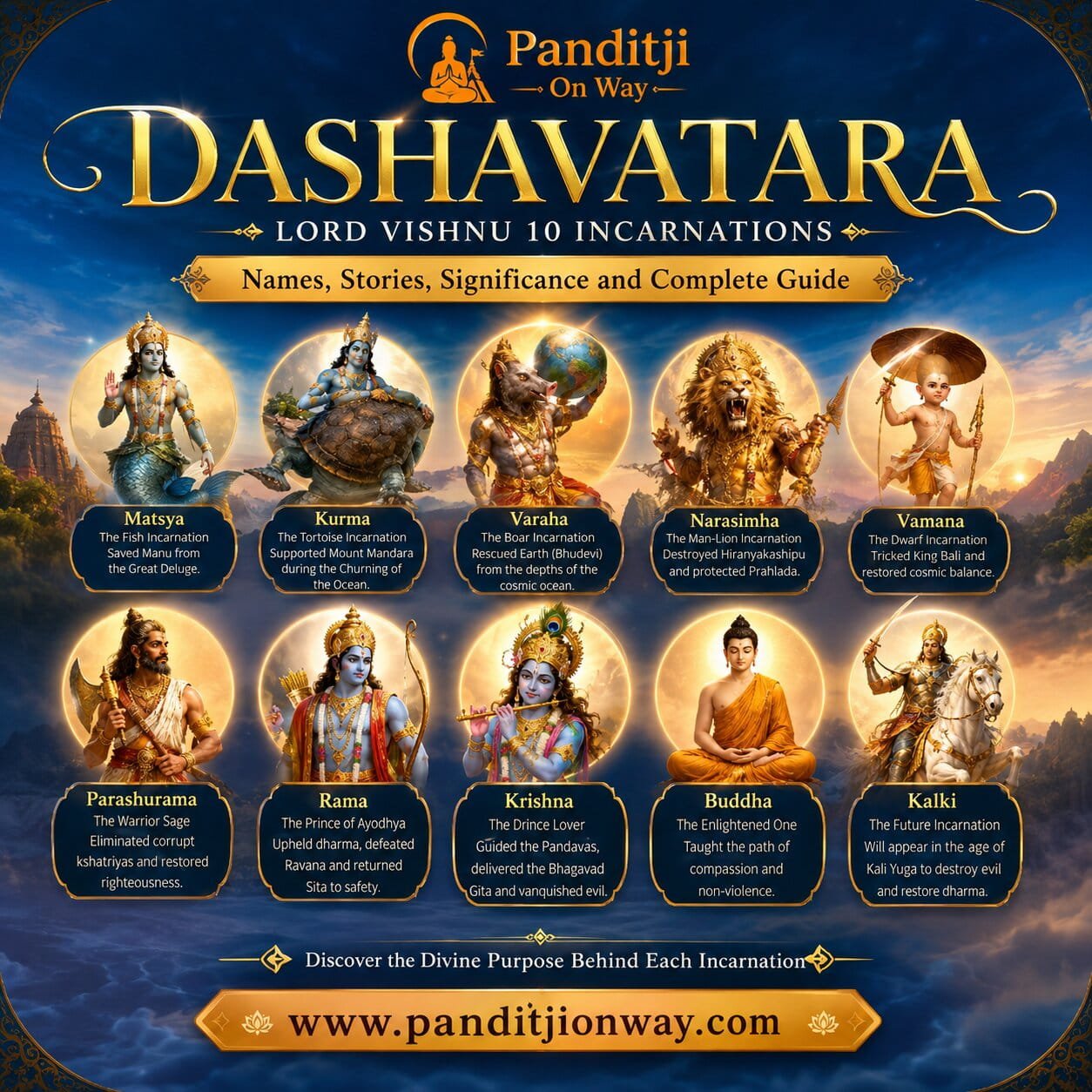
The ten celebrated incarnations of Lord Vishnu are collectively known as Dashavatara or Dashavatara of Vishnu. The Sanskrit word Dasha means “ten” and Avatara means “descent” or “incarnation.”
The commonly known Dashavatara includes Matsya, Kurma, Varaha, Narasimha, Vamana, Parashurama, Rama, Balarama, Krishna and Kalki. However, Dashavatara traditions are not completely uniform. In several traditions, Buddha appears in place of Balarama, making it important to mention the variation when presenting a comprehensive account.
This detailed guide explains the 10 avatars of Lord Vishnu, their stories, forms, significance, associated teachings, major places of worship and their role in Hindu religious tradition.
For devotees seeking traditional puja services, temple rituals, sankalp, havan and other religious services, Panditji on Way provides an online platform for pooja booking and related devotional services.
What is Dashavatara?
Dashavatara refers to the ten principal incarnations associated with Lord Vishnu in Hindu tradition. Each avatar is connected with a particular divine purpose, such as protecting creation, defeating destructive forces, restoring dharma or guiding humanity.
The ten forms discussed in this article are:
| No. | Avatar | Form | Major Purpose | Associated Theme |
|---|---|---|---|---|
| 1 | Matsya | Fish | Protection during cosmic flood | Preservation and knowledge |
| 2 | Kurma | Tortoise | Supporting Mount Mandara | Stability and support |
| 3 | Varaha | Boar | Rescuing Earth | Restoration |
| 4 | Narasimha | Man-Lion | Protecting Prahlada | Divine protection |
| 5 | Vamana | Dwarf/Brahmin | Restoring cosmic balance | Humility and dharma |
| 6 | Parashurama | Warrior Sage | Restraining oppressive rulers | Justice and discipline |
| 7 | Rama | Prince/King | Defeating Ravana and upholding dharma | Ideal conduct |
| 8 | Balarama | Divine Elder Brother | Strength and agricultural symbolism | Power and support |
| 9 | Krishna | Divine Cowherd/Teacher | Restoring dharma and guiding humanity | Dharma, devotion and wisdom |
| 10 | Kalki | Future Warrior | Ending the Kali Yuga cycle | Renewal and restoration |
The Bhagavata Purana describes numerous manifestations of the Lord rather than restricting divine incarnations to only ten. Therefore, Dashavatara is best understood as a particularly important traditional grouping of Vishnu’s incarnations.
The 10 Avatars of Lord Vishnu
1. Lord Matsya – The First Incarnation
Matsya Avatar is traditionally described as the fish incarnation of Lord Vishnu.
The word Matsya means fish. In the Matsya narrative, Vishnu appears in a fish form during a great cosmic deluge and protects the Vedas and important beings associated with the continuation of creation.
The Matsya story is closely associated with Manu, the righteous ancestor and lawgiver. In versions of the story, Manu is warned of the coming flood and is guided to preserve life and sacred knowledge.
The symbolism of Matsya is especially significant because water represents both destruction and the possibility of renewal.
Significance of Matsya Avatar
Matsya represents:
- Preservation of knowledge
- Protection during catastrophe
- Divine guidance
- Renewal after destruction
- Protection of creation
The Bhagavata Purana specifically narrates the Matsya incarnation and describes it as the Lord’s fish manifestation.
Matsya Avatar and Hindu Tradition
Matsya is therefore not simply a story about a divine fish. The deeper religious interpretation is that divine protection appears when creation faces overwhelming danger.
keywords: Matsya Avatar, Matsya incarnation of Vishnu, Lord Matsya story, first avatar of Vishnu.
2. Lord Kurma – The Second Incarnation
Kurma Avatar is the tortoise incarnation of Lord Vishnu.
The word Kurma means tortoise.
Kurma Avatar is primarily associated with the famous Samudra Manthan, or churning of the cosmic ocean. The Devas and Asuras sought the nectar of immortality, known as Amrita.
Mount Mandara was used as the churning rod, while Vasuki served as the rope. However, the mountain began sinking into the cosmic ocean.
Lord Vishnu appeared as the giant tortoise, Kurma, and supported Mount Mandara on his back.
Significance of Kurma Avatar
Kurma symbolizes:
- Stability
- Patience
- Support
- Endurance
- The foundation required for great achievements
The Kurma tradition specifically connects Vishnu’s tortoise form with supporting Mount Mandara during the churning of the ocean.
Spiritual Lesson of Kurma
The story teaches that major transformations require a stable foundation. The churning of the ocean can also be understood symbolically as the struggle between opposing forces that ultimately produces valuable results.
keywords: Kurma Avatar, Kurma incarnation, Samudra Manthan, Vishnu tortoise avatar, second avatar of Vishnu.
3. Lord Varaha – The Third Incarnation
Varaha Avatar is the boar incarnation of Lord Vishnu.
The Sanskrit word Varaha means boar.
According to the traditional story, the Earth, personified as Bhudevi, was submerged in the cosmic waters by the demon Hiranyaksha. Lord Vishnu appeared as Varaha and entered the waters to rescue the Earth.
Varaha lifted the Earth with his tusks and restored her to her proper place.
Why Did Vishnu Take the Varaha Avatar?
The Varaha incarnation represents divine intervention when the very foundation of worldly existence is threatened.
Significance of Varaha Avatar
Varaha symbolizes:
- Restoration of the Earth
- Protection of creation
- Strength
- Courage
- Triumph over destructive forces
The Varaha tradition is particularly important in Vaishnava worship, and temples dedicated to Varaha can be found in several parts of India.
Varaha and Bhudevi
Varaha is frequently depicted together with Bhudevi, representing the relationship between divine protection and the Earth.
keywords: Varaha Avatar, Lord Varaha story, Varaha incarnation of Vishnu, Bhudevi Varaha.
4. Lord Narasimha – The Fourth Incarnation
Narasimha Avatar is one of the most powerful and distinctive manifestations of Lord Vishnu.
Narasimha has the body of a human and the head of a lion. The name itself combines Nara, meaning human, and Simha, meaning lion.
The story is connected with the demon king Hiranyakashipu and his son Prahlada, one of the most famous devotees of Lord Vishnu.
Hiranyakashipu had received a boon that made him extremely difficult to defeat. He believed himself virtually invincible and opposed devotion to Vishnu.
Prahlada, however, remained devoted to Vishnu despite his father’s opposition.
How Did Narasimha Defeat Hiranyakashipu?
According to the traditional narrative, Vishnu appeared as Narasimha at twilight, neither fully human nor animal.
Hiranyakashipu was placed on Narasimha’s lap and killed at the threshold, using neither a conventional weapon nor under the ordinary circumstances protected by his boon.
The story demonstrates that divine intelligence can transcend apparently impossible conditions.
Significance of Narasimha Avatar
Narasimha represents:
- Protection of devotees
- Victory of dharma
- Destruction of arrogance
- Divine justice
- Fearlessness
- Faith under persecution
Narasimha and Prahlada
The relationship between Prahlada and Narasimha is one of the most important devotional narratives in Vaishnava literature.
It teaches that sincere devotion is not defeated by external circumstances.
keywords: Narasimha Avatar, Lord Narasimha story, Prahlada and Narasimha, Narasimha temple, fourth avatar of Vishnu.
5. Lord Vamana – The Fifth Incarnation
Vamana Avatar is the fifth incarnation in the Dashavatara sequence used in this article.
Vamana is traditionally depicted as a dwarf Brahmin.
The story is associated with King Mahabali, a powerful and generous Asura ruler.
Mahabali had gained immense influence and performed numerous acts of charity. Lord Vishnu appeared before him as Vamana and requested three paces of land.
Mahabali agreed.
Vamana then expanded into a cosmic form. With two steps, he covered the Earth and the heavens. Mahabali offered his own head for the third step.
What Does Vamana Avatar Represent?
Vamana represents:
- Humility
- Divine sovereignty
- The limits of material power
- Charity
- Surrender
- Restoration of cosmic balance
The story is especially important in Kerala, where Onam is traditionally associated with the annual return of King Mahabali.
Vamana Avatar and Mahabali
The story is not merely a conflict between good and evil. Mahabali is remembered in many traditions as a generous and devoted ruler whose encounter with Vamana ultimately becomes a story of humility, surrender and divine grace.
keywords: Vamana Avatar, Vamana and Mahabali, Lord Vishnu Vamana story, Vamana incarnation, Onam Mahabali.
6. Lord Parashurama – The Sixth Incarnation
Parashurama is traditionally described as a warrior sage and is the sixth avatar in this Dashavatara presentation.
His name means Rama with the axe, referring to the divine weapon known as the Parashu.
Parashurama was born to the sage Jamadagni and Renuka.
He is particularly associated with the struggle against rulers who had become oppressive and violated dharma.
Significance of Parashurama
Parashurama represents:
- Justice
- Discipline
- Courage
- Restraint of power
- Protection of dharma
- The responsibility associated with authority
Parashurama occupies a unique place because he is both a warrior and a sage.
Parashurama in the Ramayana Tradition
Parashurama is also associated with the story of Lord Rama. Their encounter after Rama breaks Shiva’s bow provides an important transition between two major manifestations of Vishnu in Hindu epic tradition.
Parashurama is also traditionally regarded as a Chiranjivi, one of the beings believed to continue living into the present age.
keywords: Parashurama Avatar, Lord Parashurama story, Parashurama incarnation, Parashurama and Rama.
7. Lord Rama – The Seventh Incarnation
Lord Rama is one of the most widely worshipped manifestations of Vishnu.
Rama is the central figure of the Ramayana, particularly the Valmiki Ramayana and its numerous regional and devotional retellings.
He was born in Ayodhya to King Dasharatha and Queen Kaushalya.
Rama is celebrated as Maryada Purushottama, the ideal person who demonstrates righteousness, duty, truth and ethical conduct.
Why Did Lord Vishnu Take the Rama Avatar?
The Rama narrative is associated with the defeat of Ravana, the ruler of Lanka, and the restoration of dharma.
Rama’s life includes:
- His exile from Ayodhya
- His relationship with Sita
- His brotherhood with Lakshmana
- His friendship with Hanuman
- The search for Sita
- The alliance with Sugriva
- The battle with Ravana
- His return to Ayodhya
Significance of Lord Rama
Rama represents:
- Dharma
- Truth
- Duty
- Ideal kingship
- Family responsibility
- Moral courage
- Leadership
Major Places Associated with Lord Rama
Important Rama-related pilgrimage traditions include:
- Ayodhya
- Chitrakoot
- Nashik
- Rameswaram
- Janakpur
- Hampi and Kishkindha-associated traditions
For devotees planning religious services around Ayodhya, Ram Navami, puja, havan or other Hindu rituals, online pooja booking can provide a convenient way to arrange traditional ceremonies.
keywords: Lord Rama Avatar, Rama seventh avatar, Lord Rama story, Ramayana, Rama temple, Ram Navami.
8. Lord Balarama – The Eighth Incarnation
In the Dashavatara sequence used in this article, Balarama is the eighth avatar.
Balarama is the elder brother of Lord Krishna and is one of the most important figures in Krishna traditions.
He is traditionally associated with the plough, making him strongly connected with agriculture, strength and the fertility of the land.
Balarama and Krishna
Balarama and Krishna grew up together in the pastoral environment of Vraja.
Balarama is often portrayed as Krishna’s elder brother, protector and companion.
Significance of Balarama
Balarama symbolizes:
- Physical and spiritual strength
- Agriculture
- Support
- Loyalty
- Protection
- Discipline
Important Note About the Dashavatara List
Not every Hindu tradition lists Balarama as the eighth Dashavatara.
A major alternative list places Buddha among the ten avatars and does not include Balarama. Therefore, when writing about the Dashavatara, it is useful to identify the tradition or list being followed rather than claiming that every Hindu scripture gives exactly the same ten names.
This distinction makes the article more accurate and useful for readers searching for “Balarama vs Buddha Dashavatara.”
keywords: Balarama Avatar, Lord Balarama, Balarama Krishna, eighth avatar of Vishnu, Balarama Dashavatara.
9. Lord Krishna – The Ninth Incarnation
Lord Krishna is among the most widely revered figures in Hinduism and is central to the Bhagavata Purana, Mahabharata and Bhagavad Gita traditions.
In the Dashavatara sequence used here, Krishna is the ninth incarnation.
Krishna was born in Mathura to Devaki and Vasudeva. Due to the threat posed by King Kamsa, he was taken to Gokul and raised in the pastoral community of Vraja.
His life is associated with numerous celebrated episodes, including:
- Childhood pastimes in Gokul and Vrindavan
- His relationship with Yashoda and Nanda
- Govardhan
- Kamsa’s defeat
- Mathura
- Dwarka
- The Mahabharata
- The Bhagavad Gita
Krishna as Teacher of the Bhagavad Gita
One of Krishna’s most important philosophical roles appears in the Bhagavad Gita, where he guides Arjuna on the battlefield of Kurukshetra.
The Gita discusses major spiritual themes including:
- Dharma
- Karma
- Bhakti
- Jnana
- Self-discipline
- Detachment
- Liberation
Significance of Krishna
Krishna represents:
- Divine love
- Wisdom
- Dharma
- Bhakti
- Compassion
- Spiritual knowledge
- The relationship between the individual soul and the Divine
Major Krishna Pilgrimage Places
Important Krishna pilgrimage destinations include:
- Mathura
- Vrindavan
- Gokul
- Govardhan
- Barsana
- Nandgaon
- Dwarka
- Kurukshetra
Krishna Janmashtami is one of the most important Hindu festivals associated with Krishna.
keywords: Krishna Avatar, Lord Krishna ninth avatar, Krishna story, Krishna Janmashtami, Krishna temples, Bhagavad Gita.
10. Lord Kalki – The Tenth Avatar
Kalki is traditionally described as the future incarnation of Lord Vishnu.
Unlike Matsya, Kurma, Varaha, Narasimha, Vamana, Parashurama, Rama, Balarama and Krishna, Kalki is traditionally understood as an avatar who is yet to appear.
According to Hindu cosmological traditions, Kalki will appear at the end of the Kali Yuga.
He is generally depicted as a warrior riding a white horse and carrying a sword.
What is the Purpose of Kalki Avatar?
Kalki represents:
- Destruction of adharma
- End of a dark phase
- Restoration of righteousness
- Renewal of cosmic order
- Transition to a new age
The Kalki concept therefore completes the Dashavatara narrative with the theme of renewal.
Kalki and the Kali Yuga
The Kali Yuga is traditionally described as the final age in the current four-age cycle.
The appearance of Kalki is associated with the conclusion of Kali Yuga and the beginning of a new Satya Yuga.
keywords: Kalki Avatar, Kalki Vishnu, tenth avatar of Vishnu, Kalki story, Kalki at the end of Kali Yuga.
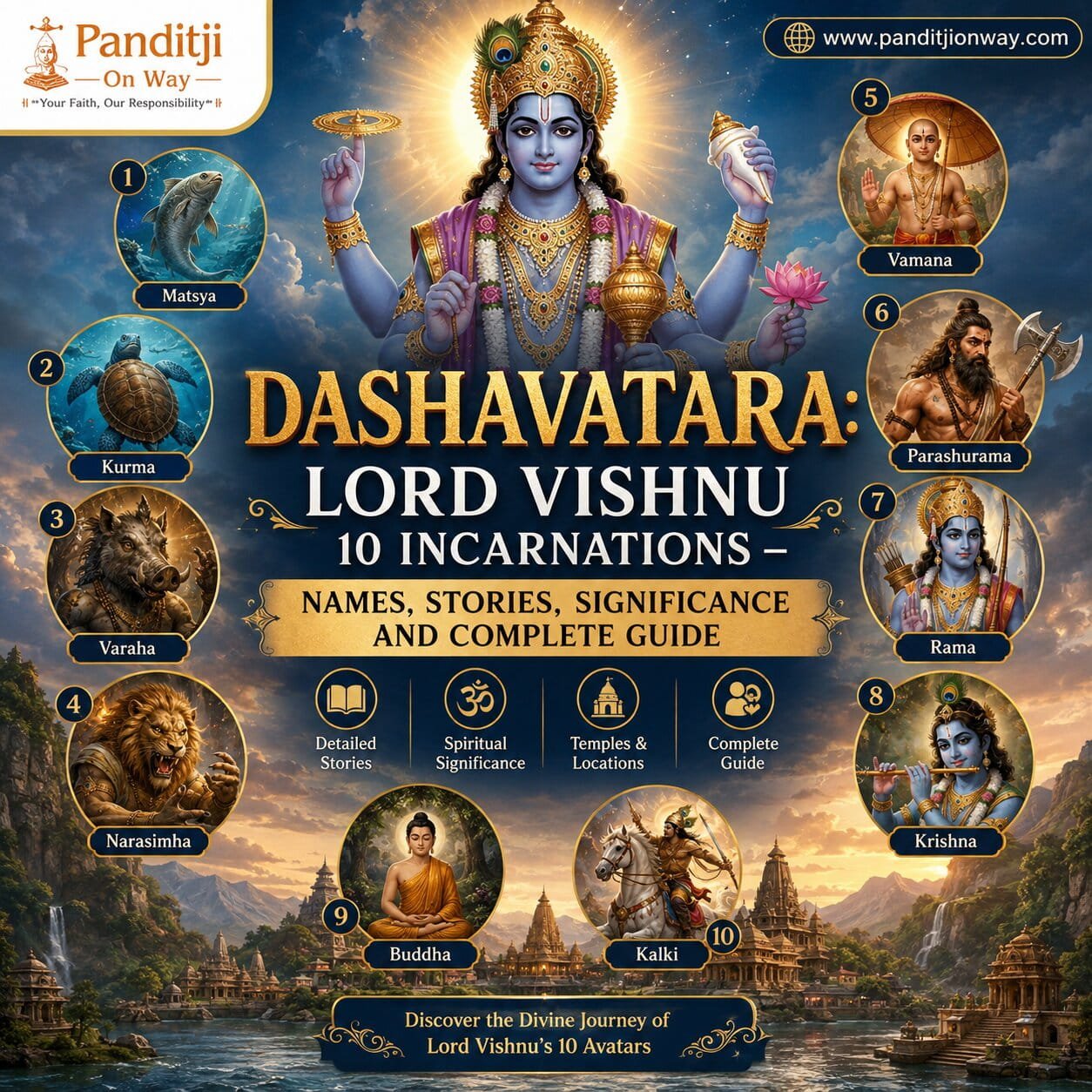
Dashavatara List at a Glance
| Rank | Lord Vishnu Avatar | Sanskrit Name | Form | Main Symbolism |
|---|---|---|---|---|
| 1 | Matsya | मत्स्य | Fish | Preservation |
| 2 | Kurma | कूर्म | Tortoise | Stability |
| 3 | Varaha | वराह | Boar | Restoration |
| 4 | Narasimha | नरसिंह | Man-Lion | Protection |
| 5 | Vamana | वामन | Dwarf Brahmin | Humility |
| 6 | Parashurama | परशुराम | Warrior Sage | Justice |
| 7 | Rama | राम | Prince/King | Dharma |
| 8 | Balarama | बलराम | Divine Elder Brother | Strength |
| 9 | Krishna | कृष्ण | Divine Teacher | Wisdom and Bhakti |
| 10 | Kalki | कल्कि | Future Warrior | Renewal |
Dashavatara and the Evolution of Forms
One popular modern interpretation observes that the Dashavatara sequence moves through aquatic, amphibious, animal, human-animal and human forms.
A simplified symbolic progression is sometimes presented as:
Matsya → Kurma → Varaha → Narasimha → Vamana → Parashurama → Rama → Balarama → Krishna → Kalki
Some writers compare this sequence with biological evolution. However, this should be presented as a modern interpretive analogy, not as a claim that ancient Hindu texts were presenting Darwinian evolutionary theory.
The traditional religious meaning is primarily concerned with divine manifestations and the restoration of dharma.
Why Does Lord Vishnu Take Different Avatars?
The fundamental idea behind Vishnu’s avatars is that divine intervention takes an appropriate form according to the needs of the world.
The avatars demonstrate different dimensions of divine action.
Matsya protects knowledge and life.
Kurma provides support.
Varaha restores the Earth.
Narasimha protects a devotee and destroys tyranny.
Vamana restores cosmic balance.
Parashurama restrains destructive power.
Rama establishes the ideal of righteous conduct.
Balarama represents strength and support.
Krishna teaches dharma and spiritual wisdom.
Kalki represents the ultimate restoration of righteousness at the end of the age.
What is the Main Message of Dashavatara?
The central message of Dashavatara can be understood through the principle of dharma.
Dharma represents righteousness, order, duty and the principles that sustain life and society.
The avatars show that when disorder becomes dominant, divine power manifests to restore balance.
Therefore, Dashavatara is not simply a list of ten mythological characters. It is a major religious framework for understanding:
- Dharma and adharma
- Divine protection
- Cosmic order
- Devotion
- Justice
- Spiritual transformation
- Renewal
Dashavatara in Hindu Scriptures
The idea of Vishnu’s incarnations appears across several Hindu scriptures and traditions.
Important textual sources associated with Vishnu’s avatars include:
- Bhagavata Purana
- Vishnu Purana
- Matsya Purana
- Harivamsa
- Mahabharata
- Ramayana
- Various Vaishnava theological texts
The Bhagavata Purana contains extensive material concerning Vishnu and his incarnations and describes many manifestations rather than limiting the Lord’s incarnations to only ten.
This is one reason different Dashavatara lists can be found across Hindu traditions.(Incredible India)
Balarama or Buddha: Which One is the Eighth/Ninth Dashavatara?
This is one of the most common questions about Dashavatara.
The answer is that different traditions use different lists.
One commonly circulated traditional list includes:
Matsya, Kurma, Varaha, Narasimha, Vamana, Parashurama, Rama, Balarama, Krishna and Kalki.
Another well-known list includes:
Matsya, Kurma, Varaha, Narasimha, Vamana, Parashurama, Rama, Krishna, Buddha and Kalki.
Therefore, websites should avoid presenting the Balarama version as the only universally accepted list.
For a comprehensive article, the best approach is to mention both traditions and explain the variation.
Famous Temples and Pilgrimage Places Associated with Dashavatara
Dashavatara worship is spread throughout India and across Vaishnava traditions.
Some important places associated with individual avatars include:
| Avatar | Important Associated Places |
|---|---|
| Matsya | Traditional Matsya worship sites and Vaishnava pilgrimage traditions |
| Kurma | Srikurmam, Andhra Pradesh |
| Varaha | Tirumala/Varaha traditions and Varaha temples |
| Narasimha | Ahobilam, Yadadri and other Narasimha temples |
| Vamana | Kerala and Vamana-Mahabali traditions |
| Parashurama | Konkan, Kerala and associated pilgrimage traditions |
| Rama | Ayodhya, Chitrakoot, Rameswaram |
| Balarama | Braj and other Vaishnava traditions |
| Krishna | Mathura, Vrindavan, Gokul, Govardhan, Dwarka |
| Kalki | Future manifestation; Kalki traditions and temples are associated with his expected appearance |
These associations can vary by regional tradition, scripture and sect.
Dashavatara and Festivals
The avatars of Vishnu are celebrated through numerous Hindu festivals and religious observances.
| Avatar | Major Festival/Observance |
|---|---|
| Matsya | Matsya Jayanti |
| Kurma | Kurma-related worship and Vaishnava observances |
| Varaha | Varaha Jayanti |
| Narasimha | Narasimha Jayanti |
| Vamana | Vamana Jayanti and Onam-related Mahabali traditions |
| Parashurama | Parashurama Jayanti |
| Rama | Ram Navami |
| Balarama | Balarama Jayanti |
| Krishna | Krishna Janmashtami |
| Kalki | Future avatar; no historical birth festival |
Dashavatara Puja and Religious Services
Devotees may perform Vishnu-related puja, Vishnu Sahasranama recitation, Satyanarayan Puja, Narasimha Puja, Krishna Puja, Rama worship and other Vaishnava rituals according to their family tradition and spiritual purpose.
When a devotee cannot personally visit a temple or arrange a priest, online pooja booking can make it easier to organize traditional religious ceremonies.
Panditji on Way is an online pooja booking platform offering devotees a convenient way to arrange religious services, puja, havan and other traditional ceremonies.
For festival-specific rituals, devotees should select the puja according to the relevant deity, tithi, sankalp and family tradition.
Dashavatara vs Other Avatars of Lord Vishnu
A common misconception is that Vishnu has only ten avatars.
The term Dashavatara specifically refers to a group of ten celebrated incarnations.
Hindu scriptures describe many more forms and incarnations of Vishnu.
The Bhagavata Purana, for example, discusses numerous divine incarnations and manifestations.
Therefore:
Dashavatara = a traditional group of ten important avatars
It does not necessarily mean:
Vishnu has only ten manifestations.
This distinction is important for anyone studying Vaishnavism and Hindu scriptures.
Dashavatara Symbolism
The ten avatars can also be studied as a sequence of spiritual and ethical themes.
| Avatar | Symbolic Teaching |
|---|---|
| Matsya | Protect knowledge and life |
| Kurma | Build a stable foundation |
| Varaha | Restore what has been damaged |
| Narasimha | Protect devotion and oppose tyranny |
| Vamana | Remain humble despite power |
| Parashurama | Restrain misuse of authority |
| Rama | Follow dharma and responsibility |
| Balarama | Develop strength and discipline |
| Krishna | Seek wisdom and devotion |
| Kalki | Believe in renewal and restoration |
This makes Dashavatara relevant not only as mythology but also as a framework for religious reflection.
Frequently Asked Questions About Dashavatara
What is Dashavatara?
Dashavatara means the ten principal or celebrated incarnations of Lord Vishnu. The word comes from Sanskrit Dasha, meaning ten, and Avatara, meaning incarnation or descent.
What are the 10 avatars of Lord Vishnu?
The list used in this article is Matsya, Kurma, Varaha, Narasimha, Vamana, Parashurama, Rama, Balarama, Krishna and Kalki.
Who is the first avatar of Vishnu?
Matsya, the fish incarnation, is traditionally regarded as the first avatar in the Dashavatara sequence.
Who is the second avatar of Vishnu?
Kurma, the tortoise incarnation, is traditionally regarded as the second Dashavatara.
Who is the third avatar of Vishnu?
Varaha, the boar incarnation, is traditionally regarded as the third avatar.
Who is the fourth avatar of Vishnu?
Narasimha, the man-lion incarnation, is traditionally regarded as the fourth avatar.
Who is the fifth avatar of Vishnu?
Vamana, the dwarf Brahmin incarnation, is traditionally regarded as the fifth avatar.
Who is the sixth avatar of Vishnu?
Parashurama is traditionally regarded as the sixth avatar.
Who is the seventh avatar of Vishnu?
Lord Rama is traditionally regarded as the seventh avatar in the Dashavatara sequence.
Who is the eighth avatar of Vishnu?
In the Balarama tradition used here, Balarama is the eighth avatar. Other traditions place Buddha in the Dashavatara list instead.
Who is the ninth avatar of Vishnu?
In the sequence used in this article, Krishna is the ninth avatar. Other Dashavatara traditions may arrange the names differently.
Who is the tenth avatar of Vishnu?
Kalki is traditionally described as the tenth and future avatar of Vishnu.
Is Kalki Avatar born yet?
According to traditional Hindu cosmology, Kalki is a future incarnation associated with the end of Kali Yuga.
Why did Lord Vishnu take ten avatars?
The avatars are traditionally understood as manifestations through which Vishnu protects creation, restores dharma and removes forces that threaten cosmic order.
Is Buddha one of the Dashavatara?
Yes, in several widely known Dashavatara traditions Buddha is included among the ten avatars. Other traditions include Balarama instead.
Is Balarama an avatar of Vishnu?
Balarama is revered as a divine manifestation in Vaishnava traditions, and some Dashavatara lists include him among Vishnu’s ten avatars.
Which Purana describes Vishnu’s avatars?
Several Puranic texts discuss Vishnu’s incarnations, particularly the Bhagavata Purana and Vishnu Purana. The Bhagavata Purana contains extensive accounts of divine incarnations.
Which avatar of Vishnu killed Hiranyakashipu?
Lord Narasimha killed Hiranyakashipu and protected his devotee Prahlada.
Which avatar of Vishnu rescued the Earth?
Lord Varaha rescued the Earth in the traditional Varaha narrative.
Which avatar supported Mount Mandara?
Lord Kurma supported Mount Mandara during the Samudra Manthan.
Which avatar is associated with Mahabali?
Lord Vamana is closely associated with King Mahabali.
Which avatar is associated with Ravana?
Lord Rama is the Vishnu avatar associated with the defeat of Ravana in the Ramayana tradition.
Which avatar gave the teachings of the Bhagavad Gita?
Lord Krishna delivered the teachings of the Bhagavad Gita to Arjuna.
Conclusion: Understanding the Dashavatara of Lord Vishnu
The Dashavatara of Lord Vishnu is one of the most important concepts in Hindu religious tradition.
From Matsya, who protects during the great flood, to Kurma, who provides the foundation for the churning of the ocean; from Varaha, who restores the Earth, to Narasimha, who protects Prahlada; from Vamana, who restores cosmic balance, to Parashurama, who restrains destructive power; from Rama, the embodiment of righteous conduct, to Balarama and Krishna, and finally Kalki, the future restorer of dharma, the Dashavatara presents a powerful vision of divine protection and renewal.
The central teaching remains the restoration of dharma whenever cosmic and moral order is threatened.
For devotees interested in performing Vishnu Puja, Narasimha Puja, Krishna Puja, Rama Puja, Satyanarayan Puja, havan and other Hindu rituals, Panditji on Way provides online pooja booking services designed to help devotees arrange traditional ceremonies conveniently.
Dashavatara is therefore not simply a list of ten names. It is a living part of Hindu theology, scripture, pilgrimage, festivals, art, temple traditions and devotional practice.
About Panditji on Way
Panditji on Way is an online pooja booking platform connecting devotees with traditional Hindu religious services. The platform can be used for arranging puja, havan, religious ceremonies and other devotional services according to the devotee’s requirements.
For readers exploring Hindu festivals, puja vidhi, tithi, vrat, temples and spiritual traditions, Panditji on Way can also serve as a dedicated resource for learning and arranging religious services.