

Rudrabhishek Puja Guide: Mantra, Vidhi, Samagri, Benefits, Cost & Best Time
Learn Rudrabhishek Puja Guide, Vidhi, Mantra, Samagri, Benefits, Best Time, Cost and FAQs. Complete guide to Shiva Abhishek, Sri Rudram and booking a Pandit in India.
Rudrabhishek Puja is one of the most revered forms of Shiva worship in the Hindu tradition. The ritual involves offering sacred substances to a Shiva Lingam while reciting Vedic mantras, particularly Rudra-related prayers and, according to the tradition followed, Sri Rudram or Rudra Sukta.
For devotees, Rudrabhishek is a deeply devotional practice associated with prayer for peace, spiritual purification, health, prosperity, protection and the removal of obstacles. The exact procedure, mantras, offerings and number of priests can vary according to the Vedic tradition, family custom, temple practice and purpose of the puja.
The Vedic Heritage Portal of the Government of India places the relevant Rudra traditions within the Yajurveda corpus, including the Taittiriya Samhita and other Yajurvedic traditions. This makes it important to distinguish a traditional Vedic Rudrabhishek from a simplified home Shiva Abhishek.
Panditji on Way helps devotees arrange Rudrabhishek Puja with experienced Pandits, puja samagri and location-based services across India.

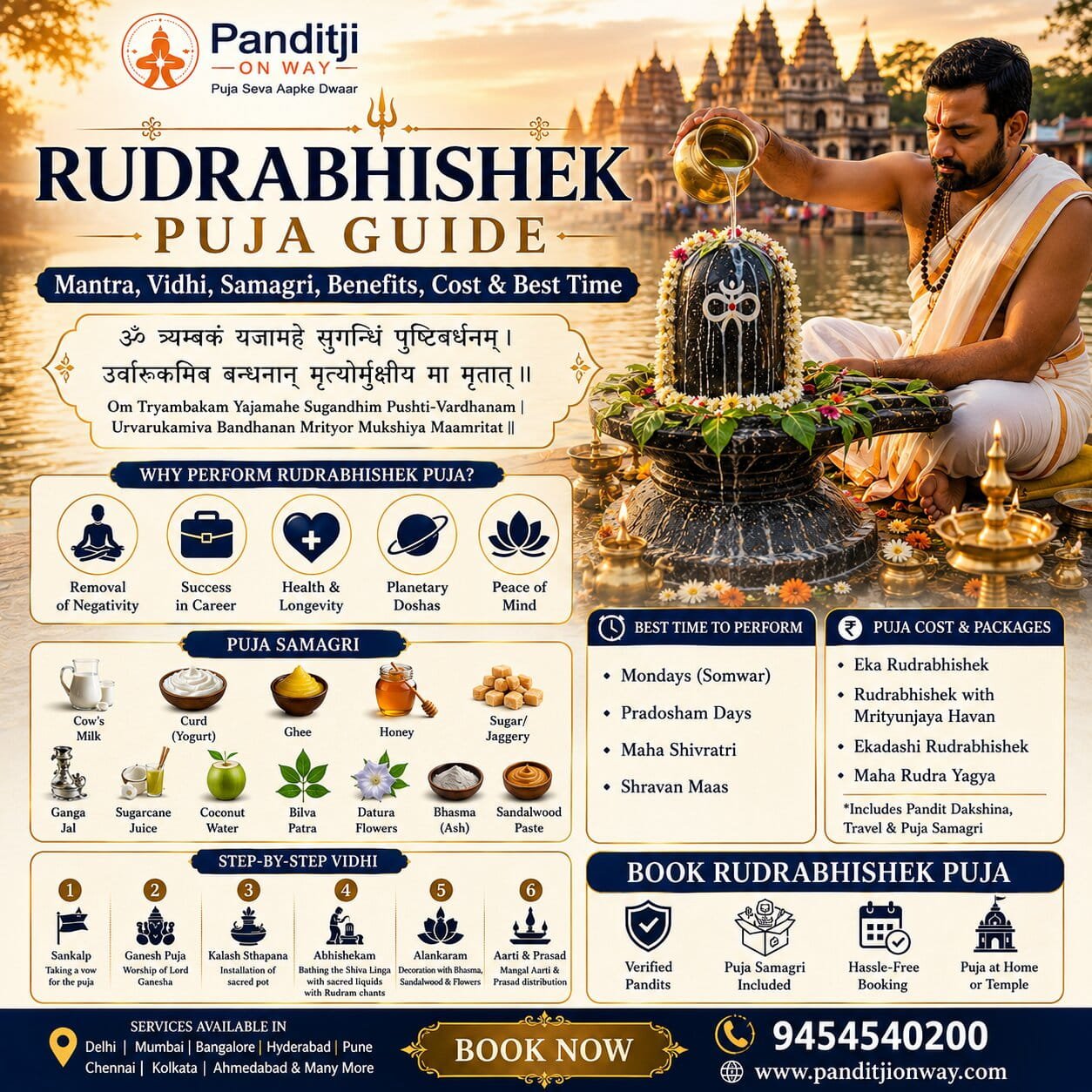
Quick Answer: What Is Rudrabhishek Puja?
Rudrabhishek Puja is a Vedic Shiva worship ritual in which the Shiva Lingam is ceremonially bathed with sacred offerings while Shiva mantras and, in more elaborate forms, Rudram recitations are performed.
The word Rudrabhishek combines:
- Rudra – a Vedic name and form associated with Lord Shiva
- Abhishek – ceremonial bathing or anointing of a deity
The central purpose is devotional worship of Lord Shiva. Depending on the tradition and the devotee’s intention, the puja may include Sankalp, Ganesh Puja, Kalash Sthapana, Shiva Abhishek, Rudram chanting, Bilva Patra Archana, Shiva Ashtottara or Sahasranama, Aarti, Havan and Prasad.
Rudrabhishek Puja Mantra
One of the most widely recited Shiva mantras associated with Rudrabhishek is the Maha Mrityunjaya Mantra:
ॐ त्र्यम्बकं यजामहे सुगन्धिं पुष्टिवर्धनम् ।
उर्वारुकमिव बन्धनान् मृत्योर्मुक्षीय मामृतात् ॥
Om Tryambakam Yajamahe Sugandhim Pushtivardhanam
Urvarukamiva Bandhanan Mrityor Mukshiya Maamritat
The mantra is traditionally associated with prayer for liberation, protection and freedom from the fear of death. It is often included in Shiva worship and may be combined with Rudram chanting depending on the form of puja being performed.
Panchakshari Shiva Mantra
Another foundational Shiva mantra is:
ॐ नमः शिवाय
Om Namah Shivaya
This five-syllable mantra, known as the Panchakshari Mantra, is commonly recited during Shiva Puja, meditation, Abhishek and daily worship.
Sri Rudram
In a more elaborate Rudrabhishek, the chanting of Sri Rudram, including the Namakam and Chamakam, may form an important part of the ceremony.
The Vedic Heritage Portal identifies Rudra-related material within the Yajurvedic tradition, including the Taittiriya Samhita and other Yajurveda Samhitas.
Why Is Rudrabhishek Puja Performed?
Rudrabhishek is traditionally performed as an act of devotion and prayer to Lord Shiva. Different devotees undertake the ritual for different spiritual intentions.
1. Spiritual Purification
Devotees believe that sincere Shiva worship helps purify the mind, encourage self-discipline and create a peaceful spiritual environment.
2. Peace and Mental Well-Being
The repetitive chanting of Shiva mantras and the structured nature of the puja can provide a focused devotional practice and a sense of calm.
3. Removal of Obstacles
In Hindu devotional tradition, Lord Shiva is worshipped for overcoming difficulties and seeking divine guidance during challenging periods.
4. Health and Longevity
The Maha Mrityunjaya Mantra is traditionally associated with prayer for protection, healing and longevity.
This should be understood as a religious and devotional belief, not as a substitute for medical diagnosis or treatment.
5. Prosperity and Stability
Devotees may perform Rudrabhishek while praying for prosperity, stability, success in work and harmony within the family.
6. Planetary and Astrological Remedies
In many Hindu astrological traditions, Shiva worship is recommended as a spiritual remedy for certain perceived planetary influences or doshas. The exact recommendation should depend on the individual’s horoscope and the tradition followed by the Pandit or astrologer.
Rudrabhishek Puja Samagri List
The exact samagri varies according to the type of Rudrabhishek and regional tradition.
Essential Rudrabhishek Samagri
| Puja Samagri | Traditional Use |
|---|---|
| Clean Water | Jal Abhishek |
| Gangajal | Sacred water offering |
| Cow’s Milk | Abhishek |
| Curd | Panchamrit and Abhishek |
| Ghee | Panchamrit and ritual offering |
| Honey | Panchamrit and Abhishek |
| Sugar or Mishri | Panchamrit |
| Panchamrit | Sacred bathing offering |
| Sugarcane Juice | Used in some traditions |
| Coconut Water | Used according to ritual tradition |
| Bilva Patra | Important Shiva offering |
| Fresh Flowers | Decoration and offering |
| Sandalwood Paste | Tilak and Alankaram |
| Bhasma/Vibhuti | Traditional Shiva offering |
| Dhoop | Ritual purification |
| Camphor | Aarti |
| Incense | Puja offering |
| Diya | Aarti |
| Fruits | Naivedya |
| Coconut | Offering |
| Betel Nut | Puja offering |
| Kalash | Kalash Sthapana |
| Mauli/Kalava | Sacred thread |
| Akshata | Ritual offering |
| Rudraksha Mala | Japa |
Important: Not every item is required for every Rudrabhishek. A qualified Pandit should determine the samagri according to the specific puja procedure.
Panchamrit for Rudrabhishek
Panchamrit traditionally refers to a sacred mixture prepared using five principal ingredients.
A commonly used combination is:
- Milk
- Curd
- Ghee
- Honey
- Sugar
The exact preparation can vary by region and tradition.
For a home puja, devotees should follow the instructions of their family tradition, temple or Pandit rather than assuming that every Rudrabhishek requires the same ingredients.
Rudrabhishek Puja Vidhi: Step-by-Step Procedure
The detailed procedure varies between traditions, but a typical ceremony may follow this sequence.
Step 1: Preparation and Shuddhikaran
The puja area is cleaned and prepared. The devotee and Pandit traditionally undertake purification practices before beginning the ceremony.
Step 2: Sankalp
The devotee makes a Sankalp, stating the purpose of the puja, such as spiritual well-being, family peace, prosperity, a new beginning or another personal prayer.
Step 3: Ganesh Puja
Lord Ganesha is worshipped before the principal ritual as part of the traditional opening of many Hindu pujas.
Step 4: Kalash Sthapana
A Kalash is established and invoked according to the ritual tradition being followed.
Step 5: Shiva Avahan
The puja proceeds with invocation and worship of Lord Shiva.
Step 6: Shiva Lingam Abhishek
This is the central part of Rudrabhishek.
The Shiva Lingam may be offered:
- Water
- Gangajal
- Milk
- Curd
- Ghee
- Honey
- Sugar/Panchamrit
- Coconut water
- Sugarcane juice
- Other offerings prescribed by the ritual tradition
Mantras are recited throughout the Abhishek.
Step 7: Sri Rudram or Rudra Mantra Chanting
For a traditional Vedic Rudrabhishek, the Pandit may chant Sri Rudram, Rudra Sukta or other prescribed Shiva mantras.
The number of recitations depends on the type of Rudra ritual.
Step 8: Bilva Patra Archana
Bilva leaves are offered to Lord Shiva with appropriate mantras.
Fresh and clean Bilva Patra should be used according to the customary rules of the tradition being followed.
Step 9: Shiva Alankaram
After Abhishek, the Shiva Lingam may be decorated with sandalwood, Bhasma/Vibhuti, flowers and other permitted offerings.
Step 10: Aarti
The puja concludes with Shiva Aarti and devotional prayers.
Step 11: Prasad and Blessings
Prasad is distributed and the devotee receives the blessings of the Pandit.
Types of Rudrabhishek Puja
Rudrabhishek is not a single standardized package. Different traditions use different names and levels of recitation.
Eka Rudram
A comparatively smaller Rudra ritual generally performed with one Pandit, depending on the prescribed procedure.
Ekadasha Rudram
An elaborate form involving repeated Rudram recitation. The exact number of priests and sequence can vary by tradition.
Maha Rudra
A larger-scale Vedic ritual involving multiple Pandits and repeated Rudram chanting.
Rudrabhishek with Havan
The Abhishek may be followed by a Havan when the chosen ritual package includes an Agni ceremony.
Rudrabhishek with Maha Mrityunjaya Jaap
This combines Shiva Abhishek with repeated recitation of the Maha Mrityunjaya Mantra.
Before booking, ask the Pandit exactly which mantras, recitations, number of priests, Havan and samagri are included.
Best Time to Perform Rudrabhishek Puja
Rudrabhishek can be performed throughout the year. However, certain occasions are traditionally considered especially suitable for Shiva worship.
Monday
Monday, or Somvar, is traditionally associated with Lord Shiva and is a popular day for Shiva Puja.
Pradosh
Pradosh refers to the worship period associated with the Trayodashi Tithi, particularly the evening period. Many devotees consider Pradosh an auspicious occasion for Shiva worship.
Maha Shivratri
Maha Shivratri is one of the most important annual occasions for Lord Shiva worship.
Masik Shivratri
Monthly Shivratri observances are also used by devotees for Shiva Puja.
Shravan Maas
The month of Shravan is particularly associated with Shiva worship in many Hindu traditions.
Personal Muhurat
For a specific purpose, some devotees consult a Vedic astrologer or Pandit to determine an appropriate Tithi, Nakshatra or Muhurat.
Rudrabhishek Puja Benefits
The benefits attributed to Rudrabhishek should be understood within the framework of Hindu faith and devotional practice.
Traditionally, devotees perform Rudrabhishek with prayers for:
- Spiritual purification
- Peace of mind
- Family harmony
- Protection and well-being
- Health and longevity
- Prosperity
- Success in important undertakings
- Removal of perceived obstacles
- Relief from fear and anxiety through devotion
- Strength during difficult periods
- Positive spiritual discipline
- Divine blessings of Lord Shiva
Rudrabhishek should not be presented as a guaranteed treatment for disease, financial loss, infertility, mental-health conditions or other medical or legal problems. Religious practice can complement a person’s spiritual life, but professional medical, financial or legal advice should be sought where appropriate.
Rudrabhishek for Health and Longevity
One of the most common reasons devotees perform Rudrabhishek is to pray for health and longevity.
The Maha Mrityunjaya Mantra is especially associated with this devotional intention.
However, it is important to distinguish spiritual prayer from medical treatment. A Rudrabhishek may be performed as an expression of faith, hope and prayer, while a person experiencing a health problem should continue appropriate medical care.
Rudrabhishek for Career, Business and Prosperity
Devotees may perform Shiva Puja before:
- Starting a new business
- Beginning a new job
- Making an important professional transition
- Facing prolonged obstacles
- Seeking stability and clarity
- Starting a major project
The puja is traditionally viewed as a spiritual practice for seeking divine blessings and inner strength rather than a guaranteed financial outcome.
Rudrabhishek for Graha Dosha
Some Vedic astrology traditions recommend Shiva worship for specific planetary conditions.
Depending on the horoscope, a Pandit or astrologer may recommend:
- Rudrabhishek
- Maha Mrityunjaya Jaap
- Shiva Puja
- Rudra Havan
- Navagraha Shanti
- Specific mantra Japa
There is no single remedy appropriate for every horoscope. A personalized recommendation should be based on the actual birth chart and the astrological tradition being followed.
Which Flowers Should Not Be Offered to Lord Shiva?
The traditional rules regarding flowers differ across regional and textual traditions.
A widely followed Hindu tradition discourages offering Ketaki/Kewda to Lord Shiva because of the well-known Puranic story associated with the flower.
Some traditions also avoid Champaka/Champa in Shiva worship.
Because regional customs can differ, devotees should follow the practice prescribed by their temple, family tradition or knowledgeable Pandit.
Can Women Perform Rudrabhishek Puja?
Yes.
Women can participate in Shiva worship and Rudrabhishek according to the customs of their family, temple and religious tradition.
There is no need to assume that Rudrabhishek is exclusively a male ritual.
Specific temple rules may differ, particularly regarding who may directly perform Abhishek inside a sanctum. Those rules should always be respected.
Can Rudrabhishek Be Performed at Home?
Yes, a simple Shiva Abhishek can be performed at home.
However, a full Vedic Rudrabhishek involving Sri Rudram, Namakam, Chamakam, Sankalp, Kalash Puja, specific recitation counts and Havan is better performed under the guidance of a knowledgeable Pandit.
For a home ceremony, keep the puja area clean and peaceful and use only the offerings appropriate to your tradition.
Rudrabhishek at Home: Basic Procedure
For a simple home Shiva Abhishek:
- Clean the puja area.
- Take a Sankalp.
- Invoke Lord Ganesha.
- Place the Shiva Lingam appropriately.
- Offer clean water.
- Offer Gangajal if available.
- Offer Panchamrit or other prescribed substances.
- Offer Bilva Patra.
- Chant Om Namah Shivaya.
- Recite the Maha Mrityunjaya Mantra if desired.
- Offer flowers and perform Aarti.
- Pray for the well-being of yourself and your family.
For a full Vedic ceremony, consult a qualified Pandit rather than improvising the complete ritual.
Rudrabhishek Puja Cost in India
The cost of Rudrabhishek varies considerably according to:
- City
- Number of Pandits
- Duration
- Type of Rudra recitation
- Number of mantra repetitions
- Havan requirements
- Puja samagri
- Travel
- Venue
- Personalized Muhurat
- Scale of the ceremony
For this reason, there is no single nationwide Rudrabhishek price.
Panditji on Way currently lists Rudra Abhishek Puja packages with different options, and the published product page shows a range of approximately ₹3,700 to ₹17,600, depending on the selected package. Always verify the current package, inclusions and price before booking.
What Should Be Included in the Price?
Before booking, confirm whether the quoted price includes:
| Service | What to Check |
|---|---|
| Pandit Dakshina | Included or additional? |
| Puja Samagri | Complete or partial? |
| Travel | Included within city limits? |
| Muhurat | Personalized or standard? |
| Mantra Jaap | Number of repetitions |
| Sri Rudram | Included or optional? |
| Havan | Included or additional? |
| Duration | Approximate ceremony length |
| Number of Pandits | One or multiple? |
| Prasad | Included or not? |
This makes it easier to compare Rudrabhishek packages fairly.
Booking Rudrabhishek with Panditji on Way
Finding the right Pandit is important when the ceremony involves Vedic chanting.
Panditji on Way provides Rudra Abhishek Puja services with options that include Pandit arrangements, puja samagri and different ceremony packages. Its published service page states that Rudrabhishek services are available in multiple Indian cities and locations.
Why Choose Panditji on Way?
Depending on the selected service, devotees can look for:
- Experienced Vedic Pandits
- Complete or specified puja samagri
- Location-based service
- Muhurat guidance
- Different Rudrabhishek package options
- Home Puja arrangements
- Online booking
- Support before the ceremony
Before booking any puja service, confirm the exact ritual, Pandit qualification, language, samagri, number of priests, duration and total price.
Rudrabhishek Puja Services in Major Indian Cities
If you are searching for a Pandit near you, location-based search terms can help devotees find relevant local services.
Rudrabhishek Puja in Mumbai
Common searches include:
Rudrabhishek Puja in Mumbai
Pandit for Rudrabhishek in Mumbai
Shiva Puja at home in Mumbai
Rudra Abhishek Pandit near me
Rudrabhishek Puja in Delhi NCR
Rudrabhishek Puja in Delhi
Rudrabhishek Pandit in Noida
Rudrabhishek Puja in Gurgaon/Gurugram
Shiva Puja at home in Delhi NCR
Rudrabhishek Puja in Bangalore
Rudrabhishek Puja in Bangalore
Rudra Abhishek Pandit in Bengaluru
Shiva Puja at home in Bangalore
Rudrabhishek Puja in Pune
Rudrabhishek Puja in Pune
Pandit for Rudrabhishek in Pune
Shiva Abhishek at home in Pune
Rudrabhishek Puja in Hyderabad
Rudrabhishek Puja in Hyderabad
Rudra Abhishek Pandit in Hyderabad
Shiva Puja at home in Hyderabad
Rudrabhishek Puja in Chennai
Rudrabhishek Puja in Chennai
Rudra Abhishek Pandit in Chennai
Shiva Puja at home in Chennai
Other Service Locations
Depending on actual availability, dedicated local pages can also target:
- Kolkata
- Ahmedabad
- Jaipur
- Surat
- Indore
- Lucknow
- Nashik
- Nagpur
- Thane
- Navi Mumbai
- Gurugram
- Noida
- Ghaziabad
- Varanasi
- Chandigarh
- Kochi
- Bengaluru
- Mysuru
Rudrabhishek and Rameshwaram: The Connection with Lord Rama
Rameshwaram has a particularly important place in the devotional tradition surrounding Lord Rama and Shiva.
The Ramanathaswamy Temple in Rameshwaram is associated by local tradition with Lord Rama’s worship of Lord Shiva. The Ramanathapuram district’s official government tourism page describes the local tradition connecting Rama with the worship of Shiva at Rameshwaram.
The commonly told tradition describes Rama worshipping Shiva and the establishment of the sacred Lingam at Rameshwaram. Different retellings vary in details and chronology, so this story is best presented as religious tradition and sacred legend, rather than as independently verified historical fact.
This connection makes Rameshwaram especially significant for devotees of both Rama and Shiva.
Rudrabhishek vs Shiva Abhishek
These terms are sometimes used interchangeably, but there can be an important distinction.
| Shiva Abhishek | Rudrabhishek |
|---|---|
| General Shiva worship | More specific Rudra-oriented ritual |
| May be relatively simple | May involve elaborate Vedic chanting |
| Water or selected offerings may be used | Multiple offerings may be used |
| Om Namah Shivaya may be recited | Rudram/Rudra-related chanting may be included |
| Suitable for simple home worship | Often performed under Pandit guidance |
| Procedure varies widely | More structured in traditional Vedic forms |
Not every Shiva Lingam Abhishek is necessarily a full Vedic Rudrabhishek.
Rudrabhishek vs Maha Mrityunjaya Jaap
These are related but different practices.
Rudrabhishek
The central ritual is the ceremonial Abhishek of the Shiva Lingam accompanied by Shiva mantras and, depending on the form, Rudram recitation.
Maha Mrityunjaya Jaap
The central practice is repeated chanting of the Maha Mrityunjaya Mantra.
Can They Be Combined?
Yes. A puja package may combine Rudrabhishek with Maha Mrityunjaya Jaap or Havan.
The exact number of repetitions and procedure should be confirmed before booking.
Rudrabhishek During Shravan Maas
Shravan is traditionally regarded as an important period for Shiva worship.
During Shravan, devotees commonly undertake:
- Jalabhishek
- Rudrabhishek
- Bilva Patra offering
- Om Namah Shivaya Japa
- Maha Mrityunjaya Mantra Japa
- Monday Shiva Puja
- Pradosh worship
Because customs vary across regions, devotees should follow their local Panchang and family or temple tradition.
Rudrabhishek on Monday
Monday is widely associated with Lord Shiva.
A devotee may perform:
Jalabhishek + Om Namah Shivaya
for a simple devotional observance, or arrange a more elaborate Rudrabhishek with a Pandit.
For an astrologically specific Sankalp, the appropriate Muhurat can be selected according to the devotee’s birth details and the chosen tradition.
How to Choose the Right Pandit for Rudrabhishek
Before booking a Pandit, ask these questions:
- Which Vedic tradition does the Pandit follow?
- Will Sri Rudram be recited?
- Will Namakam and Chamakam be included?
- How many Pandits will perform the ceremony?
- How long will the puja take?
- Is puja samagri included?
- Is Havan included?
- Is Pandit Dakshina included?
- Is travel included?
- Can the Pandit explain the Sankalp and procedure?
- What language will the ceremony be conducted in?
- Is the ceremony performed at home or online?
- What is the complete final price?
A transparent answer to these questions can prevent confusion later.
Frequently Asked Questions About Rudrabhishek Puja
1. What is Rudrabhishek Puja?
Rudrabhishek is a Shiva worship ritual involving the ceremonial bathing of the Shiva Lingam with sacred offerings while Shiva and Rudra-related mantras are recited.
2. What mantra is chanted during Rudrabhishek?
Commonly used mantras include Om Namah Shivaya, the Maha Mrityunjaya Mantra, and, in traditional Vedic forms, Sri Rudram and related Rudra recitations.
3. What is the best day for Rudrabhishek?
Monday is traditionally associated with Shiva worship. Pradosh, Maha Shivratri, Masik Shivratri and Shravan are also important occasions in many traditions.
4. Can Rudrabhishek be performed at home?
Yes. A simple Shiva Abhishek can be performed at home. A full Vedic Rudrabhishek is better conducted under the guidance of a knowledgeable Pandit.
5. Can women perform Rudrabhishek?
Yes. Women may participate in Shiva Puja and Rudrabhishek according to their family, temple and religious tradition.
6. What is the main samagri for Rudrabhishek?
Common ingredients include water, Gangajal, milk, curd, ghee, honey, sugar, Panchamrit, Bilva Patra, flowers, sandalwood, Bhasma, fruits, incense and camphor. The exact list varies.
7. How long does Rudrabhishek take?
A simple Abhishek may be relatively short, while a full Vedic Rudrabhishek with extensive Rudram chanting or Havan can take several hours.
8. What is the difference between Rudrabhishek and Maha Mrityunjaya Jaap?
Rudrabhishek centers on ceremonial Abhishek of the Shiva Lingam. Maha Mrityunjaya Jaap centers on repeated chanting of the Maha Mrityunjaya Mantra.
9. Can Rudrabhishek remove Graha Dosha?
In Vedic astrology traditions, Shiva worship may be prescribed as a spiritual remedy for certain planetary conditions. The appropriate remedy depends on the individual’s horoscope and tradition.
10. Can Rudrabhishek cure diseases?
Rudrabhishek is a religious practice and should not be represented as a guaranteed cure for disease. Devotees may perform it as a prayer for health and well-being while continuing appropriate medical treatment.
11. Which flower is traditionally avoided in Shiva Puja?
Ketaki/Kewda is traditionally avoided in many Shiva-worship traditions. Some traditions also avoid Champaka/Champa. Local and temple customs should be respected.
12. What is the cost of Rudrabhishek Puja?
The cost depends on the type of ritual, number of Pandits, location, samagri, duration, Havan and chanting requirements. Current Panditji on Way packages should be checked directly before booking.
13. Can Rudrabhishek be performed for marriage?
Devotees may perform Shiva worship while praying for marital harmony, a suitable life partner and family well-being. However, the puja should be understood as a spiritual practice rather than a guaranteed outcome.
14. Is Rudrabhishek suitable before starting a business?
Many devotees perform Shiva Puja before important new beginnings. It can be undertaken as a devotional prayer for clarity, stability and success.
15. Where can I book a Pandit for Rudrabhishek?
You can explore Rudra Abhishek Puja services through Panditji on Way, including location-based and package options. Check the current service details, inclusions and availability before booking.
Rudrabhishek Puja: Complete Checklist
Before the ceremony:
- Confirm the date and Muhurat.
- Confirm the type of Rudrabhishek.
- Confirm the number of Pandits.
- Confirm whether Sri Rudram is included.
- Confirm Namakam and Chamakam requirements.
- Confirm whether Havan is included.
- Confirm all Puja Samagri.
- Confirm Pandit Dakshina.
- Confirm travel charges.
- Prepare the puja space.
- Keep the Sankalp details ready.
- Follow the Pandit’s instructions for offerings.
Final Thoughts
Rudrabhishek is more than simply pouring sacred substances over a Shiva Lingam. In its traditional form, it combines Sankalp, mantra, Vedic chanting, Abhishek, devotion and prayer into a structured form of Shiva worship.
For devotees, the ceremony can become an opportunity to seek peace, strength, spiritual purification, family well-being and the blessings of Lord Shiva.
The most important part of arranging Rudrabhishek is to understand which form of the ritual is actually being performed, which mantras are included, how many Pandits are required and what is included in the package.
If you are looking for an experienced Pandit for Rudrabhishek at home or in your city, Panditji on Way provides online booking and Rudra Abhishek Puja options across India.
Har Har Mahadev.
Book Rudrabhishek Puja with Panditji on Way
For devotees who want to arrange Rudrabhishek with a Pandit, see the current Rudra Abhishek Puja service, package options and booking details on Panditji on Way.
[CTA: Book Rudrabhishek Puja]
Official website: Panditji on Way
Service: Rudra Abhishek Puja
Coverage: Multiple cities across India, subject to current availability
Rudrabhishek Puja Guide: Mantra, Vidhi, Samagri, Benefits, Cost & Best Time
- Rudra Abhishek Puja → the actual service/booking page
- Maha Mrityunjaya Jaap → relevant Jaap service
- Rudra Havan → relevant Havan service
- Puja Samagri → relevant Samagri category
- Pandit Services → relevant Pandit/service hub
- Shiva-related festival articles → Maha Shivratri, Shravan, Pradosh and related content
- City Pandit pages → only where the service genuinely exists
Panditji on Way’s current website already has a dedicated Rudra Abhishek product page and links to its broader puja/service structure, making this pillar page suitable for an internal-link hub.
Recommended High-Authority External References
For factual/contextual references, prioritize authoritative sources instead of adding random high-DA websites merely for backlinks.
- Government of India’s Vedic Heritage Portal — useful for Yajurveda/Rudra textual context.
- Ramanathapuram District, Government of Tamil Nadu — useful for the Rameshwaram/Rama-Shiva local tradition.
This article function as the Rudrabhishek all answer such as:
- Rudrabhishek Puja Vidhi at Home
- Rudrabhishek Puja Samagri List
- Rudrabhishek Mantra and Sri Rudram
- Maha Mrityunjaya Jaap vs Rudrabhishek
- Rudrabhishek Benefits According to Hindu Tradition
- Best Day for Rudrabhishek
- Rudrabhishek During Shravan
- Rudrabhishek on Monday
- Rudrabhishek on Pradosh
- Rudrabhishek for Graha Dosha
- Rudrabhishek Puja Cost in Mumbai
- Rudrabhishek Puja in Delhi NCR
- Rudrabhishek Puja in Bangalore
- Rudrabhishek Puja in Pune
- Rudrabhishek Puja in Hyderabad
- Rudrabhishek Puja in Chennai
- Rudrabhishek Puja in Kolkata
- Rudrabhishek Puja in Ahmedabad
- Rudrabhishek Puja in Jaipur
- How to Choose a Vedic Pandit for Rudrabhishek