
Parivartini Ekadashi 2026: Date, Vrat Timings, Parana, Vrat Katha, Puja Vidhi, Mantra, Significance & Fasting Rules
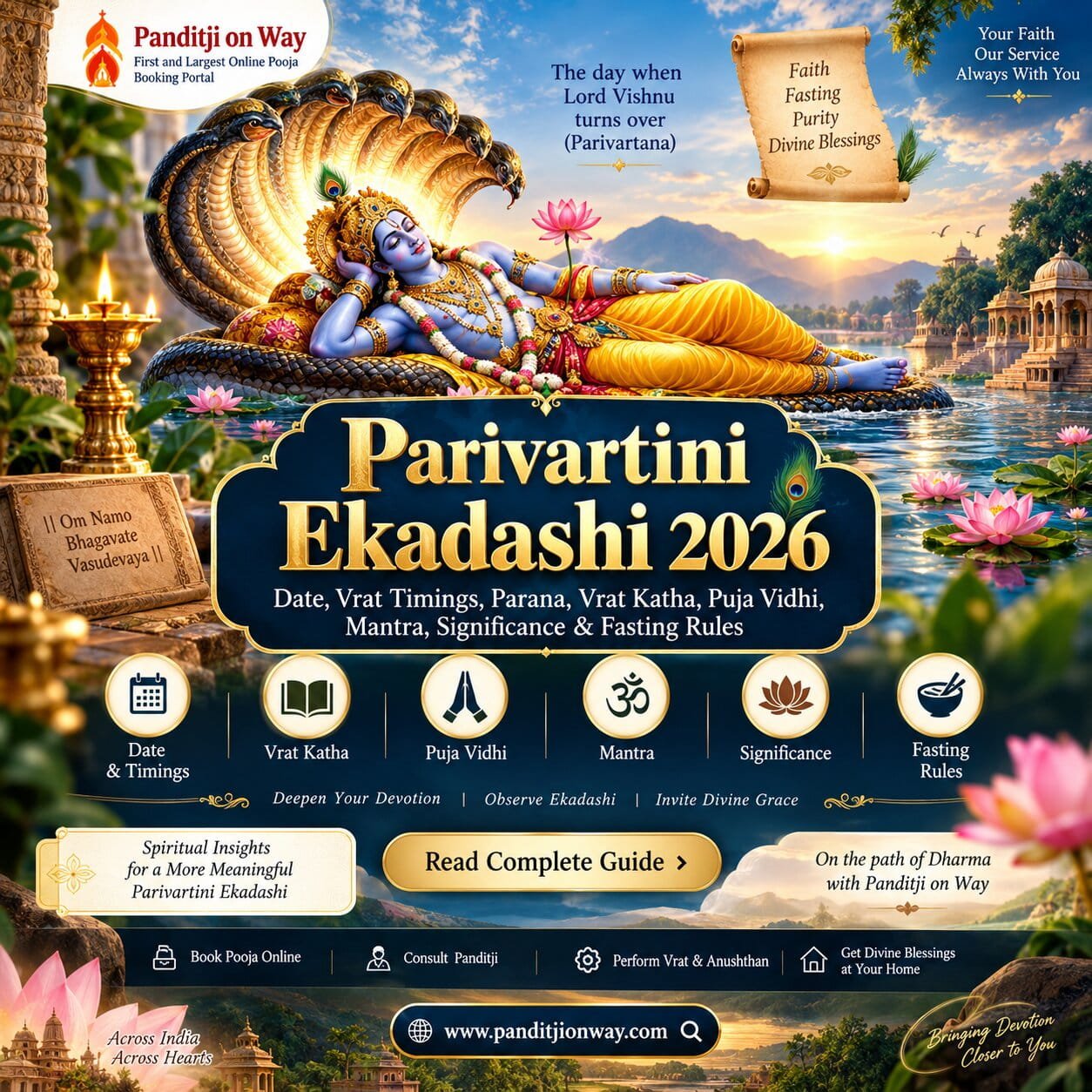
Parivartini Ekadashi 2026 will be observed on Tuesday, 22 September 2026. Also known as Parsva Ekadashi, Parshva Ekadashi and Vamana Ekadashi, this sacred Ekadashi falls during the Shukla Paksha of Bhadrapada month. It is dedicated to Lord Vishnu and is associated with the divine Vamana incarnation of Lord Vishnu and the story of King Bali.
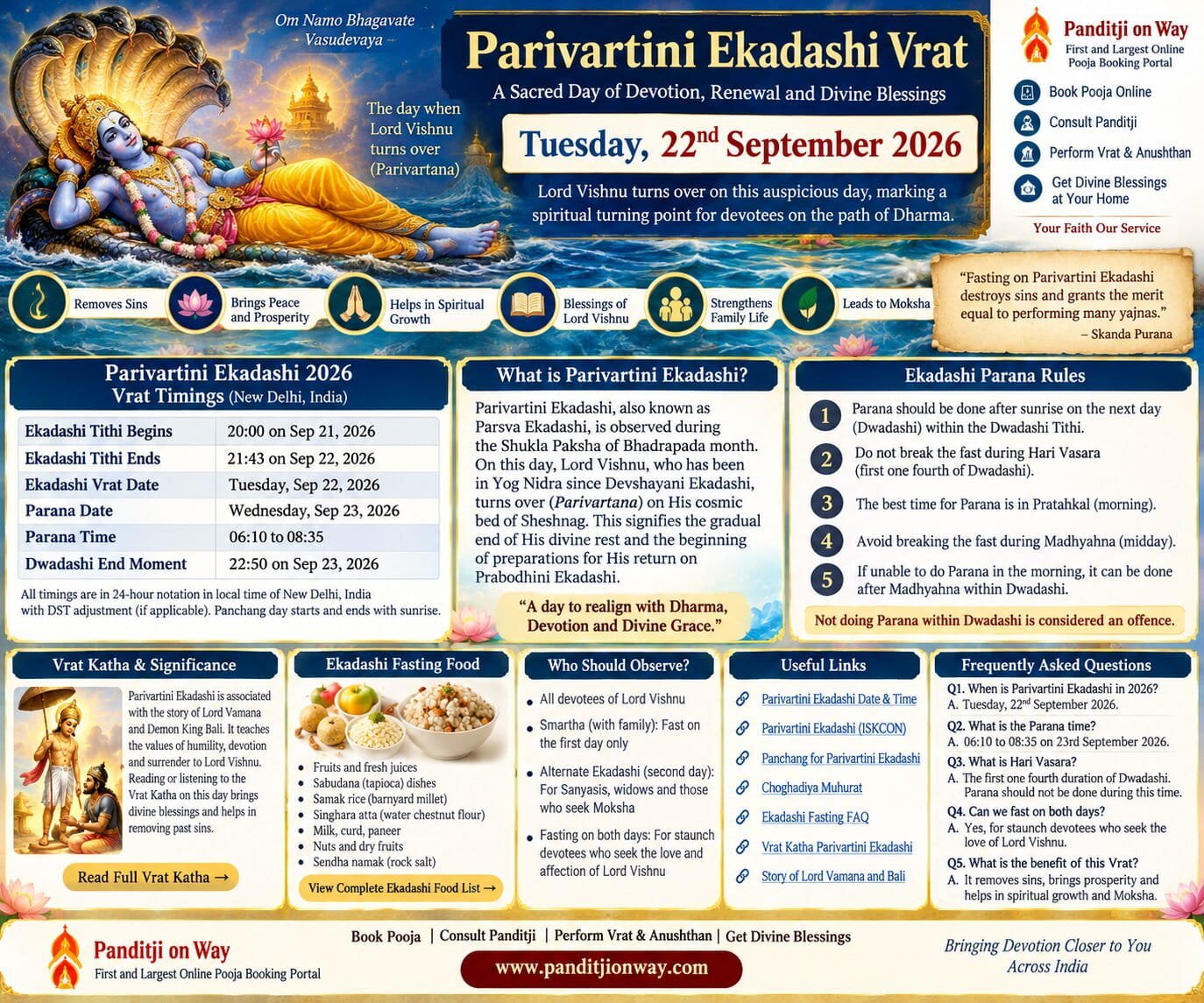
According to the Panchang timings for New Delhi, India, the Ekadashi Tithi begins at 8:00 PM on 21 September 2026 and ends at 9:43 PM on 22 September 2026. The following day, 23 September 2026, is Dwadashi and the Parana period begins after sunrise.
For devotees observing Parivartini Ekadashi Vrat, the most important points are the Ekadashi fasting date, Tithi, Parana timing, puja vidhi, fasting rules, Vrat Katha, Lord Vishnu worship and Dwadashi Parana.
Panditji on Way, one of India’s leading online pooja booking platforms, provides devotees with convenient access to religious rituals, puja services and experienced pandits for Hindu festivals and auspicious occasions.
Parivartini Ekadashi 2026 Date and Time
| Parivartini Ekadashi 2026 Details | Date / Time |
|---|---|
| Festival | Parivartini Ekadashi Vrat |
| Other Names | Parsva Ekadashi, Parshva Ekadashi, Vamana Ekadashi |
| Date | 22 September 2026 |
| Day | Tuesday |
| Month | Bhadrapada |
| Paksha | Shukla Paksha |
| Deity | Lord Vishnu |
| Ekadashi Tithi Begins | 20:00, 21 September 2026 |
| Ekadashi Tithi Ends | 21:43, 22 September 2026 |
| Parana Date | 23 September 2026 |
| New Delhi Parana | 06:10 AM to 08:35 AM |
| Dwadashi End | 10:50 PM, 23 September 2026 |
| Observance | Lord Vishnu worship and Ekadashi fasting |
The exact fasting and Parana timings can vary according to location because sunrise and local Panchang calculations differ from one city to another. The timings above are for New Delhi, India.
For devotees in cities such as Mumbai, Delhi, Jaipur, Lucknow, Ahmedabad, Pune, Bengaluru, Kolkata or other locations, it is advisable to check the local Panchang before beginning or ending the fast.
What is Parivartini Ekadashi?
Parivartini Ekadashi is the Shukla Paksha Ekadashi of Bhadrapada month. The word “Parivartini” is associated with the idea of change or turning over. In Vaishnava tradition, Lord Vishnu is believed to turn or change His resting position during this period, which gives this Ekadashi its distinctive name.
This Ekadashi is also known as Parsva Ekadashi or Parshva Ekadashi. It is associated with the worship of Lord Vishnu and the Vamana Avatar.
The 2026 Ekadashi calendar for New Delhi identifies 22 September 2026 as Parsva Ekadashi, with the Ekadashi Tithi beginning on 21 September evening and ending on 22 September night.
Why is Parivartini Ekadashi Important?
Parivartini Ekadashi is considered spiritually significant because devotees observe fasting, prayer, Vishnu worship and devotional activities on this day.
The central spiritual themes associated with the observance include:
- Devotion to Lord Vishnu
- Self-discipline and control of the senses
- Fasting and purification
- Prayer and meditation
- Charity and acts of compassion
- Listening to or reading Vishnu-related scriptures
- Remembering the Vamana Avatar and King Bali
- Seeking spiritual progress and divine grace
Ekadashi fasting is traditionally regarded as a devotional practice. The Bhagavad-gita tradition also references fasting on Ekadashi as one of the devotional observances followed by devotees.
Parivartini Ekadashi and Lord Vamana
One of the most important associations of Parivartini Ekadashi is with Lord Vamana, the fifth avatar of Lord Vishnu.
According to the traditional account, King Bali had become extremely powerful and had gained control over the three worlds. Lord Vishnu appeared as Vamana, a dwarf Brahmin, and approached Bali during a sacrificial ceremony.
Vamana asked King Bali for only three paces of land.
Bali agreed.
Lord Vamana then assumed His immense cosmic form, known as Trivikrama. With the first step He covered the earth, and with the second He covered the heavens. When there was no place remaining for the third step, Bali offered his own head.
The story is traditionally understood as a lesson in humility, devotion, truthfulness, surrender and the power of keeping one’s promise. The Metropolitan Museum of Art also describes Vamana as the fifth avatar of Vishnu and records the traditional account of Vamana and King Bali.
Parivartini Ekadashi Vrat Katha
The Parivartini Ekadashi Vrat Katha is traditionally connected with Lord Vishnu’s Vamana form and King Bali.
King Bali was known for his generosity, power and commitment to charity. During his sacrificial ceremony, Lord Vishnu appeared before him in the form of Vamana and asked for land that could be covered in three steps.
Although the request appeared extremely small, Bali agreed.
Vamana then expanded into the gigantic Trivikrama form. His first step covered the earth and His second step covered the heavens. There was no space left for the third step.
Bali realized that he had nothing remaining to offer and presented his own head for the Lord’s third step.
The story highlights several important spiritual principles:
1. Humility
Even a powerful king must ultimately recognize the supremacy of the Divine.
2. Keeping one’s promise
King Bali chose to honour his promise even when the consequences were enormous.
3. Surrender
Offering his own head for the third step represents complete surrender before the Lord.
4. Devotion
The story emphasizes that sincere devotion is more important than worldly power.
Historical and art-historical sources also document the Vamana-Bali narrative, including the three-step episode associated with Vishnu’s Trivikrama form.
Parivartini Ekadashi Puja Vidhi 2026
Devotees can observe Parivartini Ekadashi with a simple and sincere Vishnu puja at home or in a temple.
Step 1: Take a Sankalp
After bathing in the morning, wear clean clothes and take a sankalp to observe the Ekadashi fast according to your ability.
Step 2: Clean the Puja Area
Clean the place of worship and establish an image or idol of Lord Vishnu.
Step 3: Offer Panchopachara or Shodashopachara Puja
Depending on your tradition, offer:
- Water
- Panchamrit
- Sandalwood
- Flowers
- Tulsi leaves
- Incense
- Lamp
- Fruits
- Naivedya
Tulsi is especially associated with Vishnu worship.
Step 4: Chant Vishnu Mantras
Devotees may chant:
“Om Namo Bhagavate Vasudevaya”
or
“Om Namo Narayanaya”
The mantra may be repeated according to one’s devotional practice.
Step 5: Read the Vrat Katha
Read or listen to the Parivartini Ekadashi Vrat Katha and the story of Lord Vamana and King Bali.
Step 6: Perform Aarti
Conclude the puja with Vishnu Aarti and prayers.
Step 7: Observe Dwadashi Parana
Break the Ekadashi fast on Dwadashi during the prescribed Parana period.
Parivartini Ekadashi Fasting Rules
The type of Ekadashi fasting can differ according to an individual’s health, tradition and spiritual practice.
Common forms include:
| Type of Fast | Description |
|---|---|
| Nirjala Vrat | Complete fast without food or water |
| Jalahar | Water-based fasting |
| Phalahar | Fruits and permitted fasting foods |
| Ekabhukta | One permitted meal |
| Satvik Fast | Fruits, milk and Ekadashi-permitted foods |
A person should not undertake a strict or Nirjala fast simply because others are doing so. Fasting should be performed according to one’s health, age, physical capacity and established family or spiritual tradition.
Pregnant women, elderly people, children and people with medical conditions should follow appropriate professional medical advice before undertaking restrictive fasting.
What to Eat During Parivartini Ekadashi Vrat?
Foods traditionally consumed during Ekadashi fasting may include:
- Fruits
- Milk
- Curd
- Coconut
- Makhana
- Sabudana
- Singhara flour
- Rajgira
- Potatoes
- Sweet potatoes
- Peanuts
- Certain fasting preparations
- Water and permitted beverages
The exact list of permitted foods varies among traditions and households.
Foods generally avoided during Ekadashi include:
- Rice
- Wheat
- Regular flour
- Pulses
- Beans
- Lentils
- Grains
- Certain cereals
Devotees should follow the fasting rules prescribed by their own sampradaya or family tradition.
What Not to Do on Parivartini Ekadashi?
Devotees traditionally try to avoid activities that are contrary to the spiritual purpose of the fast.
It is generally recommended to avoid:
- Eating grains and prohibited foods
- Excessive sleeping
- Anger and arguments
- Unnecessary criticism
- Dishonesty
- Harmful behaviour
- Intoxicants
- Excessive material indulgence
The central purpose of Ekadashi is not merely avoiding food. It is an opportunity for greater self-control, prayer, remembrance of God and spiritual discipline.
Parivartini Ekadashi Parana 2026
Parana means breaking the Ekadashi fast.
For the New Delhi calculation, Parana on 23 September 2026 is given from 6:10 AM to 8:35 AM in the timing information supplied for this observance. The Dwadashi Tithi continues until approximately 10:50 PM.
The traditional principle is that Ekadashi fasting should be broken on Dwadashi after sunrise and within the appropriate Parana period.
Devotees should avoid breaking the fast at an inappropriate time and should pay attention to the local Dwadashi and Parana calculation.
Important
Parivartini Ekadashi Parana timings are location-specific.
Therefore, a devotee in Mumbai should not blindly use the New Delhi timing. The local sunrise and Panchang calculation should be checked for Mumbai.
Is Parivartini Ekadashi on September 21 or September 22, 2026?
The Ekadashi Tithi begins on 21 September 2026 at 8:00 PM and ends on 22 September 2026 at 9:43 PM for New Delhi.
Therefore, the fasting observance falls on Tuesday, 22 September 2026.
This distinction is important because Hindu festival dates are determined by Tithi rather than simply by the Gregorian calendar date on which the Tithi begins.
Parivartini Ekadashi 2026: Smartha and Vaishnava Observance
Different Hindu traditions can follow different rules for Ekadashi fasting.
In some circumstances, Ekadashi fasting may be prescribed on consecutive dates for specific groups or traditions. The ISKCON Ekadashi calendar also separately identifies its Vaishnava observance. For New Delhi, ISKCON lists Parshva Ekadashi on 22 September 2026, with Parana on 23 September.
Therefore, devotees following a particular sampradaya should follow the calendar and guidance of that tradition.
Parivartini Ekadashi Mantra
Devotees can chant Vishnu mantras throughout the day.
Om Namo Bhagavate Vasudevaya
ॐ नमो भगवते वासुदेवाय
Another commonly recited Vishnu mantra is:
Om Namo Narayanaya
ॐ नमो नारायणाय
Devotees may also recite Vishnu Sahasranama, read Bhagavad Gita or perform Hari Naam Sankirtan according to their tradition.
Parivartini Ekadashi Puja Samagri
The following items may be used for a simple home puja:
| Puja Item | Purpose |
|---|---|
| Lord Vishnu Idol/Image | Main deity |
| Tulsi Leaves | Vishnu offering |
| Flowers | Puja offering |
| Sandalwood | Tilak and worship |
| Incense | Dhupa |
| Ghee Lamp | Deepa |
| Fruits | Naivedya |
| Coconut | Offering |
| Panchamrit | Abhishekam |
| Clean Water | Abhisheka and Arghya |
| Yellow Cloth | Traditional Vishnu offering |
The exact samagri can be adjusted according to the puja tradition.
Benefits of Parivartini Ekadashi Vrat
In Hindu devotional tradition, observing Ekadashi is associated with spiritual discipline and devotion to Lord Vishnu.
Devotees traditionally believe that Parivartini Ekadashi can help with:
- Spiritual purification
- Greater self-discipline
- Concentration during prayer
- Devotional consciousness
- Reduction of negative habits
- Greater faith in Lord Vishnu
- Peace of mind
- Charity and compassionate living
- Progress on the spiritual path
These are religious and devotional beliefs rather than scientifically established medical claims.
The deeper purpose of the vrat is therefore better understood as bhakti, self-restraint, prayer and remembrance of Lord Vishnu.
Parivartini Ekadashi and Charity
Charity is an important part of many Hindu vrat traditions.
On Parivartini Ekadashi, devotees may choose to:
- Donate food
- Help people in need
- Offer clothes
- Support गौसेवा
- Donate to temples or charitable organizations
- Feed cows or other animals where traditionally appropriate
- Help a person who needs assistance
The spirit of charity is more important than the monetary value of the donation.
Parivartini Ekadashi 2026: Complete Quick Guide
| Question | Answer |
|---|---|
| When is Parivartini Ekadashi 2026? | 22 September 2026, Tuesday |
| What is another name for Parivartini Ekadashi? | Parsva Ekadashi / Parshva Ekadashi / Vamana Ekadashi |
| Which deity is worshipped? | Lord Vishnu |
| Which Avatar is associated with it? | Vamana Avatar |
| When does Ekadashi Tithi begin? | 8:00 PM, 21 September 2026 |
| When does Ekadashi Tithi end? | 9:43 PM, 22 September 2026 |
| When is Parana? | 23 September 2026 |
| New Delhi Parana | 6:10 AM–8:35 AM |
| Main story | Lord Vamana and King Bali |
| Main practice | Ekadashi fasting and Vishnu worship |
| Main mantra | Om Namo Bhagavate Vasudevaya |
| Fasting food | Fruits and permitted Ekadashi foods |
| Grains allowed? | Traditionally no |
| Is the timing the same everywhere? | No, it varies by location |
The New Delhi timings above are based on the 2026 Panchang data for Parsva Ekadashi.
Frequently Asked Questions About Parivartini Ekadashi 2026
When is Parivartini Ekadashi in 2026?
Parivartini Ekadashi will be observed on Tuesday, 22 September 2026.
What is Parivartini Ekadashi also called?
It is also known as Parsva Ekadashi, Parshva Ekadashi and Vamana Ekadashi.
What time does Parivartini Ekadashi begin in 2026?
For New Delhi, the Ekadashi Tithi begins at 8:00 PM on 21 September 2026.
What time does Parivartini Ekadashi end?
The Ekadashi Tithi ends at 9:43 PM on 22 September 2026 for New Delhi.
When is Parivartini Ekadashi Parana in 2026?
For New Delhi, Parana is on 23 September 2026 from 6:10 AM to 8:35 AM according to the supplied Panchang timing.
Which God is worshipped on Parivartini Ekadashi?
Lord Vishnu is the principal deity worshipped on Parivartini Ekadashi.
Which Avatar of Lord Vishnu is associated with Parivartini Ekadashi?
Parivartini Ekadashi is associated with Lord Vamana, the fifth Avatar of Lord Vishnu.
Can we eat rice on Parivartini Ekadashi?
Traditionally, rice and other grains are avoided during Ekadashi fasting. Devotees generally consume fruits and foods permitted under their fasting tradition.
Can we drink water during Parivartini Ekadashi?
Yes, devotees may choose a fasting method that permits water. Nirjala fasting is a stricter form and should not be undertaken without considering one’s health and physical capacity.
Can children observe Parivartini Ekadashi fast?
Children should not be subjected to restrictive fasting without appropriate guidance. A devotional observance involving prayer, Vishnu worship and a suitable diet may be more appropriate.
Can pregnant women observe Parivartini Ekadashi?
Pregnant women should not undertake restrictive fasting without medical guidance. Devotional activities such as prayer, mantra chanting and Vishnu worship can be followed without undertaking an unsafe fast.
What should be done on Parivartini Ekadashi?
Devotees traditionally take a sankalp, worship Lord Vishnu, chant Vishnu mantras, listen to the Vrat Katha, avoid prohibited foods and perform Parana on Dwadashi.
What is the story of Parivartini Ekadashi?
The observance is associated with Lord Vishnu, His Vamana form and King Bali. The Vamana narrative describes Vishnu asking Bali for three paces of land and then covering the worlds with His cosmic form.
Is Parivartini Ekadashi and Vamana Ekadashi the same?
The names are used in connection with the same Ekadashi observance in several traditions, although naming conventions can vary by region and sampradaya.
Is Parivartini Ekadashi important for Lord Vishnu devotees?
Yes. It is an important Vishnu-related Ekadashi during Bhadrapada Shukla Paksha and is observed with fasting, prayer and devotional practices.
Parivartini Ekadashi 2026: Location-Wise Panchang
Because Hindu fasting dates and Parana timings depend on local sunrise and Tithi calculations, devotees should check their city-specific Panchang.
For example, the published 2026 calculations show different Parana timings for New Delhi, Pune and other Indian locations.
For your city, always verify:
- Ekadashi fasting date
- Ekadashi Tithi beginning
- Ekadashi Tithi ending
- Sunrise
- Dwadashi Tithi
- Parana start time
- Parana end time
This is especially important when travelling or living outside your usual city.
Parivartini Ekadashi 2026: Spiritual Message
The story of Parivartini Ekadashi and Lord Vamana teaches a profound lesson.
King Bali possessed enormous power, wealth and authority, but when confronted with the cosmic form of Lord Vishnu, he recognized that worldly possessions are temporary.
His willingness to honour his promise and surrender before the Divine makes the Vamana-Bali story an enduring example of devotion and humility.
Parivartini Ekadashi therefore provides an opportunity to move beyond fasting alone and focus on bhakti, self-discipline, charity, truthfulness and remembrance of Lord Vishnu.
Book Your Puja with Panditji on Way
Devotees who wish to perform a traditional puja, vrat-related ritual or other Hindu religious ceremony can explore Panditji on Way, an online pooja booking platform designed to connect devotees with pandits and religious services.
Panditji on Way – First and Largest Online Pooja Booking Portal
For puja booking, religious rituals and festival-specific services, visit:
https://www.panditjionway.com/
Suggested internal links on the website:
- Parivartini Ekadashi Puja
- Ekadashi Puja
- Vishnu Puja
- Vamana Puja
- Ekadashi Vrat Katha
- Ekadashi Fasting Food
- Hindu Festival Calendar
- Online Pooja Booking
Recommended External References
For readers who want to verify Panchang calculations and learn more about the traditional Vamana-Bali narrative, authoritative or established reference sources can be linked naturally within the article.
Panchang and Ekadashi timings: Drik Panchang’s 2026 Ekadashi calendar provides location-specific dates and timings.
The Metropolitan Museum of Art (Vamana Avatar and King Bali story) – Vamana & King Bali
Vedabase (Scriptural reference mentioning Ekadashi fasting and Dwadashi) – Srimad Bhagavatam 10.28.1
Vedabase – Bhagavad Gita 9.14 -Vedabase – Bhagavad Gita 9.14

Final Takeaway
Parivartini Ekadashi 2026 will be observed on Tuesday, 22 September 2026. The Ekadashi Tithi begins at 8:00 PM on 21 September and ends at 9:43 PM on 22 September for New Delhi. The following day, 23 September, is Dwadashi and the New Delhi Parana period is 6:10 AM to 8:35 AM according to the referenced Panchang calculation.
The sacred day is associated with Lord Vishnu, the Vamana Avatar and King Bali. Devotees traditionally observe fasting, worship Lord Vishnu, chant mantras, listen to the Vrat Katha, perform charity and break the fast during the appropriate Dwadashi Parana period.
For location-specific timings, devotees should always check the Panchang for their own city.
Panditji on Way aims to make traditional Hindu puja and religious services accessible through online booking and professional pandit services.
Website: www.panditjionway.com