2083 Bikram Sambat Nepali Festivals Calendar (2026–2027): Complete Month-Wise Festival List, Dates, Vrat, Puja Vidhi and Significance
Explore the complete Nepali Festivals 2083 Calendar BS (2026–2027), including Dashain, Tihar, Teej, Janmashtami, Ekadashi, Shivaratri, puja dates and vrat details.
Published by Panditji On Way | Nepali Hindu Calendar 2083 BS | April 2026 – April 2027
The 2083 Bikram Sambat Nepali Festivals Calendar (2026–2027) provides a complete month-wise guide to important Hindu festivals, religious observances, Ekadashi fasting days, Pradosh Vrat, Sankranti, Purnima, Amavasya, and traditional celebrations observed throughout Nepal.
The Nepali year 2083 BS begins on Tuesday, 14 April 2026, and ends on Tuesday, 13 April 2027. It includes major celebrations such as Nepali New Year, Buddha Jayanti, Haritalika Teej, Raksha Bandhan, Krishna Janmashtami, Dashain, Tihar, Chhath Parba, Maghe Sankranti, Maha Shivaratri, and other important Hindu religious occasions.
Nepali festivals are deeply connected with Hindu mythology, Vedic traditions, lunar tithis, solar movements, seasonal changes, and local cultural practices. Their observance may differ according to geographical location, sunrise time, local Panchang calculations, and religious traditions.
Whether you are planning a fast, organizing a family puja, arranging a temple visit, or booking a professional Hindu priest, this guide will help you understand the important festivals of 2083 BS.
Panditji On Way, the first and largest online Pooja Booking Portal, helps devotees connect with professional pandits for Hindu pujas, Vedic rituals, havans, religious ceremonies, and other spiritual services.
Quick Overview: Nepali Festivals 2083
| Calendar information | Details |
|---|---|
| Nepali year | 2083 Bikram Sambat |
| Gregorian year | 2026–2027 |
| Starting date | 14 April 2026 |
| Ending date | 13 April 2027 |
| Calendar system | Bikram Sambat |
| Main religious traditions | Hinduism and Buddhist traditions |
| Important festivals | Dashain, Tihar, Teej, Janmashtami, Shivaratri |
| Major fasting days | Ekadashi, Pradosh Vrat, Purnima |
| Important regions | Kathmandu, Lalitpur, Bhaktapur, Pokhara, Janakpur, Lumbini, Biratnagar |
| Calendar basis | Solar and lunar calculations |
Important Nepali Festivals in 2083 BS at a Glance
These are some of the most significant festivals and observances of the year.
| Festival | Date in 2026–2027 |
|---|---|
| Nepali New Year | 14 April 2026 |
| Parashurama Jayanti | 19 April 2026 |
| Akshaya Tritiya | 20 April 2026 |
| Buddha Jayanti | 1 May 2026 |
| Nirjala Ekadashi | 25 June 2026 |
| Harishayani Ekadashi | 25 July 2026 |
| Raksha Bandhan | 28 August 2026 |
| Krishna Janmashtami | 4 September 2026 |
| Hartalika Teej | 14 September 2026 |
| Ganesh Chaturthi | 14 September 2026 |
| Radha Ashtami | 19 September 2026 |
| Ghatasthapana | 11 October 2026 |
| Phulpati | 17 October 2026 |
| Maha Ashtami | 18 October 2026 |
| Maha Navami | 20 October 2026 |
| Vijaya Dashami | 21 October 2026 |
| Tihar celebrations | November 2026 |
| Chhath Parba | 15 November 2026 |
| Maghe Sankranti | 15 January 2027 |
| Shree Panchami | 11 February 2027 |
| Maha Shivaratri | 6 March 2027 |
| Amalaki Ekadashi | 18 March 2027 |
Dates above follow the supplied festival calendar except where the article separately identifies official-calendar differences requiring verification.
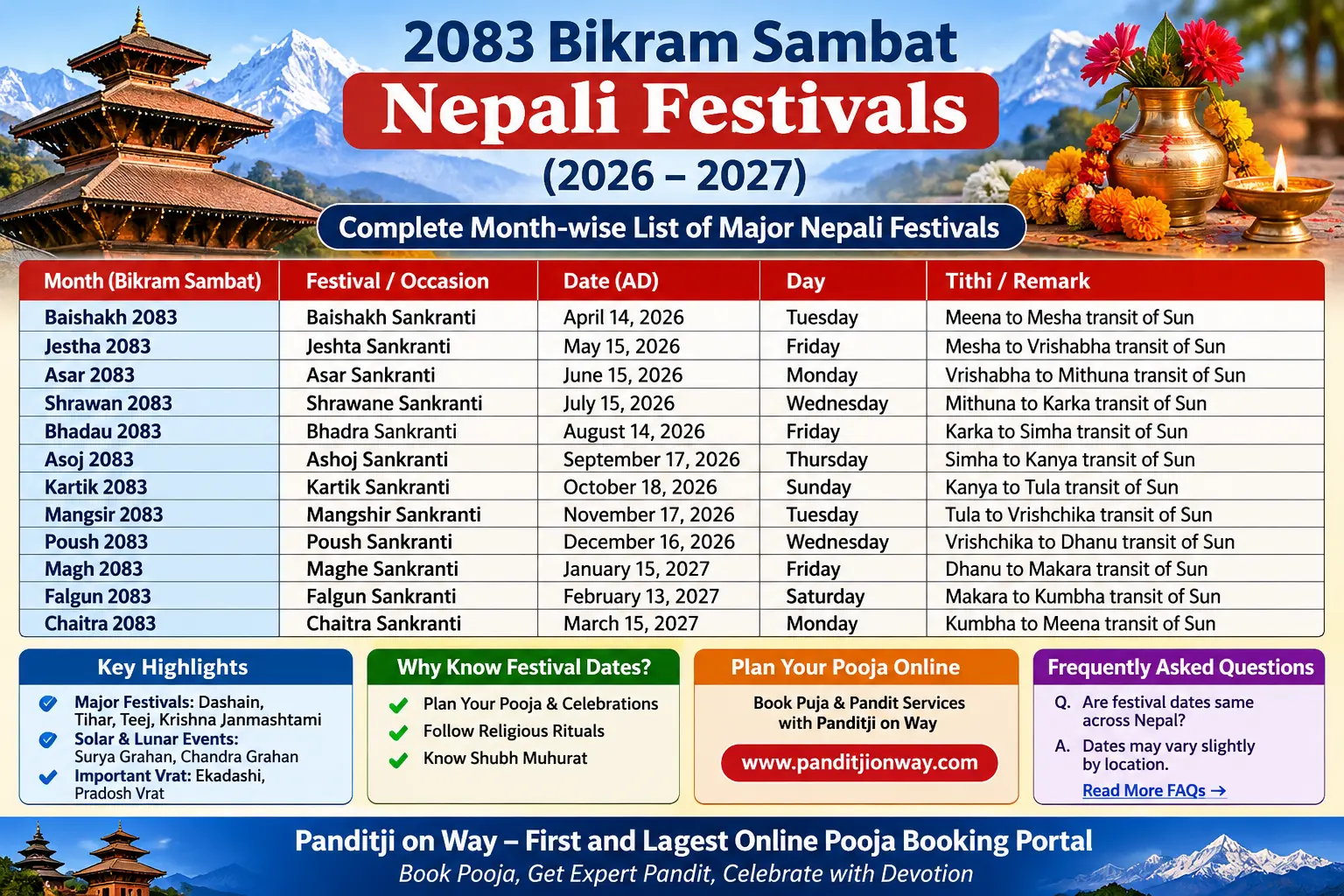
Complete Month-Wise Nepali Festivals Calendar 2083 BS
The following calendar retains the festival dates and observances from your supplied list, removes repeated duplicate name entries, and organizes the information into readable tables.
1. Baishakh 2083 (April–May 2026)
Baishakh marks the beginning of the Nepali New Year and the first month of Bikram Sambat 2083. It is an important period for new beginnings, religious activities, temple visits, and prayers for prosperity.
Important religious observances include Baishakh Sankranti, Parashurama Jayanti, Akshaya Tritiya, Sita Jayanti, Mohini Ekadashi, and Pradosh Vrat.
| Date | Day | Festival / Vrat | Tithi or significance |
|---|---|---|---|
| 14 April 2026 | Tuesday | Baishakh Sankranti / Nepali New Year | Sun enters Mesha |
| 15 April 2026 | Wednesday | Budha Pradosh Vrat | Krishna Trayodashi |
| 18 April 2026 | Saturday | Chandra Darshan | Shukla Pratipada |
| 19 April 2026 | Sunday | Parashurama Jayanti | Shukla Tritiya |
| 20 April 2026 | Monday | Akshaya Tritiya | Shukla Tritiya |
| 25 April 2026 | Saturday | Sita Jayanti | Shukla Navami |
| 27 April 2026 | Monday | Mohini Ekadashi | Shukla Ekadashi |
| 28 April 2026 | Tuesday | Bhauma Pradosh Vrat | Shukla Trayodashi |
| 13 May 2026 | Wednesday | Apara Ekadashi | Krishna Ekadashi |
| 14 May 2026 | Thursday | Guru Pradosh Vrat | Krishna Trayodashi |
Religious significance: Akshaya Tritiya is traditionally associated with prosperity, auspicious beginnings, charity, and spiritual activities. Devotees worship Lord Vishnu and Goddess Lakshmi and perform acts of charity.
Important places: Pashupatinath Temple in Kathmandu, Budhanilkantha Temple, and Janaki Mandir in Janakpur are important destinations for Hindu devotees.
2. Jestha 2083 (May–June 2026)
| Date | Day | Festival / Vrat | Tithi or significance |
|---|---|---|---|
| 15 May 2026 | Friday | Jestha Sankranti | Sun enters Vrishabha |
| 18 May 2026 | Monday | Adhika Chandra Darshan | Adhika Shukla Pratipada |
| 27 May 2026 | Wednesday | Padmini Ekadashi | Adhika Shukla Ekadashi |
| 28 May 2026 | Thursday | Guru Pradosh Vrat | Adhika Shukla Trayodashi |
| 11 June 2026 | Thursday | Parama Ekadashi | Adhika Krishna Ekadashi |
| 12 June 2026 | Friday | Shukra Pradosh Vrat | Adhika Krishna Trayodashi |
Religious significance: Padmini Ekadashi and Parama Ekadashi are associated with devotion to Lord Vishnu. Devotees observe fasting, recite Vishnu mantras, perform charitable activities, and listen to religious stories.
Important places: Pashupatinath Temple, Budhanilkantha Temple, and Muktinath Temple are significant pilgrimage destinations for devotees.
3. Asar 2083 (June–July 2026)
Asar is associated with important fasting traditions, particularly Nirjala Ekadashi and Yogini Ekadashi. Devotees also observe Pradosh Vrat and Chandra Darshan.
| Date | Day | Festival / Vrat | Tithi or significance |
|---|---|---|---|
| 15 June 2026 | Monday | Asar Sankranti | Sun enters Mithuna |
| 16 June 2026 | Tuesday | Chandra Darshan | Shukla Pratipada |
| 25 June 2026 | Thursday | Nirjala Ekadashi | Shukla Ekadashi |
| 27 June 2026 | Saturday | Shani Pradosh Vrat | Shukla Trayodashi |
| 10 July 2026 | Friday | Yogini Ekadashi | Krishna Ekadashi |
| 12 July 2026 | Sunday | Ravi Pradosh Vrat | Krishna Trayodashi |
| 15 July 2026 | Wednesday | Chandra Darshan | Shukla Pratipada |
Religious significance: Nirjala Ekadashi is one of the most important Ekadashi fasts. Traditionally, devotees observe a strict fast and worship Lord Vishnu. Those unable to observe a waterless fast may follow a suitable form of fasting according to their health and religious tradition.
Important places: Muktinath, Pashupatinath, and other Vishnu and Shiva temples across Nepal.
4. Shrawan 2083 (July–August 2026)
Shrawan is especially sacred to Lord Shiva. Devotees visit Shiva temples, perform Rudrabhishek, offer Bilva leaves, and observe religious fasts. Harishayani Ekadashi also marks the traditional beginning of Chaturmas.
| Date | Day | Festival / Vrat | Tithi or significance |
|---|---|---|---|
| 17 July 2026 | Friday | Shrawane Sankranti | Sun enters Karka |
| 25 July 2026 | Saturday | Harishayani Ekadashi | Shukla Ekadashi |
| 26 July 2026 | Sunday | Ravi Pradosh Vrat | Shukla Trayodashi |
| 8 August 2026 | Saturday | Kamika Ekadashi | Krishna Ekadashi |
| 9 August 2026 | Sunday | Gauna Kamika Ekadashi | Krishna Ekadashi |
| 10 August 2026 | Monday | Soma Pradosh Vrat | Krishna Trayodashi |
| 12 August 2026 | Wednesday | Solar Eclipse | Astronomical event; local visibility must be checked |
| 14 August 2026 | Friday | Chandra Darshan | Shukla Pratipada |
Religious significance: Harishayani Ekadashi is associated with Lord Vishnu entering divine yogic sleep. The four-month Chaturmas period begins around this observance in many Hindu traditions.
Important places: Pashupatinath Temple, Gokarneshwar Mahadev, and Doleshwar Mahadev Temple.
5. Bhadau 2083 (August–September 2026)
Bhadau contains several important Hindu festivals, including Raksha Bandhan, Krishna Janmashtami, Hartalika Teej, Ganesh Chaturthi, and Rishi Panchami.
| Date | Day | Festival / Vrat | Tithi or significance |
|---|---|---|---|
| 17 August 2026 | Monday | Bhadra Sankranti | Sun enters Simha |
| 23 August 2026 | Sunday | Putrada Ekadashi | Shukla Ekadashi |
| 25 August 2026 | Tuesday | Bhauma Pradosh Vrat | Shukla Trayodashi |
| 28 August 2026 | Friday | Raksha Bandhan | Shukla Purnima |
| 28 August 2026 | Friday | Partial Lunar Eclipse | Purnima; visibility requires verification |
| 4 September 2026 | Friday | Shree Krishna Janmashtami | Krishna Ashtami |
| 7 September 2026 | Monday | Aja Ekadashi | Krishna Ekadashi |
| 8 September 2026 | Tuesday | Agastya Arghya | Astronomical observation |
| 8 September 2026 | Tuesday | Bhauma Pradosh Vrat | Krishna Trayodashi |
| 12 September 2026 | Saturday | Chandra Darshan | Shukla Pratipada |
| 14 September 2026 | Monday | Hartalika Teej | Shukla Tritiya |
| 14 September 2026 | Monday | Ganesh Chaturthi | Shukla Chaturthi |
| 15 September 2026 | Tuesday | Rishi Panchami | Shukla Panchami |
Religious significance: Krishna Janmashtami celebrates the birth of Lord Krishna. Devotees observe fasting, sing bhajans, read the Bhagavad Gita, and participate in midnight worship.
Hartalika Teej is particularly significant for women, who worship Lord Shiva and Goddess Parvati and pray for marital happiness, family prosperity, and well-being.
Important places:
-
Krishna Mandir, Patan Durbar Square, Lalitpur.
-
Pashupatinath Temple, Kathmandu.
-
Doleshwar Mahadev Temple, Bhaktapur.
-
Janaki Mandir, Janakpur.
6. Asoj 2083 (September–October 2026)
Asoj is one of the most spiritually significant months in Nepal. It includes Pitrupaksha, Navratri, Ghatasthapana, Phulpati, and preparations for the grand Dashain celebration.
| Date | Day | Festival / Vrat | Tithi or significance |
|---|---|---|---|
| 17 September 2026 | Thursday | Bishwakarma Pooja | Kanya Sankranti |
| 17 September 2026 | Thursday | Asoj Sankranti | Sun enters Kanya |
| 19 September 2026 | Saturday | Radhashtami | Shukla Ashtami |
| 22 September 2026 | Tuesday | Hari-Parivartan Ekadashi | Shukla Ekadashi |
| 24 September 2026 | Thursday | Guru Pradosh Vrat | Shukla Trayodashi |
| 27 September 2026 | Sunday | Pitrupaksha Arambha | Krishna Pratipada |
| 27 September 2026 | Sunday | Pratipada Shraddha | Krishna Pratipada |
| 6 October 2026 | Tuesday | Indira Ekadashi | Krishna Ekadashi |
| 8 October 2026 | Thursday | Guru Pradosh Vrat | Krishna Trayodashi |
| 10 October 2026 | Saturday | Pitri Bisarjan | Amavasya observance |
| 11 October 2026 | Sunday | Navratri Arambha | Shukla Pratipada |
| 11 October 2026 | Sunday | Ghatasthapana | Shukla Pratipada |
| 12 October 2026 | Monday | Chandra Darshan | Shukla Pratipada |
| 15 October 2026 | Thursday | Upang Lalita Vrat | Shukla Panchami |
| 16 October 2026 | Friday | Saraswati Avahan | Mula Nakshatra |
| 16 October 2026 | Friday | Bilva Nimantran | Shukla Shashthi |
| 17 October 2026 | Saturday | Nava Patrika Pravesh | Shukla Saptami |
| 17 October 2026 | Saturday | Phulpati | Shukla Saptami |
Religious significance: Navratri is dedicated to Goddess Durga and her different manifestations. During this period, devotees perform Durga Puja, recite sacred texts, observe fasting, and seek divine blessings.
Ghatasthapana marks the beginning of Dashain rituals. A sacred kalash is established, and Jamara is traditionally grown as part of the worship.
Important places:
-
Guhyeshwari Temple, Kathmandu.
-
Taleju Bhawani Temple, Kathmandu.
-
Dakshinkali Temple, Kathmandu.
-
Manakamana Temple, Gorkha.
-
Bindhyabasini Temple, Pokhara.
7. Kartik 2083 (October–November 2026)
Kartik is one of the most celebrated months in Nepal. It includes the concluding days of Dashain, Tihar, Laxmi Puja, Govardhan Puja, Mha Puja, Bhai Tika, and Chhath Parba.
| Date | Day | Festival / Vrat | Tithi or significance |
|---|---|---|---|
| 18 October 2026 | Sunday | Maha Ashtami | Shukla Ashtami |
| 18 October 2026 | Sunday | Kartik Sankranti | Sun enters Tula |
| 20 October 2026 | Tuesday | Maha Navami | Shukla Navami |
| 20 October 2026 | Tuesday | Buddha Jayanti | As listed in supplied calendar; verify |
| 21 October 2026 | Wednesday | Vijaya Dashami | Shukla Dashami |
| 22 October 2026 | Thursday | Papankusha Ekadashi | Shukla Ekadashi |
| 23 October 2026 | Friday | Shukra Pradosh Vrat | Shukla Trayodashi |
| 25 October 2026 | Sunday | Kojagrat Brat | Shukla Purnima |
| 5 November 2026 | Thursday | Gowatsa Dwadashi | Krishna Dwadashi |
| 5 November 2026 | Thursday | Rama Ekadashi | Krishna Ekadashi |
| 6 November 2026 | Friday | Dhanteras | Krishna Trayodashi |
| 6 November 2026 | Friday | Yamadip Danam | Krishna Trayodashi |
| 6 November 2026 | Friday | Yampanchak Arambha | Tihar observance |
| 6 November 2026 | Friday | Kag Tihar | Tihar observance |
| 6 November 2026 | Friday | Shukra Pradosh Vrat | Krishna Trayodashi |
| 8 November 2026 | Sunday | Lakshmi Pooja | Amavasya |
| 8 November 2026 | Sunday | Narak Chaturdashi | Krishna Chaturdashi |
| 8 November 2026 | Sunday | Dipmalika | Deepavali observance |
| 8 November 2026 | Sunday | Kukkur Tihar | Tihar observance |
| 8 November 2026 | Sunday | Gai Tihar | Tihar observance |
| 9 November 2026 | Monday | Gobardhan Pooja | Shukla Pratipada |
| 9 November 2026 | Monday | Goru Tihar | Tihar observance |
| 9 November 2026 | Monday | Mha Pooja | Newar tradition |
| 10 November 2026 | Tuesday | Nepal Sambat Arambha | Newar New Year |
| 10 November 2026 | Tuesday | Bhai Tika | Shukla Dwitiya |
| 10 November 2026 | Tuesday | Chandra Darshan | Shukla Pratipada |
| 15 November 2026 | Sunday | Chhath Parba | Shukla Shashthi |
Important calendar verification: The official Kathmandu Metropolitan City calendar places Laxmi Puja and Kukur Tihar on 8 November, Gai Tihar on 9 November, Govardhan Puja and Mha Puja on 10 November, and Bhai Tika on 11 November 2026. This differs from some entries in the supplied list. For Nepal-specific publication, verify the final dates against the local official calendar before presenting them as confirmed.
Religious significance:
-
Dashain celebrates the victory of good over evil and the blessings of Goddess Durga.
-
Tihar honours animals, celebrates Goddess Lakshmi, and strengthens family relationships.
-
Mha Puja is an important Newar tradition celebrating the purification and worship of the self.
-
Bhai Tika celebrates the special relationship between brothers and sisters.
-
Chhath Parba honours the Sun God and Chhathi Maiya through offerings made near rivers, ponds, and other water bodies.
Important places:
-
Kathmandu Durbar Square.
-
Patan Durbar Square, Lalitpur.
-
Bhaktapur Durbar Square.
-
Janaki Mandir, Janakpur.
-
Bagmati River ghats, Kathmandu.
-
Pokhara lakeside ghats.
8. Mangsir 2083 (November–December 2026)
Mangsir is associated with religious fasting, Vishnu worship, Sankranti, Ekadashi, and Pradosh Vrat.
| Date | Day | Festival / Vrat | Tithi or significance |
|---|---|---|---|
| 17 November 2026 | Tuesday | Gopashtami | Shukla Ashtami |
| 17 November 2026 | Tuesday | Mangsir Sankranti | Sun enters Vrishchika |
| 20 November 2026 | Friday | Haribodhini Ekadashi | Shukla Ekadashi |
| 22 November 2026 | Sunday | Ravi Pradosh Vrat | Shukla Trayodashi |
| 4 December 2026 | Friday | Utpanna Ekadashi | Krishna Ekadashi |
| 6 December 2026 | Sunday | Ravi Pradosh Vrat | Krishna Trayodashi |
| 10 December 2026 | Thursday | Chandra Darshan | Shukla Pratipada |
Religious significance: Haribodhini Ekadashi is an important Vishnu-related observance associated with the conclusion of Chaturmas. Tulsi Vivah is also traditionally observed around this period according to the regional Panchang.
Important places: Muktinath Temple, Budhanilkantha Temple, Pashupatinath Temple, and Janaki Mandir.
9. Poush 2083 (December 2026–January 2027)
Poush includes important solar transitions and Vishnu-related fasting observances. Devotees observe Mokshada Ekadashi, Safala Ekadashi, and Pradosh Vrat.
| Date | Day | Festival / Vrat | Tithi or significance |
|---|---|---|---|
| 16 December 2026 | Wednesday | Poush Sankranti | Sun enters Dhanu |
| 20 December 2026 | Sunday | Mokshada Ekadashi | Shukla Ekadashi |
| 21 December 2026 | Monday | Soma Pradosh Vrat | Shukla Trayodashi |
| 3 January 2027 | Sunday | Safala Ekadashi | Krishna Ekadashi |
| 5 January 2027 | Tuesday | Bhauma Pradosh Vrat | Krishna Trayodashi |
| 9 January 2027 | Saturday | Chandra Darshan | Shukla Pratipada |
Religious significance: Mokshada Ekadashi is associated with spiritual liberation and the observance of the Bhagavad Gita Jayanti in many Hindu calendars. Devotees worship Lord Vishnu and perform prayers and charity.
Important places: Pashupatinath Temple, Muktinath Temple, and Budhanilkantha Temple.
10. Magh 2083 (January–February 2027)
Magh is an important month for seasonal and religious observances. Maghe Sankranti is particularly popular in Nepal, where people traditionally consume sesame seeds, molasses, ghee, and root vegetables.
| Date | Day | Festival / Vrat | Tithi or significance |
|---|---|---|---|
| 15 January 2027 | Friday | Maghe Sankranti | Sun enters Makara |
| 18 January 2027 | Monday | Putrada Ekadashi | Shukla Ekadashi |
| 20 January 2027 | Wednesday | Budha Pradosh Vrat | Shukla Trayodashi |
| 2 February 2027 | Tuesday | Shat-Tila Ekadashi | Krishna Ekadashi |
| 3 February 2027 | Wednesday | Budha Pradosh Vrat | Krishna Trayodashi |
| 6 February 2027 | Saturday | Annular Solar Eclipse | Astronomical event; not a Nepal-wide viewing event |
| 7 February 2027 | Sunday | Chandra Darshan | Shukla Pratipada |
| 11 February 2027 | Thursday | Shree Panchami / Vasant Panchami | Shukla Panchami |
Religious significance: Maghe Sankranti is associated with the Sun’s transition into Capricorn. Devotees take holy baths, perform charitable acts, and worship the Sun.
Vasant Panchami is dedicated to Goddess Saraswati, the deity of knowledge, music, learning, and wisdom. Students and educational institutions conduct Saraswati Puja.
Important places: Devghat Dham, Triveni Dham, Pashupatinath Temple, and Saraswati temples across Nepal.
11. Falgun 2083 (February–March 2027)
Falgun includes major religious observances such as Maha Shivaratri, Bhima Ekadashi, Vijaya Ekadashi, and lunar eclipse-related astronomical events.
| Date | Day | Festival / Vrat | Tithi or significance |
|---|---|---|---|
| 13 February 2027 | Saturday | Falgun Sankranti | Sun enters Kumbha |
| 17 February 2027 | Wednesday | Bhima Ekadashi | Shukla Ekadashi |
| 18 February 2027 | Thursday | Guru Pradosh Vrat | Shukla Trayodashi |
| 21 February 2027 | Sunday | Penumbral Lunar Eclipse | Purnima; visibility to be checked |
| 4 March 2027 | Thursday | Vijaya Ekadashi | Krishna Ekadashi |
| 5 March 2027 | Friday | Shukra Pradosh Vrat | Krishna Trayodashi |
| 6 March 2027 | Saturday | Maha Shivaratri | Krishna Chaturdashi |
| 9 March 2027 | Tuesday | Chandra Darshan | Shukla Pratipada |
Religious significance: Maha Shivaratri is one of the most important Hindu festivals dedicated to Lord Shiva. Devotees observe fasting, chant Om Namah Shivaya, perform Rudrabhishek, and participate in night-long worship.
Important places:
-
Pashupatinath Temple, Kathmandu.
-
Halesi Mahadev Temple, Khotang.
-
Doleshwar Mahadev Temple, Bhaktapur.
-
Gokarneshwar Mahadev Temple, Kathmandu.
-
Kumbheshwar Temple, Lalitpur.
Pashupatinath Temple is especially significant during Maha Shivaratri, when devotees from Nepal and other countries gather for prayers and religious ceremonies.
12. Chaitra 2083 (March–April 2027)
Chaitra is the final month of Bikram Sambat 2083. It includes Chaitra Sankranti, Amalaki Ekadashi, Papamochani Ekadashi, and Pradosh Vrat.
| Date | Day | Festival / Vrat | Tithi or significance |
|---|---|---|---|
| 15 March 2027 | Monday | Chaitra Sankranti | Sun enters Meena |
| 18 March 2027 | Thursday | Amalaki Ekadashi | Shukla Ekadashi |
| 20 March 2027 | Saturday | Shani Pradosh Vrat | Shukla Trayodashi |
| 2 April 2027 | Friday | Papamochani Ekadashi | Krishna Ekadashi |
| 4 April 2027 | Sunday | Ravi Pradosh Vrat | Krishna Trayodashi |
| 8 April 2027 | Thursday | Chandra Darshan | Shukla Pratipada |
Religious significance: Amalaki Ekadashi is associated with Lord Vishnu and the sacred Amla tree. Papamochani Ekadashi is traditionally observed for spiritual purification and the removal of sins.
Important places: Janaki Mandir, Janakpur; Pashupatinath Temple, Kathmandu; and Muktinath Temple.
Major Nepali Festivals in 2083: History, Significance and Puja Traditions
The following sections provide additional information about the most important festivals, helping readers understand not only their dates but also their religious and cultural significance.
1. Nepali New Year 2083 – 14 April 2026
How it is celebrated:
-
People visit temples and offer prayers.
-
Families exchange greetings and blessings.
-
Cultural programs and traditional fairs take place.
-
Bisket Jatra is celebrated in Bhaktapur around the New Year period.
Best places to experience it: Bhaktapur Durbar Square, Kathmandu Durbar Square, Patan, and other cultural centres of Nepal.
2. Buddha Jayanti – May 2026
Buddha Jayanti commemorates the birth of Gautama Buddha and is an important Buddhist festival. It is celebrated with prayers, meditation, peaceful processions, and charitable activities.
Important places: Lumbini, the birthplace of Gautama Buddha; Swayambhunath Stupa and Boudhanath Stupa in Kathmandu.
Note: Your supplied list does not give a separate Buddha Jayanti date in May and instead includes it on 20 October. The official Nepal public-holiday calendar identifies Buddha Jayanti on 1 May 2026.
3. Haritalika Teej – 14 September 2026
Haritalika Teej is a major Hindu festival observed by women. It is dedicated to Goddess Parvati and Lord Shiva.
Women traditionally wear red clothing, sing devotional songs, visit temples, and observe fasting according to their family traditions.
Main rituals:
-
Shiva-Parvati Puja.
-
Teej Vrat.
-
Listening to Teej Vrat Katha.
-
Devotional singing and traditional dancing.
Best location: Pashupatinath Temple, Kathmandu.
4. Krishna Janmashtami – 4 September 2026
Krishna Janmashtami celebrates the birth of Lord Krishna. Devotees worship Krishna, observe fasting, sing bhajans, and perform midnight prayers.
Main rituals: Krishna Abhishek, Bhagavad Gita recitation, Krishna Bhajan, and midnight Aarti.
Best location: Krishna Mandir, Patan Durbar Square, Lalitpur.
5. Dashain 2083 – October 2026
Dashain is Nepal’s most significant Hindu festival. It celebrates the victory of Goddess Durga over Mahishasura and symbolizes the triumph of good over evil.
Important Dashain occasions include:
| Occasion | Date |
|---|---|
| Ghatasthapana | 11 October 2026 |
| Phulpati | 17 October 2026 |
| Maha Ashtami | 18 October 2026 |
| Maha Navami | 20 October 2026 |
| Vijaya Dashami | 21 October 2026 |
During Dashain, families gather, elders bless younger family members with Tika and Jamara, and devotees worship Goddess Durga.
Best places: Kathmandu Durbar Square, Taleju Temple, Manakamana Temple, and Dakshinkali Temple.
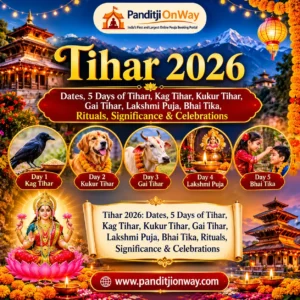
6. Tihar 2083 – November 2026
Tihar, also known as the festival of lights, is one of the most beautiful festivals in Nepal. It celebrates the relationship between humans, animals, nature, and family.
The five main traditional observances are:
| Festival | Religious or cultural significance |
|---|---|
| Kag Tihar | Worship of crows |
| Kukur Tihar | Honour and worship of dogs |
| Gai Tihar | Worship of cows |
| Laxmi Puja | Worship of Goddess Lakshmi |
| Govardhan Puja / Mha Puja | Worship of Govardhan and the self |
| Bhai Tika | Celebration of the brother-sister relationship |
In Nepal, Mha Puja and the beginning of Nepal Sambat are particularly important Newar traditions.
Best places: Kathmandu, Lalitpur, Bhaktapur, and traditional Newar settlements.
7. Chhath Parba – 15 November 2026
Chhath Parba is dedicated to Surya Dev, the Sun God, and Chhathi Maiya. Devotees offer Arghya to the setting and rising Sun and pray for family well-being, health, and prosperity.
Main rituals:
-
Preparation of traditional offerings.
-
Fasting and spiritual discipline.
-
Evening Arghya to the setting Sun.
-
Morning Arghya to the rising Sun.
Best places: Janakpur, Birgunj, Biratnagar, and riverbanks and ponds throughout the Terai region.
8. Maghe Sankranti – 15 January 2027
Maghe Sankranti marks the Sun’s transition into Makara Rashi. It is celebrated with traditional foods, holy bathing, charity, and religious prayers.
Popular foods include:
-
Til ko Laddu.
-
Chaku.
-
Ghee.
-
Tarul.
-
Sweet potatoes.
Best places: Devghat Dham, Triveni Dham, and other sacred river locations in Nepal.
9. Maha Shivaratri – 6 March 2027
Maha Shivaratri is dedicated to Lord Shiva. Devotees observe fasting, offer milk and Bilva leaves, chant Shiva mantras, and participate in night-long worship.
The Pashupatinath Temple in Kathmandu is among the most important destinations for Shivaratri celebrations.
Popular rituals:
-
Rudrabhishek.
-
Shiva Lingam Puja.
-
Maha Mrityunjaya Mantra.
-
Om Namah Shivaya chanting.
-
Night-long meditation and devotional worship.
Important Hindu Vrat and Religious Observances in 2083 BS
Apart from major festivals, several recurring vrat and tithi-based observances are important throughout the year.
| Religious observance | Meaning and importance |
|---|---|
| Ekadashi Vrat | Fasting and worship dedicated to Lord Vishnu |
| Pradosh Vrat | Evening worship of Lord Shiva on Trayodashi |
| Chandra Darshan | Worship and viewing of the new crescent Moon |
| Purnima Vrat | Full Moon fasting, prayers, and charity |
| Amavasya | New Moon observance, often associated with Pitru Tarpan |
| Sankranti | Solar transition into a new zodiac sign |
| Shraddha | Ritual offerings and prayers for ancestors |
| Navratri | Worship of the nine manifestations of Goddess Durga |
| Rudrabhishek | Sacred bathing and worship of Lord Shiva |
| Satyanarayan Puja | Worship of Lord Vishnu for well-being and prosperity |
What Is the Importance of Ekadashi in the Nepali Hindu Calendar?
Ekadashi occurs on the eleventh lunar day of both the waxing and waning Moon phases. There are generally two Ekadashi observances in a lunar month.
Devotees observe Ekadashi to worship Lord Vishnu, practice self-discipline, and develop spiritual awareness.
Some of the important Ekadashi observances in 2083 BS include:
-
Mohini Ekadashi.
-
Apara Ekadashi.
-
Padmini Ekadashi.
-
Parama Ekadashi.
-
Nirjala Ekadashi.
-
Yogini Ekadashi.
-
Harishayani Ekadashi.
-
Kamika Ekadashi.
-
Putrada Ekadashi.
-
Aja Ekadashi.
-
Indira Ekadashi.
-
Haribodhini Ekadashi.
-
Mokshada Ekadashi.
-
Safala Ekadashi.
-
Shat-Tila Ekadashi.
-
Vijaya Ekadashi.
-
Amalaki Ekadashi.
-
Papamochani Ekadashi.
For Ekadashi fasting, the exact observance should be determined using the local Panchang, including Hari Vasara and Parana timings.
What Is Pradosh Vrat and Why Is It Observed?
Pradosh Vrat is dedicated to Lord Shiva and is observed on Trayodashi Tithi.
Devotees traditionally worship Lord Shiva during the evening Pradosh period.
The weekday on which Pradosh occurs gives the observance its traditional name:
| Name | Weekday |
|---|---|
| Soma Pradosh | Monday |
| Bhauma Pradosh | Tuesday |
| Budha Pradosh | Wednesday |
| Guru Pradosh | Thursday |
| Shukra Pradosh | Friday |
| Shani Pradosh | Saturday |
| Ravi Pradosh | Sunday |
Devotees perform Shiva Puja, offer Bilva leaves, chant mantras, and observe fasting according to their religious traditions.
Best Places in Nepal to Celebrate Hindu Festivals and Visit Sacred Temples
Nepal is home to many ancient Hindu temples, Shakti Peethas, pilgrimage destinations, and religious heritage sites. Visiting these places during major festivals offers devotees an opportunity to experience traditional worship and Nepal’s spiritual culture.
| Temple / Religious place | Location | Religious importance |
|---|---|---|
| Pashupatinath Temple | Kathmandu | Lord Shiva and Maha Shivaratri |
| Janaki Mandir | Janakpur | Goddess Sita and Ram Navami |
| Muktinath Temple | Mustang | Lord Vishnu and liberation |
| Manakamana Temple | Gorkha | Goddess Bhagwati |
| Krishna Mandir | Lalitpur | Lord Krishna and Janmashtami |
| Budhanilkantha Temple | Kathmandu | Lord Vishnu |
| Dakshinkali Temple | Kathmandu | Goddess Kali |
| Guhyeshwari Temple | Kathmandu | Shakti worship |
| Halesi Mahadev Temple | Khotang | Lord Shiva |
| Devghat Dham | Chitwan/Tanahun | Sacred pilgrimage and holy bathing |
These destinations are especially important during Dashain, Tihar, Teej, Janmashtami, Shivaratri, and other religious occasions.
How to Book a Pandit for Nepali Hindu Festivals and Puja Ceremonies
Hindu pujas and religious ceremonies are traditionally performed with the guidance of a knowledgeable priest. The correct rituals, mantras, samagri, and auspicious timings are important parts of traditional worship.
For devotees living in Nepal, India, or abroad, arranging a suitable pandit can sometimes be challenging.
Panditji On Way – First and Largest Online Pooja Booking Portal provides an online platform to explore and arrange Hindu puja services.
Puja services to explore on Panditji On Way
-
Navgraha Shanti Puja.
-
Durga Puja.
-
Lakshmi Puja.
-
Griha Pravesh Puja.
-
Marriage and Vivah Sanskar.
-
Rudri Path.
-
Vastu Shanti Puja.
-
Mahamrityunjaya Havan.
-
Janmashtami Puja.
-
Maha Shivaratri Puja.
-
Pitru Dosha and Shraddha-related rituals.
Explore services: Panditji On Way – Online Pooja Booking Portal.
Before booking, confirm the puja’s purpose, preferred language, location, date, required samagri, priest qualifications, and any special family traditions.
Important Calendar Guidelines: Tithi, Muhurat, Location and Eclipse
The Nepali Hindu calendar follows a combination of solar and lunar calculations. Festival dates are not always identical across all locations.
Why Do Nepali Festival Dates Differ Between Cities?
Festival dates can differ due to:
-
Geographical location: Sunrise and sunset occur at different times in Kathmandu, Pokhara, Janakpur, and other cities.
-
Time zone: Local time calculations affect the interpretation of tithi boundaries.
-
Tithi duration: A lunar tithi does not necessarily correspond to a complete Gregorian calendar day.
-
Panchang traditions: Different calendar authorities may use different interpretative rules.
-
Sunrise-based observances: Some festivals depend on the tithi prevailing at sunrise, while others depend on evening or midnight timings.
For this reason, devotees should consult the appropriate local Panchang before performing a religious ceremony.
Solar and Lunar Eclipses in 2083 BS
Eclipses are astronomical events, but their religious observance depends on traditional rules and local visibility.
The supplied calendar mentions these eclipse dates:
| Date | Event listed | Verification note |
|---|---|---|
| 12 August 2026 | Total solar eclipse | NASA identifies a total solar eclipse; Nepal is not among the listed total-eclipse viewing regions |
| 28 August 2026 | Partial lunar eclipse | Check local visibility and local astronomical timings |
| 6 February 2027 | Annular solar eclipse | NASA lists visibility in parts of South America and Africa, not Nepal |
| 21 February 2027 | Penumbral lunar eclipse | NASA gives the event as 20–21 February, depending on location and time zone |
NASA’s astronomical information should be used to distinguish an eclipse’s global occurrence from its visibility at a particular location.
Important: Do not assume Sutak Kaal applies in every location merely because an eclipse occurs somewhere in the world. Consult a local religious authority and astronomical visibility information.
Frequently Asked Questions (FAQs): Nepali Festivals 2083 BS
The following FAQs are written to answer common search queries directly and provide useful information for readers.
1. When does Nepali Year 2083 BS start and end?
Nepali Year 2083 BS starts on 14 April 2026 (Tuesday) and ends on 13 April 2027 (Tuesday). It follows the Bikram Sambat calendar, which is widely used in Nepal for official dates, festivals, and cultural observances.
2. What are the most important Nepali festivals in 2083 BS?
The major festivals include Nepali New Year, Buddha Jayanti, Haritalika Teej, Raksha Bandhan, Krishna Janmashtami, Dashain, Tihar, Chhath Parba, Maghe Sankranti, Vasant Panchami, and Maha Shivaratri.
These festivals represent Nepal’s religious, cultural, and spiritual traditions.
3. When is Dashain in Nepal in 2083 BS?
According to the supplied 2083 festival calendar, Ghatasthapana is on 11 October 2026, Phulpati on 17 October, Maha Ashtami on 18 October, Maha Navami on 20 October, and Vijaya Dashami on 21 October 2026.
Dashain is celebrated through Durga worship, family gatherings, Tika, Jamara, and traditional blessings.
4. When is Tihar in Nepal in 2083 BS?
Tihar is celebrated in November 2026. The main celebrations include Kag Tihar, Kukur Tihar, Gai Tihar, Laxmi Puja, Govardhan Puja, Mha Puja, and Bhai Tika.
For Nepal-specific dates, consult the Kathmandu Metropolitan City calendar or the latest local Panchang because some dates in the supplied list differ from the municipal calendar.
5. When is Haritalika Teej in 2026?
Haritalika Teej is listed on 14 September 2026 (Monday). It is dedicated to Lord Shiva and Goddess Parvati. Women traditionally observe fasting, perform puja, sing devotional songs, and pray for family happiness and marital well-being.
6. When is Krishna Janmashtami in Nepal in 2026?
Krishna Janmashtami is listed on 4 September 2026 (Friday). It celebrates the birth of Lord Krishna. Devotees observe fasting, perform Krishna Puja, sing bhajans, recite the Bhagavad Gita, and participate in midnight worship.
7. When is Raksha Bandhan in Nepal in 2083 BS?
Raksha Bandhan is listed on 28 August 2026 (Friday), corresponding to Shrawan Shukla Purnima in the supplied calendar. The festival celebrates the bond of affection, protection, and responsibility between brothers and sisters.
8. When is Chhath Parba in Nepal in 2026?
Chhath Parba is listed on 15 November 2026 (Sunday). It is dedicated to the Sun God and Chhathi Maiya. Devotees offer Arghya to the setting and rising Sun, observe fasting, and pray for the well-being of their families.
9. When is Maghe Sankranti in Nepal in 2027?
Maghe Sankranti falls on 15 January 2027 (Friday). It marks the Sun’s transition into Makara Rashi. People traditionally celebrate by taking holy baths, offering prayers, and eating sesame sweets, chaku, ghee, and tarul.
10. When is Maha Shivaratri in Nepal in 2027?
Maha Shivaratri is listed on 6 March 2027 (Saturday). It is dedicated to Lord Shiva. Devotees observe fasting, perform Rudrabhishek, chant Shiva mantras, and visit important Shiva temples, particularly Pashupatinath Temple in Kathmandu.
11. Which is the most important Hindu temple in Nepal?
Pashupatinath Temple in Kathmandu is among Nepal’s most important Hindu pilgrimage destinations. Dedicated to Lord Shiva, it attracts devotees throughout the year, particularly during Maha Shivaratri and other significant religious occasions.
12. How many Ekadashis are observed in 2083 BS?
Traditionally, there are approximately 24 Ekadashi observances in a regular lunar year, with additional observances possible during Adhik Maas. The 2083 calendar includes important Ekadashis such as Nirjala, Mohini, Padmini, Parama, Yogini, Harishayani, Kamika, Aja, Indira, Haribodhini, Mokshada, and Amalaki Ekadashi.
13. Why do Nepali Hindu festival dates change every year?
Hindu festivals are determined by lunar tithis, solar transitions, Nakshatras, and local sunrise or sunset calculations. Since the Gregorian calendar follows a different system, Hindu festivals move between Gregorian dates every year.
14. Which Nepali cities are best for experiencing Hindu festivals?
Kathmandu, Lalitpur, Bhaktapur, Janakpur, Pokhara, Biratnagar, and Gorkha are among the important destinations for experiencing Nepali Hindu festivals.
Kathmandu is particularly significant for Pashupatinath and Dashain celebrations, Janakpur for Janaki Mandir and Chhath, and Bhaktapur for traditional New Year and Tihar celebrations.
15. What is the difference between Bikram Sambat and the Gregorian calendar?
Bikram Sambat is a traditional calendar system used in Nepal, while the Gregorian calendar is internationally used. Bikram Sambat months include Baishakh, Jestha, Asar, Shrawan, Bhadau, Asoj, Kartik, Mangsir, Poush, Magh, Falgun, and Chaitra.
16. How can I find the correct puja muhurat for Nepali festivals?
To find the correct puja muhurat, consult a location-specific Panchang that includes tithi, Nakshatra, sunrise, sunset, and the applicable religious observance rules. For important ceremonies, a qualified local pandit can help determine the appropriate timing.
17. Can I book a pandit online for Hindu puja and religious ceremonies?
Yes. Devotees can explore online Hindu puja booking services through Panditji On Way. Before confirming a booking, provide the ceremony type, date, location, language preference, and required rituals so the service can be arranged appropriately.
18. What is the significance of Ghatasthapana in Dashain?
Ghatasthapana marks the beginning of Dashain and Navratri. Devotees establish a sacred Kalash and traditionally grow Jamara, which is used during Vijaya Dashami blessings. The ritual is dedicated to Goddess Durga.
19. What is Mha Puja in Nepal?
Mha Puja is a traditional Newar festival celebrated during Tihar. The word Mha means body or self. The ceremony symbolically worships and honours the self, promoting purification, good health, longevity, and prosperity. It is also associated with the beginning of Nepal Sambat.
20. Where can I check the official Nepali festival calendar for 2083?
You can consult the Government of Nepal’s Ministry of Home Affairs public holiday notice, the Kathmandu Metropolitan City calendar, the Nepal Embassy holiday notices, and a location-specific Hindu Panchang.
These sources are useful for checking public holidays and festival observances. However, government holiday lists and religious Panchangs serve different purposes, so puja timings should be checked separately.
Trusted External Resources for Nepali Festivals and Hindu Calendar Information
For accurate festival information, readers should refer to authoritative government, astronomical, and Panchang resources.
| Resource | What readers can verify |
|---|---|
| Nepal Ministry of Home Affairs | Government public holidays for 2083 |
| Kathmandu Metropolitan City Calendar | Local calendar, festivals, and holidays |
| Drik Panchang – Nepali Festivals | Nepali Hindu festival dates and tithis |
| Embassy of Nepal, New Delhi | Public holiday information for 2083 |
| NASA Future Eclipses | Scientific eclipse dates and visibility |
| Lumbini Development Trust | Information about Lumbini, a major Buddhist pilgrimage destination |
Conclusion: Celebrate Nepali Festivals 2083 with Devotion and Tradition
The year 2083 Bikram Sambat (2026–2027) is filled with important religious festivals, spiritual observances, fasting days, and cultural celebrations.
From Nepali New Year and Buddha Jayanti to Haritalika Teej, Krishna Janmashtami, Dashain, Tihar, Chhath Parba, Maghe Sankranti, and Maha Shivaratri, every festival reflects Nepal’s rich religious and cultural heritage.
Understanding festival dates, tithis, rituals, and local traditions helps devotees prepare for their religious activities and celebrate important occasions with their families.
For Hindu pujas, Vedic rituals, havans, and religious ceremonies, explore Panditji On Way – First and Largest Online Pooja Booking Portal.
Visit Panditji On Way to explore available puja services and make your religious occasions spiritually meaningful.