

Lord Vamana Avatar: Story, Mahabali, Trivikrama, Mantras, Temples, Vamana Jayanti & Complete Puja Guide
Lord Vamana is the fifth incarnation of Lord Vishnu in the commonly followed Dashavatara tradition. He is remembered as the divine Brahmin dwarf who approached King Mahabali and asked for three paces of land. When Mahabali granted the request, Vamana expanded into His magnificent Trivikrama form and covered the cosmic realms in two steps. For the third step, Mahabali offered his own head.
The story of Lord Vamana and King Mahabali is one of the most important narratives associated with Vishnu Avatar, Vamana Jayanti, Vamana Dwadashi and Onam. It explores themes of dharma, generosity, humility, devotion, surrender and the relationship between spiritual power and worldly authority.
According to the Srimad Bhagavatam, Vamanadeva appeared as the son of Sage Kashyapa and Goddess Aditi and later visited Mahabali’s sacrificial arena. The Bhagavatam describes Vamana’s appearance, His Brahmachari form and His visit to Bali’s yajna.
Panditji on Way, an online Puja booking platform, provides information and booking assistance for Hindu Puja, Havan, Jaap, Katha and other Vedic rituals. Devotees planning Vishnu Puja or Vamana-related worship can use the platform to explore available Puja services.
Lord Vamana at a Glance
| Topic | Details |
|---|---|
| Deity | Lord Vamana |
| Divine Identity | Avatar of Lord Vishnu |
| Avatar Number | Fifth in the commonly followed Dashavatara |
| Other Name | Vamanadeva |
| Cosmic Form | Trivikrama |
| Father | Sage Kashyapa |
| Mother | Goddess Aditi |
| Associated King | Mahabali / Bali |
| Major Story | Three Steps of Land |
| Important Festival | Vamana Jayanti |
| Other Major Festival | Onam |
| Tithi Associated with Vamana Jayanti | Shukla Dwadashi of Bhadrapada in many traditions |
| Main Scriptures | Srimad Bhagavatam, Vishnu Purana, Vamana Purana and Vedic literature |
| Iconographic Form | Dwarf Brahmin / Brahmachari |
| Major Temple Connection | Thrikkakara, Kerala |
| Famous Temple | Vamana Temple, Khajuraho, Madhya Pradesh |
| Major Spiritual Themes | Dharma, humility, generosity, devotion and surrender |
Who Is Lord Vamana?

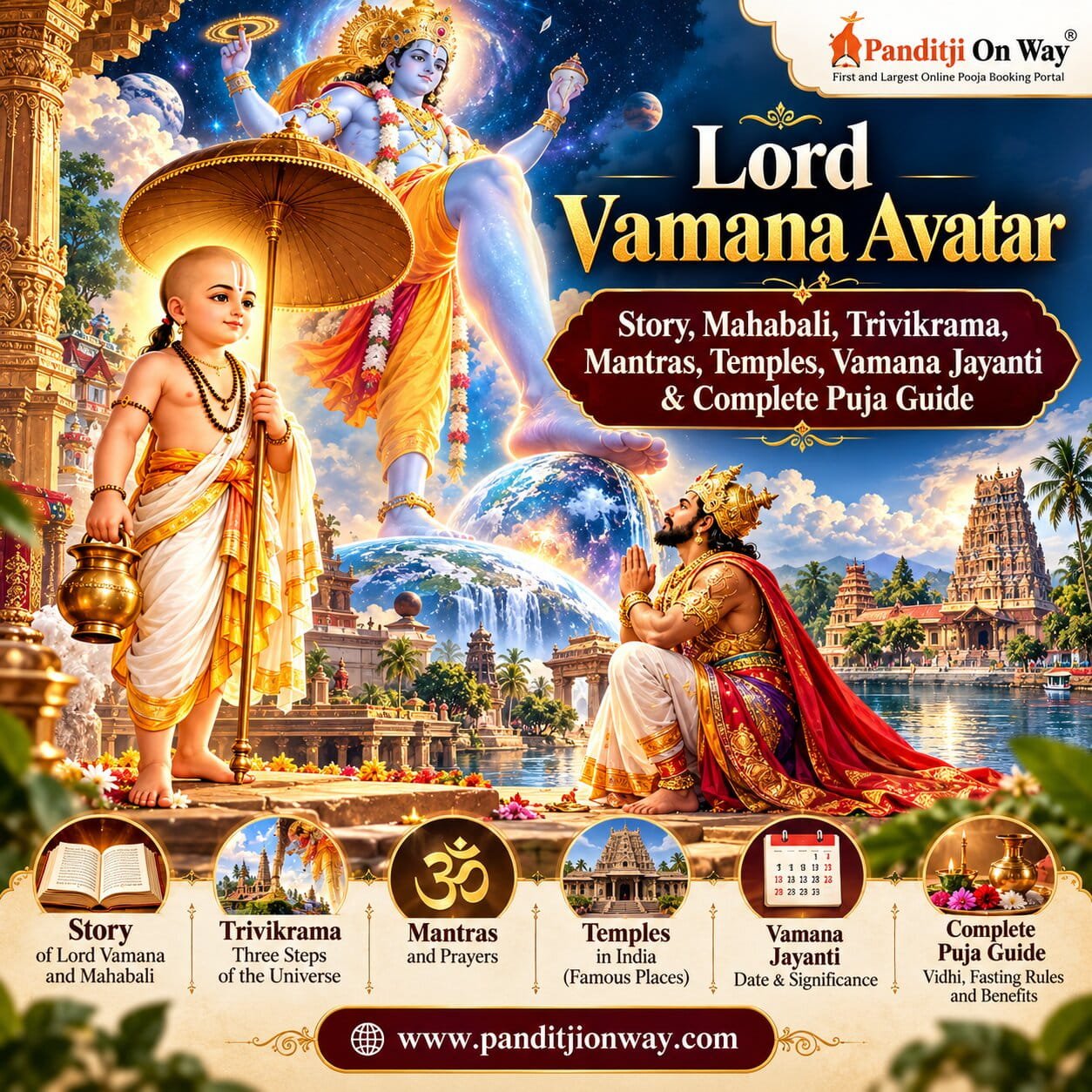
Lord Vamana is the fifth incarnation of Lord Vishnu according to the commonly followed Dashavatara sequence.
The Sanskrit name Vamana is associated with His dwarf or short-statured Brahmin form. In the Vamana narrative, however, His apparently small physical form conceals His cosmic divinity. After receiving Mahabali’s promise of three steps of land, Vamana assumes the immense Trivikrama form.
The Srimad Bhagavatam describes Vamanadeva appearing from Aditi and Kashyapa and then assuming the form of a dwarf Brahmachari. He carries the traditional items associated with a Brahmin student, including a staff, umbrella and water pot.
Lord Vamana is also associated with names such as:
- Vamanadeva
- Vamana
- Trivikrama
- Urukrama
- Upendra
- Vikrama
- Balibandhana
- Dadhivamana
The name Trivikrama is especially important because it refers to the cosmic manifestation of Vishnu in which the Lord takes three great strides.
Why Did Lord Vishnu Take the Vamana Avatar?
The central purpose of the Vamana Avatar is traditionally connected with the restoration of cosmic order and the protection of dharma.
King Mahabali had become extraordinarily powerful and, according to the traditional narrative, had established his authority over the three worlds. His power caused concern among the Devas, particularly Indra.
Aditi, mother of the Devas, undertook devotional austerities and prayed to Lord Vishnu. In response to her devotion, Vishnu agreed to appear as her son.
Thus, Lord Vamana was born to Kashyapa and Aditi.
The Bhagavatam describes His appearance as an auspicious divine event and states that after appearing in His original divine form, He assumed the form of Vamana, the dwarf Brahmachari.
The story therefore is not simply about defeating a powerful king. It is also about:
- Restoring balance.
- Testing generosity.
- Demonstrating the power of divine wisdom.
- Teaching humility.
- Honouring a promise.
- Transforming worldly power into spiritual surrender.
Lord Vamana and King Mahabali: Complete Story
Mahabali’s Lineage
King Mahabali, also called Bali or Mahabali Chakravarti, belonged to the Asura lineage.
He was the grandson of Prahlada, one of the most celebrated devotees of Lord Vishnu.
Mahabali inherited qualities associated with his lineage but was also remembered for generosity, courage and devotion.
According to the traditional narrative, Mahabali’s growing power enabled him to defeat Indra and extend his authority across the three worlds.
Mahabali Performs the Ashvamedha Yajna
Mahabali organized a great sacrificial ceremony as part of his royal ambitions.
His reputation for generosity was already widespread. It was said that anyone who approached him seeking charity would not leave empty-handed.
The sacrificial arena therefore became the setting for one of the most famous encounters in Hindu religious literature.
Aditi Prays to Lord Vishnu
The Devas approached Aditi and explained their difficulties.
Aditi performed austerities and worshipped Lord Vishnu.
Pleased with her devotion, Vishnu granted her wish and agreed to appear as her son.
Vamana was subsequently born to Aditi and Kashyapa.
The Appearance of Vamana as a Brahmin Boy
When Lord Vamana arrived at Mahabali’s sacrificial arena, He appeared as a young Brahmin Brahmachari.
Traditional descriptions associate Vamana with:
- A wooden umbrella
- A Brahmin’s staff
- Kamandalu
- Sacred thread
- Simple Brahminical clothing
- Spiritual radiance
The Srimad Bhagavatam specifically describes Vamana arriving at Bali’s sacrificial arena carrying a staff, umbrella and water pot.
Mahabali welcomed the young Brahmin and offered to grant Him whatever He desired.
What Did Lord Vamana Ask From Mahabali?
Lord Vamana asked for only three paces of land.
Mahabali was surprised because the request appeared extremely small compared with his enormous wealth and authority.
He offered Vamana the opportunity to ask for much more.
Vamana, however, insisted upon three steps.
Mahabali agreed.
This simple request became the turning point of the entire story.
Shukracharya Warns Mahabali
Shukracharya, the spiritual teacher of the Asuras, recognized that the young Brahmin was actually Lord Vishnu.
He warned Mahabali against making the donation.
According to the traditional account, Shukracharya attempted to prevent the ritual water from flowing from the vessel used to confirm the donation.
Vamana then used a blade of grass to clear the obstruction.
The story traditionally explains this episode as the reason Shukracharya lost the sight of one eye.
Despite his Guru’s warning, Mahabali decided to honour his promise.
Vamana Becomes Trivikrama
After Mahabali granted the three steps, the small Brahmin boy expanded into an immense cosmic form.
This is the Trivikrama form of Lord Vishnu.
The contrast is central to the symbolism of the story:
Vamana represents apparent smallness; Trivikrama reveals limitless divinity.
The Srimad Bhagavatam describes the Lord expanding His body and taking His first and second steps across the cosmic realms, leaving no place for the third step.

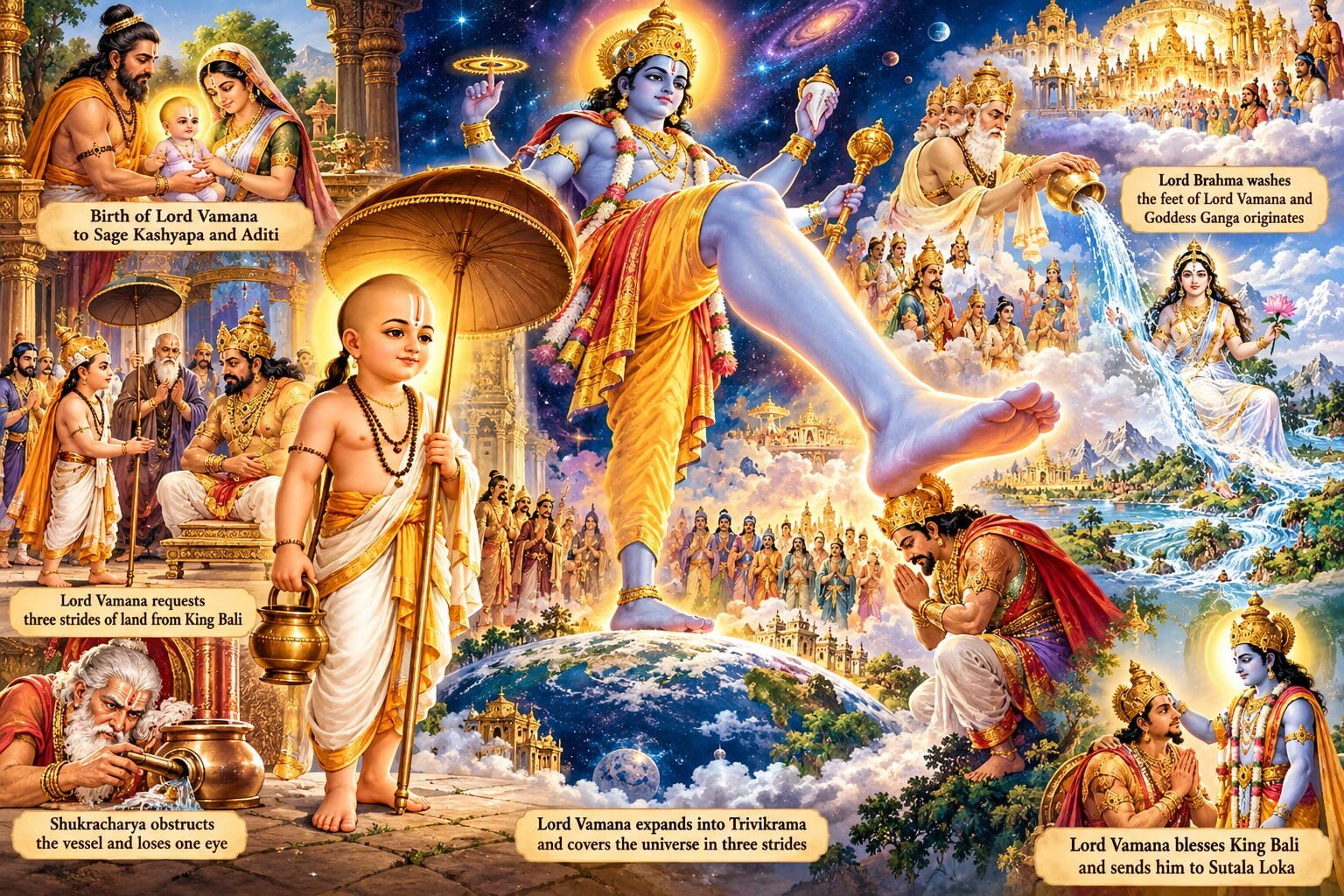
The Three Steps of Lord Vamana
| Step | What Lord Vamana Covered | Meaning |
|---|---|---|
| First Step | Earth / terrestrial realm | Divine sovereignty over the material world |
| Second Step | Heavenly and cosmic realms | Expansion beyond worldly boundaries |
| Third Step | Mahabali’s head | Surrender, humility and fulfillment of the promise |
The exact cosmological interpretation of the three steps varies among Hindu textual and theological traditions. The central narrative, however, consistently focuses on Vamana’s transformation into Trivikrama and Mahabali’s inability to provide a separate location for the third step.
Why Did Mahabali Offer His Head to Lord Vamana?
After two steps, Vamana had covered the realms promised by Mahabali.
There was no physical space remaining for the third step.
Mahabali then offered his own head.
This moment is one of the most significant parts of the Vamana story.
Mahabali had made a promise.
Rather than breaking his word, he surrendered himself.
Lord Vamana placed His third step upon Mahabali’s head.
The episode is traditionally interpreted as a powerful illustration of:
- Keeping one’s word
- Humility
- Devotion
- Surrender
- Generosity
- Recognition of divine authority
What Happened to Mahabali After the Third Step?
Traditional accounts differ in their description of Mahabali’s final destination and status.
One widely known version says that Mahabali was sent to Sutala or Patala, the nether regions.
Another devotional interpretation emphasizes that Mahabali was blessed by Lord Vishnu and granted a special place under divine protection.
The story of Mahabali therefore does not simply end with his loss of earthly sovereignty.
His generosity and commitment to his promise are remembered with respect, especially in the cultural traditions surrounding Onam in Kerala.
Lord Vamana and Onam
The connection between Lord Vamana and Onam is particularly strong in Kerala.
According to Kerala’s traditional Onam narrative, King Mahabali returns annually to visit his people.
The Thrikkakara Vamanamoorthy Temple in Ernakulam, Kerala, is one of the most important sacred sites associated with the Vamana-Mahabali tradition.
Kerala Tourism describes Thrikkakara as a major centre of Onam celebrations and identifies its presiding deity as Lord Vamana. The temple’s annual celebrations include rituals, processions, floral decorations and Onam festivities.
The official Kerala Tourism material also describes Thrikkakara’s association with the Mahabali legend and the 10-day Onam celebration.
Onam and Mahabali
Onam is associated with:
- King Mahabali
- Lord Vamana
- The annual return of Mahabali
- Pookalam
- Onasadya
- Thiruvonam
- Community celebrations
- Traditional worship
Kerala Tourism describes Onam as a ten-day festival beginning with the Atham asterism in the month of Chingam, with Pookkalam and Onasadya among its major traditions.
Famous Vamana Temples in India
1. Thrikkakara Vamanamoorthy Temple, Kerala
Location: Thrikkakara, Ernakulam, Kerala
This is one of the most important temples associated with Lord Vamana and the Mahabali-Onam tradition.
Kerala Tourism identifies the temple as a major centre of Onam celebrations and states that it is dedicated to Vamanamoorthy, the Vamana form of Lord Vishnu.
locationwise search keywords:
- Lord Vamana Temple Kerala
- Vamana Temple Thrikkakara
- Vamanamoorthy Temple Ernakulam
- Lord Vamana Temple Kochi
- Mahabali Temple Kerala
- Vamana Onam Temple
2. Vamana Temple, Khajuraho, Madhya Pradesh
Location: Khajuraho, Chhatarpur district, Madhya Pradesh
The Vamana Temple at Khajuraho is an important temple dedicated to the dwarf incarnation of Lord Vishnu.
The Government of India’s Incredible India tourism portal identifies the Vamana Temple as a temple dedicated to the dwarf incarnation of Vishnu and notes its architectural and sculptural features.
The Archaeological Survey of India also lists the Vamana Temple, Khajuraho among the centrally protected monuments/sites.
location keywords:
- Vamana Temple Khajuraho
- Lord Vamana Temple Madhya Pradesh
- Vamana Temple Chhatarpur
- Vishnu Temple Khajuraho
- Vamana Avatar Temple India
3. Other Vamana-Related Temples and Sacred Sites
Devotees may also encounter Vamana or Trivikrama worship in different Vaishnava traditions across India.
When researching a particular temple, it is useful to distinguish between:
- A temple whose principal deity is Vamana.
- A temple containing a Vamana shrine.
- A temple dedicated to Trivikrama.
- A Vishnu temple that commemorates the Vamana-Bali narrative.
This distinction makes temple research more accurate and avoids treating every Vishnu temple as a dedicated Vamana temple.
Lord Vamana Iconography
Lord Vamana is commonly represented as a short-statured Brahmin youth.
His traditional iconography may include:
- Chatra: umbrella
- Lakuti or Danda: staff
- Kamandalu: water pot
- Sacred thread
- Simple Brahminical clothing
In His Trivikrama form, Vishnu is represented as a magnificent cosmic figure with an enormous stride.
The imagery may depict:
- One foot extending across the earthly realm.
- Another reaching toward the heavens.
- Mahabali below.
- Brahma worshipping or washing the Lord’s raised foot.
- Divine beings witnessing the cosmic manifestation.
The Vamana narrative therefore has two major visual forms:
Vamana: the dwarf Brahmin.
Trivikrama: the cosmic Vishnu taking the three great strides.
Lord Vamana Family
| Family Member | Relationship |
|---|---|
| Sage Kashyapa | Father |
| Goddess Aditi | Mother |
| Lord Indra | Brother |
| Other Adityas | Brothers |
| Prahlada | Ancestor of Mahabali, not Vamana’s direct family member |
Vamana is traditionally identified with the Adityas, the divine sons of Kashyapa and Aditi.
Different Hindu texts and traditions may vary in how they enumerate and identify the Adityas, so lists should be understood in their textual context.
Is Lord Vamana Married?
Lord Vamana is traditionally depicted as a Brahmachari in the Vamana incarnation.
Therefore, unlike several other forms or manifestations of Vishnu, the Vamana form is not generally presented as having a wife.
His Brahmachari identity is an important part of the narrative because He approaches Mahabali as a young Brahmin student.
Lord Vamana Mantras
Devotees may chant traditional Vishnu and Vamana mantras according to their sampradaya, family tradition and spiritual practice.
Vamana Mantra
ॐ वामनाय नमः।
Om Vamanaya Namah.
Meaning:
A devotional salutation to Lord Vamana.
Dadhivamana Mantra
ॐ नमो भगवते दधिवामनाय।
Om Namo Bhagavate Dadhivamanaya.
This mantra invokes Lord Dadhivamana.
Vamana Pranam Mantra
देवेश्वराय देवस्य देवसम्भूतिकारिणे।
प्रभावे सर्वदेवानां वामनाय नमो नमः॥
Deveshvaraya Devasya Devasambhutikarine
Prabhave Sarvadevanam Vamanaya Namo Namah.
Devotees may recite Vamana prayers with concentration and devotion rather than treating the number of repetitions as the only measure of worship.
Lord Vamana Gayatri Mantra
ॐ तपरूपाय विद्महे सृष्टिकर्ताय धीमहि।
तन्नो वामनः प्रचोदयात्॥
Om Taparupaya Vidmahe
Srishtikartaya Dhimahi
Tanno Vamanah Prachodayat.
For formal Vedic or temple rituals, devotees should follow the pronunciation and procedure taught by their qualified Guru, Acharya or family tradition.
How to Worship Lord Vamana at Home
A simple home worship can be performed according to one’s family tradition.
Basic Vamana Puja Steps
| Step | Puja Practice |
|---|---|
| 1 | Clean the Puja area |
| 2 | Take a bath and wear clean clothes |
| 3 | Place an image or murti of Lord Vamana |
| 4 | Light a lamp |
| 5 | Offer flowers |
| 6 | Offer Tulsi where appropriate in Vishnu worship |
| 7 | Offer fruits and suitable Naivedya |
| 8 | Chant Vamana or Vishnu mantras |
| 9 | Read or listen to Vamana Katha |
| 10 | Perform Aarti |
| 11 | Offer prayers for dharma and spiritual well-being |
| 12 | Distribute Prasad |
Ritual details can differ among Vaishnava sampradayas and regional traditions.
Vamana Jayanti
Vamana Jayanti commemorates the appearance of Lord Vamana.
It is traditionally associated with Bhadrapada Shukla Dwadashi, although the exact civil date and Puja Muhurat depend on the lunar calendar and location.
For example, Panditji on Way’s 2026 festival calendar lists Vamana Jayanti on September 23, 2026, on Bhadrapada Shukla Dwadashi, while also noting that location-specific Panchang calculations should be checked for exact timings.
For current festival dates, devotees should always verify:
- Local sunrise
- Dwadashi Tithi
- Puja Muhurat
- Fasting rules
- Parana timing
- Local Panchang
Vamana Jayanti Puja Vidhi
A traditional Vamana Jayanti observance may include:
- Morning bath and purification.
- Sankalpa.
- Cleaning the Puja area.
- Installation of Lord Vamana’s image or murti.
- Invocation of Lord Vishnu.
- Offering of flowers and Tulsi where appropriate.
- Offering of fruits and Naivedya.
- Recitation of Vamana Mantra.
- Reading Vamana Avatar Katha.
- Vishnu Sahasranama or Vishnu prayers.
- Aarti.
- Charity or Annadan according to one’s ability.
Fasting should be followed according to one’s health, age, family tradition and guidance from a qualified religious authority.
Spiritual Significance of Lord Vamana
The Vamana Avatar carries several layers of spiritual symbolism.
1. Humility
Vamana appears in a small and simple form despite being the Supreme Divine Being in the narrative.
The story demonstrates that spiritual greatness does not have to appear in a form associated with worldly power.
2. The Limits of Material Power
Mahabali possesses extraordinary wealth and authority, yet his possessions cannot contain the cosmic form of Vishnu.
The story presents worldly sovereignty as limited compared with the divine.
3. The Importance of Keeping a Promise
Mahabali is remembered for refusing to withdraw his promise even after understanding the identity of Vamana.
His commitment to his word becomes one of the defining elements of his character.
4. Devotion Through Surrender
The third step, placed on Mahabali’s head, is traditionally understood as an act of surrender.
5. Divine Protection of Dharma
The Vamana story is traditionally understood as part of Vishnu’s role in restoring balance and protecting dharma.
Vamana and Trivikrama: What Is the Difference?
| Vamana | Trivikrama |
|---|---|
| Dwarf Brahmin form | Cosmic form of Vishnu |
| Young Brahmachari | Universal manifestation |
| Carries umbrella and staff | Often depicted with Vishnu’s divine attributes |
| Approaches Mahabali | Measures the universe |
| Requests three paces | Takes the cosmic strides |
| Represents humility and divine strategy | Represents cosmic sovereignty |
Thus, Vamana and Trivikrama are not two unrelated deities in this narrative. Trivikrama represents the cosmic manifestation of the Vamana Avatar.
Vamana Avatar in Hindu Scriptures
The Vamana story appears in multiple Hindu textual traditions.
Important sources include:
Srimad Bhagavatam
The Eighteenth and Nineteenth Chapters of the Eighth Canto provide an extensive account of Vamanadeva’s appearance, His arrival at Bali’s sacrificial arena and the three-step episode.
Vishnu Purana
The Vishnu Purana also contains traditions concerning Vishnu’s incarnations and the story of Bali and Vamana.
Vamana Purana
The Vamana Purana is another important Sanskrit Purana associated with the Vamana tradition.
Vedic Literature
The Vamana-Trivikrama imagery is also associated with ancient Vedic references to Vishnu’s strides.
For scholarly or academic work, readers should consult critical editions, translations and the relevant Sanskrit passages rather than relying exclusively on modern retellings.
Lord Vamana Temples and Important Places for Devotees
| Place | State | Vamana Connection | SEO Search Intent |
|---|---|---|---|
| Thrikkakara | Kerala | Vamanamoorthy and Mahabali-Onam tradition | Vamana Temple Kerala |
| Ernakulam | Kerala | Major Vamana worship centre | Vamana Temple Ernakulam |
| Kochi | Kerala | Thrikkakara temple connection | Vamana Temple Kochi |
| Khajuraho | Madhya Pradesh | Historic Vamana Temple | Vamana Temple Khajuraho |
| Chhatarpur | Madhya Pradesh | Vamana Temple area | Vamana Temple Madhya Pradesh |
The Government of India’s tourism portal specifically identifies the Khajuraho Vamana Temple as a temple dedicated to Vishnu’s dwarf incarnation, while the Archaeological Survey of India lists it as a protected monument.
Kerala Tourism identifies Thrikkakara Vamanamoorthy Temple as a major centre of Vamana worship and Onam celebrations.
Vamana Puja and Vishnu Puja Services by Panditji on Way
Devotees who wish to organize a Vamana Jayanti Puja, Vishnu Puja, Havan, Katha or other Hindu religious ceremony can explore services through Panditji on Way.
Panditji on Way – Online Puja & Pandit Booking
The platform covers categories such as:
- Puja
- Havan
- Jaap
- Festival Puja
- Pitru Puja
- Shanti Puja
- Hindu religious ceremonies


For Vamana Jayanti, families may consider arranging a Vamana Puja, Vishnu Puja, Vishnu Havan or devotional Katha according to their family tradition.
Vamana Jayanti 2026 – Date, Muhurat, Puja Vidhi & Vamana Avatar
Vamana Puja Locations in India
Panditji on Way can be positioned around location-based search intent such as:
Maharashtra
- Vamana Puja in Mumbai
- Vishnu Puja in Mumbai
- Vamana Jayanti Puja in Thane
- Vishnu Havan in Pune
- Vamana Puja in Navi Mumbai
Gujarat
- Vamana Puja in Ahmedabad
- Vishnu Puja in Surat
- Vamana Jayanti Puja in Vadodara
Rajasthan
- Vamana Puja in Jaipur
- Vishnu Puja in Jodhpur
- Vamana Jayanti Puja in Udaipur
Delhi NCR
- Vamana Puja in Delhi
- Vamana Jayanti Puja in Noida
- Vishnu Puja in Gurugram
- Vamana Puja in Ghaziabad
Karnataka
- Vamana Puja in Bengaluru
- Vishnu Puja in Mysuru
Telangana and Andhra Pradesh
- Vamana Puja in Hyderabad
- Vishnu Puja in Secunderabad
- Vamana Jayanti Puja in Vijayawada
- Vishnu Puja in Visakhapatnam
Tamil Nadu
- Vamana Puja in Chennai
- Trivikrama Puja in Tamil Nadu
- Vishnu Puja in Coimbatore
Kerala
- Vamana Puja in Kochi
- Vamana Puja in Ernakulam
- Vamana Temple Puja in Thrikkakara
- Vishnu Puja in Thiruvananthapuram
United States
For Indian and Hindu families living abroad, location-specific priest availability can be checked before booking.
Potential search locations include:
- Vamana Puja in Arizona
- Vishnu Puja in Phoenix
- Vamana Jayanti Puja in Scottsdale
- Vishnu Puja in California
- Vamana Puja in Texas
- Hindu Puja in New Jersey
- Vishnu Puja in New York
Availability depends on city, date, priest schedule and the type of ceremony requested.
Vamana Avatar: Important Facts
| Question | Short Answer |
|---|---|
| Who is Lord Vamana? | Vamana is an incarnation of Lord Vishnu. |
| Which avatar is Vamana? | Vamana is commonly regarded as the fifth Dashavatara. |
| Who were Vamana’s parents? | Sage Kashyapa and Goddess Aditi. |
| Who was Mahabali? | A powerful Asura king and grandson of Prahlada. |
| What did Vamana ask for? | Three paces of land. |
| What is Trivikrama? | The cosmic form of Vishnu manifested by Vamana. |
| What did Mahabali offer for the third step? | His own head. |
| Which festival is associated with Mahabali? | Onam. |
| Which Kerala temple is associated with Vamana? | Thrikkakara Vamanamoorthy Temple. |
| Which famous Madhya Pradesh temple is dedicated to Vamana? | Vamana Temple at Khajuraho. |
| What is Vamana Jayanti? | The traditional observance commemorating Vamana’s appearance. |
| What is Vamana’s mantra? | Om Vamanaya Namah is a commonly used devotional mantra. |
Frequently Asked Questions About Lord Vamana
1. Who is Lord Vamana?
Lord Vamana is a form of Lord Vishnu and is commonly regarded as the fifth incarnation in the Dashavatara tradition. He appears as a young Brahmin dwarf and later manifests as the cosmic Trivikrama.
2. Why did Lord Vishnu become Vamana?
According to the traditional narrative, Vishnu appeared as Vamana in response to Aditi’s prayers and to restore cosmic balance in the context of King Mahabali’s growing power.
3. Who are Lord Vamana’s parents?
Lord Vamana is traditionally described as the son of Sage Kashyapa and Goddess Aditi.
4. Who was King Mahabali?
Mahabali was a powerful king of the Asura lineage and the grandson of Prahlada. He is especially remembered for his generosity and his encounter with Lord Vamana.
5. What did Vamana ask Mahabali for?
Vamana asked Mahabali for three paces of land.
6. Why did Vamana ask for only three steps?
The request is deliberately modest in the narrative. After Mahabali grants it, Vamana expands into His cosmic Trivikrama form and uses the three steps to encompass the cosmic realms.
7. What is the Trivikrama form?
Trivikrama is the cosmic manifestation of Vishnu associated with Vamana’s three great strides.
8. What happened when Vamana took the first two steps?
According to the Bhagavatam narrative, the Lord expanded His universal form and covered the terrestrial and heavenly/cosmic realms with His first two steps.
9. Where did Vamana place the third step?
Mahabali offered his own head as the place for Vamana’s third step.
10. What happened to Mahabali after Vamana’s three steps?
Traditional accounts associate Mahabali with Sutala or Patala, while devotional traditions emphasize the blessings and divine protection granted to him by Vishnu.
11. Is Vamana the same as Trivikrama?
They are closely connected manifestations in the same narrative. Vamana is the dwarf Brahmin form, while Trivikrama is the cosmic form revealed after Vamana receives Mahabali’s promise.
12. What is the connection between Lord Vamana and Onam?
Onam in Kerala is deeply associated with King Mahabali. The traditional story connects Mahabali’s annual return to his people with the Vamana narrative. Thrikkakara is a major centre of this tradition.
13. Where is the famous Vamana Temple in Kerala?
The Vamanamoorthy Temple at Thrikkakara in Ernakulam district is one of the most prominent temples associated with Lord Vamana.
14. Where is the Vamana Temple in Khajuraho?
The Vamana Temple is located in the Khajuraho temple complex in Madhya Pradesh. It is dedicated to the dwarf incarnation of Lord Vishnu.
15. What is Vamana Jayanti?
Vamana Jayanti is the traditional Hindu observance commemorating the appearance of Lord Vamana. It is associated with Shukla Dwadashi of Bhadrapada in many Panchang traditions.
16. What mantra is used to worship Lord Vamana?
A simple devotional mantra is:
ॐ वामनाय नमः।
Om Vamanaya Namah.
17. Can Vamana Puja be performed at home?
Yes. Devotees may worship Lord Vamana at home according to their family tradition, including offering flowers, Tulsi where appropriate, fruits, Naivedya and prayers.
18. What should be offered to Lord Vamana?
Offerings vary by tradition. Common Vishnu worship may include flowers, Tulsi, fruits, sweets, water and suitable Naivedya.
19. Is Lord Vamana married?
The Vamana incarnation is traditionally portrayed as a young Brahmachari and is not generally depicted with a wife.
20. Why is Mahabali respected even though Vamana defeats his sovereignty?
Mahabali is remembered for his generosity and commitment to his promise. His decision to offer his own head for the third step is one of the central devotional elements of the story.
People Also Ask: Lord Vamana
Is Vamana the fifth Avatar of Vishnu?
Yes. Vamana is commonly listed as the fifth incarnation of Lord Vishnu in the Dashavatara sequence.
Who defeated Mahabali?
In the traditional Vamana narrative, Lord Vishnu appeared as Vamana and ultimately limited Mahabali’s cosmic sovereignty through the three-step episode.
Why did Vamana take three steps?
Vamana asked Mahabali for three paces of land. After Mahabali agreed, Vamana expanded into Trivikrama and covered the cosmic realms with His strides.
What is the story of Vamana and Bali?
Vamana approached Mahabali during a sacrificial ceremony and requested three paces of land. Mahabali granted the request. Vamana then expanded into Trivikrama and covered the realms in two steps. Mahabali offered his head for the third.
What is the relationship between Vamana and Onam?
Onam is strongly associated with the story of Mahabali, whose annual return is celebrated in Kerala. The Vamana-Mahabali tradition is particularly connected with Thrikkakara.
Which temple is famous for Lord Vamana?
The Thrikkakara Vamanamoorthy Temple in Kerala and the Vamana Temple at Khajuraho in Madhya Pradesh are two prominent examples.
What is Vamana Jayanti 2026?
Panditji on Way’s 2026 calendar lists Vamana Jayanti on September 23, 2026, corresponding to Bhadrapada Shukla Dwadashi in that calendar. Exact Muhurat should be checked for the devotee’s location.
What is Lord Vamana’s main teaching?
The narrative is traditionally associated with humility, dharma, generosity, keeping one’s word, devotion and surrender.
Conclusion: The Spiritual Meaning of Lord Vamana
The story of Lord Vamana and Mahabali remains one of the most meaningful narratives in Hindu tradition because it combines divine wisdom with a profound lesson about power, generosity and surrender.
Vamana appears as a small Brahmin youth, yet His true nature is revealed through the Trivikrama form. Mahabali possesses immense worldly authority, but ultimately demonstrates his greatness by keeping his promise and offering his own head for the third step.
The story continues to influence religious traditions, temple worship and festivals, especially Vamana Jayanti and Onam.
From the Vamanamoorthy Temple at Thrikkakara in Kerala to the historic Vamana Temple at Khajuraho, devotees encounter different expressions of this important Vishnu tradition.
For devotees planning a Vamana Puja, Vishnu Puja, Havan, Katha or Vamana Jayanti ceremony, Panditji on Way can be used to explore online Puja and Pandit-booking services.
Explore Panditji on Way Puja Booking Services
Vamana teaches that divine power can appear in the humblest form, and the three steps of Trivikrama continue to symbolize the limitless nature of the Divine.
For the published article, these are useful contextual references :
- Srimad Bhagavatam – Lord Vamanadeva, Canto 8
- Srimad Bhagavatam – Vamana’s Three Steps
- Kerala Tourism – Thrikkakara Vamanamoorthy Temple
- Kerala Tourism – Thrikkakara Onam Celebrations
- Government of India – Incredible India, Khajuraho Vamana Temple
- Archaeological Survey of India – Vamana Temple, Khajuraho
- Google Search Central – SEO & Search Appearance Guidance