


2026 Dashavatara Calendar: Lord Vishnu Avatar Jayanti Dates, Tithi, Significance, Puja Vidhi and Complete Guide
2026 Dashavatara Calendar with Matsya, Rama, Parashurama, Narasimha, Kurma, Kalki, Krishna, Varaha, Balarama, Vamana & Buddha Jayanti dates, Tithi and significance.
The 2026 Dashavatara Calendar provides the important Jayanti and festival dates associated with the major incarnations of Lord Vishnu. In Hindu tradition, Vishnu is regarded as the preserver of the universe, and the Dashavatara refers to the principal incarnations through which Lord Vishnu is believed to restore Dharma, protect devotees and establish righteousness.
In 2026, the major Vishnu Avatar observances fall across Chaitra, Vaishakha, Shravana, Bhadrapada and Ashwina months. These include Matsya Jayanti, Rama Navami, Parashurama Jayanti, Narasimha Jayanti, Kurma Jayanti, Kalki Jayanti, Krishna Janmashtami, Varaha Jayanti, Balarama Jayanti, Vamana Jayanti and Buddha Jayanti.
This complete guide by Panditji on Way explains the 2026 Dashavatara dates, Hindu lunar tithi, significance of each incarnation, traditional worship practices, fasting information, important questions and useful Panchang-related details.
2026 Dashavatara Calendar at a Glance: The first major observance is Matsya Jayanti on March 21, followed by Rama Navami on March 26. The calendar continues with Parashurama Jayanti, Narasimha Jayanti, Kurma Jayanti, Kalki Jayanti, Krishna Janmashtami, Varaha Jayanti, Balarama Jayanti, Vamana Jayanti and Buddha Jayanti.

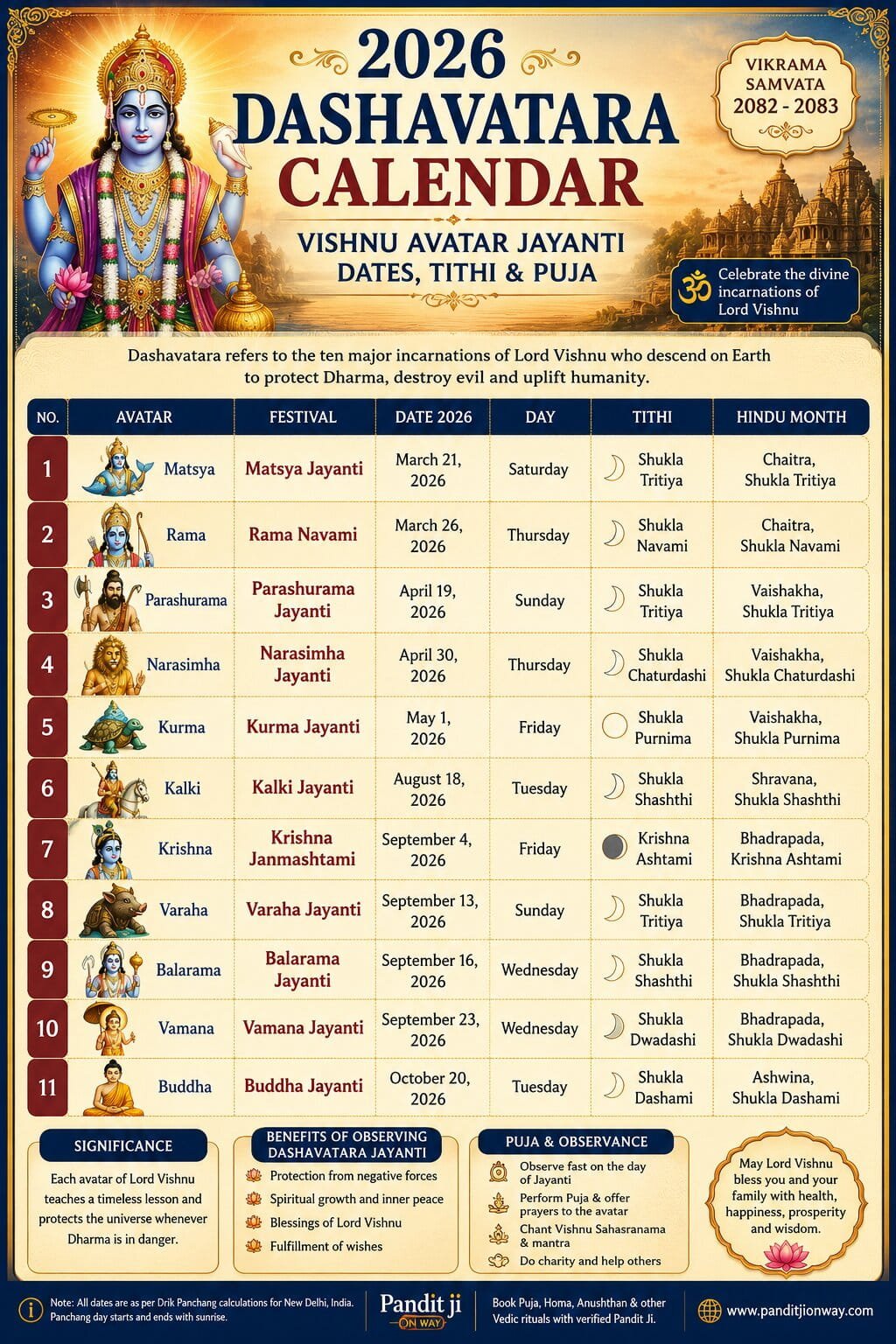
2026 Dashavatara Calendar: Complete Dates and Tithi
| No. | Avatar / Jayanti | Date in 2026 | Day | Hindu Tithi | Hindu Month |
|---|---|---|---|---|---|
| 1 | Matsya Jayanti | March 21, 2026 | Saturday | Shukla Tritiya | Chaitra |
| 2 | Rama Navami | March 26, 2026 | Thursday | Shukla Navami | Chaitra |
| 3 | Parashurama Jayanti | April 19, 2026 | Sunday | Shukla Tritiya | Vaishakha |
| 4 | Narasimha Jayanti | April 30, 2026 | Thursday | Shukla Chaturdashi | Vaishakha |
| 5 | Kurma Jayanti | May 1, 2026 | Friday | Shukla Purnima | Vaishakha |
| 6 | Kalki Jayanti | August 18, 2026 | Tuesday | Shukla Shashthi | Shravana |
| 7 | Krishna Janmashtami | September 4, 2026 | Friday | Krishna Ashtami | Bhadrapada |
| 8 | Varaha Jayanti | September 13, 2026 | Sunday | Shukla Tritiya | Bhadrapada |
| 9 | Balarama Jayanti | September 16, 2026 | Wednesday | Shukla Shashthi | Bhadrapada |
| 10 | Vamana Jayanti | September 23, 2026 | Wednesday | Shukla Dwadashi | Bhadrapada |
| 11 | Buddha Jayanti | October 20, 2026 | Tuesday | Shukla Dashami | Ashwina |
The calendar dates and tithis above correspond to the 2026 Dashavatara calendar data. Panchang calculations can vary by location, so exact sunrise, tithi-ending time and puja timings should be checked according to the devotee’s city.
What Is Dashavatara?
The word Dashavatara comes from two Sanskrit words: “Dasha,” meaning ten, and “Avatara,” meaning incarnation or descent.
According to Hindu religious tradition, Lord Vishnu assumes different forms to protect Dharma and restore cosmic balance when righteousness declines. The Dashavatara concept is therefore closely associated with the principle that divine intervention occurs whenever the balance between Dharma and Adharma is disturbed.
The commonly known sequence is:
- Matsya
- Kurma
- Varaha
- Narasimha
- Vamana
- Parashurama
- Rama
- Krishna
- Balarama or Buddha, depending on tradition
- Kalki
There is an important traditional variation here. Some North Indian traditions replace Balarama with Buddha in the ten-avatar list, while other traditions, particularly in South India, retain Balarama and do not include Buddha in the Dashavatara list.
Therefore, the 2026 calendar presented here includes both Balarama Jayanti and Buddha Jayanti so that readers can find the important observances followed by different Hindu traditions.
Dashavatara According to the Four Yugas
The traditional classification connects the avatars with the four Yugas.
| Yuga | Important Avatars |
|---|---|
| Satya Yuga | Matsya, Kurma, Varaha, Narasimha |
| Treta Yuga | Vamana, Parashurama, Rama |
| Dwapara Yuga | Balarama, Krishna |
| Kali Yuga | Kalki, who is traditionally expected at the end of Kali Yuga |
The exact interpretation and enumeration of avatars can differ across scriptures and regional traditions.
1. Matsya Jayanti 2026
Matsya Jayanti Date: March 21, 2026
Day: Saturday
Tithi: Chaitra Shukla Tritiya
Matsya is traditionally regarded as the fish incarnation of Lord Vishnu and the first avatar in the commonly accepted Dashavatara sequence.
According to Hindu tradition, Lord Vishnu appeared as Matsya to protect life and sacred knowledge during a catastrophic flood. The Matsya tradition is associated with the preservation of the Vedas and the protection of the righteous.
How is Matsya Jayanti observed?
Devotees traditionally worship Lord Vishnu and Matsya Avatar, observe fasting according to their family tradition, recite Vishnu mantras and perform charitable activities.
Matsya Jayanti is especially significant for devotees who worship Vishnu as the divine protector and preserver.
2. Rama Navami 2026
Rama Navami Date: March 26, 2026
Day: Thursday
Tithi: Chaitra Shukla Navami
Rama Navami commemorates the birth of Lord Rama, one of the most revered incarnations of Lord Vishnu.
Lord Rama is celebrated as Maryada Purushottama, representing righteousness, duty, truth, discipline and ideal conduct.
Why is Rama Navami important?
Rama Navami is one of the most significant Vaishnava festivals. Devotees worship Lord Rama, Sita, Lakshmana and Hanuman, listen to the Ramayana and participate in devotional ceremonies.
Many devotees observe a fast during the day and perform special worship during the auspicious period prescribed by their local Panchang.
3. Parashurama Jayanti 2026
Parashurama Jayanti Date: April 19, 2026
Day: Sunday
Tithi: Vaishakha Shukla Tritiya
Parashurama is traditionally described as a warrior-sage and an incarnation of Lord Vishnu. He is associated with discipline, righteousness, courage and the restoration of Dharma.
Parashurama Jayanti occurs during Vaishakha Shukla Tritiya, which is also associated with Akshaya Tritiya.
Significance of Parashurama Jayanti
Devotees worship Lord Parashurama and remember the importance of righteousness, self-discipline and the responsible use of strength.
Traditional observances may include fasting, Vishnu worship, recitation of religious texts and charity.
4. Narasimha Jayanti 2026
Narasimha Jayanti Date: April 30, 2026
Day: Thursday
Tithi: Vaishakha Shukla Chaturdashi
Lord Narasimha is the powerful man-lion incarnation of Lord Vishnu.
The Narasimha story is closely connected with Prahlada, the devoted son of the demon king Hiranyakashipu. According to Hindu tradition, Vishnu appeared as Narasimha to protect Prahlada and destroy Hiranyakashipu while honoring the conditions of the boon that had protected the demon king.
Why do devotees observe Narasimha Jayanti?
Narasimha is worshipped as a powerful protector against Adharma and evil forces.
Devotees may observe fasting, recite Narasimha prayers and perform Vishnu Puja according to their family and regional traditions.
5. Kurma Jayanti 2026
Kurma Jayanti Date: May 1, 2026
Day: Friday
Tithi: Vaishakha Shukla Purnima
Kurma is the tortoise incarnation of Lord Vishnu.
Kurma Avatar is particularly associated with the famous Samudra Manthan, or churning of the ocean. According to the traditional account, Mount Mandara was used as the churning rod, and Lord Vishnu assumed the form of a tortoise to support the mountain.
Significance of Kurma Avatar
Kurma represents stability, patience, support and the sustaining power necessary for great cosmic efforts.
On Kurma Jayanti, devotees worship Lord Vishnu and seek spiritual strength, stability and protection.
6. Kalki Jayanti 2026
Kalki Jayanti Date: August 18, 2026
Day: Tuesday
Tithi: Shravana Shukla Shashthi
Kalki is traditionally regarded as the future incarnation of Lord Vishnu who will appear at the end of Kali Yuga.
Unlike avatars associated with historical or mythological narratives of earlier Yugas, Kalki is traditionally understood as an avatar yet to appear.
What is the significance of Kalki Avatar?
Kalki represents the eventual restoration of Dharma and the destruction of Adharma at the conclusion of the Kali Yuga.
Devotees may observe Kalki Jayanti through Vishnu worship, prayer, fasting and remembrance of the principle of righteousness.
7. Krishna Janmashtami 2026
Krishna Janmashtami Date: September 4, 2026
Day: Friday
Tithi: Bhadrapada Krishna Ashtami
Krishna Janmashtami celebrates the birth of Lord Krishna, one of the most beloved and widely worshipped forms of Vishnu in Hindu tradition.
Lord Krishna’s teachings and life are central to Vaishnava traditions. The Bhagavad Gita, presented through the dialogue between Krishna and Arjuna, is one of the most influential Hindu scriptures.
How is Krishna Janmashtami celebrated?
Devotees commonly observe a fast, perform Krishna Puja, sing devotional songs, listen to Krishna Janma Katha and conduct celebrations around midnight, according to local tradition.
Temples and homes may be decorated with images of Krishna, and devotees may perform Abhishekam and other devotional rituals.
8. Varaha Jayanti 2026
Varaha Jayanti Date: September 13, 2026
Day: Sunday
Tithi: Bhadrapada Shukla Tritiya
Varaha is the boar incarnation of Lord Vishnu.
According to Hindu tradition, Lord Vishnu appeared as Varaha to rescue the Earth, personified as Bhudevi, from the cosmic waters and defeat the demon Hiranyaksha.
Significance of Varaha Avatar
Varaha represents the restoration of the Earth and the triumph of divine order over destructive forces.
Devotees worship Varaha Avatar as a symbol of protection, strength and restoration.
9. Balarama Jayanti 2026
Balarama Jayanti Date: September 16, 2026
Day: Wednesday
Tithi: Bhadrapada Shukla Shashthi
Balarama is traditionally known as the elder brother of Lord Krishna.
He is associated with strength, agriculture, protection and spiritual discipline. In several Vaishnava traditions, Balarama is regarded as an incarnation or manifestation connected with Lord Vishnu/Krishna.
Why is Balarama Jayanti important?
Devotees remember Balarama for his strength, loyalty and role in Krishna’s life and divine pastimes.
The festival may be observed through fasting, worship and devotional activities.
10. Vamana Jayanti 2026
Vamana Jayanti Date: September 23, 2026
Day: Wednesday
Tithi: Bhadrapada Shukla Dwadashi
Vamana is the dwarf Brahmin incarnation of Lord Vishnu and is traditionally regarded as the fifth avatar in the Dashavatara sequence.
The Vamana story is closely associated with King Bali.
According to Hindu tradition, Vamana approached Bali during a sacrificial ceremony and requested three paces of land. Bali agreed. Vamana then expanded into the cosmic Trivikrama form and covered Earth and Heaven in two steps. For the third step, Bali offered his own head.
The story is traditionally understood as a lesson about humility, devotion, Dharma and surrender.
Vamana Jayanti Puja
Devotees may worship Lord Vamana, observe a fast and perform Vishnu Puja. Donations of food and other suitable items may also be made according to local tradition.
11. Buddha Jayanti 2026
Buddha Jayanti Date: October 20, 2026
Day: Tuesday
Tithi: Ashwina Shukla Dashami
Some Hindu traditions include Buddha among the Dashavatara of Lord Vishnu, while other traditions use Balarama instead.
This distinction is important when discussing a complete Dashavatara calendar.
Buddha Jayanti is associated with the birth of Gautama Buddha and is observed in different ways across Buddhist and Hindu traditions.
For a Dashavatara calendar, Buddha is included in some North Indian lists, while Balarama is retained in other traditions.
Why Are There 11 Entries in This 2026 Dashavatara Calendar?
Readers may notice that this calendar contains 11 festival entries, even though Dashavatara literally means ten avatars.
The reason is the traditional difference concerning Balarama and Buddha.
One commonly followed list includes:
Matsya, Kurma, Varaha, Narasimha, Vamana, Parashurama, Rama, Krishna, Balarama and Kalki.
Another tradition replaces Balarama with Buddha:
Matsya, Kurma, Varaha, Narasimha, Vamana, Parashurama, Rama, Krishna, Buddha and Kalki.
Because both Balarama Jayanti and Buddha Jayanti are significant observances, this 2026 calendar presents both dates rather than excluding either tradition.
2026 Dashavatara Calendar: Month-Wise List
March 2026
| Date | Festival | Tithi |
|---|---|---|
| March 21 | Matsya Jayanti | Chaitra Shukla Tritiya |
| March 26 | Rama Navami | Chaitra Shukla Navami |
April 2026
| Date | Festival | Tithi |
|---|---|---|
| April 19 | Parashurama Jayanti | Vaishakha Shukla Tritiya |
| April 30 | Narasimha Jayanti | Vaishakha Shukla Chaturdashi |
May 2026
| Date | Festival | Tithi |
|---|---|---|
| May 1 | Kurma Jayanti | Vaishakha Shukla Purnima |
August 2026
| Date | Festival | Tithi |
|---|---|---|
| August 18 | Kalki Jayanti | Shravana Shukla Shashthi |
September 2026
| Date | Festival | Tithi |
|---|---|---|
| September 4 | Krishna Janmashtami | Bhadrapada Krishna Ashtami |
| September 13 | Varaha Jayanti | Bhadrapada Shukla Tritiya |
| September 16 | Balarama Jayanti | Bhadrapada Shukla Shashthi |
| September 23 | Vamana Jayanti | Bhadrapada Shukla Dwadashi |
October 2026
| Date | Festival | Tithi |
|---|---|---|
| October 20 | Buddha Jayanti | Ashwina Shukla Dashami |
What Should Devotees Do on Dashavatara Jayanti?
The exact ritual procedure varies according to the avatar, Sampradaya, family tradition and regional practice. A simple devotional observance may include:
- Wake up early and take a bath.
- Clean the Puja area.
- Place an image or idol of Lord Vishnu or the relevant Avatar.
- Light a lamp.
- Offer flowers, fruits and other suitable Naivedya.
- Recite Vishnu mantras or prayers.
- Read the relevant Avatar Katha.
- Observe a fast if permitted by one’s tradition and health.
- Perform charity or donation.
- Conclude the worship with Aarti and Prasad.
For exact Muhurat, sunrise, tithi-ending time and fasting rules, devotees should use a Panchang calculated for their specific city.
Is Fasting Observed on Dashavatara Jayanti?
Fasting is traditionally observed on several Vishnu-related Jayantis, but the rules differ from one festival and tradition to another.
Some devotees observe a complete fast, while others follow a partial fast or consume permitted fasting foods.
The correct fasting-parana time can depend on the local Panchang and the particular festival. Therefore, devotees should not assume that the same fasting rule applies to every Avatar Jayanti.
Importance of Tithi in the Dashavatara Calendar
Hindu festivals are generally determined using the lunar calendar rather than only the Gregorian calendar.
Therefore, the date of a Jayanti is connected with a specific Tithi, such as:
- Tritiya
- Navami
- Chaturdashi
- Purnima
- Shashthi
- Ashtami
- Dwadashi
- Dashami
Because Tithi begins and ends at specific times, the Gregorian calendar date alone may not provide the complete information needed to determine Puja Muhurat or fasting.
This is why a reliable Panchang should be consulted for location-specific festival timings.
2026 Dashavatara Calendar and Vikrama Samvata
The 2026 Dashavatara calendar corresponds to Vikrama Samvata 2082–2083.
The Hindu calendar uses different systems, including lunar and lunisolar calculations, and the relationship between a Gregorian year and Hindu calendar months does not correspond exactly to January–December.
This is why a single Gregorian year can contain dates belonging to more than one Vikrama Samvata year.
Dashavatara and the Message of Dharma
The Dashavatara tradition is more than a list of religious festivals. Each incarnation carries a different theological and symbolic message.
| Avatar | Traditional Theme |
|---|---|
| Matsya | Protection and preservation |
| Kurma | Stability and support |
| Varaha | Restoration of Earth |
| Narasimha | Protection of devotees and victory over Adharma |
| Vamana | Humility and surrender |
| Parashurama | Justice, discipline and restoration of Dharma |
| Rama | Duty, truth and ideal conduct |
| Krishna | Dharma, wisdom, devotion and divine guidance |
| Balarama | Strength, agriculture and protection |
| Buddha | Compassion and spiritual awakening in traditions that include him |
| Kalki | Future restoration of Dharma |
These interpretations can vary among Hindu philosophical and devotional traditions, but they provide a useful way to understand why the Avatar festivals remain spiritually significant.
Frequently Asked Questions About 2026 Dashavatara Calendar
When is Matsya Jayanti in 2026?
Matsya Jayanti will be observed on March 21, 2026, on Chaitra Shukla Tritiya according to the calendar used for this article.
When is Rama Navami in 2026?
Rama Navami will be observed on March 26, 2026, on Chaitra Shukla Navami.
When is Parashurama Jayanti in 2026?
Parashurama Jayanti falls on April 19, 2026, on Vaishakha Shukla Tritiya.
When is Narasimha Jayanti in 2026?
Narasimha Jayanti will be observed on April 30, 2026, on Vaishakha Shukla Chaturdashi.
When is Kurma Jayanti in 2026?
Kurma Jayanti falls on May 1, 2026, on Vaishakha Shukla Purnima.
When is Kalki Jayanti in 2026?
Kalki Jayanti will be observed on August 18, 2026, on Shravana Shukla Shashthi.
When is Krishna Janmashtami in 2026?
Krishna Janmashtami will be observed on September 4, 2026, on Bhadrapada Krishna Ashtami.
When is Varaha Jayanti in 2026?
Varaha Jayanti falls on September 13, 2026, on Bhadrapada Shukla Tritiya.
When is Balarama Jayanti in 2026?
Balarama Jayanti will be observed on September 16, 2026, on Bhadrapada Shukla Shashthi.
When is Vamana Jayanti in 2026?
Vamana Jayanti will be observed on September 23, 2026, on Bhadrapada Shukla Dwadashi.
When is Buddha Jayanti in 2026 according to this calendar?
Buddha Jayanti is listed on October 20, 2026, on Ashwina Shukla Dashami in the supplied Dashavatara calendar.
How many Dashavatara are there?
Dashavatara literally means ten avatars. However, the identity of the ninth avatar varies between traditions. Some lists include Balarama, while others include Buddha. This can result in calendars that show both Balarama and Buddha observances.
Which Yuga did Lord Rama belong to?
Lord Rama is traditionally associated with the Treta Yuga.
Which Yuga did Lord Krishna belong to?
Lord Krishna is traditionally associated with the Dwapara Yuga.
Which is the first Dashavatara?
Matsya, the fish incarnation of Lord Vishnu, is traditionally considered the first of the Dashavatara.
Which is the last Dashavatara?
Kalki is traditionally considered the final Dashavatara and is expected to appear at the end of Kali Yuga according to Hindu tradition.
Can Dashavatara dates vary by location?
Yes. Hindu festival calculations depend on astronomical and Panchang factors, including local sunrise and tithi timings. Therefore, exact Muhurat and fasting-parana timings can differ by city.
2026 Dashavatara Calendar: Quick Reference
For readers looking for only the dates, here is the complete quick-reference list:
March 21, 2026 — Matsya Jayanti
March 26, 2026 — Rama Navami
April 19, 2026 — Parashurama Jayanti
April 30, 2026 — Narasimha Jayanti
May 1, 2026 — Kurma Jayanti
August 18, 2026 — Kalki Jayanti
September 4, 2026 — Krishna Janmashtami
September 13, 2026 — Varaha Jayanti
September 16, 2026 — Balarama Jayanti
September 23, 2026 — Vamana Jayanti
October 20, 2026 — Buddha Jayanti
Why Choose Panditji on Way for Hindu Puja Services?

Panditji on Way is an online Puja booking platform designed to help devotees arrange traditional Hindu Puja and religious services.
The purpose of publishing the 2026 Dashavatara Calendar is not only to provide festival dates but also to help devotees understand the Tithi, significance and traditional observances associated with the different forms of Lord Vishnu.
Readers can use the calendar as a reference while planning their devotional activities, Puja ceremonies, fasting and religious observances throughout the year.
Final Word
The 2026 Dashavatara Calendar brings together the major Jayanti dates associated with Lord Vishnu and his celebrated incarnations. From Matsya Jayanti in March to Buddha Jayanti in October, each observance connects devotees with a different aspect of the Hindu understanding of Dharma, protection, devotion and divine intervention.
The most important dates to remember are Matsya Jayanti on March 21, Rama Navami on March 26, Parashurama Jayanti on April 19, Narasimha Jayanti on April 30, Kurma Jayanti on May 1, Kalki Jayanti on August 18, Krishna Janmashtami on September 4, Varaha Jayanti on September 13, Balarama Jayanti on September 16, Vamana Jayanti on September 23 and Buddha Jayanti on October 20, 2026.
For exact Puja Muhurat, sunrise, Tithi ending and fasting-parana timings, always refer to the Panchang for your specific location.
Panditji on Way — Bringing traditional Puja services closer to devotees.
- Incredible India – Ministry of Tourism for Indian cultural and tourism context.