

How The Endless Battles Between the Devas and Asuras Started
Samudra Manthan, Avatars of Vishnu & The Origin of Eternal Conflict
Introduction
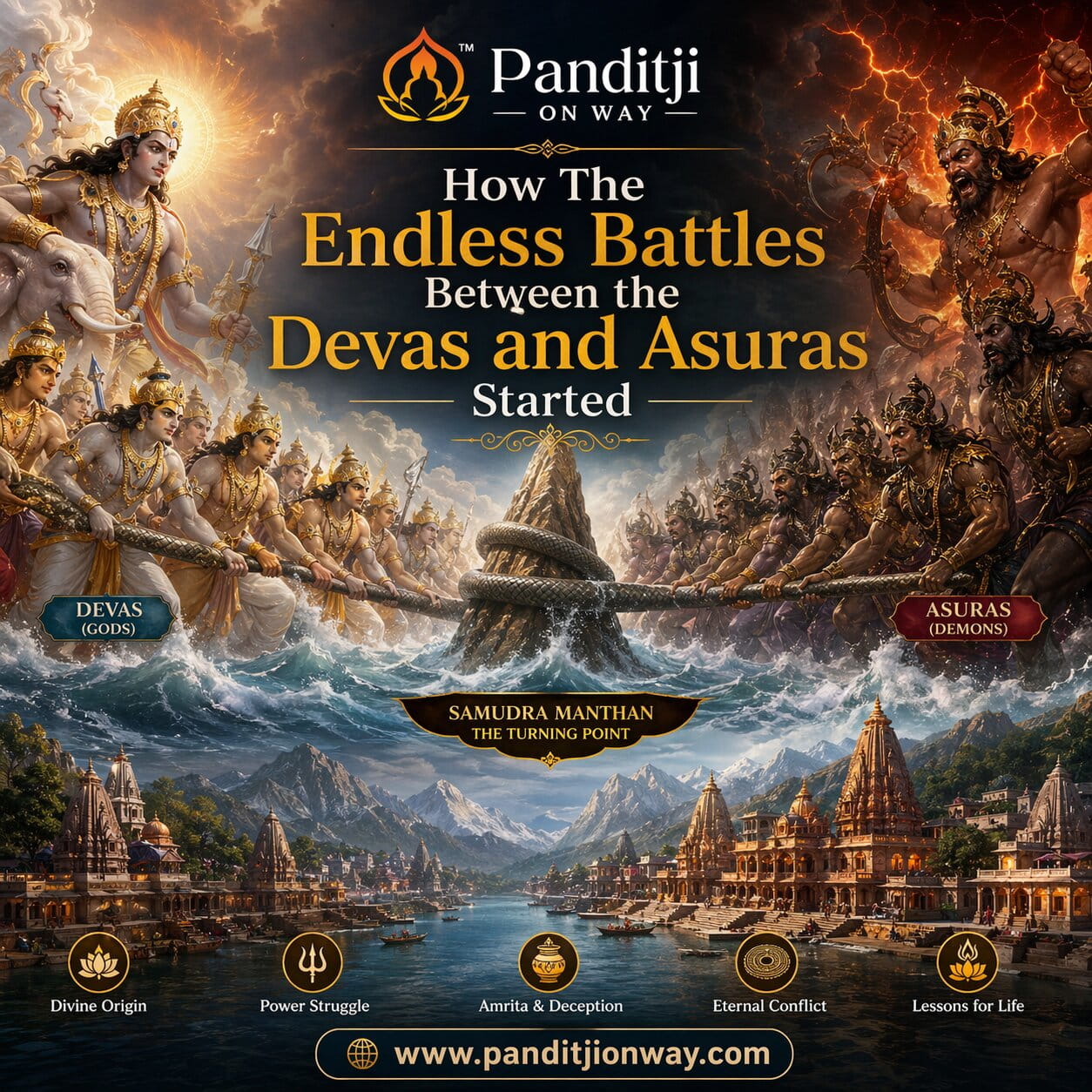
The endless battles between Devas (gods) and Asuras (demons) in Hindu scriptures originated from differences in values, power struggles, and the quest for immortality (Amrita). Key events like Samudra Manthan, the avatars of Lord Vishnu such as Narasimha and Vamana, and the deception involving Mohini intensified mistrust, leading to eternal rivalry.

Origin of Devas and Asuras
According to Hindu scriptures, all beings — Devas, Asuras, and humans — originate from Lord Brahma.
| Aspect | Devas | Asuras |
|---|---|---|
| Nature | Divine, sattvic | Powerful, ambitious |
| Goal | Maintain cosmic order (Dharma) | Seek control and dominance |
| Worship | Trimurti | Same Trimurti |
| Difference | Approach to knowledge | Ego-driven interpretation |
The key difference is not origin, but attitude and intention.
Major Conflicts Between Devas and Asuras
1. Narasimha Avatar and Hiranyakashipu


- Narasimha appeared to protect devotee Prahlada
- Killed demon king Hiranyakashipu
- Restored balance and ended tyranny
- Marked the first major divine intervention in Deva–Asura conflict
Narasimha, Prahlada, and Hiranyakashipu – Detailed Story, Meaning & Significance
The Divine Background
Narasimha is one of the most powerful incarnations of Lord Vishnu, taken to protect pure devotion and destroy arrogance. This story is a cornerstone of Hindu philosophy, symbolizing the victory of faith over ego.
Who Was Hiranyakashipu?
Boon He Received:
- Not killed by man or animal
- Not during day or night
- Not indoors or outdoors
- Not by any weapon
- Not on earth or in sky
This made him nearly invincible, leading to extreme arrogance. He declared himself God and demanded universal worship.
Prahlada – The Ideal Devotee
Prahlada, the son of Hiranyakashipu, was a true भक्त (devotee) of Lord Vishnu.
Key Traits:
- Fearless devotion
- Constant chanting of Vishnu’s name
- Unshakable faith despite torture
Tortures He Faced:
- Thrown into fire
- Poisoned
- Trampled by elephants
- Thrown from a cliff
Yet, he survived every attempt due to divine protection.
The Appearance of Narasimha
One day, Hiranyakashipu asked Prahlada:
“Where is your Vishnu?”
Prahlada replied:
“He is everywhere.”
In anger, Hiranyakashipu struck a pillar. From that pillar emerged Narasimha — a half-man, half-lion form.
How Narasimha Killed Hiranyakashipu
Narasimha cleverly bypassed the boon conditions:
| Condition | How It Was Broken |
|---|---|
| Not man or animal | Narasimha = half man, half lion |
| Not day or night | Twilight (sandhya) |
| Not indoors or outdoors | Threshold (doorstep) |
| Not on land or sky | On his lap |
| Not by weapon | Used claws |
He placed Hiranyakashipu on his lap and tore him apart with his claws, restoring cosmic balance.
Spiritual & Philosophical Meaning
1. Victory of Faith Over Ego
Prahlada represents pure devotion, while Hiranyakashipu represents ego and arrogance.
2. God Is Everywhere
The story proves that the divine is omnipresent, even in a pillar.
3. Dharma Always Wins
No matter how powerful evil becomes, truth and righteousness prevail.
Importance in Hindu Tradition
- Celebrated as Narasimha Jayanti
- Worshipped for protection from evil and fear
- Symbol of divine justice
Key Takeaways
- Narasimha avatar represents divine intervention
- Prahlada symbolizes ultimate devotion (Bhakti)
- Hiranyakashipu represents ego and misuse of power
- The story explains how God protects true भक्तों
2. Vamana Avatar and King Mahabali


- Vamana tricked Mahabali
- Took control of the universe in three steps
- Sent Mahabali to Patala (netherworld)
- Demonstrated how intelligence defeated brute power
Samudra Manthan – The Turning Point


What Happened?
The Samudra Manthan (Churning of the Ocean of Milk) is the most crucial event that sparked eternal rivalry.
Key Elements
| Element | Role |
|---|---|
| Mount Mandara | Churning rod |
| Vasuki | Rope |
| Kurma | Supported mountain |
| Lord Shiva | Consumed poison (Halahala) |
| Dhanvantari | Brought Amrita |
Important Events During Samudra Manthan
1. Curse of Durvasa
- Durvasa cursed Indra
- Devas lost power and were defeated by Asuras
2. Alliance Between Devas and Asuras
- Temporary alliance formed to obtain Amrita
- Suggested by Lord Vishnu
3. Emergence of Poison (Halahala)
- Deadly poison threatened creation
- Lord Shiva drank it → became Neelkantha
4. Appearance of Amrita
- Brought by Dhanvantari
5. Mohini Avatar and Deception
- Mohini tricked Asuras
- Amrita given only to Devas
6. Rahu–Ketu Incident
- Rahu disguised as Deva
- Beheaded by Vishnu
- Became Rahu and Ketu (shadow planets)
Why Did the Endless Battles Begin?
| Reason | Explanation |
|---|---|
| Betrayal during Samudra Manthan | Asuras were denied Amrita |
| Power struggle | Both wanted control of universe |
| Ideological conflict | Dharma vs ambition |
| Distrust | Permanent after Mohini episode |
Conclusion
The Samudra Manthan episode created permanent mistrust between Devas and Asuras. Although both originated from the same source, their intentions diverged, leading to endless cosmic battles.


For authentic Vedic rituals and expert pandit booking services:
https://www.panditjionway.com
High Authority External Links
- Encyclopaedia Britannica – https://www.britannica.com
- Wikipedia – https://www.wikipedia.org
FAQ & People Also Ask (PAA) How The Endless Battles Between the Devas and Asuras Started
1. What started the war between Devas and Asuras?
The war between Devas and Asuras started due to power struggles, ego, and the desire for immortality (Amrita). The conflict intensified after the Samudra Manthan, when Asuras were denied the nectar.
2. What is Samudra Manthan in Hindu mythology?
Samudra Manthan is the churning of the ocean of milk by Devas and Asuras to obtain Amrita (immortality nectar), guided by Lord Vishnu.
3. Why did Devas and Asuras work together during Samudra Manthan?
They formed a temporary alliance to obtain Amrita because both sides wanted immortality and ultimate power.
4. Who got the Amrita after Samudra Manthan?
Only the Devas received Amrita after Lord Vishnu took the form of Mohini and distributed it strategically.
5. Why are Asuras considered enemies of Devas?
Asuras are considered enemies due to their ambition for dominance and rejection of divine order (Dharma).
6. Who created Devas and Asuras?
Both were created by Lord Brahma, making them equal in origin.
7. What is the difference between Devas and Asuras?
The difference lies in mindset and values—Devas follow Dharma, while Asuras are driven by power and ego.
8. What role did Lord Shiva play in Samudra Manthan?
Lord Shiva consumed the deadly poison Halahala, saving the universe and earning the name Neelkantha.
9. Who are Rahu and Ketu in Hindu mythology?
Rahu and Ketu are shadow planets formed after a demon consumed Amrita and was split by Vishnu.
10. How many wars happened between Devas and Asuras?
Hindu scriptures mention 12 major wars between Devas and Asuras.
11. Why did Lord Vishnu deceive the Asuras during Samudra Manthan?
Lord Vishnu deceived the Asuras to maintain cosmic balance (Dharma). If Asuras had gained immortality, they could have disrupted universal harmony. The Mohini avatar ensured that only the deserving (Devas) received Amrita, preserving order in the cosmos.
12. What is the spiritual meaning of Deva-Asura conflict?
The Deva-Asura conflict represents the inner battle within humans—good vs evil, discipline vs desire, wisdom vs ignorance. It teaches that self-control and righteousness lead to victory, while ego leads to downfall.
13. Why did the Asuras lose despite being powerful?
Asuras lost because of lack of unity, ego, and impatience. Even though they were physically stronger, Devas had strategy, divine guidance, and discipline, which led to their victory.
14. What lessons does Samudra Manthan teach us in modern life?
Samudra Manthan teaches:
- Success requires teamwork and persistence
- Challenges (poison) come before rewards (Amrita)
- Divine guidance and patience are essential
- Greed and shortcuts lead to failure
It is a powerful metaphor for personal growth and struggle.
15. How did distrust between Devas and Asuras become permanent?
Distrust became permanent after the Amrita betrayal, where Asuras were tricked by Mohini. This event created eternal enmity, leading to continuous wars for control over the universe.
16. What is the complete story of Samudra Manthan and its significance?
Samudra Manthan is one of the most important events in Hindu mythology where Devas and Asuras churned the ocean using Mount Mandara and Vasuki. During the process, several divine elements emerged, including poison (Halahala), which was consumed by Lord Shiva, and finally Amrita, brought by Dhanvantari. The significance lies in its symbolism—life’s struggles produce both challenges and rewards, and only the wise achieve true success.
17. Why is Samudra Manthan important in Hindu philosophy?
Samudra Manthan is important because it explains cosmic balance, karma, and the duality of existence. It shows that both positive and negative forces are necessary for creation, and balance is maintained through divine intervention.
18. How do Vishnu avatars influence Deva-Asura battles?
Avatars of Lord Vishnu like Narasimha, Vamana, and Mohini play crucial roles in restoring balance. Each avatar appears during a crisis to defeat evil and protect Dharma.
19. Are Asuras always evil according to Hindu scriptures?
No, Asuras are not always evil. Some, like Mahabali, were known for their generosity and righteousness. However, their ambition and desire for control often led them into conflict with Devas.
20. What is the deeper philosophical meaning of Amrita in Samudra Manthan?
Amrita symbolizes immortality, wisdom, and spiritual enlightenment. In a deeper sense, it represents achieving moksha (liberation). Only those who follow Dharma and maintain discipline can attain this “nectar” in life.