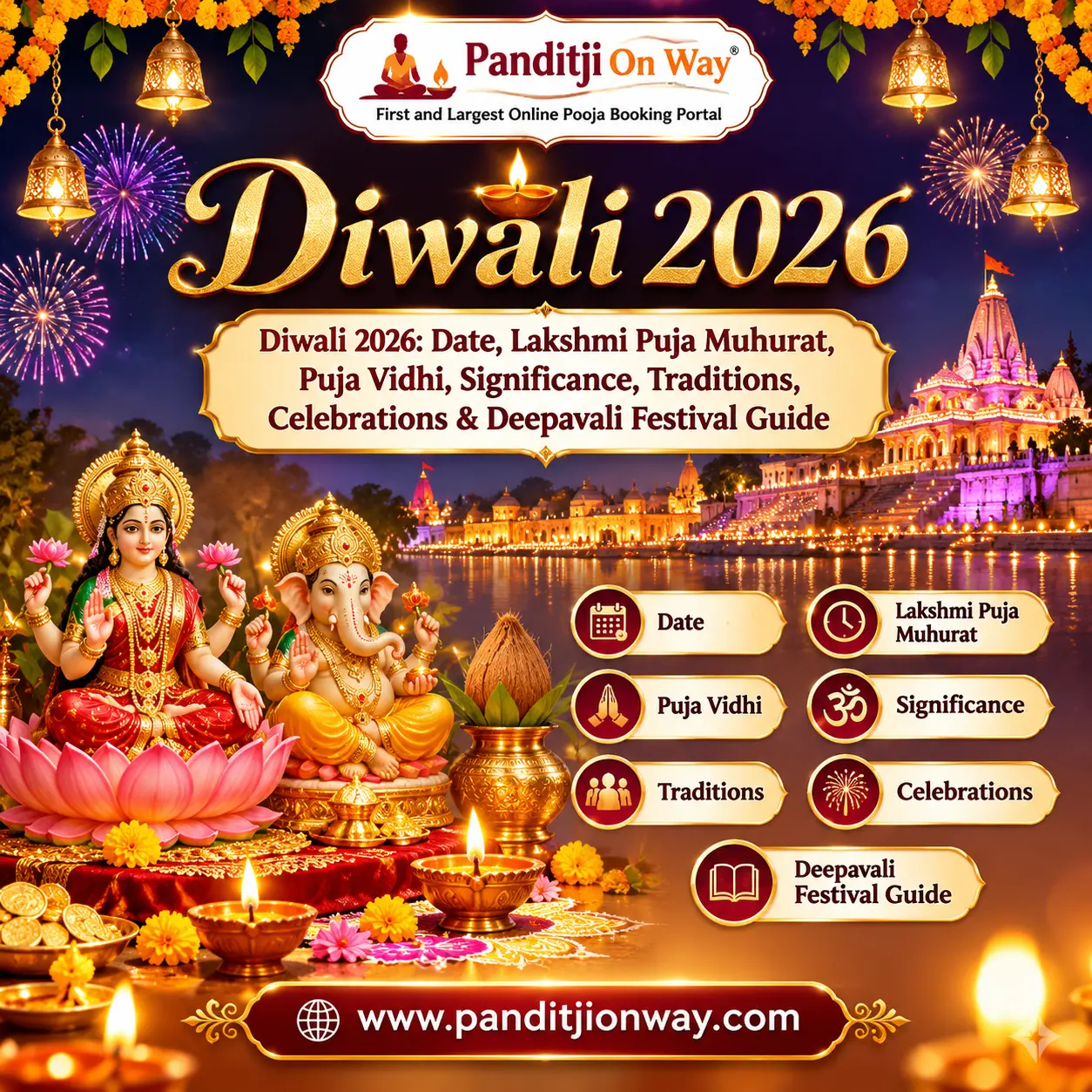
Diwali 2026: Date, Lakshmi Puja Muhurat, Puja Vidhi, Significance, Traditions, Celebrations & Deepavali Festival Guide
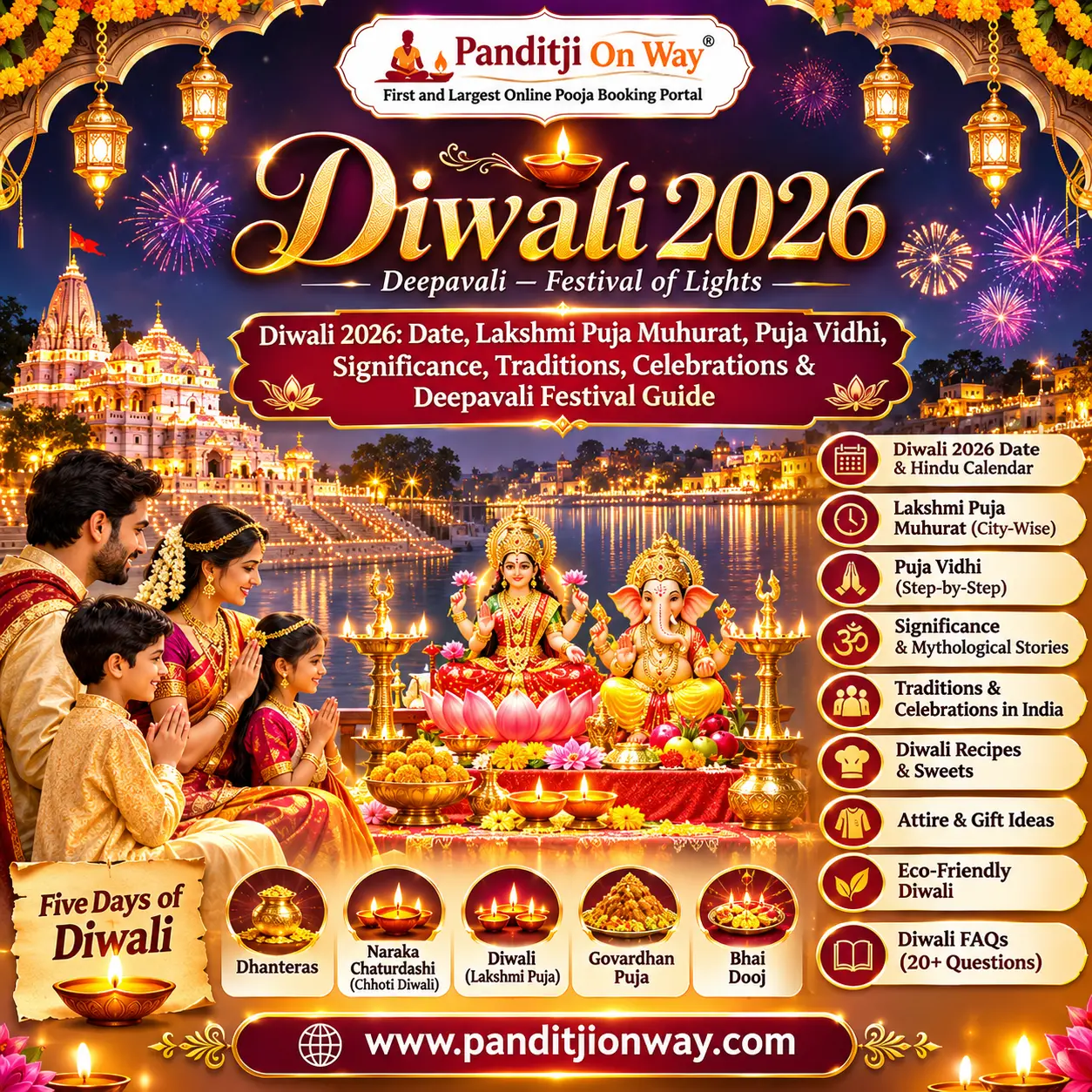
Diwali 2026, also known as Deepavali or the Festival of Lights, will be celebrated on Sunday, November 8, 2026. It is one of the most important Hindu festivals, symbolising the victory of light over darkness, good over evil, knowledge over ignorance, and hope over despair.
The main celebration takes place on Kartik Amavasya, when families worship Lord Ganesha and Goddess Lakshmi, illuminate their homes with diyas, create colourful rangoli designs, prepare traditional sweets, exchange gifts, and pray for happiness, prosperity, and well-being.
In 2026, Lakshmi Puja will be performed during the auspicious Pradosh period. The New Delhi Lakshmi Puja Muhurat is 5:54 PM to 7:50 PM, according to Panditji on way Panchang.
This complete Diwali 2026 guide by Panditji On Way – First and Largest Online Pooja Booking Portal explains the festival date, city-wise Lakshmi Puja timings, Hindu Panchang, puja samagri, step-by-step puja vidhi, mythology, five-day celebrations, regional traditions, devotional songs, recipes, and frequently asked questions.
Diwali 2026: Important Information at a Glance
| Particulars | Details |
|---|---|
| Festival Name | Diwali / Deepavali |
| Diwali 2026 Date | Sunday, November 8, 2026 |
| Also Known As | Deepawali, Festival of Lights |
| Hindu Month | Kartik (Purnimanta) / Ashwin (Amanta) |
| Paksha | Krishna Paksha |
| Tithi | Amavasya |
| Main Deities | Goddess Lakshmi and Lord Ganesha |
| Other Worship | Goddess Saraswati and Lord Kubera in some traditions |
| Main Ritual | Lakshmi-Ganesha Puja |
| Important Period | Pradosh Kaal |
| Main Celebration | Lighting diyas, Lakshmi Puja, rangoli, sweets and family gatherings |
| Festival Duration | Traditionally five days |
| Main Message | Victory of good over evil and light over darkness |
When Is Diwali in 2026?
Diwali 2026 will be celebrated on Sunday, November 8, 2026. The main Lakshmi Puja is performed on Kartik Amavasya during the evening Pradosh Kaal.
The date of Diwali changes every year because the Hindu lunar calendar determines the festival according to the Amavasya Tithi of the relevant lunar month.
The festival is celebrated across India and by Hindu communities worldwide, including the United States, Canada, the United Kingdom, Australia, Nepal, Singapore, and Mauritius.
Diwali Dates for 2025, 2026, 2027 and 2028
| Year | Diwali Date | Day |
|---|---|---|
| 2025 | October 20 | Monday |
| 2026 | November 8 | Sunday |
| 2027 | October 29 | Friday |
| 2028 | October 17 | Tuesday |
These dates follow the published Hindu festival calendar.
Diwali 2026 Hindu Calendar: Tithi, Paksha and Maas
Diwali is observed on Amavasya, the new moon day, of the Hindu lunar calendar.
The same lunar date is identified differently in the two widely used Hindu calendar systems:
| Hindu Panchang Detail | Diwali 2026 |
|---|---|
| Purnimanta Calendar | Kartik Maas |
| Amanta Calendar | Ashwin Maas |
| Paksha | Krishna Paksha |
| Tithi | Amavasya |
| Lunar Phase | New Moon |
| Festival | Deepavali / Lakshmi Puja |
Amavasya Tithi in 2026:
-
Begins: November 8, 2026, at approximately 11:27 AM.
-
Ends: November 9, 2026, at approximately 12:31 PM.
Timings are based on the New Delhi Panchang and may differ slightly between calculations and locations.
Diwali 2026 Lakshmi Puja Muhurat: City-Wise Timings in India
Lakshmi Puja is the most important religious ritual of Diwali. Devotees worship Goddess Lakshmi, the goddess of wealth and prosperity, and Lord Ganesha, the remover of obstacles.
The evening Pradosh Kaal is considered particularly auspicious for Lakshmi Puja when Amavasya Tithi prevails.
The following are the 2026 city-wise Lakshmi Puja Muhurat timings, as published by Panditji on way Panchang.
| City | Diwali Puja Muhurat |
|---|---|
| New Delhi | 5:54 PM – 7:50 PM |
| Pune | 6:24 PM – 8:24 PM |
| Chennai | 6:07 PM – 8:09 PM |
| Kolkata | 5:20 PM – 7:18 PM |
| Hyderabad | 6:07 PM – 8:08 PM |
| Ahmedabad | 6:22 PM – 8:20 PM |
| Noida | 5:54 PM – 7:49 PM |
| Jaipur | 6:03 PM – 7:59 PM |
| Mumbai | 6:27 PM – 8:27 PM |
| Gurgaon | 5:55 PM – 7:51 PM |
| Bengaluru | 6:17 PM – 8:20 PM |
| Chandigarh | 5:52 PM – 7:46 PM |
All timings are local to the respective cities. They are not interchangeable between locations. Consult your local Panchang and family tradition before performing the puja.
Why Is Pradosh Kaal Important for Diwali Lakshmi Puja?
Pradosh Kaal is the period around sunset and early evening. It is considered auspicious for several Hindu religious observances.
On Diwali, devotees traditionally perform Lakshmi Puja during the period when Pradosh Kaal and Amavasya Tithi overlap. The Vrishabha (Taurus) Lagna is also considered favourable for Lakshmi Puja in many traditions.
The exact timing depends on the geographical location, sunset, and Panchang calculations.
What Is Diwali? Meaning and Significance of Deepavali
The word Deepavali originates from Sanskrit.
-
Deepa means lamp or light.
-
Avali means a row or series.
Therefore, Deepavali means a row of lights or lamps.
Diwali is celebrated as a festival of spiritual renewal, prosperity, happiness, and righteousness. Lighting diyas represents the removal of darkness and the arrival of positive energy.
The festival has different religious and regional meanings:
-
Victory of good over evil: The return of Lord Rama to Ayodhya after defeating Ravana.
-
Victory of light over darkness: Diyas symbolise knowledge, wisdom, and hope.
-
Prosperity and abundance: Goddess Lakshmi is worshipped for wealth and well-being.
-
New beginnings: Families clean their homes, purchase new items, and begin new financial or business activities.
-
Family togetherness: People celebrate with relatives, friends, neighbours, and communities.
-
Spiritual purification: Devotees pray, perform puja, chant mantras, and practise charity.
Diwali is not only a religious celebration but also an important cultural festival that brings communities together.
Why Is Diwali Celebrated? Religious and Spiritual Significance
1. Return of Lord Rama to Ayodhya
According to the Ramayana, Lord Rama returned to Ayodhya with Goddess Sita and Lakshmana after completing fourteen years of exile and defeating Ravana.
The people of Ayodhya welcomed them by lighting rows of oil lamps. This tradition is associated with the celebration of Diwali.
2. Worship of Goddess Lakshmi
Goddess Lakshmi is worshipped as the deity of wealth, prosperity, fortune, and abundance.
On Diwali, devotees clean their homes, decorate entrances, prepare offerings, and perform Lakshmi Puja to seek her blessings.
3. Victory of Lord Krishna over Narakasura
In another important tradition, Diwali celebrations are associated with Lord Krishna’s victory over the demon Narakasura.
This story is particularly significant during Naraka Chaturdashi, also known as Chhoti Diwali.
4. Lord Vishnu and King Bali
In some Hindu traditions, Bali Pratipada is associated with the story of Lord Vishnu’s Vamana Avatar and King Mahabali.
This story is especially significant during Govardhan Puja and Bali Pratipada.
5. Goddess Kali and Diwali in Bengal
In West Bengal and several eastern Indian regions, Kali Puja is performed on the night of Diwali.
Devotees worship Goddess Kali for protection, courage, and the destruction of negative forces.
Five Days of Diwali 2026: Complete Festival Calendar
Diwali is traditionally celebrated over five days, beginning with Dhanteras and concluding with Bhai Dooj. Some regional calendars include additional observances or assign different dates to individual rituals.
| Day | Festival | Main Significance |
|---|---|---|
| Day 1 | Dhanteras | Worship of Lord Dhanvantari and prosperity |
| Day 2 | Naraka Chaturdashi | Victory over Narakasura |
| Day 3 | Diwali / Lakshmi Puja | Worship of Goddess Lakshmi and Lord Ganesha |
| Day 4 | Govardhan Puja | Worship of Lord Krishna and Govardhan |
| Day 5 | Bhai Dooj | Celebration of the brother-sister relationship |
Important: The exact dates of the five observances can vary according to regional Panchang calculations. Check the local calendar for each ritual.
Day 1: Dhanteras
Dhanteras marks the beginning of the Diwali festival. It is observed on Krishna Trayodashi of the Hindu lunar month.
People worship Lord Dhanvantari and Goddess Lakshmi. Buying gold, silver, utensils, and other auspicious items is a popular tradition.
Day 2: Naraka Chaturdashi (Chhoti Diwali)
Naraka Chaturdashi commemorates Lord Krishna’s victory over Narakasura.
People traditionally wake up early, take an auspicious oil bath, decorate their homes, and light diyas.
Day 3: Diwali – Lakshmi Puja
This is the main Diwali celebration.
Families worship Lord Ganesha and Goddess Lakshmi, light diyas, prepare sweets, decorate their houses, and exchange gifts.
Day 4: Govardhan Puja
Govardhan Puja celebrates Lord Krishna’s protection of the people of Braj by lifting Govardhan Hill.
Devotees prepare Annakut, an offering consisting of a variety of vegetarian food items, and offer prayers to Lord Krishna.
Day 5: Bhai Dooj
Bhai Dooj celebrates the special bond between brothers and sisters.
Sisters apply tilak to their brothers’ foreheads and pray for their happiness, health, and long life. Brothers traditionally offer gifts and blessings.
Diwali Puja Vidhi 2026: Step-by-Step Lakshmi Ganesha Puja at Home
Lakshmi-Ganesha Puja is the central religious ritual of Diwali. Devotees perform the puja with devotion and offer prayers for prosperity, peace, happiness, and wisdom.
Diwali Puja Samagri: Complete Checklist
Prepare the following puja materials before beginning the ritual.
| Puja Samagri | Purpose |
|---|---|
| Idols or pictures of Lakshmi and Ganesha | Main deities |
| Red or yellow cloth | Puja platform |
| Kalash | Auspicious water vessel |
| Coconut | Religious offering |
| Mango leaves | Kalash decoration |
| Flowers and garlands | Offering to deities |
| Kumkum and turmeric | Tilak and worship |
| Akshat (uncooked rice) | Traditional offering |
| Sandalwood paste | Puja ritual |
| Incense sticks | Fragrance and worship |
| Ghee or oil diyas | Lighting lamps |
| Cotton wicks | Diyas |
| Fruits | Bhog |
| Sweets and mithai | Prasad |
| Betel leaves and nuts | Traditional offerings |
| Coins | Symbolic prosperity |
| Panchamrit | Traditional offering |
| Gangajal or clean water | Ritual purification |
| Aarti thali | Concluding worship |
Step-by-Step Diwali Lakshmi Puja Procedure
Step 1: Clean the House and Puja Area
Clean the house before Diwali. Decorate the entrance with rangoli, flowers, torans, and diyas.
Step 2: Prepare the Puja Platform
Place a clean red or yellow cloth on the puja platform. Arrange the idols or pictures of Goddess Lakshmi and Lord Ganesha respectfully.
Step 3: Establish the Kalash
Fill a kalash with clean water, place mango leaves and a coconut on top, and decorate it according to your family tradition.
Step 4: Begin with Lord Ganesha Puja
Offer flowers, kumkum, rice, sweets, and prayers to Lord Ganesha. Seek his blessings for the successful completion of the puja.
Step 5: Perform Goddess Lakshmi Puja
Offer flowers, lotus, sweets, fruits, and other traditional offerings to Goddess Lakshmi. Recite Lakshmi mantras and pray for prosperity.
Step 6: Worship Goddess Saraswati and Lord Kubera
Some families also worship Goddess Saraswati for knowledge and Lord Kubera for wealth and financial stability.
Step 7: Offer Bhog
Offer fruits, sweets, dry fruits, and other prepared food items to the deities.
Step 8: Perform Lakshmi Aarti
Sing Om Jai Lakshmi Mata and other traditional devotional prayers.
Step 9: Light Diyas
Light earthen lamps in the puja area, entrances, balconies, and other suitable locations.
Step 10: Distribute Prasad
Conclude the puja and distribute prasad among family members and guests.
Note: Puja procedures differ among families, regions, and sampradayas. Follow your family tradition or consult a qualified pandit for the complete ritual.
Diwali Mantras, Aarti, Chalisa and Devotional Songs
Devotional prayers and mantras are an important part of Diwali celebrations.
Here are some commonly recited prayers.
| Devotional Category | Name |
|---|---|
| Lakshmi Aarti | Om Jai Lakshmi Mata |
| Lakshmi Chalisa | Shri Lakshmi Chalisa |
| Lakshmi Stotram | Shri Suktam |
| Lakshmi Stotram | Ashtalakshmi Stotram |
| Lakshmi Stotram | Kanakadhara Stotram |
| Devotional Prayer | Dhanalakshmi Stotram |
| Namavali | 108 Names of Goddess Lakshmi |
| Namavali | 1000 Names of Goddess Lakshmi |
| Mantra | Lakshmi Mantra |
| Mantra | Lakshmi-Ganesha Mantra |
| Mantra | Diwali Lakshmi Puja Mantra |
Popular Lakshmi Mantra
ॐ श्रीं महालक्ष्म्यै नमः।
Meaning: I offer my respectful salutations to Goddess Mahalakshmi and seek her blessings for prosperity, peace, and well-being.
Popular Lakshmi-Ganesha Mantra
ॐ श्री गणेशाय नमः।
Meaning: I bow to Lord Ganesha and seek his blessings for wisdom, auspicious beginnings, and the removal of obstacles.
Diwali Legends and Mythological Stories
Diwali has several important mythological stories that explain why people celebrate the festival.
Lord Rama, Goddess Sita and Lakshmana
The Ramayana describes the return of Lord Rama to Ayodhya after fourteen years of exile.
After defeating Ravana and rescuing Goddess Sita, Lord Rama returned to his kingdom with Sita and Lakshmana. The people welcomed them by lighting lamps throughout the city.
This tradition is one of the most widely known explanations for Diwali celebrations.
Lord Krishna and Narakasura
According to the Bhagavata Purana tradition, Narakasura was a powerful demon who troubled the gods and people.
Lord Krishna defeated Narakasura, symbolising the victory of righteousness over evil.
This event is remembered during Naraka Chaturdashi.
Goddess Lakshmi’s Appearance
According to Hindu mythology, Goddess Lakshmi emerged during the Samudra Manthan, the churning of the cosmic ocean.
She represents prosperity, beauty, abundance, and auspiciousness. Her worship is central to Diwali.
King Mahabali and Lord Vishnu
The Vamana Avatar of Lord Vishnu is associated with King Mahabali.
This story represents humility, devotion, righteousness, and the divine protection of the universe. It is remembered in different regional celebrations during the Diwali period.
Diwali Celebrations Across India: Famous Places and Regional Traditions
Diwali is celebrated throughout India, but the traditions, religious interpretations, and festivities differ from state to state.
1. Ayodhya, Uttar Pradesh
Ayodhya is one of the most significant destinations associated with Diwali because of its connection with Lord Rama.
The city is famous for its Deepotsav celebrations, illuminated temples, decorations, and lamps along the Sarayu River.
2. Varanasi, Uttar Pradesh
Varanasi celebrates the festive season with illuminated ghats, temple decorations, devotional prayers, and the famous Dev Deepawali celebration later in Kartik.
3. Jaipur, Rajasthan
Jaipur is famous for its decorated markets, illuminated buildings, traditional sweets, and colourful festive shopping.
4. Kolkata, West Bengal
Kolkata celebrates Kali Puja on Diwali night. Temples and beautifully decorated pandals attract thousands of devotees.
5. Mumbai, Maharashtra
Mumbai celebrates Diwali with illuminated residential buildings, markets, traditional faral, family gatherings, and Lakshmi Puja.
6. Amritsar, Punjab
Amritsar is especially significant during Bandi Chhor Divas, which coincides with Diwali. The Golden Temple is beautifully illuminated.
7. Ahmedabad, Gujarat
Ahmedabad celebrates Diwali with Lakshmi Puja, Chopda Pujan, festive shopping, and the Gujarati New Year.
8. Chennai, Tamil Nadu
Chennai and other parts of Tamil Nadu place particular emphasis on Deepavali celebrations, including traditional oil baths, new clothes, sweets, and family prayers.
9. Bengaluru, Karnataka
Bengaluru celebrates Deepavali through traditional puja, decorative lighting, family gatherings, and regional sweets such as adhirasam.
10. Hyderabad, Telangana
Hyderabad celebrates Diwali with Lakshmi Puja, illuminated homes, festive markets, and traditional sweets.
Diwali Celebrations Outside India
Diwali is celebrated by Hindu communities across the world.
Popular international locations include:
| Country | Popular Celebration Locations |
|---|---|
| United States | New York, New Jersey, California, Arizona, Texas |
| United Kingdom | Leicester, London, Birmingham |
| Canada | Toronto, Brampton, Vancouver |
| Australia | Sydney, Melbourne, Brisbane |
| Singapore | Little India |
| Nepal | Kathmandu |
| Mauritius | Port Louis |
Diwali Celebrations in Arizona, USA
Indian communities in Arizona celebrate Diwali through temple visits, Lakshmi-Ganesha Puja, cultural programmes, devotional singing, traditional food, and community gatherings.
Families living in Phoenix, Mesa, Chandler, Gilbert, Scottsdale, Tempe, and surrounding areas often arrange home pujas and festive celebrations.
For families looking to perform traditional Hindu rituals in Arizona, Panditji On Way provides a platform to explore and book pandit services for religious ceremonies. baps.org
Website: Panditji On Way – Online Pooja Booking Portal.
Diwali Observances and Traditions
Diwali is celebrated through various religious, cultural, and family activities.
Some of the most common observances include:
-
Cleaning and decorating homes.
-
Lighting earthen diyas and decorative lamps.
-
Creating rangoli at entrances.
-
Performing Lakshmi-Ganesha Puja.
-
Wearing traditional Indian clothes.
-
Purchasing gold, silver, and new household items.
-
Preparing sweets and festive snacks.
-
Exchanging gifts with family and friends.
-
Visiting temples and offering prayers.
-
Donating food, clothes, and essentials to people in need.
-
Organising community celebrations.
-
Enjoying fireworks where legally permitted and safe.
Eco-Friendly Diwali Celebration
Celebrate Diwali responsibly by choosing environmentally conscious practices.
-
Use traditional clay diyas.
-
Prefer LED decorative lights.
-
Avoid excessive noise and air pollution.
-
Choose reusable decorations.
-
Use natural rangoli colours.
-
Reduce plastic packaging.
-
Distribute homemade sweets and gifts.
-
Keep pets, children, and elderly people safe.
Fireworks should be used only where legally permitted, following local safety and pollution-control regulations.
Diwali Rangoli, Lakshmi Pada and Traditional Artwork
Rangoli is one of the most beautiful traditions of Diwali.
Families create decorative patterns outside their homes using coloured powders, flower petals, rice flour, and other natural materials.
Popular Diwali artwork includes:
-
Traditional Diwali Rangoli.
-
Lakshmi Pada Rangoli.
-
Floral Rangoli.
-
Diwali greeting cards.
-
Diwali wallpapers.
-
Diwali festival images.
-
Decorative diya artwork.
-
Lakshmi-Ganesha illustrations.
-
Deepavali entrance decorations.
Lakshmi Pada designs represent the welcoming of Goddess Lakshmi into the home.
Traditional Diwali Recipes and Sweets
Popular Diwali Sweets
| Sweet | Popularity / Region |
|---|---|
| Gujiya | North India |
| Karanji | Maharashtra |
| Chandrakala | Various Indian regions |
| Gulab Jamun | Across India |
| Kaju Katli | Across India |
| Anarsa | Bihar and Maharashtra |
| Adhirasam | Tamil Nadu and southern India |
| Dry Fruit Sweets | Across India |
Popular Diwali Snacks
-
Shakkarpara.
-
Namakpara.
-
Mathri.
-
Chakli.
-
Chivda.
-
Mixture.
-
Sev.
-
Murukku.
Families also prepare regional delicacies according to their culinary traditions.
What to Wear on Diwali? Traditional and Indo-Western Attire
Diwali is an occasion when people wear new and traditional clothes.
Popular festive attire includes:
For Women
-
Silk sarees.
-
Banarasi sarees.
-
Lehengas.
-
Anarkali suits.
-
Salwar kameez.
-
Indo-western dresses.
For Men
-
Kurta-pajama.
-
Sherwani.
-
Nehru jackets.
-
Traditional dhoti-kurta.
-
Indo-western outfits.
Yellow, red, green, maroon, gold, and cream are popular festive colours.
How to Celebrate Diwali with Family?
Diwali is an opportunity to strengthen family relationships and create meaningful memories.
Some wonderful ways to celebrate include:
-
Clean and decorate your home together.
-
Prepare traditional sweets.
-
Perform Lakshmi-Ganesha Puja.
-
Light diyas around your home.
-
Visit a nearby Hindu temple.
-
Exchange gifts with relatives.
-
Organise a family dinner.
-
Donate food and clothes.
-
Teach children the stories of Lord Rama and Goddess Lakshmi.
-
Celebrate with environmentally responsible decorations.
Book a Pandit for Diwali Lakshmi Puja with Panditji On Way
Diwali Lakshmi Puja is an important religious ceremony for Hindu families. Many devotees prefer to invite an experienced pandit to perform the puja according to their family traditions and regional customs.
Panditji On Way is a pooja booking portal offering pandit booking services for Hindu religious ceremonies. It helps devotees explore priest services for festivals, special pujas, havans, jaap, kathas, and family ceremonies.
Diwali Puja Services You Can Explore
-
Lakshmi-Ganesha Puja.
-
Diwali Puja at home.
-
Lakshmi Kubera Puja.
-
Ganapati Puja.
-
Vedic Havan.
-
Mantra Jaap.
-
Satyanarayana Swamy Vratam.
-
Navagraha Puja.
-
Special festival pujas.
Why Choose Panditji On Way?
-
Online pooja booking platform.
-
Services for traditional Hindu ceremonies.
-
Pandit booking options for families.
-
Support for different Hindu puja requirements.
-
Services focused on Arizona and other available locations.
Book a Pandit for Diwali 2026
Visit: www.panditjionway.com
Contact the platform to confirm availability, location coverage, puja requirements, and booking details.
Diwali Around the World: Religious and Cultural Importance
Although Diwali is primarily associated with Hindu traditions, the festival also holds significance for other religious communities.
| Religion / Community | Significance |
|---|---|
| Hinduism | Worship of Goddess Lakshmi, Lord Ganesha, and celebrations associated with Lord Rama |
| Jainism | Commemoration of Lord Mahavira’s Nirvana |
| Sikhism | Bandi Chhor Divas, associated with Guru Hargobind Sahib Ji |
| Buddhism | Some Buddhist communities observe Diwali-related cultural celebrations, including certain Newar Buddhist traditions |
Diwali reflects shared themes of freedom, spiritual awakening, hope, and the triumph of righteousness, although the religious meanings differ.
Diwali Gift Ideas for Family and Friends
Exchanging gifts is a popular Diwali tradition. Some thoughtful gift ideas include:
-
Traditional sweets and mithai boxes.
-
Dry fruit gift hampers.
-
Silver coins and decorative utensils.
-
Lakshmi-Ganesha idols.
-
Brass diyas and puja accessories.
-
Traditional clothing.
-
Decorative lamps and lanterns.
-
Indoor plants.
-
Handmade chocolates.
-
Eco-friendly gift hampers.
Gifts are traditionally exchanged as a symbol of affection, gratitude, and good wishes.
Diwali Puja Preparation Checklist
Use this checklist to prepare for the festival.
Frequently Asked Questions About Diwali 2026 (FAQs)
The following FAQs are designed around common Diwali date, Panchang, puja, rituals, mythology, and celebration searches.
1. When is Diwali in 2026?
Diwali in 2026 will be celebrated on Sunday, November 8. The festival falls on Kartik Amavasya according to the Purnimanta calendar and Ashwin Amavasya according to the Amanta calendar. The main celebration includes Lakshmi-Ganesha Puja, lighting diyas, decorating homes, preparing sweets, and exchanging gifts.
2. What is the Diwali Lakshmi Puja Muhurat in 2026?
The Diwali Lakshmi Puja Muhurat in New Delhi on November 8, 2026, is 5:54 PM to 7:50 PM. The timing is associated with Pradosh Kaal and Vrishabha Lagna. Other Indian cities have different puja timings because of differences in sunset and geographical location. Devotees should consult the local Panchang for their exact timings.
3. Why is Diwali celebrated?
Diwali is celebrated to mark the victory of good over evil, light over darkness, and knowledge over ignorance. In the Ramayana tradition, it commemorates Lord Rama’s return to Ayodhya after fourteen years of exile and his victory over Ravana. It is also associated with Goddess Lakshmi, Lord Krishna, and other regional religious traditions.
4. Which God and Goddess are worshipped on Diwali?
Lord Ganesha and Goddess Lakshmi are the principal deities worshipped during the main Diwali Lakshmi Puja. Lord Ganesha is worshipped for wisdom and the removal of obstacles, while Goddess Lakshmi is worshipped for prosperity, wealth, fortune, and well-being. Some families also worship Goddess Saraswati and Lord Kubera.
5. What is the Hindu Tithi of Diwali 2026?
Diwali 2026 falls on Krishna Paksha Amavasya. It is Kartik Amavasya in the Purnimanta calendar and Ashwin Amavasya in the Amanta calendar. The Amavasya Tithi begins at approximately 11:27 AM on November 8 and ends at approximately 12:31 PM on November 9, according to the New Delhi Panchang.
6. How many days is Diwali celebrated?
Diwali is traditionally celebrated over five days. The celebrations begin with Dhanteras, followed by Naraka Chaturdashi, the main Diwali Lakshmi Puja, Govardhan Puja, and Bhai Dooj. Each day has a distinct religious meaning and associated rituals. Regional calendars may include additional observances.
7. What is the significance of lighting diyas on Diwali?
Lighting diyas symbolises the removal of darkness and the arrival of knowledge, hope, positivity, and righteousness. It is also connected with the traditional welcome of Lord Rama to Ayodhya. Families illuminate their entrances, balconies, temples, and puja areas with earthen lamps.
8. What is the best time to perform Lakshmi Puja on Diwali?
Lakshmi Puja is traditionally performed during Pradosh Kaal while Amavasya Tithi is prevailing. Vrishabha Lagna is also considered auspicious by many Hindu traditions. The exact timing changes according to the city, sunset, and Panchang calculations. Therefore, devotees should follow their local city’s Lakshmi Puja Muhurat.
9. What items are required for Diwali Lakshmi Puja?
The essential puja materials include Lakshmi-Ganesha idols or pictures, flowers, garlands, kumkum, turmeric, akshat, sandalwood, incense sticks, ghee or oil diyas, cotton wicks, fruits, sweets, coconut, kalash, mango leaves, coins, and an aarti thali. Additional items may be required depending on the family tradition and the pandit’s puja procedure.
10. Why do people clean their houses before Diwali?
Cleaning houses before Diwali is a traditional practice associated with welcoming Goddess Lakshmi and preparing the home for auspicious beginnings. Families clean, paint, decorate entrances, create rangoli, and illuminate their homes before performing Lakshmi Puja.
11. Which city is famous for Diwali celebrations in India?
Ayodhya is particularly famous for its connection with Lord Rama and its Deepotsav celebrations. Other popular destinations include Varanasi, Jaipur, Mumbai, Kolkata, Amritsar, Ahmedabad, Chennai, and Bengaluru. Each city celebrates Diwali through its own cultural and religious traditions.
12. Is Diwali celebrated outside India?
Yes. Diwali is celebrated in many countries, including the United States, United Kingdom, Canada, Australia, Nepal, Singapore, and Mauritius. Hindu communities organise Lakshmi Puja, temple events, cultural programmes, festive gatherings, and traditional celebrations.
13. What is the difference between Diwali and Deepavali?
Diwali and Deepavali refer to the same festival of lights. Deepavali is derived from Sanskrit and means a row of lamps. Diwali is the commonly used shortened name. Both names describe the festival celebrated on Amavasya during the Hindu lunar month associated with Kartik or Ashwin, depending on the calendar system.
14. What are the famous sweets prepared during Diwali?
Popular Diwali sweets include Gujiya, Karanji, Chandrakala, Gulab Jamun, Kaju Katli, laddoo, barfi, Anarsa, and Adhirasam. Regional food traditions differ across India. Families also prepare Shakkarpara, Namakpara, Mathri, Chakli, and dry-fruit snacks.
15. What should we wear on Diwali?
Traditional Indian clothing is popular during Diwali. Women commonly wear sarees, lehengas, Anarkali suits, and salwar kameez. Men often wear kurta-pajamas, sherwanis, dhoti-kurta, and Nehru jackets. Indo-western outfits are also popular for family celebrations and festive gatherings.
16. Can we perform Diwali Lakshmi Puja at home without a pandit?
Yes. Families can perform a simple Lakshmi-Ganesha Puja at home using traditional prayers, mantras, flowers, diyas, and offerings. However, people wishing to perform elaborate Vedic rituals, special Lakshmi Puja, havan, or other ceremonies may choose to consult a qualified pandit.
17. What is the importance of Lord Ganesha worship during Diwali?
Lord Ganesha is worshipped before Goddess Lakshmi because he is traditionally regarded as the remover of obstacles and the deity of wisdom and auspicious beginnings. Worshipping Ganesha along with Lakshmi symbolises the importance of combining prosperity with wisdom and good judgement.
18. What is the significance of Lakshmi Pada Rangoli?
Lakshmi Pada Rangoli represents the symbolic footprints of Goddess Lakshmi entering the home. It is traditionally drawn near entrances and puja areas to welcome prosperity, auspiciousness, and good fortune.
19. What is an eco-friendly way to celebrate Diwali?
An eco-friendly Diwali involves using traditional clay diyas, LED lights, natural rangoli colours, reusable decorations, and sustainable gift packaging. Families can avoid excessive fireworks, reduce noise and air pollution, and share food and gifts with people in need.
20. How can I book a pandit for Diwali Lakshmi Puja in Arizona?
You can explore pandit booking services through Panditji On Way at www.panditjionway.com. The platform offers access to Hindu religious ceremony booking services, including puja, havan, jaap, and other traditional rituals. Contact the service to confirm Diwali 2026 availability, the required ceremony, location, and booking arrangements.
People Also Ask (PAA): Diwali 2026
These additional short-answer questions target conversational and voice-search queries.
Q. Is Diwali on November 8 or November 9 in 2026?
Diwali Lakshmi Puja will be observed on November 8, 2026. Amavasya Tithi continues until approximately 12:31 PM on November 9.
Q. What is the Diwali date according to the Hindu calendar?
Diwali falls on Krishna Paksha Amavasya of Kartik Maas in the Purnimanta calendar or Ashwin Maas in the Amanta calendar.
Q. Which direction should Goddess Lakshmi face during Diwali Puja?
Families generally arrange the idols according to their family tradition and the guidance of their pandit. There is no single arrangement that should be presented as compulsory for every Hindu household.
Q. Why is Lord Ganesha worshipped with Goddess Lakshmi?
Ganesha represents wisdom and the removal of obstacles, while Lakshmi represents prosperity and abundance. Their combined worship symbolises prosperity accompanied by wisdom.
Q. What is the importance of Amavasya on Diwali?
Amavasya is the new moon day on which the main Diwali Lakshmi Puja is traditionally performed. It is associated with the spiritual symbolism of lighting lamps and welcoming prosperity.
Q. What is the most important ritual of Diwali?
Lakshmi-Ganesha Puja is the principal ritual of the main Diwali day for many Hindu families.
Q. Is Diwali a five-day festival?
Yes. Traditionally, the festival includes Dhanteras, Naraka Chaturdashi, Diwali, Govardhan Puja, and Bhai Dooj.
Q. Which mantra should be chanted during Diwali Lakshmi Puja?
A commonly recited mantra is: Om Shreem Mahalakshmyai Namah. Devotees also recite Lakshmi Ashtottara Shatanamavali and Shri Suktam according to their traditions.
Conclusion: Celebrate Diwali 2026 with Devotion, Prosperity and Happiness
Diwali is much more than a festival of lamps and decorations. It represents the eternal message that truth, righteousness, knowledge, and goodness ultimately triumph over darkness and negativity.
On Sunday, November 8, 2026, Hindu families will celebrate Deepavali with Lakshmi-Ganesha Puja, traditional rituals, diyas, rangoli, festive food, prayers, and family gatherings.
Whether you celebrate Diwali in India, Arizona, the United States, or another part of the world, the festival provides an opportunity to reconnect with traditions, strengthen family relationships, share happiness, and welcome new beginnings.
May Goddess Lakshmi bless every home with prosperity, Lord Ganesha remove obstacles, and the light of Diwali bring peace, wisdom, and happiness into everyone’s life.
Shubh Deepawali 2026!
For traditional Hindu puja, havan, jaap, and festival ceremony booking services, visit Panditji On Way – Your Online Pooja Booking Portal.
Website: www.panditjionway.com