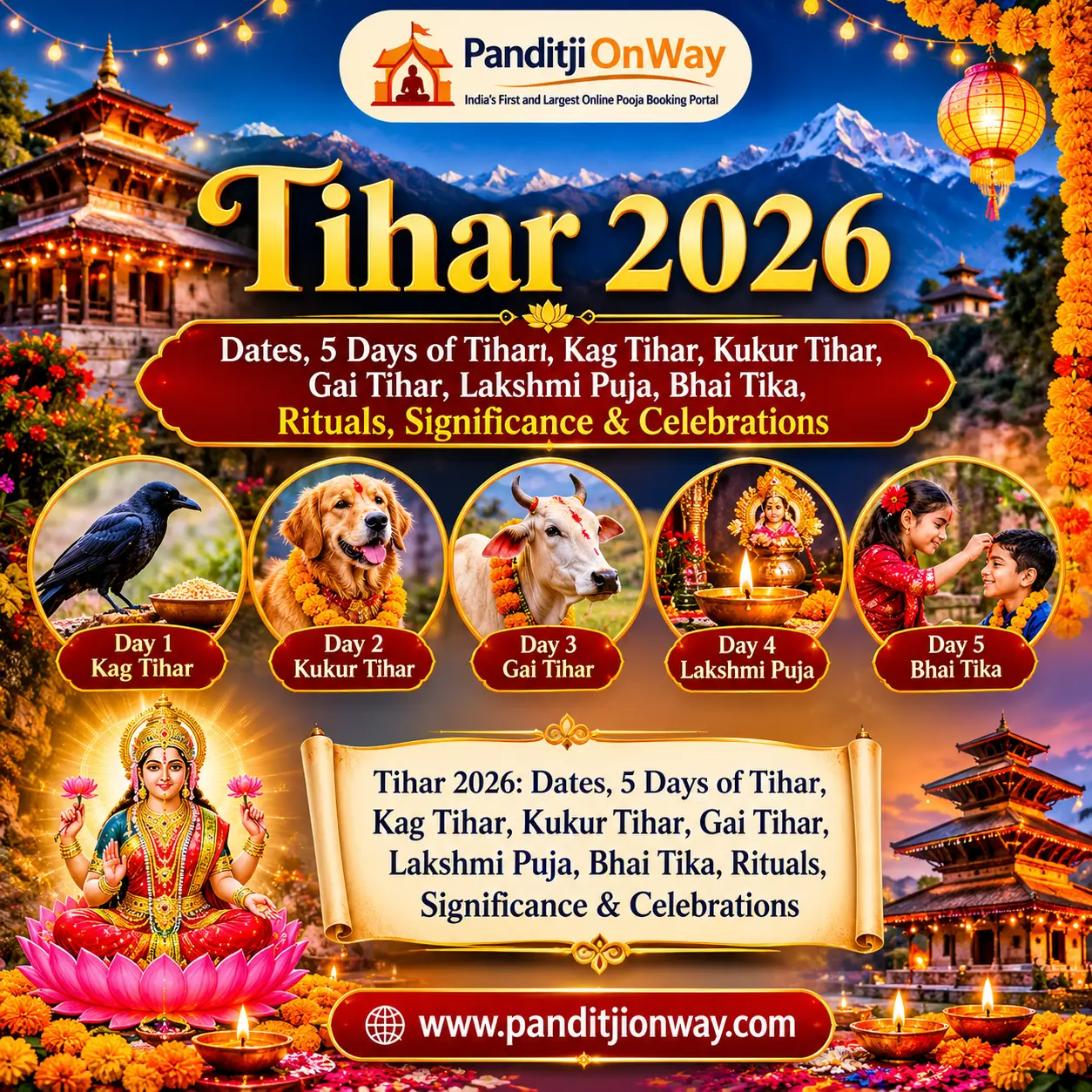
Tihar 2026: Dates, 5 Days of Tihar, Kag Tihar, Kukur Tihar, Gai Tihar, Lakshmi Puja, Bhai Tika, Rituals, Significance & Celebrations
Tihar 2026 dates, five-day calendar, Kag Tihar, Kukur Tihar, Lakshmi Puja, Gai Tihar, Mha Puja and Bhai Tika rituals, significance and celebrations.
Tihar 2026 (तिहार २०८३) is one of Nepal’s most significant Hindu festivals, celebrated over five days with devotion, lights, flowers, traditional music, family gatherings and religious rituals. Also known as Deepawali, Yamapanchak and Swanti in the Newar community, Tihar celebrates the relationship between humans, animals, nature, prosperity and family.
In 2026, the main five-day Tihar celebration in Nepal is observed from 7 November to 11 November 2026, corresponding to Kartik 21–25, 2083 BS, according to the Kathmandu Metropolitan City calendar. The celebrations include Kag Tihar, Kukur Tihar, Gai Tihar, Lakshmi Puja, Goru Tihar, Govardhan Puja, Mha Puja, Nepal Sambat New Year and Bhai Tika.
Tihar is particularly famous for worshipping crows, dogs and cows, decorating homes with marigold flowers, creating colourful rangoli, lighting traditional oil lamps (diyas), performing Lakshmi Puja and celebrating the sacred bond between brothers and sisters.
At Panditji On Way – First and Largest Online Pooja Booking Portal, we aim to help devotees understand Hindu festivals, discover traditional puja rituals and access convenient online pooja booking services.
This complete Tihar 2026 guide explains the festival dates, five-day calendar, puja vidhi, religious significance, traditional celebrations, important places to experience Tihar and frequently asked questions.
Tihar 2026: Important Dates and Festival Calendar
Tihar is celebrated for five consecutive days during the Hindu lunar month of Kartik. Each day has its own religious importance, traditional observances and spiritual message.
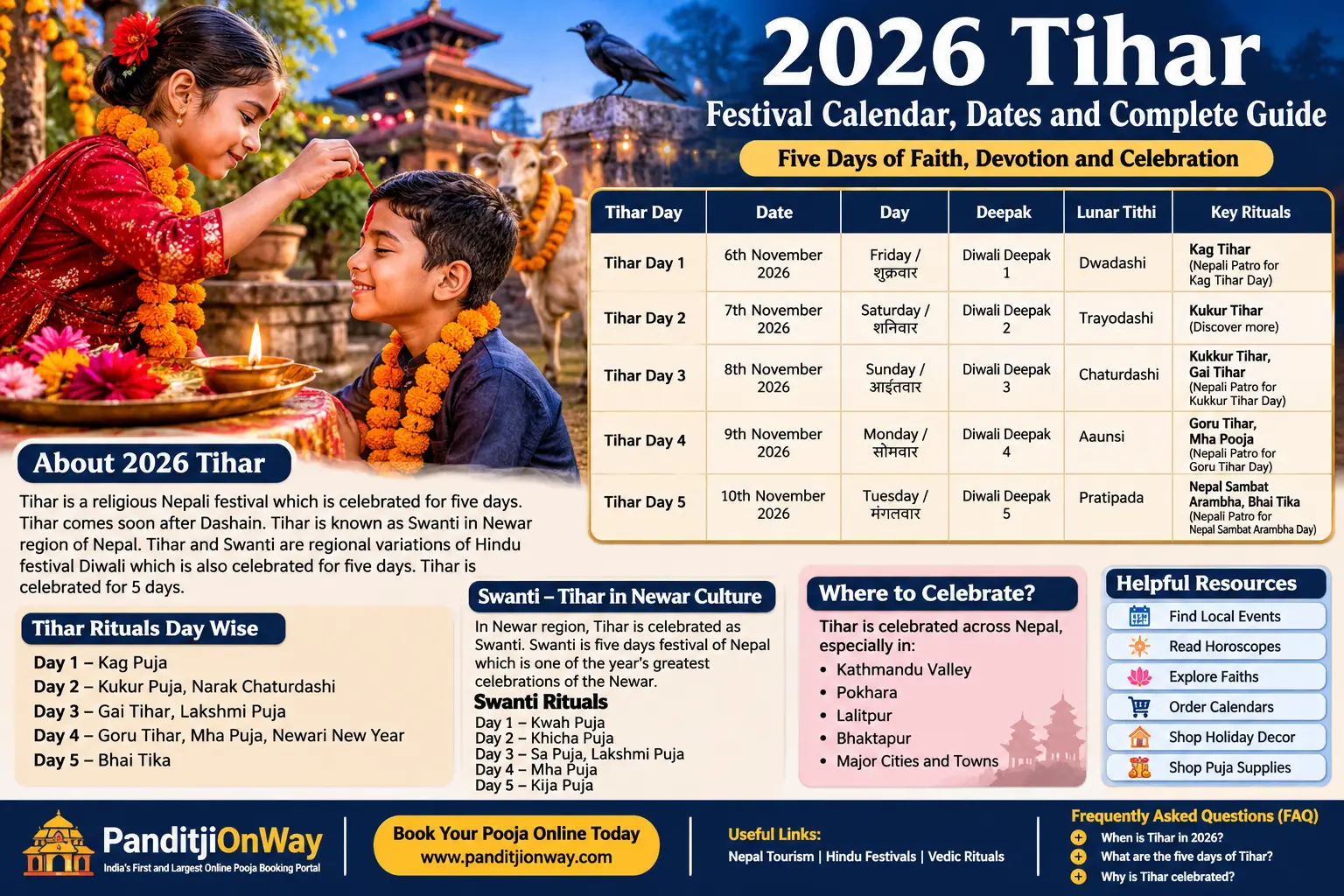
Tihar 2026 Calendar at a Glance
| Day | Festival Name | Date | Weekday | Main Significance |
|---|---|---|---|---|
| Day 1 | Kag Tihar | 7 November 2026 | Saturday | Worship of crows |
| Day 2 | Kukur Tihar and Lakshmi Puja | 8 November 2026 | Sunday | Worship of dogs and Goddess Lakshmi |
| Day 3 | Gai Tihar | 9 November 2026 | Monday | Worship of cows |
| Day 4 | Goru Tihar, Govardhan Puja and Mha Puja | 10 November 2026 | Tuesday | Worship of oxen, Govardhan and the self |
| Day 5 | Bhai Tika | 11 November 2026 | Wednesday | Celebration of the brother-sister relationship |
Important: Some online calendars show different dates or combine particular observances differently. The above table follows the Kathmandu Metropolitan City 2083 calendar. Devotees should confirm local Panchang and puja timings before performing rituals.
When Is Tihar in 2026?
Tihar 2026 begins on Saturday, 7 November, with Kag Tihar and concludes on Wednesday, 11 November, with Bhai Tika in Nepal.
Is Tihar and Diwali the Same Festival?
Tihar and Diwali share several traditions, including the worship of Goddess Lakshmi, lighting diyas, decorating homes and celebrating prosperity. However, Tihar has distinctive Nepali traditions, especially the worship of crows, dogs and cows, Mha Puja and Bhai Tika.
What Is Tihar? History, Meaning and Religious Significance
Tihar is a five-day Hindu festival primarily celebrated in Nepal and by Nepali communities throughout the world. It is considered one of the biggest festivals in Nepal after Dashain.
The word Tihar is associated with the celebration of light, happiness, devotion and prosperity. The festival represents gratitude towards nature, animals, family members and divine energies.
Tihar is also called Yamapanchak because several traditional observances are associated with Yama, the Hindu deity connected with death and dharma.
During these five days, people express gratitude to different forms of life:
- Crows are respected as messengers.
- Dogs are honoured for their loyalty and companionship.
- Cows are worshipped as sacred and nurturing animals.
- Oxen are appreciated for their contribution to agriculture.
- Goddess Lakshmi is worshipped for wealth and prosperity.
- Brothers and sisters celebrate their relationship through Bhai Tika.
The festival promotes the values of compassion, gratitude, family unity, respect for nature and spiritual awareness.
Why Is Tihar Celebrated for Five Days?
Tihar is celebrated over five days because each day represents a different traditional observance. The festival begins with Kag Tihar, continues with Kukur Tihar and Lakshmi Puja, and concludes with Bhai Tika.
The five-day celebration symbolises harmony between humans, animals, nature, prosperity and family relationships.
Five Days of Tihar 2026: Complete Day-by-Day Celebration Guide
Day 1: Kag Tihar – 7 November 2026 (Saturday)
Kag Tihar, also known as Kaag Puja, marks the first day of the five-day Tihar festival.
On this day, crows are worshipped and offered food by Hindu and Nepali households. In traditional belief, crows are associated with Yama and are regarded as messengers who communicate important information.
Families prepare rice, grains, sweets and other food offerings and place them outside their homes for crows.
Religious Significance of Kag Tihar
Crows are respected because of their symbolic association with messages, ancestors and the natural world. Offering food to them represents gratitude and the desire to avoid negative events.
How Is Kag Tihar Celebrated?
- Families clean their homes and surroundings.
- Food offerings are prepared for crows.
- Offerings are placed in suitable outdoor locations.
- Families pray for peace, protection and well-being.
- Devotees express gratitude towards nature and living creatures.
Spiritual Message: Kag Tihar teaches people to respect all living beings and recognise their place in nature.
Day 2: Kukur Tihar and Lakshmi Puja – 8 November 2026 (Sunday)
Kukur Tihar is one of the most recognisable and beautiful traditions of Nepal.
The day is dedicated to the worship of dogs, which are traditionally associated with Lord Yama. Dogs are honoured for their loyalty, protection, friendship and companionship.
In Nepal, dogs are decorated with colourful tika, marigold garlands and offered delicious food.
Kukur Tihar Puja Vidhi
- Clean and prepare the worship area.
- Give the dog a bath or gently clean its body, where appropriate.
- Apply tika to its forehead.
- Place a flower garland around its neck.
- Offer suitable food and treats.
- Express gratitude for its companionship and protection.
Dogs are respected irrespective of whether they are household pets or community animals.
Lakshmi Puja 2026
Lakshmi Puja is among the most important religious observances associated with Tihar.
Goddess Lakshmi is worshipped as the divine source of wealth, prosperity, happiness, good fortune and abundance.
Families clean their houses, decorate entrances with rangoli, arrange flowers and light traditional oil lamps.
A special pathway made using small footprints is sometimes created from the entrance towards the home shrine to symbolically welcome Goddess Lakshmi.
Lakshmi Puja Samagri
- Goddess Lakshmi idol or photograph
- Ganesh idol or photograph
- Kumkum and haldi
- Akshat (unbroken rice)
- Flowers and marigold garlands
- Diya and cotton wicks
- Ghee or sesame oil
- Incense sticks
- Fruits and sweets
- Kalash
- Panchamrit
- Coins and offerings
- Clean puja cloth
Lakshmi Puja Vidhi
- Clean the house, especially the entrance and puja room.
- Decorate the entrance with rangoli and flowers.
- Establish the idols or photographs of Lord Ganesha and Goddess Lakshmi.
- Light diyas and incense.
- Offer flowers, fruits, sweets and other traditional offerings.
- Perform Ganesh Puja before Lakshmi Puja.
- Recite Lakshmi mantras and prayers.
- Perform aarti and seek blessings for prosperity and peace.
The exact puja procedure and auspicious timings should be followed according to the local Panchang and family traditions.
Spiritual Significance: Lakshmi Puja reminds devotees that prosperity should be accompanied by gratitude, discipline, generosity and righteous living.
Day 3: Gai Tihar – 9 November 2026 (Monday)
Gai Tihar is dedicated to the worship of cows.
In Hindu traditions, cows are regarded as sacred and are associated with motherhood, nourishment, abundance and religious purity.
Cows are decorated with flowers and offered food as a gesture of respect and gratitude.
How Is Gai Tihar Celebrated?
- Cows are cleaned and decorated.
- Marigold garlands are offered.
- Tika is applied to their foreheads.
- Suitable food and fodder are provided.
- Families offer prayers and express gratitude.
In Hindu tradition, the cow is also associated with Goddess Lakshmi and prosperity.
Gai Tihar highlights the importance of compassion towards animals and respect for nature.
Day 4: Goru Tihar, Govardhan Puja and Mha Puja – 10 November 2026 (Tuesday)
The fourth day of Tihar has special importance in Nepali Hindu and Newar traditions.
Different communities observe Goru Tihar, Govardhan Puja and Mha Puja.
Goru Tihar
Goru Tihar is dedicated to oxen, which traditionally play an important role in agricultural activities.
Farmers worship oxen as a symbol of hard work, agricultural prosperity and rural livelihood.
They decorate the animals, offer food and express gratitude for their contribution to farming.
Govardhan Puja
Govardhan Puja is associated with Lord Krishna and the sacred Govardhan Hill.
According to Hindu tradition, Lord Krishna protected the people of Vrindavan from heavy rainfall by lifting Govardhan Hill.
This observance reminds devotees of the importance of nature, environmental protection and divine protection.
Families perform Govardhan Puja and offer traditional food preparations as part of their worship.
Mha Puja
Mha Puja is an important Newar religious tradition observed in Nepal, especially in the Kathmandu Valley.
The word Mha means self. Mha Puja is therefore understood as the worship and purification of one’s own self.
The ritual represents self-respect, spiritual renewal, good health, inner peace and a positive beginning.
How Is Mha Puja Celebrated?
- A traditional mandala is prepared.
- Family members sit around their respective mandalas.
- Ritual offerings are arranged.
- Family members receive traditional blessings and offerings.
- Prayers are offered for health, prosperity and longevity.
Nepal Sambat New Year 1147
Mha Puja also marks the beginning of the Nepal Sambat New Year.
In 2026, Nepal Sambat 1147 begins on 10 November according to the Kathmandu Metropolitan City calendar.
Nepal Sambat is an important traditional calendar associated with the cultural and historical heritage of the Newar community.
Day 5: Bhai Tika – 11 November 2026 (Wednesday)
Bhai Tika is the final and one of the most emotionally significant days of Tihar.
It celebrates the sacred relationship between brothers and sisters.
On this day, sisters apply colourful tika to their brothers’ foreheads and pray for their long life, happiness, good health and prosperity.
Brothers offer gifts and blessings to their sisters in return.
Bhai Tika Puja Samagri
- Seven-colour tika, according to family tradition
- Akshat
- Marigold flowers
- Makhamali garlands
- Diyas
- Fruits and sweets
- Dry fruits
- Traditional festive food
- Betel nuts and other customary offerings
Bhai Tika Puja Vidhi
- Prepare a clean place for the ceremony.
- Arrange the traditional puja materials.
- Prepare the mandala and ritual offerings according to family customs.
- Sisters apply tika to their brothers’ foreheads.
- Offer flower garlands and prayers.
- Pray for the brother’s long life and prosperity.
- Brothers give gifts and blessings to their sisters.
- Celebrate together with traditional food and family gatherings.
Bhai Tika represents love, responsibility, protection and lifelong family relationships.
Swanti Festival 2026: Tihar Celebrations in the Newar Community
In the Newar community of Nepal, Tihar is widely celebrated as Swanti.
Swanti is a five-day cultural and religious celebration that includes unique rituals and traditional customs.
Although Swanti shares several observances with Tihar, it has its own cultural identity and religious significance.
Five Days of Swanti
| Day | Traditional Celebration | Significance |
|---|---|---|
| Day 1 | Kwah Puja | Worship associated with crows |
| Day 2 | Khicha Puja | Worship associated with dogs |
| Day 3 | Sa Puja and Lakshmi Puja | Cow worship and prosperity |
| Day 4 | Mha Puja | Worship of the self |
| Day 5 | Kija Puja | Celebration of the brother-sister relationship |
The celebrations are especially important in Kathmandu, Lalitpur and Bhaktapur.
Swanti reflects Newar culture, traditional worship practices, family unity and the preservation of Nepal’s cultural heritage.
Best Places to Experience Tihar 2026 in Nepal
Tihar is celebrated throughout Nepal, but some destinations are particularly popular for their traditional atmosphere, cultural heritage, beautiful decorations and community celebrations.
1. Kathmandu
Kathmandu is one of the best places to experience Tihar celebrations.
The city becomes especially attractive during the festival, with illuminated houses, temples, traditional music and colourful decorations.
Important locations include:
- Kathmandu Durbar Square
- Swayambhunath Stupa
- Pashupatinath Temple
- Boudhanath Stupa
- Thamel
- Ason Bazaar
Visitors can experience traditional Newari culture, religious ceremonies and festive decorations.
2. Bhaktapur
Bhaktapur is famous for its traditional Newari architecture, historic temples and cultural celebrations.
During Tihar, the city’s traditional streets, courtyards and temples create a beautiful atmosphere.
Popular locations include:
- Bhaktapur Durbar Square
- Nyatapola Temple
- Taumadhi Square
- Pottery Square
Bhaktapur is especially interesting for visitors who want to experience traditional Newar celebrations.
3. Lalitpur (Patan)
Patan is another important cultural destination during Tihar.
Its historic temples, traditional architecture and Newar communities provide opportunities to experience the cultural side of Swanti.
Popular places include:
- Patan Durbar Square
- Krishna Mandir
- Hiranya Varna Mahavihar
- Mangal Bazaar
4. Pokhara
Pokhara offers a different festive experience with its beautiful natural surroundings, lakeside decorations and community celebrations.
Important locations include:
- Phewa Lake
- Lakeside
- Bindhyabasini Temple
- World Peace Pagoda
5. Dharan and Other Nepali Communities
Tihar is also celebrated enthusiastically in Dharan, Biratnagar, Butwal, Chitwan and other parts of Nepal.
Each region adds its own cultural traditions, food, music and community activities.
Travel Tip: Festival programmes and temple arrangements may differ from one location to another. Visitors should check local announcements before travelling.
Tihar Celebrations Outside Nepal: India and Worldwide
Tihar is not limited to Nepal. Nepali communities living in India, Bhutan, the United Kingdom, Australia, the United States and other countries also celebrate the festival.
Tihar in India
Tihar celebrations can be found among Nepali communities in several Indian locations.
Important areas include:
- Darjeeling, West Bengal
- Kalimpong, West Bengal
- Sikkim
- Dehradun, Uttarakhand
- Delhi
- Mumbai, Maharashtra
- Assam
- Himachal Pradesh
Nepali families living in these regions celebrate with traditional diyas, flowers, Lakshmi Puja, family gatherings and Bhai Tika.
Tihar in Mumbai
Nepali communities in Mumbai also celebrate Tihar with traditional worship, cultural gatherings and family celebrations.
Families can observe Lakshmi Puja at home and arrange traditional religious ceremonies according to their customs.
Devotees looking for Hindu religious services and online puja assistance can explore Panditji On Way, a platform for online pooja booking.
Website: https://www.panditjionway.com/
Tihar 2026 Puja Preparation: Complete Checklist
Proper preparation helps families perform religious ceremonies comfortably and maintain traditional customs.
| Preparation | Purpose |
|---|---|
| Home cleaning | Welcome positivity and prosperity |
| Diyas and oil lamps | Symbolise light and knowledge |
| Rangoli | Decorate the entrance |
| Marigold flowers | Traditional festive decoration |
| Puja samagri | Perform religious ceremonies |
| Fruits and sweets | Traditional offerings |
| Flowers and garlands | Honour deities and animals |
| Traditional clothing | Celebrate cultural heritage |
| Family arrangements | Prepare for Bhai Tika |
| Food offerings | Express gratitude towards animals |
Spiritual Significance of Tihar: What Does Each Day Teach Us?
Tihar is more than a festival of lights. Each day carries a valuable spiritual message.
| Festival | Spiritual Message |
|---|---|
| Kag Tihar | Respect nature and living creatures |
| Kukur Tihar | Appreciate loyalty and companionship |
| Lakshmi Puja | Welcome prosperity and positive energy |
| Gai Tihar | Respect nourishment and motherhood |
| Goru Tihar | Honour agricultural contributions |
| Govardhan Puja | Protect nature and the environment |
| Mha Puja | Respect and purify the self |
| Bhai Tika | Strengthen family relationships |
The festival encourages people to live with compassion, gratitude, responsibility and devotion.
How Panditji On Way Can Help with Your Hindu Puja Requirements
Religious festivals are an important part of Hindu culture. From Lakshmi Puja and Ganesh Puja to Diwali celebrations and traditional family ceremonies, performing rituals according to established customs is meaningful for devotees.
Panditji On Way is the First and Largest Online Pooja Booking Portal, helping devotees explore pooja-related services and connect with religious ceremony arrangements.
Whether you are preparing for a festival, organising a traditional Hindu puja or looking for assistance with a religious ceremony, you can explore the services available through Panditji On Way.
Why Explore Panditji On Way?
- Online pooja booking convenience.
- Access to information about Hindu festivals and rituals.
- Assistance with religious ceremony arrangements.
- Information about traditional puja practices.
- A convenient platform for exploring pooja services.
Visit: https://www.panditjionway.com/
Frequently Asked Questions (FAQs) About Tihar 2026
1. When is Tihar in 2026?
Tihar 2026 is observed from 7 November to 11 November 2026 in Nepal, according to the Kathmandu Metropolitan City calendar. The five-day festival begins with Kag Tihar and concludes with Bhai Tika.
2. What are the five days of Tihar in 2026?
The five main days are Kag Tihar on 7 November, Kukur Tihar and Lakshmi Puja on 8 November, Gai Tihar on 9 November, Goru Tihar and Mha Puja on 10 November, and Bhai Tika on 11 November 2026.
3. Why is Tihar celebrated in Nepal?
Tihar is celebrated to honour animals, nature, Goddess Lakshmi and family relationships. It promotes gratitude, prosperity, devotion, compassion and unity. The five-day festival also celebrates the cultural traditions of Nepal, particularly the Newar community’s Swanti observances.
4. What is another name for Tihar?
Tihar is also known as Deepawali, Yamapanchak and Swanti. Swanti is the traditional name used in the Newar community of Nepal, while Deepawali refers to the festival of lights.
5. What is Kag Tihar and why are crows worshipped?
Kag Tihar is the first day of Tihar. Crows are traditionally associated with Yama and are considered messengers. Families offer food to crows and pray for peace, protection and freedom from negative events.
6. When is Kukur Tihar in 2026?
Kukur Tihar falls on Sunday, 8 November 2026, according to the Kathmandu Metropolitan City calendar. On this day, dogs are honoured with tika, flower garlands and food offerings as a symbol of loyalty, protection and companionship.
7. Why are dogs worshipped during Kukur Tihar?
Dogs are worshipped because they represent loyalty, friendship and protection. In Hindu traditions, dogs are also associated with Lord Yama and his messengers. Kukur Tihar encourages people to respect and care for animals.
8. When is Lakshmi Puja in Tihar 2026?
According to the Kathmandu Metropolitan City 2083 calendar, Lakshmi Puja is observed on Sunday, 8 November 2026. It is an important worship ceremony dedicated to Goddess Lakshmi, the deity associated with wealth, prosperity and abundance. Confirm the local puja timing before performing the ceremony.
9. What is the importance of Lakshmi Puja during Tihar?
Lakshmi Puja is performed to seek blessings for wealth, happiness, peace and prosperity. Devotees clean and decorate their homes, light diyas, offer flowers and sweets, and worship Goddess Lakshmi along with Lord Ganesha.
10. When is Gai Tihar in 2026?
Gai Tihar falls on Monday, 9 November 2026, according to the Kathmandu calendar. On this day, cows are worshipped and offered flowers, tika and food as a symbol of respect, nourishment and prosperity.
11. What is Goru Tihar?
Goru Tihar is a traditional observance dedicated to oxen. Oxen are honoured for their contribution to agriculture and rural livelihoods. Farmers decorate them, offer food and express gratitude for their hard work.
12. When is Govardhan Puja in 2026?
Govardhan Puja is observed on Tuesday, 10 November 2026, according to the Kathmandu Metropolitan City calendar. It is associated with Lord Krishna lifting Govardhan Hill to protect the people of Vrindavan from heavy rainfall.
13. What is Mha Puja and why is it celebrated?
Mha Puja is an important Newar tradition in which individuals worship their own selves. The ritual symbolises self-purification, spiritual renewal, good health and prosperity. It is traditionally observed on the fourth day of Tihar.
14. When does Nepal Sambat New Year 1147 begin?
Nepal Sambat 1147 begins on Tuesday, 10 November 2026, according to the Kathmandu Metropolitan City calendar. It coincides with the traditional Newar observance of Mha Puja.
15. When is Bhai Tika in 2026?
Bhai Tika is observed on Wednesday, 11 November 2026, in Nepal. It marks the final day of Tihar and celebrates the relationship between brothers and sisters through traditional tika, garlands, prayers, blessings and gifts.
16. Why do sisters apply seven-coloured tika during Bhai Tika?
In many Nepali traditions, sisters apply a colourful seven-coloured tika to their brothers’ foreheads. The colours symbolise blessings, protection, happiness, prosperity and long life. The exact ritual arrangements may differ according to family and community customs.
17. What is the difference between Tihar and Diwali?
Diwali and Tihar are related Hindu festivals of lights, but their regional traditions differ. Diwali is widely celebrated across India, while Tihar is particularly associated with Nepal’s five-day traditions, including Kag Tihar, Kukur Tihar, Gai Tihar, Mha Puja and Bhai Tika.
18. Is Tihar a five-day festival?
Yes. Tihar is traditionally celebrated for five days. Each day has a separate religious or cultural significance, beginning with the worship of crows and concluding with Bhai Tika.
19. Where is Tihar celebrated outside Nepal?
Tihar is celebrated by Nepali communities in India, Bhutan, the United Kingdom, Australia, the United States and many other countries. In India, celebrations are especially visible in Darjeeling, Kalimpong, Sikkim, Dehradun, Delhi and Mumbai.
20. Which are the best places to experience Tihar in Nepal?
Kathmandu, Bhaktapur, Lalitpur and Pokhara are among the popular places to experience Tihar. Kathmandu Valley is particularly interesting for its Newar traditions, traditional architecture, religious ceremonies, illuminated streets and cultural celebrations.
21. What are the main items required for Tihar Puja?
Common puja items include flowers, marigold garlands, diya, cotton wicks, ghee, incense sticks, kumkum, haldi, rice, fruits, sweets and traditional offerings. The specific samagri depends on whether the ceremony is Kag Puja, Lakshmi Puja, Govardhan Puja or Bhai Tika.
22. Why is Goddess Lakshmi worshipped during Tihar?
Goddess Lakshmi is worshipped as the divine representation of wealth, abundance, good fortune and prosperity. Families pray for financial stability, happiness, harmony and positive beginnings.
23. What is the spiritual message of Tihar?
The central spiritual message of Tihar is gratitude and respect for all forms of life. It encourages compassion towards animals, appreciation of nature, devotion to the divine, self-respect and stronger family relationships.
24. Can Tihar Puja be performed at home?
Yes. Families can perform traditional Tihar rituals at home according to their religious customs. They can arrange the necessary puja materials, clean their worship area, light diyas, offer flowers and fruits, recite prayers and perform aarti.
25. How can I book a Hindu Pandit online for festival puja?
You can explore online pooja booking services through Panditji On Way. Visit https://www.panditjionway.com/ to learn about available pooja services and religious ceremony arrangements.
Conclusion: Celebrate Tihar 2026 with Devotion, Light and Happiness
Tihar 2026 is a beautiful celebration of spirituality, nature, prosperity, culture and family relationships. From Kag Tihar and Kukur Tihar to Lakshmi Puja, Gai Tihar, Govardhan Puja, Mha Puja and Bhai Tika, every day carries a unique religious and cultural message.
The festival reminds us to respect animals, appreciate nature, welcome prosperity, maintain family relationships and live with compassion.
Whether you celebrate Tihar in Kathmandu, Bhaktapur, Lalitpur, Pokhara, Darjeeling, Sikkim, Delhi or Mumbai, its message of light, gratitude and togetherness remains universal.
For more Hindu festival information, traditional puja guides and convenient online pooja booking services, visit Panditji On Way – First and Largest Online Pooja Booking Portal.
Website: https://www.panditjionway.com/
Wishing everyone a blessed, peaceful and prosperous Tihar 2026!
May Goddess Lakshmi bless every home with happiness, prosperity, good health and success.
References and Further Reading
- Nepal Tourism Board – Tihar Festival: https://ntb.gov.np/tihar
- Kathmandu Metropolitan City – Official Calendar: https://kathmandu.gov.np/en/calendar
- Drik Panchang – Tihar Calendar 2026: https://www.drikpanchang.com/nepali/tihar/tihar-calendar.html
- Nepal Calendar – Tihar Festival: https://nepcalendar.com/tihar/
- Panditji On Way – Online Pooja Booking: https://www.panditjionway.com/
Festival dates and observances should be checked against the applicable local Panchang, particularly when celebrating outside Nepal.