

Why Did Parashurama Destroy the Kshatriyas 21 Times?
Introduction
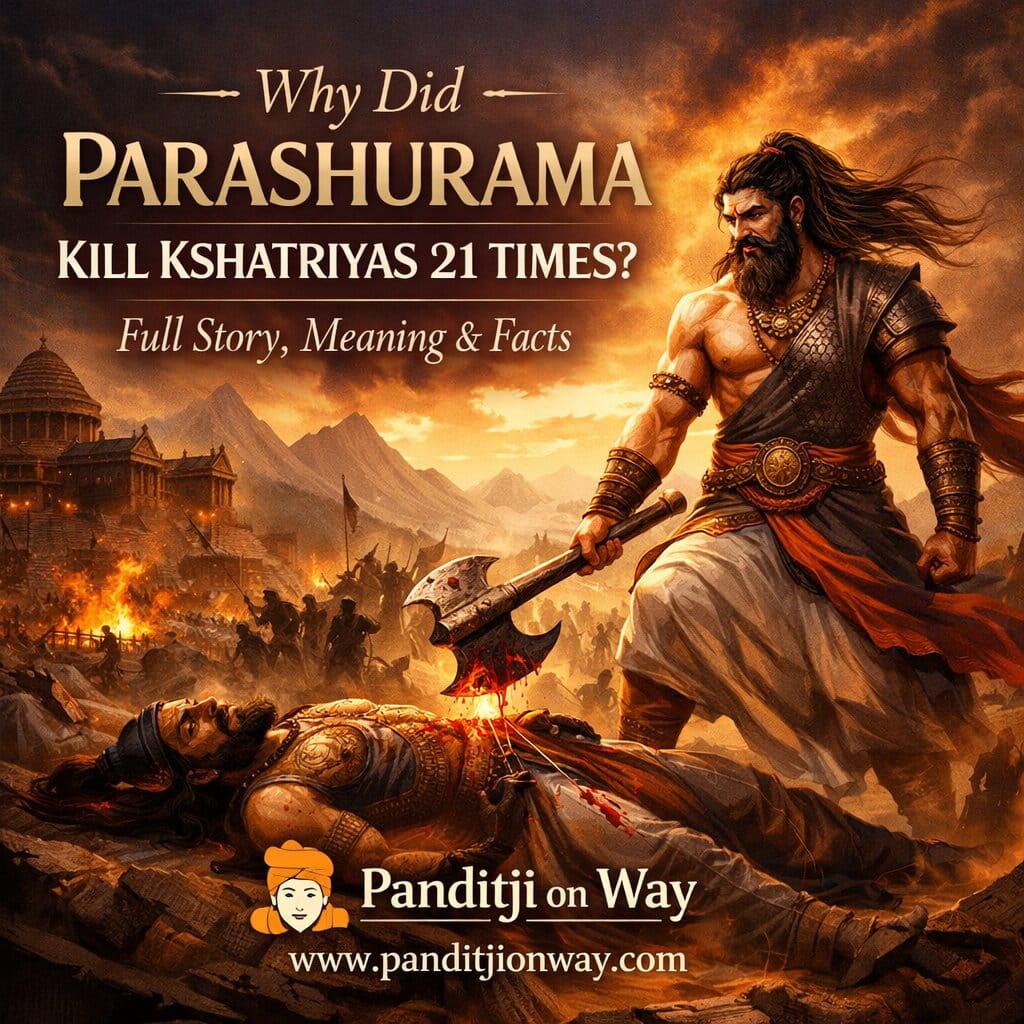
Parashurama, the sixth incarnation of Vishnu, is one of the most intense and paradoxical figures in Hindu mythology. Unlike other avatars, he is both a Brahmin and a warrior, symbolizing the balance between knowledge and power.
One of the most debated and fascinating aspects of his life is his vow to eliminate the Kshatriya rulers 21 times from Earth. This act is not just a story of revenge, but a deep symbolic narrative rooted in dharma (righteousness), justice, and cosmic balance.
Background Story: The Rise of Tyranny
King Kartavirya Arjuna (Sahasrarjuna)
- Also known as Sahasrarjuna (the thousand-armed king)
- Ruled the kingdom of Mahishmati
- Gained immense power through penance to Dattatreya
His Downfall
Despite divine blessings, Sahasrarjuna became:
- Arrogant and tyrannical
- Disrespectful toward sages and Brahmins
- A destroyer of ashrams and dharma
- A ruler who misused power for personal pleasure
This marks a critical theme in Hindu scriptures:
Power without dharma leads to destruction.

The Kamadhenu Incident
At the Ashram of Jamadagni
- Sage Jamadagni possessed the divine cow Kamadhenu
- Kamadhenu could provide unlimited food and resources
What Happened?
- Sahasrarjuna visited the ashram with his army
- He was treated with great hospitality
- He became greedy after seeing Kamadhenu’s powers
- When Jamadagni refused to give the cow:
- Sahasrarjuna destroyed the ashram
- Attempted to seize Kamadhenu
This act was not just theft—it was a direct attack on dharma and spiritual order.
The First Revenge: Death of Sahasrarjuna
When Parashurama returned and learned about the incident from his mother Renuka:
- He was enraged
- Took up his divine weapon (Parshu – axe)
- Fought and killed Sahasrarjuna
This act was considered justified as it restored dharma.
The Turning Point: Murder of Jamadagni
After Sahasrarjuna’s death:
- His sons sought revenge
- They attacked Jamadagni’s ashram
- Killed Sage Jamadagni brutally
- Left 21 wounds on his body
When Parashurama saw this:
- His grief turned into rage
- This moment triggered his legendary vow
Why 21 Times?
The Core Reason
Parashurama vowed:
“I will eliminate the Kshatriyas from Earth 21 times.”
Symbolism of 21
- Represents the 21 wounds on Jamadagni’s body
- Symbolizes total and repeated cleansing of adharma
- Indicates not just revenge, but systematic restoration of righteousness
The 21 Campaigns Explained
| Aspect | Explanation |
|---|---|
| Objective | Eliminate corrupt and tyrannical Kshatriyas |
| Not Target | Righteous and dharmic rulers |
| Duration | Multiple generations |
| Outcome | Restoration of balance between power and wisdom |
| Symbolism | Destruction of ego, greed, and injustice |
Was It Genocide or Justice?
This is often misunderstood.
Important Clarification:
- Parashurama did not destroy all Kshatriyas blindly
- He targeted:
- Corrupt rulers
- Oppressors of sages
- Violators of dharma
Scriptural Insight
Texts like Mahabharata and Bhagavata Purana indicate:
- The Earth was burdened by adharmic rulers
- Parashurama acted as a divine cleanser
The Aftermath
After completing his vow:
- Parashurama performed:
- Ashwamedha Yajna
- Vishwajit Yajna
- Donated land to Brahmins
- Retired to penance
Eventually, sages like Richika calmed him down, ending the cycle of destruction.
Spiritual Interpretation (Modern Perspective)
What This Story Teaches
- Abuse of Power Leads to Downfall
- Dharma Must Be Protected at All Costs
- Anger Can Be Both Destructive and Transformative
- Justice May Require Strong Action
High Authority External Links
- Learn more about Parashurama from Britannica:
https://www.britannica.com/topic/Parashurama - Mahabharata references:
https://www.sacred-texts.com/hin/maha/ - Bhagavata Purana insights:
https://www.vedabase.io
Pandit Booking & Puja Services
For authentic Vedic rituals, Yajna, and spiritual guidance:
https://www.panditjionway.com
Panditji on Way is a trusted platform for:
- Rudrabhishek Puja
- Grih Pravesh
- Pitru Shanti
- Online & Offline Pandit Booking
FAQs & PAA (People Also Ask) Why did Parashurama kill Kshatriyas 21 times
1. Why did Parashurama kill Kshatriyas 21 times?
Parashurama vowed to destroy Kshatriyas 21 times to avenge the brutal murder of his father Jamadagni and to eliminate tyrannical rulers who had deviated from dharma.
2. What triggered Parashurama’s anger against Kshatriyas?
The killing of Sage Jamadagni by the sons of Kartavirya Arjuna triggered his anger and led to his vow.
3. Who was Kartavirya Arjuna in Parashurama’s story?
Kartavirya Arjuna was a powerful but arrogant king who misused his divine powers and attacked sages.
4. What is the significance of the number 21 in this story?
The number 21 represents the wounds on Jamadagni’s body and symbolizes repeated cleansing of injustice.
5. Did Parashurama kill all Kshatriyas?
No, he targeted only those Kshatriyas who were corrupt, unjust, and against dharma.
6. What is the role of Kamadhenu in this story?
Kamadhenu was the sacred cow of Jamadagni, which Kartavirya tried to seize, triggering the conflict.
7. Which scriptures mention Parashurama’s story?
This story is found in Mahabharata, Bhagavata Purana, and other Puranas.
8. Was Parashurama justified in killing Kshatriyas?
According to Hindu philosophy, his actions were justified as they restored dharma and balance.
9. How did Parashurama defeat Kartavirya Arjuna?
Parashurama used his divine axe (Parshu) and unmatched warrior skills to defeat and kill him.
10. What happened after Parashurama completed his vow?
He performed yajnas, donated land, and retired to penance.
11. What is the deeper spiritual meaning behind Parashurama destroying Kshatriyas 21 times?
The story of Parashurama is not merely about violence but represents the cyclical restoration of dharma. In Hindu philosophy, whenever power becomes corrupt and rulers abandon righteousness, divine intervention occurs to reset balance. The repeated 21 campaigns symbolize that evil and injustice are not eliminated in one attempt—they re-emerge over time. Therefore, Parashurama’s actions highlight that maintaining dharma requires continuous effort, discipline, and courage. It also signifies the destruction of ego, greed, and misuse of authority.
12. Why is Parashurama considered both a Brahmin and a warrior?
Parashurama is unique because he was born into a Brahmin family (son of Jamadagni) but possessed the qualities of a Kshatriya warrior. This dual identity symbolizes the perfect balance between knowledge (Brahmatej) and power (Kshatratej). His life teaches that true strength lies not just in physical power but in wisdom and righteousness. When knowledge is combined with strength, it leads to justice; when power exists without wisdom, it leads to tyranny—as seen in the case of Kartavirya Arjuna.
13. Did Parashurama really wipe out all Kshatriyas from Earth?
No, scriptural interpretations clarify that Parashurama did not completely eliminate all Kshatriyas forever. Instead, he destroyed those who were adharmic and oppressive. Over time, new generations of righteous Kshatriyas emerged. The purpose was purification, not annihilation. Hindu texts often use symbolic language, so “destroying the earth of Kshatriyas 21 times” represents repeated cleansing of corrupt leadership rather than literal extinction of an entire class.
14. What lessons can modern society learn from Parashurama’s story?
Parashurama’s story is highly relevant even today. It teaches that:
- Power must always be accountable
- Leaders should follow ethical and moral values
- Injustice and corruption must be challenged
- Anger should be controlled and used constructively
- Society must maintain balance between authority and wisdom
In modern terms, it can be interpreted as a call for ethical governance, social justice, and responsible leadership.
15. How does Parashurama’s story connect with the concept of Dharma?
Dharma is the central theme of Parashurama’s life. When rulers like Kartavirya Arjuna began violating dharma by exploiting people, attacking sages, and misusing power, the balance of the universe was disturbed. As an incarnation of Vishnu, Parashurama’s role was to restore that balance. His actions emphasize that dharma is not passive—it sometimes requires strong and decisive action to protect righteousness and ensure justice prevails.
16. Is Parashurama still alive according to Hindu beliefs?
Yes, Parashurama is considered one of the Chiranjivis (immortal beings) in Hindu tradition. Scriptures suggest that he continues to live on Earth in a hidden form and will reappear in the future to guide the final avatar of Vishnu, known as Kalki. His immortality symbolizes eternal vigilance over dharma and righteousness.
17. Where did Parashurama perform his penance after destroying Kshatriyas?
After completing his vow, Parashurama is believed to have retreated to sacred places like the Mahendra Mountains (Mahendragiri) and other spiritual regions for deep penance (tapasya). These places are still associated with his presence and are considered highly sacred in Hindu pilgrimage traditions.
18. Did Parashurama regret killing the Kshatriyas?
According to various interpretations of Bhagavata Purana and other scriptures, Parashurama did perform atonement rituals (prayaschitta) after his campaigns. He conducted yajnas like Ashwamedha and donated land to Brahmins, indicating that even divine warriors acknowledge the karmic weight of violence and seek purification.
19. How is Parashurama different from other avatars of Vishnu?
Unlike other avatars such as Rama or Krishna, Parashurama represents a fierce and corrective form of divine intervention. While other avatars focus on establishing dharma through guidance and diplomacy, Parashurama’s role was more direct—eliminating injustice through force when necessary. This highlights that divine methods can vary depending on the situation and severity of imbalance.
20. What is the connection between Parashurama and later Hindu epics?
Parashurama appears across multiple timelines in Hindu mythology. In the Ramayana, he confronts Lord Rama, and in the Mahabharata, he serves as a गुरु (teacher) to great warriors like Bhishma, Drona, and Karna. This shows that his role extends beyond destruction—he is also a preserver of martial knowledge and discipline.
Summary
The story of Parashurama killing Kshatriyas 21 times is a powerful narrative rooted in justice, dharma, and cosmic balance. It began with the tyranny of Kartavirya Arjuna and escalated after the unjust killing of Sage Jamadagni.
Parashurama’s vow was not blind revenge but a mission to eliminate corrupt and oppressive rulers who had strayed from righteousness. The number 21 symbolizes both the wounds of his father and the repeated cleansing of adharma from society.
This story teaches timeless lessons:
- Power must be guided by morality
- Injustice cannot be tolerated
- Dharma requires protection through action
- Balance between strength and wisdom is essential
Ultimately, Parashurama’s actions represent the restoration of order in a world consumed by chaos, making his story deeply relevant even in modern times.