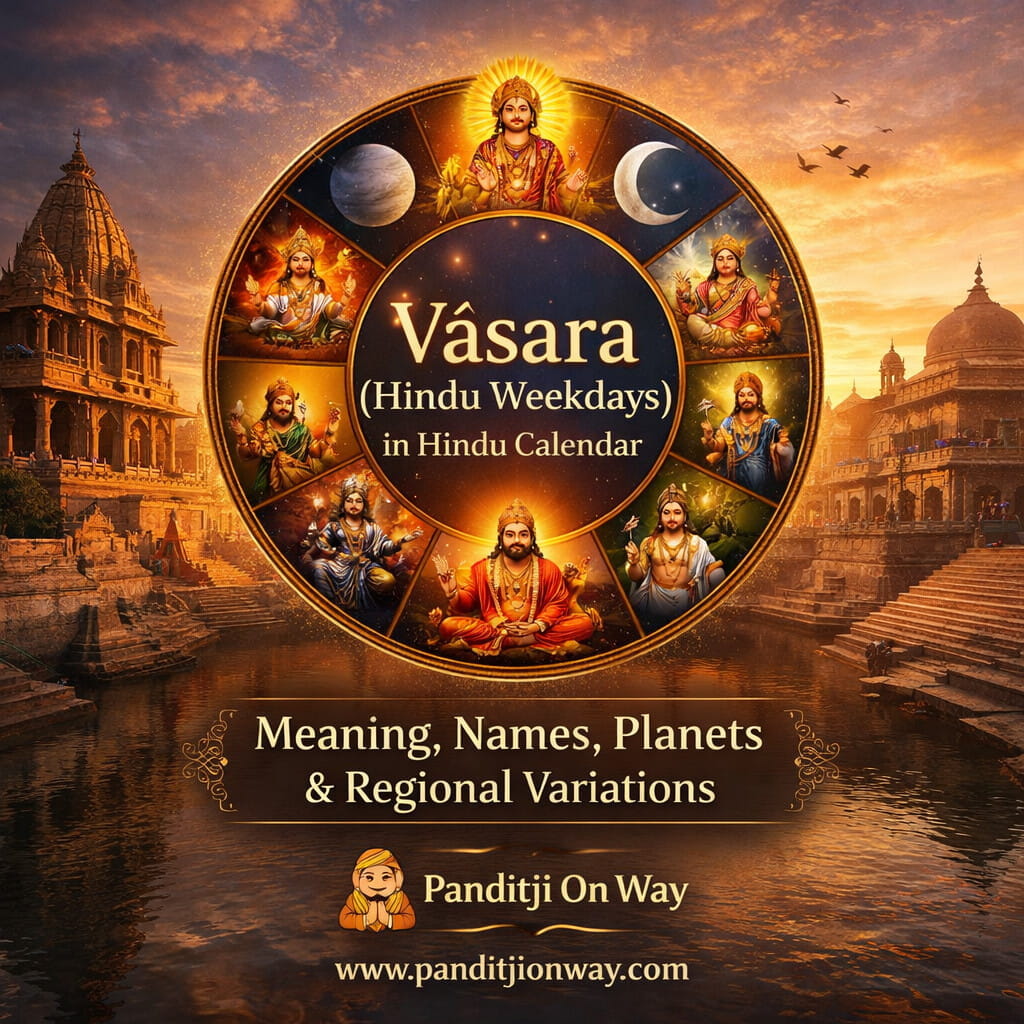
Vāsara (Hindu Weekdays) in Hindu Calendar – Meaning, Names, Planets & Regional Variations
Explore Vāsara (Hindu weekdays), their planetary rulers, meanings, and regional names across Indian languages with detailed tables and Vedic insights.
Introduction to Vāsara in Hindu Calender / Panchang
In the Hindu Panchang, Vāsara refers to the weekday. It is one of the five core elements of Panchang:
- Tithi
- Vāra (Vāsara – Weekday)
- Nakshatra
- Yoga
- Karana
The system of weekdays used in Hindu calendars is astronomically and linguistically aligned with other Indo-European calendars, including the Roman and Greek systems. This alignment is believed to have occurred around the 3rd century CE, establishing a universal planetary weekday structure still followed today.
Astronomical Division of a Vāsara
A single Vāsara (weekday) is precisely divided as follows:
- 1 Day = 60 Ghatikas
- 1 Ghatika = 24 minutes
- 1 Ghatika = 60 Palas
- 1 Pala = 24 seconds
- 1 Pala = 60 Vipalas
This highly accurate timekeeping system highlights the scientific precision of Vedic astronomy.
Why Vāsara is Important in Hindu Rituals
Each weekday is ruled by a specific Graha (planet) and is crucial for:
- Selecting auspicious Muhurats
- Performing Vrat (fasts)
- Conducting Puja, Havan, Jaap, and Katha
- Astrological remedies and planetary pacification
Panditji On Way uses Vāsara analysis while booking customized pujas and astrological rituals for devotees worldwide.
Complete List of Hindu Weekdays (Vāsara) with Planetary Lords
Hindu Weekdays Table
| No. | Sanskrit Vāsara | Common Name | Planet (Graha) | Celestial Body |
|---|---|---|---|---|
| 1 | Ravivāsara (रविवासर) | Sunday | Ravi / Aditya | Sun |
| 2 | Somavāsara (सोमवासर) | Monday | Soma / Chandra | Moon |
| 3 | Maṅgalavāsara (मंगलवासर) | Tuesday | Mangala | Mars |
| 4 | Budhavāsara (बुधवासर) | Wednesday | Budha | Mercury |
| 5 | Guruvāsara / Bṛhaspativāsara | Thursday | Guru / Bṛhaspati | Jupiter |
| 6 | Śukravāsara (शुक्रवासर) | Friday | Shukra | Venus |
| 7 | Śanivāsara (शनिवासर) | Saturday | Shani | Saturn |
Regional Names of Vāsara in Indian Languages
The Sanskrit term “-vāsara” is commonly realized as vāra / vaar in modern Indian languages.
Examples Across Languages
- Hindi: Ravivār, Somvār, Maṅgalvār, Budhvār, Guruvār, Śukravār, Śanivār
- Tamil: Nyayiru, Thingal, Chevvai, Budhan, Vyazhan, Velli, Shani
- Telugu: Ādivāram, Somavāram, Maṅgalavāram, Budhavāram, Guruvāram, Śukravāram, Śanivāram
- Bengali: Robibār, Sombār, Mongolbār, Budhbār, Brihospotibār, Shukrobār, Shonibār
- Marathi: Ravivār, Somvār, Mangalvār, Budhavār, Guruvār, Shukravār, Shanivār
- Punjabi (Hindus & Sikhs): Aitvār, Somvār, Mangalvār, Budhvār, Veervār, Shukravār, Shanīvār
- Urdu / Islamic Influence: Itvār, Peer, Mangal, Budh, Jumerāt, Juma, Sanīchar
This linguistic consistency reinforces the shared Indo-European astronomical heritage.
Regional Names of Vāsara in Indian Languages (Complete & Authoritative Guide)
The Sanskrit word Vāsara (weekday) evolved organically across Indian languages due to Prakrit influence, phonetic shifts, and regional culture, while retaining the same planetary ruler (Graha).
Most Indo-Aryan and Dravidian languages replace “-vāsara” with vāra / vār / bār / vaar, while southern languages often use native Tamil-Dravidian terms.
This continuity makes Hindu weekday nomenclature one of the most linguistically preserved astronomical systems in the world.
How Sanskrit Vāsara Transformed Regionally
| Sanskrit Suffix | Regional Variations | Languages |
|---|---|---|
| vāsara | vāra / vār / vaar | Hindi, Marathi, Gujarati, Punjabi |
| vāsara | bār | Bengali, Assamese, Odia |
| vāsara | vāram | Telugu |
| vāsara | kizhamai / nāl | Tamil |
| vāsara | dinam | Malayalam |
Pan-India Regional Names of Weekdays
Sunday – Ravivāsara (Sun Day)
| Language | Regional Name |
|---|---|
| Sanskrit | Ravivāsara / Sūrya-vāsara |
| Hindi | Ravivār |
| Bengali | Robibār |
| Marathi | Ravivār |
| Gujarati | Ravivār |
| Punjabi | Aitvār |
| Tamil | Nyayiru |
| Telugu | Ādivāram |
| Malayalam | Njaayar |
| Kannada | Bhānuvāra |
| Urdu | Itvār |
| Nepali | Aitabar |
Monday – Somavāsara (Moon Day)
| Language | Regional Name |
|---|---|
| Sanskrit | Somavāsara |
| Hindi | Somvār |
| Bengali | Sombār |
| Marathi | Somvār |
| Gujarati | Somvār |
| Punjabi | Somvār |
| Tamil | Thingal |
| Telugu | Somavāram |
| Malayalam | Thinkal |
| Kannada | Sōmavāra |
| Urdu | Peer |
| Nepali | Sombar |
Tuesday – Maṅgalavāsara (Mars Day)
| Language | Regional Name |
|---|---|
| Sanskrit | Maṅgalavāsara / Bhaumavāsara |
| Hindi | Mangalvār |
| Bengali | Mongolbār |
| Marathi | Mangalvār |
| Gujarati | Mangalvār |
| Punjabi | Mangalvār |
| Tamil | Chevvai |
| Telugu | Maṅgalavāram |
| Malayalam | Chovva |
| Kannada | Maṅgaḷavāra |
| Urdu | Mangal |
| Nepali | Mangalbar |
Wednesday – Budhavāsara (Mercury Day)
| Language | Regional Name |
|---|---|
| Sanskrit | Budhavāsara |
| Hindi | Budhvār |
| Bengali | Budhbār |
| Marathi | Budhavār |
| Gujarati | Budhvār |
| Punjabi | Budhvār |
| Tamil | Budhan |
| Telugu | Budhavāram |
| Malayalam | Budhan |
| Kannada | Budhavāra |
| Urdu | Budh |
| Nepali | Budhabar |
Thursday – Guruvāsara (Jupiter Day)
| Language | Regional Name |
|---|---|
| Sanskrit | Guruvāsara / Bṛhaspativāsara |
| Hindi | Guruvār / Brihaspativār |
| Bengali | Brihospotibār |
| Marathi | Guruvār |
| Gujarati | Guruvār |
| Punjabi | Veervār |
| Tamil | Vyazhan |
| Telugu | Guruvāram |
| Malayalam | Vyaazham |
| Kannada | Guruvāra |
| Urdu | Jumerāt |
| Nepali | Bihibar |
Friday – Śukravāsara (Venus Day)
| Language | Regional Name |
|---|---|
| Sanskrit | Śukravāsara |
| Hindi | Shukravār |
| Bengali | Shukrobār |
| Marathi | Shukravār |
| Gujarati | Shukravār |
| Punjabi | Shukravār |
| Tamil | Velli |
| Telugu | Śukravāram |
| Malayalam | Velli |
| Kannada | Śukravāra |
| Urdu | Juma |
| Nepali | Sukrabar |
Saturday – Śanivāsara (Saturn Day)
| Language | Regional Name |
|---|---|
| Sanskrit | Śanivāsara |
| Hindi | Shanivār |
| Bengali | Shonibār |
| Marathi | Shanivār |
| Gujarati | Shanivār |
| Punjabi | Shanivār / Sanicharvār |
| Tamil | Shani |
| Telugu | Śanivāram |
| Malayalam | Shani |
| Kannada | Śanivāra |
| Urdu | Sanichar |
| Nepali | Sanibar |
Linguistic & Astrological Observations
- Indo-Aryan languages retain planet-based naming
- Dravidian languages emphasize native phonetics
- Islamic influence introduces Arabic weekday terms without altering planetary order
- Planetary alignment remains identical across cultures
Spiritual Application of Regional Vāsara Names
Knowing regional weekday names helps in:
- Booking local temple pujas
- Understanding regional Panchang
- Aligning vrats with correct planetary day
- Consulting astrologers accurately
For region-specific puja bookings, vrat rituals, and planetary remedies, visit
👉 https://www.panditjionway.com
India’s First & Largest Online Pooja Booking Portal
Why do weekday names change across Indian languages?
Due to linguistic evolution, regional phonetics, and cultural adaptation, while planetary rulership remains constant.
Do all Indian languages follow the same weekday order?
Yes. The planetary sequence is universally consistent.
Which language preserves Sanskrit names most closely?
Hindi, Marathi, Gujarati, and Kannada retain near-Sanskrit forms.
Which languages use non-planetary names?
Tamil and Malayalam use traditional Dravidian terms but still follow planetary alignment.
Planetary Significance of Each Vāsara
Ravivāsara (Sunday)
- Ruled by Sun
- Best for leadership, authority, health rituals
- Ideal for Surya Puja
Somavāsara (Monday)
- Ruled by Moon
- Best for peace, mind, emotions
- Sacred to Lord Shiva
Maṅgalavāsara (Tuesday)
- Ruled by Mars
- Power, courage, protection
- Dedicated to Hanuman Ji
Budhavāsara (Wednesday)
- Ruled by Mercury
- Intelligence, business, communication
Guruvāsara (Thursday)
- Ruled by Jupiter
- Wisdom, prosperity, marriage
- Dedicated to Guru & Vishnu
Śukravāsara (Friday)
- Ruled by Venus
- Wealth, luxury, relationships
- Dedicated to Goddess Lakshmi
Śanivāsara (Saturday)
- Ruled by Saturn
- Karma, discipline, justice
- Dedicated to Shani Dev
Vāsara Selection for Puja & Muhurat
Choosing the correct weekday enhances results of:
- Rudrabhishek
- Navagraha Shanti
- Griha Pravesh
- Marriage Muhurat
- Business opening ceremonies
Book expert pandits based on Vāsara and planetary alignment at
👉 https://www.panditjionway.com (Panditji on way – Spiritual Platform)
Vedic Time Measurement – National Council of Educational Research and Training (NCERT)
https://ncert.nic.in
- Planetary Weekdays – NASA Solar System Exploration
https://solarsystem.nasa.gov
Frequently Asked Questions (FAQ) on Vāsara (Hindu Weekdays)
What is Vāsara in the Hindu calendar?
Vāsara means weekday in Sanskrit and is one of the five core elements of the Hindu Panchang. Each Vāsara is ruled by a specific planet (Graha) and influences daily activities, muhurat selection, fasting, and religious rituals in Vedic tradition.
How many Vāsaras are there in Hindu Panchang?
There are seven Vāsaras in the Hindu calendar. These correspond to the seven days of the week, each governed by one of the Navagrahas—Sun, Moon, Mars, Mercury, Jupiter, Venus, and Saturn.
Which planet rules each Vāsara?
Each weekday is ruled by a planet: Sunday – Sun, Monday – Moon, Tuesday – Mars, Wednesday – Mercury, Thursday – Jupiter, Friday – Venus, Saturday – Saturn. This planetary rulership determines the spiritual, astrological, and practical significance of each day.
Why are Hindu weekdays named after planets?
Hindu weekdays are planet-based because Vedic astronomy linked planetary motion with daily time cycles. This system later influenced and aligned with Roman and other Indo-European calendars, creating a universal planetary weekday structure used worldwide today.
Are Hindu weekdays the same as Western weekdays?
Yes. Hindu and Western weekday systems follow the same planetary order and sequence. The alignment occurred around the 3rd century CE, making Sunday to Saturday identical in both calendars, although names and religious meanings differ.
Why do weekday names vary across Indian languages?
Regional variations exist due to linguistic evolution, Prakrit influence, and cultural adaptation. While pronunciation and terms differ, the planetary ruler and weekday order remain unchanged across all Indian languages.
Which languages preserve Sanskrit Vāsara names most closely?
Languages such as Hindi, Marathi, Gujarati, Kannada, and Telugu retain names closest to Sanskrit. Dravidian languages like Tamil and Malayalam use traditional native terms while maintaining the same planetary alignment.
Which Vāsara is considered most auspicious?
No single Vāsara is universally most auspicious. The best weekday depends on the purpose of the ritual—Monday for Shiva puja, Thursday for Vishnu and Guru, Friday for Lakshmi, and Saturday for Shani remedies.
Why is Vāsara important for muhurat selection?
Vāsara directly affects auspicious timing (muhurat) in Hindu rituals. Choosing the correct weekday enhances the effectiveness of puja, vrat, marriage, griha pravesh, and astrological remedies.
Is Vāsara considered in astrology and horoscope analysis?
Yes. Vāsara plays an important role in Jyotish astrology, especially in birth chart interpretation, planetary strength analysis, and remedial measures. The ruling planet of the day influences energy and outcomes.
Where can I book puja based on Vāsara and planetary alignment?
You can book expert-guided pujas, havans, and vrat rituals based on Vāsara, muhurat, and planetary alignment through Panditji On Way, India’s first and largest online pooja booking platform.
What are regional names of Vāsara in Indian languages?
Regional names of Vāsara are local-language terms for weekdays derived from Sanskrit or native linguistic roots. While pronunciation and wording differ across Hindi, Tamil, Bengali, Telugu, Marathi, and other languages, the weekday order and planetary rulers remain identical throughout India.
Why do weekday names differ across Indian states?
Weekday names vary due to linguistic evolution, regional phonetics, Prakrit influence, and cultural history. Indo-Aryan languages preserve Sanskrit forms like vār, while Dravidian languages use traditional terms such as Thingal or Velli without changing planetary meaning.
Do all Indian languages follow the same Vāsara sequence?
Yes. Every Indian language follows the same seven-day Vāsara sequence based on planetary rulership. Only the spoken names change, not the order, astronomical basis, or astrological significance.
Which Indian languages use Sanskrit-based weekday names?
Languages such as Hindi, Marathi, Gujarati, Punjabi, Odia, Assamese, and Kannada use weekday names closely derived from Sanskrit Vāsara terminology, often ending in vār, vāra, or bār.
Which Indian languages use non-Sanskrit weekday names?
Tamil and Malayalam primarily use Dravidian-origin weekday names like Nyayiru, Thingal, Velli, and Shani. Despite linguistic differences, each day still corresponds to the same ruling planet as in Sanskrit tradition.
How did planetary names remain consistent despite language differences?
Planetary consistency was preserved due to the astronomical foundation of Vedic timekeeping. Regional languages adapted pronunciation, not planetary associations, ensuring uniform astrological interpretation across India.
Are Muslim and Arabic weekday names used in India related to Vāsara?
Yes. In Urdu-speaking regions, Arabic names like Juma (Friday) or Peer (Monday) are used culturally, but Hindu Panchang calculations still follow the same planetary weekday system.
Which regional language preserves the oldest weekday terminology?
Sanskrit remains the original and oldest source. Among living languages, Kannada and Telugu retain forms closest to classical Sanskrit weekday nomenclature.
Why is understanding regional Vāsara names important?
Understanding regional names helps in reading local Panchangs, temple calendars, vrat schedules, and astrological charts, especially when performing rituals in different states or languages.
Are regional weekday names used in temple rituals?
Yes. Many temples announce ritual schedules and vrats using regional weekday names, making it important for devotees to recognize local terminology while aligning with planetary significance.
Can pujas be booked based on regional Vāsara preferences?
Yes. Panditji On Way allows devotees to book pujas based on regional traditions, local Panchang, and correct Vāsara selection, ensuring authenticity and astrological accuracy.
Conclusion
The concept of Vāsara (weekday) in the Hindu calendar reflects the scientific depth, astronomical accuracy, and cultural continuity of the Vedic timekeeping system. While the names of Vāsara vary across Indian languages due to regional linguistics and historical evolution, the planetary order, astrological significance, and ritual importance remain uniform throughout India.
From Sanskrit-based terms like Ravivār and Somvār to Dravidian expressions such as Nyayiru, Thingal, and Velli, regional names of Vāsara demonstrate how diverse languages preserved a single cosmic framework. This consistency allows devotees, astrologers, and scholars to interpret Panchang, select muhurat, and perform rituals accurately—regardless of language or region.
Understanding regional Vāsara names is essential for reading local Panchangs, observing vrats, scheduling temple rituals, and consulting astrology, especially in a culturally diverse country like India. It bridges classical Sanskrit wisdom with living regional traditions, making Hindu calendrical science both timeless and accessible.
For devotees seeking authentic, Vāsara-based pujas, astrological guidance, and ritual services aligned with regional customs, Panditji On Way stands as India’s first and largest online pooja booking platform—combining Vedic accuracy with modern convenience.
This comprehensive understanding of Vāsara not only preserves ancient knowledge but also ensures its relevance, applicability, and spiritual effectiveness in the present age, making it a cornerstone of Hindu calendrical and astrological practice.
For authentic Vedic guidance, planetary remedies, and online puja bookings, trust
Panditji On Way – First and Largest Online Pooja Booking Portal