

Difference Among Various Shraddha Types: Nitya, Naimittika, Kamya, Vriddhi & Parvana
Learn the difference Shraddha types Nitya, Naimittika, Kamya, Vriddhi and Parvana Shraddha, including meaning, purpose, occasions, Pitru Paksha connection and FAQs.
Shraddha (Śrāddha) is an important Hindu ancestral ritual performed with faith and reverence for Pitru, or departed ancestors. Different Hindu scriptures and ritual traditions classify Shraddha according to its purpose, occasion, timing and the ancestor for whom it is performed.
The five forms commonly discussed in this context are Nitya Shraddha, Naimittika Shraddha, Kamya Shraddha, Vriddhi Shraddha and Parvana Shraddha. However, scriptural classifications vary. The Matsya Purana, for example, describes three categories—Nitya, Naimittika and Kamya—while other texts discuss additional categories such as Vriddhi and Parvana.
This guide explains the meaning, purpose, occasions, major features and differences between the various types of Shraddha, helping families understand which form may be appropriate in a particular traditional context.
Book Shraddha Puja Online: Panditji On Way – Shraddha & Pitru Puja Services

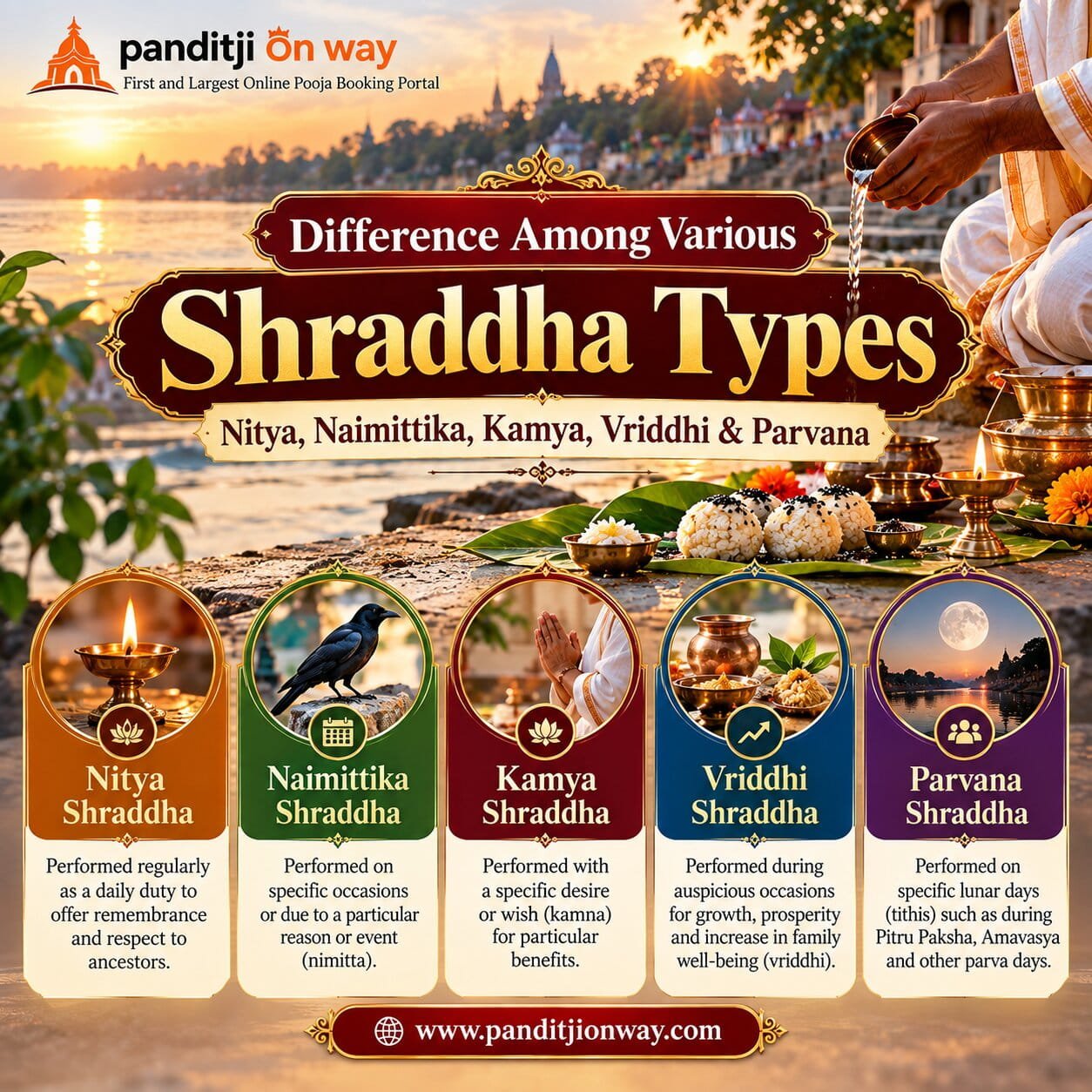
What Is Shraddha in Hinduism?
Shraddha is an ancestral ritual performed with faith, reverence and remembrance. The ritual tradition involves offerings and acts of respect directed toward the Pitru.
Ancient Hindu texts contain detailed discussions of Shraddha and its classifications. The Yajnavalkya Smriti, for example, discusses Parvana and Ekoddista as two broad forms and subsequently describes Nitya, Naimittika and Kamya according to another classification.
Therefore, it is important to understand that different scriptures can classify Shraddha differently. A particular family’s ritual tradition, regional practice and the guidance of its priest may also affect the procedure.
Quick Definition
The five commonly discussed types of Shraddha are Nitya, Naimittika, Kamya, Vriddhi and Parvana. Nitya is associated with regular observance, Naimittika with a specific occasion or person, Kamya with a desired objective, Vriddhi with auspicious occasions, and Parvana with prescribed lunar or ancestral observances. Scriptural classifications vary by text and tradition.
Five Types of Shraddha: Quick Comparison Table
| Type of Shraddha | Sanskrit | Basic Meaning | Main Purpose | Common Association |
|---|---|---|---|---|
| Nitya Shraddha | नित्य श्राद्ध | Regular/obligatory Shraddha | Regular remembrance of ancestors | Daily or prescribed recurring observance |
| Naimittika Shraddha | नैमित्तिक श्राद्ध | Occasion-specific Shraddha | Performed because of a particular circumstance | Specific ancestor, death-related observance |
| Kamya Shraddha | काम्य श्राद्ध | Desire-based Shraddha | Performed for a particular desired result | Specific wish or objective |
| Vriddhi Shraddha | वृद्धि श्राद्ध | Shraddha associated with prosperity/growth | Invoking ancestral blessings during auspicious occasions | Marriage and other joyous rites |
| Parvana Shraddha | पार्वण श्राद्ध | Shraddha associated with a Parva/lunar occasion | Ancestral observance on prescribed days | Amavasya and Pitru-related occasions |
Important: These categories overlap in some traditional classifications. They should not be treated as five completely separate systems used identically by every Hindu tradition.
1. Nitya Shraddha (नित्य श्राद्ध)
What Is Nitya Shraddha?
Nitya Shraddha refers to a regular or obligatory form of ancestral remembrance described in Hindu ritual literature.
The Padma Purana describes Nitya, Naimittika and Kamya as three forms of Shraddha and explains Nitya Shraddha separately. Other traditional sources similarly describe Nitya as the regularly performed form.
Key Features of Nitya Shraddha
- Associated with regular ancestral observance.
- Its procedure can differ according to the ritual tradition.
- Some traditional descriptions distinguish Nitya Shraddha from forms involving formal deity invocation.
- Offerings of food or water are described in different textual traditions.
Why Is Nitya Shraddha Performed?
The underlying purpose is regular remembrance, reverence and fulfillment of ancestral duty.
It should not automatically be assumed that every Hindu household is required to perform a full Nitya Shraddha every day. The actual practice depends on one’s Shakha, family tradition, regional custom and priestly guidance.
2. Naimittika Shraddha (नैमित्तिक श्राद्ध)
What Is Naimittika Shraddha?
Naimittika Shraddha is associated with a particular occasion, circumstance or ritual purpose.
Traditional literature describes Naimittika as an occasional form of Shraddha. Some texts also associate specific-ancestor observances with Ekoddista Shraddha, in which the offering is directed toward one particular departed person.
Common Examples
Naimittika or related occasion-specific ancestral rites may be associated with:
- Death-related observances
- Annual death-Tithi observances
- Particular ritual circumstances
- Certain special occasions prescribed by tradition
Naimittika vs Ekoddista
These terms should not simply be treated as identical in every text.
Ekoddista literally indicates a Shraddha directed toward one particular ancestor, while Naimittika describes the occasion-specific nature of a rite. The Yajnavalkya Smriti separately discusses Ekoddista and Parvana and also provides the Nitya-Naimittika-Kamya classification.
3. Kamya Shraddha (काम्य श्राद्ध)
What Is Kamya Shraddha?
Kamya Shraddha is a form performed with a specific desired objective or intention.
Traditional sources describe Kamya Shraddha as being performed when a person seeks a particular result. The Brahma Purana study, for example, connects Kamya Shraddha with a desired fruit and gives examples involving particular Nakshatra observances.
Purpose of Kamya Shraddha
Depending on the particular textual and ritual tradition, a person may undertake Kamya Shraddha with an intention such as:
- Seeking prosperity
- Seeking progeny
- Seeking a particular spiritual or worldly objective
- Performing a prescribed ancestral rite associated with a desired result
The exact Nakshatra, Tithi, offerings and Sankalpa should be determined according to the relevant tradition rather than assuming that the same procedure applies everywhere.
4. Vriddhi Shraddha (वृद्धि श्राद्ध)
What Is Vriddhi Shraddha?
Vriddhi Shraddha is associated with occasions of growth, prosperity, joy or auspicious family events.
Traditional sources describe Vriddhi Shraddha as the Shraddha performed at a time of Vriddhi, meaning growth or prosperity.
It is also known in some traditions as Nandi Shraddha or is closely associated with Nandi-related ancestral observances.
When Is Vriddhi Shraddha Performed?
Depending on family and regional tradition, it may be associated with:
- Marriage ceremonies
- Birth-related auspicious ceremonies
- Other major family Samskaras
- Beginning of an important auspicious undertaking
A traditional Agama-related source specifically describes the five-type classification as including Nitya, Naimittika, Kamya, Vriddhi and Parvana and associates Vriddhi with the marriage day.
Purpose
The purpose is traditionally connected with ancestral remembrance and seeking blessings during an auspicious family occasion.
5. Parvana Shraddha (पार्वण श्राद्ध)
What Is Parvana Shraddha?
Parvana Shraddha is associated with particular Parva or prescribed lunar occasions.
The Yajnavalkya Smriti distinguishes Parvana from Ekoddista, describing Parvana as intended for multiple ancestral generations and Ekoddista as intended for one person.
Other traditional sources specifically associate Parvana Shraddha with Amavasya.
Parvana Shraddha During Pitru Paksha
Parvana-type ancestral observances are especially relevant to discussions of Pitru Paksha, the period traditionally dedicated to ancestral rites.
However, Pitru Paksha should not be treated as synonymous with every form of Parvana Shraddha. The precise ritual depends on the Tithi, purpose and family tradition.

Nitya vs Naimittika vs Kamya vs Vriddhi vs Parvana Shraddha
| Feature | Nitya | Naimittika | Kamya | Vriddhi | Parvana |
|---|---|---|---|---|---|
| Basic idea | Regular | Occasion-specific | Desire-based | Auspicious/growth-related | Parva/lunar occasion |
| Main focus | Regular ancestral duty | Particular circumstance/person | Desired objective | Family prosperity/auspicious event | Prescribed ancestral occasion |
| Typical association | Regular observance | Death-related or specific event | Specific intention | Marriage/birth-related traditions | Amavasya/Pitru observances |
| Scope | Depends on tradition | Often specific | Intention-specific | Family ceremony | Often collective ancestral context |
| Procedure | Tradition-specific | Tradition-specific | Sankalpa-specific | Ceremony-specific | Tithi-specific |
| Requires exact Tithi? | Depends | Often | Often | Ceremony-dependent | Usually important |
| Suitable for Pitru Paksha? | Depends on tradition | Depends | Depends | Generally not the defining category | Yes, in appropriate traditional observances |
Difference Between Nitya and Naimittika Shraddha
The simplest distinction is:
Nitya Shraddha is associated with regular or prescribed recurring observance, whereas Naimittika Shraddha is associated with a particular occasion or circumstance.
Traditional sources explicitly describe Nitya as regular and Naimittika as occasional.
Difference Between Naimittika and Parvana Shraddha
The two terms describe different aspects of classification.
Naimittika focuses on the occasion or circumstance that gives rise to the rite.
Parvana identifies a Shraddha associated with a Parva or prescribed lunar occasion and, in certain texts, is contrasted with Ekoddista, which is directed toward one individual.
Therefore, they should not automatically be treated as interchangeable terms.
Difference Between Kamya and Nitya Shraddha
The key distinction is intention.
- Nitya Shraddha: associated with regular prescribed observance.
- Kamya Shraddha: undertaken with a particular desired objective.
Traditional literature explicitly describes Kamya as being performed for a desired purpose.
Difference Between Vriddhi and Parvana Shraddha
Vriddhi Shraddha is connected with auspicious growth, prosperity and family ceremonies.
Parvana Shraddha is connected with prescribed Parva or lunar occasions and is particularly relevant to ancestral observances on dates such as Amavasya in traditional classifications.
Is Pitru Paksha Shraddha the Same as Parvana Shraddha?
Not necessarily.
Pitru Paksha is a specific period devoted to ancestral observances. Within this period, different Shraddha rites may be performed according to the deceased person’s Tithi and the family’s ritual tradition.
Parvana Shraddha is a broader ritual classification connected with Parva/lunar occasions.
For example, traditional Panchang references distinguish Bhadrapada Purnima from Pitru Paksha and note that Sarvapitri Amavasya is an important concluding observance of Pitru Paksha.
Therefore, the correct Shraddha should be selected according to Tithi, relationship, ritual purpose and family tradition.
What Is the Difference Between Shraddha and Tarpan?
Although both are connected with ancestral remembrance, Shraddha and Tarpan are not simply identical rituals.
Shraddha generally refers to a broader ancestral ritual involving prescribed offerings and ceremonial procedures.
Tarpan refers specifically to offerings, traditionally involving water and other prescribed substances, made with a particular intention.
The exact procedure differs according to the ritual tradition followed.
Where Can Shraddha Be Performed?
Shraddha can be performed according to one’s family tradition, regional custom and the instructions applicable to the particular rite.
Important traditional pilgrimage locations associated with Pitru rituals include:
- Gaya
- Varanasi
- Prayagraj
- Haridwar
- Nashik
- Ujjain
- Siddhpur
- Pushkar
- Gokarna
However, a family does not necessarily need to travel to a pilgrimage city for every Shraddha. Many ancestral rites are traditionally performed at home or at a suitable place under the guidance of a qualified priest.
For location-based service such as:
- Shraddha Puja in Arizona
- Pitru Paksha Puja in California
- Shraddha Puja in New Jersey
- Shraddha Puja in Texas
- Shraddha Puja in New York
- Shraddha Puja in Mumbai
- Shraddha Puja in Delhi
- Shraddha Puja in Hyderabad
- Shraddha Puja in Bengaluru
This is preferable to unnecessarily stuffing city names into the main article.
What Is Required for Shraddha Puja?
The exact requirements vary according to the type of Shraddha and the family tradition.
Commonly associated ritual materials may include:
- Water
- Black sesame
- Kusha/Darbha grass
- Pinda ingredients where applicable
- Cooked food or prescribed offerings
- Flowers
- Fruits
- Ghee
- Appropriate vessels
- Items specified by the performing priest
The Matsya Purana discussion of Shraddha, for example, describes various substances associated with ancestral offerings.
Do not use a generic shopping list for every Shraddha. The materials should be confirmed according to the particular rite.
How Is Shraddha Performed?
The procedure varies according to the type of Shraddha, but a traditional ceremony may include:
- Sankalpa – stating the purpose and intention of the ritual.
- Purification – preparing the place and participants.
- Pitru invocation – according to the applicable tradition.
- Tarpan – offering water and prescribed substances where applicable.
- Pinda offerings – where prescribed.
- Mantra recitation – according to the ritual tradition.
- Offerings and Brahmana Bhojana – where prescribed.
- Dakshina and Dana – according to the family’s tradition.
- Prarthana – concluding prayers and remembrance.
The exact mantras, sequence and offerings should be performed according to the Shrauta, Smarta, regional or family tradition being followed.
Why Do Hindus Perform Shraddha?
Shraddha represents several important religious and cultural ideas:
- Honoring ancestors
- Expressing gratitude toward previous generations
- Maintaining family remembrance
- Fulfilling traditional ancestral duties
- Performing prescribed rites for departed family members
- Continuing cultural and spiritual traditions
Claims that performing or failing to perform Shraddha will mechanically cause particular financial, marital or medical outcomes should be presented as religious beliefs or traditional interpretations, not as scientifically established facts.
Shraddha and Pitru Dosha
Pitru Dosha is a concept found in Hindu astrology and religious practice. Different traditions interpret its causes and remedies differently.
Shraddha, Tarpan, Pindadan and other Pitru-related rituals are traditionally recommended in certain contexts as remedies or acts of ancestral observance.
However, it is better to avoid absolute claims such as:
“Shraddha guarantees removal of Pitru Dosha.”
A more accurate formulation is:
In Hindu religious and astrological traditions, ancestral rituals such as Shraddha and Tarpan are commonly recommended as spiritual practices associated with Pitru Dosha. The appropriate remedy depends on the individual’s tradition and astrological assessment.
Who Should Perform Shraddha?
The answer depends on the specific ritual, family tradition, regional custom and applicable Dharmashastra practice.
Traditionally, certain Shraddha rites were associated with particular family members, but contemporary Hindu practice can vary significantly.
For this reason, families should consult a knowledgeable priest before assuming that only one particular family member can perform a particular rite.
Can Shraddha Be Performed at Home?
Yes, many forms of ancestral observance can be performed at home, depending on the ritual and family tradition.
However, more elaborate ceremonies may require a priest who knows the appropriate:
- Sankalpa
- Mantras
- Tithi
- Gotra details
- Pinda procedure
- Tarpan procedure
- Brahmana Bhojana requirements
- Regional customs
For families unfamiliar with the procedure, guidance from a qualified Pandit can help avoid confusion.
Book Pandit for Shraddha Puja Online

If you need assistance arranging a Shraddha ceremony, Panditji On Way provides an online platform for booking Hindu puja and priest services.
Official website: Panditji On Way
Shraddha/Pitru Paksha service: Pitru Paksha Mahalaya Shraddha Puja
When booking, provide the priest with:
- Name of the person for whom Shraddha is being performed
- Gotra, if known
- Date/Tithi of death, if applicable
- Place of performance
- Desired date
- Family tradition, if known
- Purpose of the ceremony
Important: How to Choose the Correct Shraddha
Do not select a Shraddha merely by searching for the most popular type online.
The appropriate ritual can depend on:
Purpose + Tithi + Occasion + Ancestor + Family Tradition + Regional Practice
For example:
| Situation | What to Discuss With a Pandit |
|---|---|
| Annual death anniversary | Naimittika/annual Shraddha tradition |
| Pitru Paksha | Appropriate Tithi-based ancestral Shraddha |
| Amavasya | Parvana-related observance where prescribed |
| Marriage | Vriddhi/Nandi-related tradition |
| Specific desired objective | Kamya Shraddha tradition |
| Regular ancestral remembrance | Nitya-related practice |
| Unknown death Tithi | Appropriate Sarvapitri observance or alternative prescribed by tradition |
Frequently Asked Questions About Types of Shraddha
1. What are the five main types of Shraddha?
The five types commonly discussed in this classification are Nitya, Naimittika, Kamya, Vriddhi and Parvana Shraddha. However, Hindu scriptures use multiple classification systems. Some texts describe three categories—Nitya, Naimittika and Kamya—while other texts include additional forms.
2. What is Nitya Shraddha?
Nitya Shraddha is the regular or prescribed recurring form of ancestral observance. Traditional sources describe it as a regular form of Shraddha, although its exact frequency and procedure vary according to the tradition followed.
3. What is Naimittika Shraddha?
Naimittika Shraddha is an occasion-specific or circumstance-based Shraddha. It can be associated with particular ancestral or death-related circumstances, depending on the tradition.
4. What is Kamya Shraddha?
Kamya Shraddha is traditionally performed for a specific desired objective. Classical discussions distinguish it from Nitya and Naimittika because its defining feature is the desired result or intention behind the observance.
5. What is Vriddhi Shraddha?
Vriddhi Shraddha is associated with growth, prosperity and auspicious family occasions. Traditional descriptions connect it with joyous occasions, including marriage-related ceremonies.
6. What is Parvana Shraddha?
Parvana Shraddha is associated with Parva or prescribed lunar occasions. Traditional sources associate it with Amavasya and distinguish it from Ekoddista Shraddha.
7. Is Pitru Paksha Shraddha the same as Parvana Shraddha?
Not exactly. Pitru Paksha is a specific ancestral period, whereas Parvana is a category associated with prescribed Parva or lunar occasions. Particular Shraddha performed during Pitru Paksha depends on the Tithi and ritual tradition.
8. Which Shraddha is performed on the death anniversary?
An annual Shraddha performed on the deceased person’s death Tithi is commonly associated with Naimittika or annual/Varshika ancestral observance. The precise terminology varies between traditions.
9. Can Shraddha be performed without a Pandit?
Some simple ancestral remembrance practices can be performed personally, but a formal Shraddha ceremony may involve specific mantras, Sankalpa and ritual procedures. A knowledgeable Pandit is useful when the family is unfamiliar with the required tradition.
10. Can Shraddha be performed at home?
Yes. Many Shraddha observances can be performed at home when the particular tradition permits it. The place and procedure depend on the type of Shraddha.
11. What is the difference between Shraddha and Tarpan?
Shraddha is a broader category of ancestral ritual, while Tarpan refers to a particular form of offering, commonly involving water. They can occur together but are not necessarily identical.
12. What is Ekoddista Shraddha?
Ekoddista Shraddha is a Shraddha directed toward one particular departed person. The Yajnavalkya Smriti contrasts Ekoddista with Parvana, which it describes in relation to multiple ancestral persons.
13. What is Nandi Shraddha?
Nandi Shraddha is a term used in some traditions for an auspicious ancestral observance connected with Vriddhi or Nandi-related ceremonies. The exact procedure varies by tradition.
14. Which Shraddha is performed during Pitru Paksha?
The appropriate Shraddha during Pitru Paksha depends primarily on the Tithi and the family tradition. It is not correct to assume that exactly one procedure applies to every family.
15. What if the death Tithi is unknown?
When the exact death Tithi is unknown, traditions may prescribe a suitable collective ancestral observance, commonly associated with Sarvapitri Amavasya during Pitru Paksha. A Pandit should be consulted for the family’s particular circumstances.
16. Is Bhadrapada Purnima part of Pitru Paksha?
No. Traditional Panchang sources distinguish Bhadrapada Purnima from Pitru Paksha, although it is also regarded as an auspicious occasion for certain Shraddha observances.
17. Is Shraddha necessary every year?
Annual ancestral observance is an important practice in many Hindu families, but the exact requirement and procedure depend on the particular tradition, relationship and circumstances.
18. What materials are required for Shraddha?
Common ritual materials can include water, sesame, Darbha/Kusha, flowers, fruits, food offerings and other prescribed items, but the exact requirements vary by the specific Shraddha. The Matsya Purana provides descriptions of materials associated with ancestral offerings.
19. Does Shraddha remove Pitru Dosha?
In Hindu religious and astrological traditions, Shraddha and related ancestral rites are commonly associated with Pitru Dosha remedies. However, this is a religious/astrological belief rather than a scientifically established causal claim.
20. How can I book a Pandit for Shraddha Puja?
You can contact Panditji On Way to arrange a priest for Shraddha and Pitru-related ceremonies.
Book Shraddha Puja Online – Panditji On Way
People Also Ask: Types of Shraddha
What are the 5 types of Shraddha?
The five commonly discussed types are Nitya, Naimittika, Kamya, Vriddhi and Parvana Shraddha, although scriptural classifications vary.
Which Shraddha is performed during Pitru Paksha?
Shraddha during Pitru Paksha is determined according to the Tithi of the deceased and the family’s ritual tradition.
What is the difference between Nitya and Naimittika Shraddha?
Nitya is associated with regular prescribed observance, while Naimittika is associated with a specific occasion or circumstance.
What is Kamya Shraddha?
Kamya Shraddha is performed with a specific desired objective or intention.
What is Vriddhi Shraddha?
Vriddhi Shraddha is associated with auspicious growth, prosperity and joyous family occasions.
What is Parvana Shraddha?
Parvana Shraddha is associated with prescribed Parva or lunar occasions, including traditional Amavasya observances.
What is Ekoddista Shraddha?
Ekoddista Shraddha is directed toward one particular departed ancestor, in contrast to Parvana in the classification described by Yajnavalkya Smriti.
Can I perform Shraddha at home?
Many Shraddha rites can be performed at home, subject to the requirements of the particular tradition and ceremony.
Conclusion: Understanding the Different Types of Shraddha
The different forms of Shraddha reflect the rich diversity of Hindu ancestral traditions.
Nitya Shraddha is associated with regular observance, Naimittika Shraddha with particular circumstances, Kamya Shraddha with a desired objective, Vriddhi Shraddha with auspicious growth and family occasions, and Parvana Shraddha with prescribed Parva or lunar observances.
At the same time, there is no single classification accepted identically across every Hindu scripture and tradition. Classical sources themselves provide different classifications, including three-part and broader systems. (Wisdom Library)
Therefore, before arranging Shraddha, families should consider the Tithi, purpose, ancestor, occasion, family tradition and regional practice.
For professional priest assistance:
Panditji On Way – Online Hindu Puja & Pandit Booking
Pitru Paksha Mahalaya Shraddha Puja
Shraddha Puja services → Panditji On Way
- Pitru Paksha Mahalaya Shraddha Puja → Pitru Paksha Mahalaya Shraddha Puja
- Pitru Paksha → Wikipedia – Pitru Paksha background