
Vamana Jayanti 2026: Date, Muhurat, Puja Vidhi, Vrat Katha, Significance & Vamana Avatar
Vamana Jayanti 2026 is on September 23. Know Vamana Dwadashi date, Dwadashi Tithi, Shravana Nakshatra, Puja Vidhi, Vrat, Katha, significance and Pandit booking.
Vamana Jayanti 2026 Date: Wednesday, September 23, 2026
Festival: Vamana Jayanti / Vamana Dwadashi
Deity: Lord Vamana, the fifth incarnation of Lord Vishnu
Tithi: Shukla Paksha Dwadashi of Bhadrapada
Nakshatra: Shravana
Recommended Worship: Lord Vishnu and Lord Vamana Puja, Vrat, Vishnu Mantra, Katha and Daan
Puja Services: Available through Panditji on Way
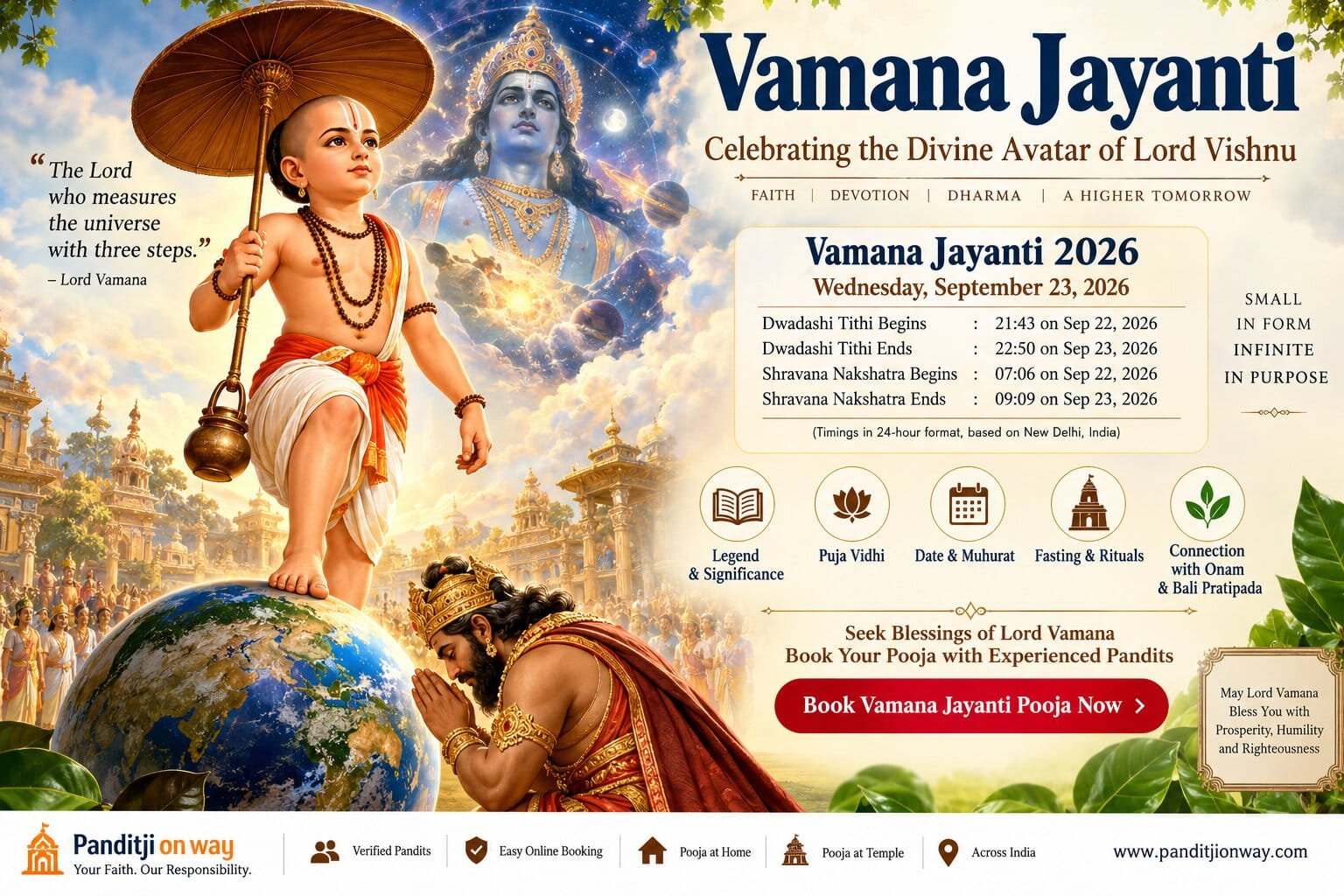
Vamana Jayanti is the sacred Hindu festival commemorating the appearance of Lord Vamana, the dwarf Brahmin incarnation of Lord Vishnu and one of the Dashavatara. In 2026, Vamana Jayanti will be observed on Wednesday, September 23, 2026, on Bhadrapada Shukla Paksha Dwadashi.
According to the Panchang details provided for New Delhi, India, Dwadashi Tithi begins at 21:43 on September 22, 2026, and ends at 22:50 on September 23, 2026. Shravana Nakshatra begins at 07:06 on September 22 and ends at 09:09 on September 23.
Vamana Jayanti is associated with the divine appearance of Lord Vishnu as Vamanadeva, His meeting with the generous King Bali, and the famous episode of the three steps of land. The story is described in the Srimad Bhagavatam, where Vamana approaches Bali during his sacrificial ceremony and asks for three paces of land. The episode ultimately becomes a profound account of humility, devotion, surrender and divine protection.
For devotees, Vamana Jayanti is an opportunity to worship Lord Vishnu, observe a vrat, listen to Vamana Jayanti Vrat Katha, perform Vishnu Puja and offer charitable donations.
Vamana Jayanti 2026: Date and Time
| Panchang Detail | Vamana Jayanti 2026 |
|---|---|
| Vamana Jayanti | Wednesday, September 23, 2026 |
| Festival Name | Vamana Jayanti / Vamana Dwadashi |
| Hindu Month | Bhadrapada |
| Paksha | Shukla Paksha |
| Tithi | Dwadashi |
| Dwadashi Begins | 21:43, September 22, 2026 |
| Dwadashi Ends | 22:50, September 23, 2026 |
| Nakshatra | Shravana |
| Shravana Ends | 09:09, September 23, 2026 |
| Deity | Lord Vamana / Lord Vishnu |
| Day | Wednesday |
Important: Hindu festival timings depend on the location because sunrise, sunset, tithi and nakshatra timings can vary from city to city. The timings above should therefore be treated as location-specific Panchang timings, with the supplied reference being New Delhi, India.
What Is Vamana Jayanti?
Vamana Jayanti is celebrated as the appearance day of Lord Vamana, an incarnation of Lord Vishnu.
Vamana is traditionally counted among the Dashavatara of Lord Vishnu. The Srimad Bhagavatam describes Vamana as a divine incarnation who appeared at the sacrificial arena of King Bali and requested three steps of land. The story of Vamana and Bali is one of the most significant narratives associated with Vishnu’s incarnations.
The festival is also commonly known as Vamana Dwadashi because it occurs on Shukla Paksha Dwadashi of Bhadrapada.
The central spiritual themes associated with Vamana Jayanti include:
- Humility
- Devotion
- Charity
- Dharma
- Surrender to God
- Keeping one’s promise
- Divine protection
- Control over pride and material power
Why Is Vamana Jayanti Celebrated?
Vamana Jayanti is celebrated to remember the divine appearance of Lord Vishnu as Vamana and the famous encounter between Lord Vamana and King Bali.
King Bali was a powerful ruler and a generous donor. Through his strength and accomplishments, he gained control over the three worlds. The Devas, including Indra, approached Lord Vishnu for help.
Lord Vishnu subsequently appeared as Vamana, a young Brahmin, and approached Bali during a sacrificial ceremony.
Vamana asked Bali for only three steps of land.
Bali agreed.
Lord Vamana then expanded into a gigantic cosmic form. With His first step, He covered the earth; with His second step, He covered the heavenly regions. When no space remained for the third step, Bali offered his own head.
The Srimad Bhagavatam describes this three-step episode directly, including Vamana’s first two steps and the question of where the third step should be placed.
This story is therefore remembered not simply as a story of power, but as a lesson concerning charity, humility, devotion and surrender.

Vamana Avatar: Story of Lord Vamana and King Bali
The story of Vamana and King Bali is one of the best-known narratives associated with Lord Vishnu.
King Bali’s Rise to Power
King Bali was a powerful ruler belonging to the Asura lineage. He was known for his strength, generosity and devotion.
Through his power, Bali became ruler over vast realms and challenged the authority of the Devas.
Indra and other Devas sought the assistance of Lord Vishnu.
Lord Vishnu promised to restore cosmic balance through His incarnation as Vamana.
Birth of Lord Vamana
Vamana appeared as the son of Rishi Kashyapa and Goddess Aditi.
He appeared in the form of a young Brahmin and eventually went to the sacrificial ceremony being performed by King Bali.
Vamana Asks for Three Steps of Land
When Bali saw Vamana, he welcomed Him and offered to give Him whatever He wanted.
Vamana asked for only three paces of land.
Bali considered the request very small and agreed.
According to the Srimad Bhagavatam, Vamana then expanded His form and covered the worlds with His steps.
The Three Steps of Vamana
The famous three-step episode can be summarized as follows:
| Step | Meaning in the Traditional Narrative |
|---|---|
| First Step | Vamana covered the earthly realm |
| Second Step | Vamana covered the heavenly/cosmic realm |
| Third Step | Bali offered his own head |
The Srimad Bhagavatam records that Vamana occupied the earth with one step and the heavenly/cosmic regions with the second.
Bali then surrendered himself for the third step.
This became one of the most enduring examples of devotion and surrender in Vaishnava tradition.
What Happened to King Bali?
After Vamana expanded His form and took the first two steps, there was no physical space remaining for the third.
Bali understood the divine identity of Vamana and offered his own head.
Traditional accounts describe Lord Vishnu sending Bali to Patala, while simultaneously granting him divine protection and a special place in the devotional tradition.
The Srimad Bhagavatam describes Bali receiving the Lord’s remaining step upon his head and portrays the encounter as one of spiritual significance rather than simply a defeat of a ruler.
Vamana Jayanti 2026 Puja Vidhi
Devotees can perform Lord Vamana Puja at home or arrange a traditional Vedic Puja with a qualified Hindu priest.
A simple Vamana Jayanti Puja can be performed using the following sequence.
Step 1: Clean the Puja Area
Clean the worship area and place a clean cloth over the Puja platform.
Step 2: Place Lord Vamana
Place an idol or image of Lord Vamana or Lord Vishnu on the Puja altar.
A small Vishnu idol may also be worshipped when a separate Vamana idol is unavailable.
Step 3: Sankalp
Take a Sankalp for Vamana Jayanti Vrat and Puja.
The Sankalp may include the devotee’s name, family name, location and purpose of worship.
Step 4: Kalash Sthapana
Set up a Kalash with clean water and traditionally used Puja materials.
Step 5: Ganesh Puja
Begin the Puja by worshipping Lord Ganesha.
Step 6: Vishnu and Vamana Puja
Offer traditional items such as:
- Water
- Panchamrit
- Flowers
- Tulsi leaves
- Chandan
- Akshat
- Incense
- Deepak
- Naivedya
- Fruits
- Prasad
Tulsi is traditionally associated with Vishnu worship.
Step 7: Vamana Jayanti Mantra
Devotees may chant Vishnu and Vamana-related mantras according to their family tradition.
A commonly used Vishnu mantra is:
Om Namo Bhagavate Vasudevaya
Devotees may also recite Vishnu Sahasranama, Vamana Stotra or other Vaishnava prayers.
Step 8: Vamana Jayanti Vrat Katha
Read or listen to the story of Lord Vamana, King Bali and the three steps.
Step 9: Aarti
Perform Lord Vishnu or Lord Vamana Aarti.
Step 10: Daan and Prasad
Offer food, clothing, grains or other appropriate donations according to one’s tradition and means.
Vamana Jayanti Vrat
Many devotees observe a fast on Vamana Jayanti.
The type of fasting can vary according to family tradition, regional practice and individual circumstances.
Possible forms include:
- Water-based fasting
- Fruit-based fasting
- Phalahar
- Satvik food
- One-time meal
- Traditional Vaishnava fasting
Devotees should follow the fasting method prescribed by their family tradition or religious guide.
The spiritual purpose of fasting is traditionally associated with self-discipline, devotion and concentration on God rather than simply abstaining from food.
Vamana Jayanti Puja Samagri
The following items can be prepared for a traditional home Puja:
| Puja Item | Purpose |
|---|---|
| Lord Vamana/Vishnu Idol | Main deity |
| Kalash | Sacred worship |
| Water | Abhishek and offerings |
| Panchamrit | Abhishek |
| Tulsi Leaves | Vishnu worship |
| Flowers | Offering |
| Chandan | Tilak |
| Akshat | Puja offering |
| Incense | Dhupa |
| Ghee/Oil Diya | Deepa |
| Fruits | Naivedya |
| Sweets | Prasad |
| Panchang | Muhurat reference |
| Vishnu/Vamana Katha | Religious recitation |
Vamana Jayanti Mantra
One of the widely known mantras used in Vishnu worship is:
Om Namo Bhagavate Vasudevaya
Devotees can chant the mantra with concentration and devotion.
Those following a particular Vaishnava tradition may use additional Vamana or Vishnu mantras prescribed by their Guru or spiritual lineage.
Vamana Jayanti Significance
The religious significance of Vamana Jayanti can be understood through several themes.
1. Humility
Vamana initially appears in a small and humble form, despite being the Supreme Lord in the theological narrative.
2. Charity
King Bali is remembered for his willingness to give.
3. Dharma
The story emphasizes the relationship between power, responsibility and cosmic order.
4. Surrender
Bali’s offering of his own head for the third step represents complete surrender.
5. Devotion
The story remains an important example of devotion to Lord Vishnu.
6. Control Over Pride
The narrative is traditionally interpreted as a reminder that worldly power and possessions are temporary.
Vamana Jayanti and the Three Worlds
The phrase “three steps of Vamana” is central to the festival.
Vamana’s three steps are traditionally interpreted in different theological and devotional ways.
The narrative presents Vamana first covering the earthly realm, then the heavenly/cosmic realm, leaving Bali to offer himself for the third step.
This makes the story particularly significant in Vaishnava literature and devotional traditions.
Vamana Jayanti and Onam
The story of Vamana and King Bali is also connected with the cultural traditions surrounding Onam in Kerala.
In Kerala’s traditional understanding of the Onam story, King Mahabali is remembered for his annual return to visit his people.
Thus, Vamana Jayanti and Onam share an important narrative connection through the story of Vamana and Mahabali.
The traditions, however, are observed as distinct festivals with their own regional practices and rituals.
Vamana Jayanti Celebration in India
Vamana Jayanti is observed by devotees across India, particularly within Vaishnava communities.
Important places and regions for Vishnu and Vamana-related worship include:
Ayodhya, Uttar Pradesh
Ayodhya is one of India’s major sacred destinations associated with Lord Rama and the broader Vaishnava tradition.
Mathura and Vrindavan, Uttar Pradesh
Mathura and Vrindavan are major Vaishnava pilgrimage centers and important destinations for devotees of Lord Krishna and Vishnu traditions.
Tirupati, Andhra Pradesh
Tirupati is one of India’s most important Vaishnava pilgrimage destinations, centered around Lord Venkateswara.
Puri, Odisha
Puri is internationally known for the Jagannath tradition, an important Vaishnava devotional center.
Udupi, Karnataka
Udupi is a significant center of Krishna worship and the Madhva Vaishnava tradition.
Kerala
Kerala has a particularly strong cultural connection with the story of Mahabali and Vamana through Onam traditions.
Vamana Jayanti Puja Booking in India and Abroad
Devotees who cannot personally arrange a priest may consider booking a qualified Pandit for Vamana Jayanti Puja.
Panditji on Way – First and Largest Online Pooja Booking Portal provides a platform for devotees looking for Hindu Puja and Vedic ritual services.
Vamana Jayanti Puja can be arranged according to the devotee’s preferred location and family tradition, subject to priest availability.
Vamana Jayanti Puja Services
Potential services include:
- Vamana Jayanti Puja
- Vamana Dwadashi Puja
- Lord Vishnu Puja
- Vishnu Sahasranama Path
- Vrat Katha
- Satyanarayan Puja
- Havan
- Jaap
- Graha Shanti Puja
- Griha Puja
- Religious ceremonies
- Festival-specific Puja services
For devotees outside India, local availability, priest tradition and ritual requirements should be confirmed before booking.
Vamana Jayanti Puja Booking in Major Cities
For local, devotees can search for Vamana Jayanti Puja and Vishnu Puja services in their city.
Vamana Jayanti Puja in Delhi
Devotees in Delhi and the National Capital Region can arrange Vishnu Puja, Vamana Jayanti Puja, Havan and Vrat Katha services according to availability.
Vamana Jayanti Puja in Mumbai
Families in Mumbai, Thane and Navi Mumbai can look for qualified Hindu priests for Vamana Dwadashi Puja and Vishnu worship.
Vamana Jayanti Puja in Pune
Pune families can arrange traditional Puja, Havan and Vishnu-related religious ceremonies according to their family customs.
Vamana Jayanti Puja in Bengaluru
Devotees in Bengaluru can book Hindu priest services for Vamana Jayanti and other Vishnu Puja requirements.
Vamana Jayanti Puja in Hyderabad
Families in Hyderabad can arrange Vamana Jayanti Puja, Vishnu Puja, Havan and religious ceremonies.
Vamana Jayanti Puja in Chennai
Devotees in Chennai can choose a suitable priest and ritual format according to their regional and family traditions.
Vamana Jayanti Puja in Ahmedabad
Families in Ahmedabad can arrange Vishnu Puja and Vamana Dwadashi rituals with appropriate Panchang guidance.
Vamana Jayanti Puja in Jaipur
Devotees in Jaipur can arrange traditional Hindu Puja services for Vamana Jayanti.
Vamana Jayanti Puja in the USA
Indian Hindu families living in the United States can look for local or traveling Hindu priests for Vamana Jayanti Puja.
Potential locations include:
- New York
- New Jersey
- California
- Texas
- Arizona
- Illinois
- Washington
- Georgia
- Florida
Availability depends on the city, date and priest schedule.
Vamana Jayanti Puja Booking in Arizona
Indian families in Arizona can arrange Hindu religious ceremonies with a priest for Vamana Jayanti, Vishnu Puja and other Vedic rituals.
Relevant Arizona locations can include:
- Phoenix
- Scottsdale
- Tempe
- Chandler
- Mesa
- Gilbert
- Glendale
For NRI families, online booking can simplify the process of finding a priest and coordinating the ceremony.
Vamana Jayanti: Do’s and Don’ts
| Do’s | Don’ts |
|---|---|
| Worship Lord Vishnu/Vamana | Avoid disrespectful behavior during Puja |
| Listen to Vamana Katha | Do not treat the vrat only as a ritual formality |
| Offer Tulsi where appropriate | Do not use unsuitable Puja materials |
| Practice charity | Avoid unnecessary extravagance |
| Follow your family tradition | Do not change fasting rules casually |
| Maintain cleanliness | Avoid arguments during the worship period |
| Chant Vishnu Mantras | Avoid distracted worship |
What Should Be Donated on Vamana Jayanti?
Charity is an important theme in the Vamana-Bali narrative.
Depending on local tradition and personal circumstances, devotees may donate:
- Rice
- Grains
- Curd
- Food
- Clothing
- Fruits
- Educational materials
- Money
- Cow-related charitable contributions where culturally appropriate
- Food to people in need
The value of charity is traditionally associated with sincerity and intention rather than simply the monetary amount.
Vamana Jayanti 2026: Simple Puja Schedule
| Time/Stage | Activity |
|---|---|
| Morning | Bath and purification |
| Morning | Sankalp |
| Morning | Ganesh Puja |
| Morning | Kalash Sthapana |
| Morning | Vishnu/Vamana Puja |
| Morning | Mantra Japa |
| Daytime | Vrat and devotional activities |
| Evening | Vamana Jayanti Katha |
| Evening | Aarti |
| After Puja | Prasad and Daan |
Exact Muhurat should be calculated for the devotee’s city because Hindu Panchang timings vary by location.
Vamana Jayanti 2026: Quick Facts
| Question | Answer |
|---|---|
| When is Vamana Jayanti 2026? | Wednesday, September 23, 2026 |
| Which Tithi is Vamana Jayanti? | Bhadrapada Shukla Paksha Dwadashi |
| Who is Vamana? | A form of Lord Vishnu |
| Which Dashavatara is Vamana? | Traditionally the fifth Dashavatara |
| Who were Vamana’s parents? | Rishi Kashyapa and Goddess Aditi |
| Who was King Bali? | A powerful ruler and devotee associated with the Vamana narrative |
| What did Vamana ask from Bali? | Three paces/steps of land |
| What happened after two steps? | Vamana had covered the realms described in the narrative |
| What did Bali offer for the third step? | His own head |
| What is another name for Vamana Jayanti? | Vamana Dwadashi |
| Which Nakshatra is associated with the 2026 date? | Shravana |
| Is Vamana Jayanti a Vishnu festival? | Yes |
| Is fasting observed? | Many devotees observe a vrat |
| Can Vamana Jayanti Puja be performed at home? | Yes |
| Can a Pandit perform Vamana Jayanti Puja? | Yes, according to availability and tradition |
Vamana Jayanti 2026 FAQ
1. When is Vamana Jayanti in 2026?
Vamana Jayanti will be observed on Wednesday, September 23, 2026. It falls on Bhadrapada Shukla Paksha Dwadashi and is celebrated as the appearance day of Lord Vamana.
2. What is Vamana Jayanti?
Vamana Jayanti is the Hindu festival commemorating the appearance of Lord Vamana, an incarnation of Lord Vishnu. The festival is observed on Dwadashi during the Shukla Paksha of Bhadrapada.
3. Is Vamana Jayanti also called Vamana Dwadashi?
Yes. Because the festival occurs on Dwadashi, it is commonly known as Vamana Dwadashi.
4. Who is Lord Vamana?
Lord Vamana is traditionally described as an incarnation of Lord Vishnu who appeared in the form of a dwarf Brahmin. He approached King Bali and requested three steps of land.
5. Who are the parents of Lord Vamana?
According to the traditional account, Vamana appeared as the son of Kashyapa Rishi and Goddess Aditi.
6. Why did Lord Vishnu take the Vamana Avatar?
The Vamana narrative is traditionally connected with restoring cosmic balance and addressing Bali’s growing control over the three worlds.
7. What did Vamana ask King Bali for?
Lord Vamana asked King Bali for three paces of land.
The request initially appeared very small. Vamana then expanded His form and covered the worlds described in the narrative with His first two steps. The third step was offered on Bali’s head.
8. What is the significance of three steps of Vamana?
The three steps symbolize the extraordinary cosmic expansion of Vamana and form the central episode of the Vamana-Bali story. The Srimad Bhagavatam explicitly describes Vamana covering the earthly and heavenly/cosmic realms with His first two steps.
9. How should Vamana Jayanti Puja be performed?
A traditional Puja may include Ganesh Puja, Sankalp, Kalash Sthapana, Vishnu/Vamana worship, offerings, mantra chanting, Vamana Katha, Aarti and Daan. Families should follow their own religious tradition where it differs.
10. Can we observe a fast on Vamana Jayanti?
Yes. Many devotees observe a Vrat on Vamana Jayanti. The specific fasting method varies between traditions and individuals.
11. Which mantra can be chanted on Vamana Jayanti?
A widely used Vishnu mantra is:
Om Namo Bhagavate Vasudevaya
Devotees may also recite Vishnu Sahasranama or Vamana-related prayers according to their tradition.
12. What should be offered to Lord Vamana?
Devotees may offer flowers, Tulsi, Chandan, Akshat, fruits, sweets, Panchamrit and other traditional Puja materials.
13. Why is King Bali important in Vamana Jayanti?
King Bali is central to the Vamana narrative because he agreed to Vamana’s request for three steps of land and ultimately offered his own head for the third step.
14. Is Vamana Jayanti connected with Onam?
Yes. Vamana and King Mahabali are central figures in the traditional narrative associated with Onam in Kerala. However, Vamana Jayanti and Onam are separate observances with different festival traditions.
15. Where is Vamana Jayanti celebrated?
Vamana Jayanti is observed by Hindu devotees across India and among Hindu communities around the world. Vishnu temples and Vaishnava communities may organize special worship and devotional programs.
16. Can Vamana Jayanti Puja be performed at home?
Yes. A simple Vishnu or Vamana Puja can be performed at home. Families seeking a more elaborate Vedic ceremony may invite a qualified priest.
17. Can I book a Pandit for Vamana Jayanti Puja?
Yes. Devotees can seek priest services for Vamana Jayanti Puja, Vamana Dwadashi Puja, Vishnu Puja, Havan and Vrat Katha according to location and availability.
18. What is the spiritual message of Vamana Jayanti?
The story is traditionally associated with humility, charity, devotion, surrender, Dharma and the temporary nature of worldly power.
19. What is the Vamana Jayanti date in 2026 according to Panchang?
Vamana Jayanti falls on September 23, 2026. The Dwadashi Tithi begins at 21:43 on September 22 and ends at 22:50 on September 23 in the supplied New Delhi timing reference.
20. What is the importance of Shravana Nakshatra on Vamana Jayanti?
Traditional accounts associate Vamana’s appearance with Shravana Nakshatra. In the supplied 2026 Panchang, Shravana Nakshatra continues until 09:09 on September 23.
People Also Ask: Vamana Jayanti 2026
When is Vamana Jayanti 2026?
Vamana Jayanti will be celebrated on Wednesday, September 23, 2026.
Is Vamana Jayanti on Dwadashi?
Yes. Vamana Jayanti is observed on Bhadrapada Shukla Paksha Dwadashi.
What is Vamana Jayanti also known as?
It is also known as Vamana Dwadashi.
Who is Vamana in Hinduism?
Vamana is an incarnation of Lord Vishnu and is traditionally counted among the Dashavatara.
What did Vamana ask from Bali?
Vamana asked King Bali for three steps of land.
Why did Vamana take three steps?
The three-step episode forms the central part of the Vamana-Bali narrative and represents Vamana’s cosmic expansion.
What did Bali give for the third step?
Bali offered his own head for Vamana’s third step.
What should we do on Vamana Jayanti?
Devotees may perform Vishnu/Vamana Puja, observe a vrat, chant Vishnu mantras, hear Vamana Katha and perform charity.
Is fasting compulsory on Vamana Jayanti?
Fasting is a devotional practice followed by many devotees, but the specific rules vary by tradition and individual circumstances.
Is Vamana Jayanti related to Onam?
Yes. The traditional story of Vamana and King Mahabali is closely connected with the cultural traditions of Onam in Kerala.
Recommended External References
For factual and scriptural context, authoritative references can strengthen the article’s credibility. The Srimad Bhagavatam / Bhagavata Purana contains the primary traditional narrative of Vamana and Bali, including the three-step episode.
The 2026 Panchang date and Tithi information can be cross-checked against the referenced Panchang source; Panchang timings should always be localized to the reader’s city.
Authoritative external links
- Srimad Bhagavatam — Vamana and Bali, Vedabase
- Srimad Bhagavatam — Vamana Avatar, Vedabase
- 2026 Vamana Jayanti Panchang Reference
- Panditji on Way
Final Word
Vamana Jayanti 2026 is a significant Vaishnava festival commemorating the appearance of Lord Vamana, the divine incarnation of Lord Vishnu associated with the story of King Bali and the three cosmic steps.
On Wednesday, September 23, 2026, devotees can observe Vamana Jayanti through Vishnu or Vamana Puja, Vrat, Mantra Japa, Vamana Jayanti Katha, Aarti and Daan.
The story of Vamana and Bali continues to carry a powerful spiritual message: material power is temporary, while humility, devotion, charity and surrender have enduring significance in the devotional tradition.
For families wishing to arrange a traditional ceremony, Panditji on Way – First and Largest Online Pooja Booking Portal can be used to explore Pandit and Puja service options according to location and availability.