
Sandhi Puja 2026: Date, Time, Muhurat, Significance, Puja Vidhi and Durga Puja Rituals
Sandhi Puja 2026 is on 19 October. Check the 10:27–11:15 AM muhurat, date, significance, Goddess Chamunda story, puja vidhi and samagri.
Copy
Sandhi Puja 2026 Date: Monday, 19 October 2026
Sandhi Puja Muhurat: 10:27 AM to 11:15 AM
Duration: 48 minutes
Ashtami Tithi Ends: 10:51 AM on 19 October 2026
Navami Tithi Begins: 10:51 AM on 19 October 2026
Main Deity: Goddess Chamunda, a fierce manifestation of Goddess Durga
Festival: Shardiya Navratri and Durga Puja
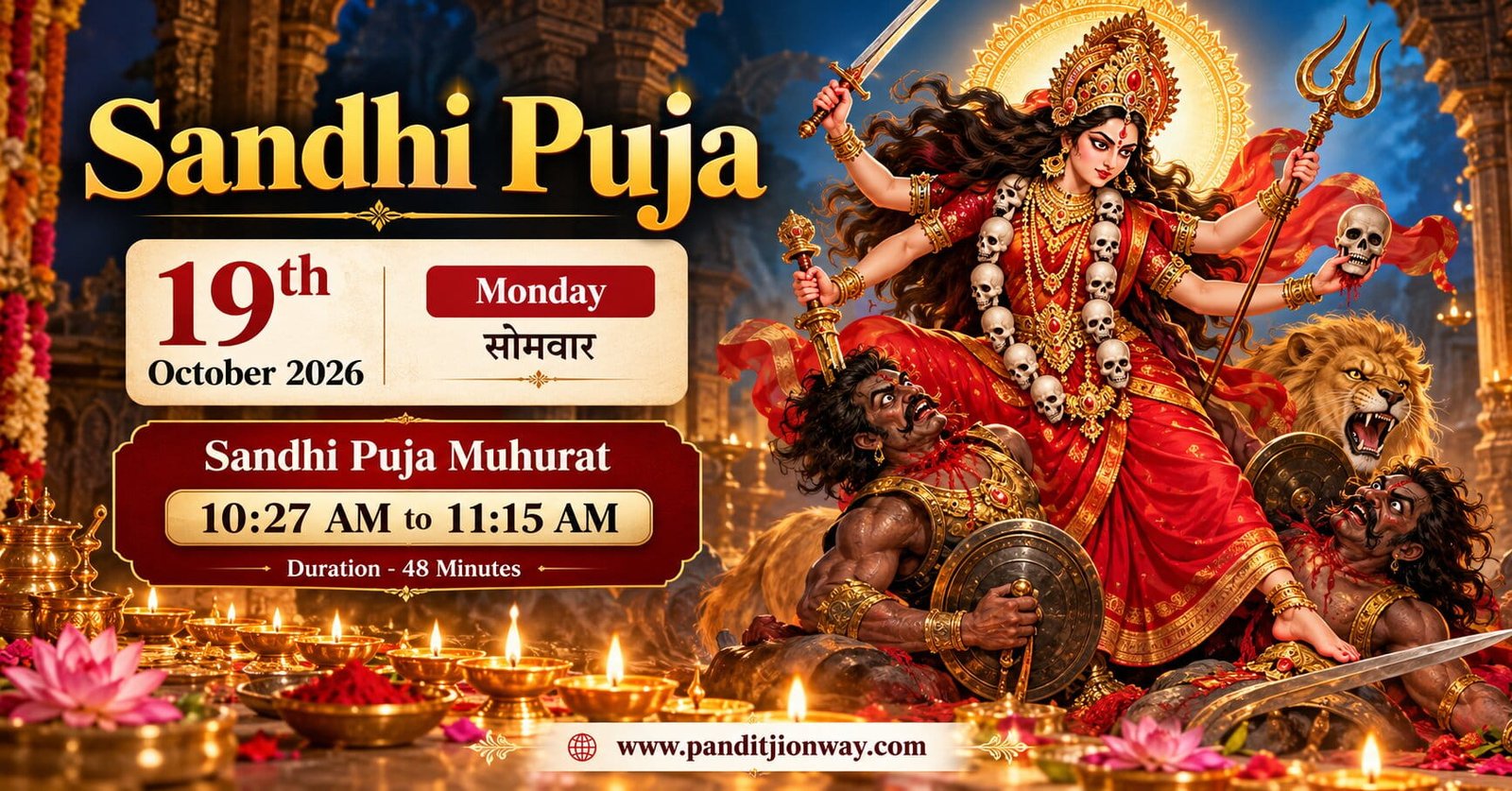
2026 Shardiya Navratri Sandhi Puja Muhurat for Mumbai, Maharashtra, India
Sandhi Puja is one of the most sacred rituals performed during Shardiya Navratri and Durga Puja. It takes place at the transition between Maha Ashtami and Maha Navami, the eighth and ninth lunar days of the Hindu calendar. According to Hindu tradition, this auspicious moment commemorates Goddess Chamunda’s victory over the demons Chanda and Munda.
In 2026, Sandhi Puja falls on Monday, 19 October. According to the cited Panchang calculation for Mumbai, the auspicious period is from 10:27 AM to 11:15 AM, lasting 48 minutes. Devotees worship Goddess Durga during this sacred interval and pray for protection, strength, prosperity and spiritual well-being.
If you are looking for the Sandhi Puja date in 2026, the exact muhurat, the story behind the ritual, the traditional puja procedure or information about observing Sandhi Puja at home, this guide by Panditji on Way, an online pooja booking portal, covers the essential details.
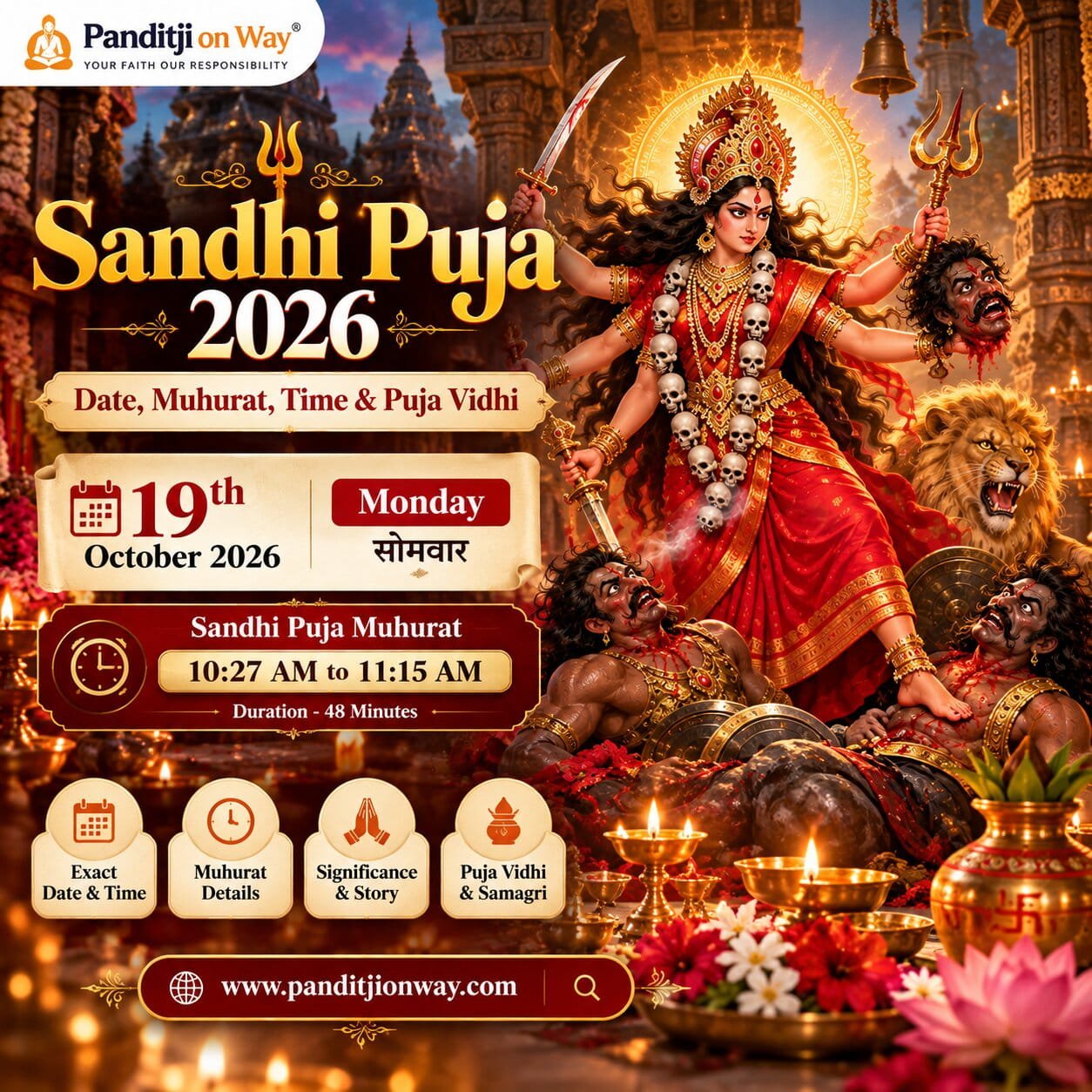
Sandhi Puja 2026: Date and Time at a Glance
The following table provides the essential details of Sandhi Puja 2026 for quick reference.
| Particulars | Details |
|---|---|
| Name of the ritual | Sandhi Puja |
| Date | Monday, 19 October 2026 |
| Sandhi Puja Muhurat | 10:27 AM–11:15 AM |
| Total duration | 48 minutes |
| Ashtami Tithi begins | 8:27 AM, 18 October 2026 |
| Ashtami Tithi ends | 10:51 AM, 19 October 2026 |
| Navami Tithi begins | 10:51 AM, 19 October 2026 |
| Presiding deity | Goddess Chamunda |
| Occasion | Shardiya Navratri and Durga Puja |
| Traditional significance | Victory of the Divine Mother over Chanda and Munda |
| Panchang reference location | Mumbai, Maharashtra, India |
Important: The muhurat above follows the supplied Mumbai Panchang reference. Panchang timings and ritual observances may differ by location and family tradition. Check the local Panchang or consult a qualified priest before performing the ritual.
What Is Sandhi Puja?
Sandhi Puja is a special worship of Goddess Durga performed during the junction, or sandhi, between Ashtami Tithi and Navami Tithi. The word sandhi means a meeting point, transition or junction. In this context, it refers to the transition between the eighth and ninth lunar days during the Durga Puja festival.
According to Hindu religious tradition, this sacred interval is associated with the manifestation of Goddess Chamunda, who defeated the demons Chanda and Munda. Devotees consider the period especially auspicious for worshipping the Divine Mother and seeking her blessings.
Sandhi Puja is particularly important in Bengal’s Durga Puja celebrations, where elaborate rituals are performed at the precise transition between Ashtami and Navami. It is also observed by devotees who celebrate Shardiya Navratri in different parts of India.
The ritual is traditionally performed for approximately two ghatis, equivalent to around 48 minutes. Its timing is determined by the transition between the two tithis rather than by a fixed clock time every year.
Why Is Sandhi Puja Celebrated?
Sandhi Puja commemorates the divine power of Goddess Durga and the destruction of evil forces represented by Chanda and Munda. It reminds devotees that courage, righteousness and divine grace can overcome negativity and injustice.
The ritual also marks a spiritually significant transition during Navratri. As Ashtami ends and Navami begins, devotees offer prayers to the Goddess, perform traditional worship and participate in ceremonies according to their regional customs.
The main reasons for observing Sandhi Puja include:
- Worshipping Goddess Chamunda, a fierce form of the Divine Mother.
- Commemorating the defeat of Chanda and Munda.
- Seeking courage, protection and spiritual strength.
- Honouring the sacred transition between Maha Ashtami and Maha Navami.
- Maintaining the traditional rituals associated with Durga Puja and Shardiya Navratri.
For many families and temples, Sandhi Puja is among the most important moments of the entire Durga Puja celebration.
The Story of Goddess Chamunda Killing Chanda and Munda
The religious significance of Sandhi Puja is closely associated with the story of Goddess Chamunda in Hindu sacred literature, particularly traditions surrounding the Devi Mahatmya.
According to the traditional narrative, Chanda and Munda were powerful demons who served the demon king Shumbha. When the demons challenged the Goddess, the Divine Mother manifested her fierce and formidable power to destroy the forces threatening the divine order.
During the battle, a fierce manifestation of the Goddess emerged and defeated Chanda and Munda. Because she destroyed these two demons, she became known as Chamunda, a name associated with Chanda and Munda.
This episode represents the victory of divine power over arrogance, destructive tendencies and evil.
Sandhi Puja commemorates this divine event during the transition from Ashtami to Navami. Devotees worship Goddess Chamunda with devotion, seeking the strength to overcome difficulties and follow the path of righteousness.
The story is one of the central religious explanations for the special status of Sandhi Puja in Durga Puja traditions.
Sandhi Puja Muhurat 2026: Why Are the 48 Minutes Important?
Sandhi Puja is traditionally associated with two ghatis, a period of approximately 48 minutes. Unlike rituals performed at a fixed daily time, its muhurat depends on the precise ending of Ashtami Tithi and beginning of Navami Tithi.
For 2026, the supplied Mumbai Panchang reference gives the following timings:
| Event | Date and time |
|---|---|
| Ashtami Tithi begins | 18 October, 8:27 AM |
| Sandhi Puja begins | 19 October, 10:27 AM |
| Ashtami Tithi ends | 19 October, 10:51 AM |
| Navami Tithi begins | 19 October, 10:51 AM |
| Sandhi Puja ends | 19 October, 11:15 AM |
All times are in Indian Standard Time for the stated reference location.
The 48-minute interval extends 24 minutes before and 24 minutes after the Ashtami–Navami junction. This is why devotees prepare the puja materials beforehand and aim to perform the central worship within the prescribed interval.
Because the muhurat is linked to lunar calculations, it can occur in the morning, afternoon, evening or night in different years. Devotees should therefore avoid assuming that Sandhi Puja always takes place at the same time of day.
Sandhi Puja Vidhi: How to Perform the Ritual
The exact procedure for Sandhi Puja can vary according to temple traditions, regional customs, family practices and the guidance of the presiding priest. The following is a general overview of traditional worship.
1. Clean the Puja Area
Clean the place of worship and arrange the idol or image of Goddess Durga or Goddess Chamunda. Keep the necessary puja materials ready before the muhurat begins.
2. Prepare the Puja Samagri
Commonly used items include flowers, incense, a lamp, sandalwood paste, kumkum, fruits, sweets, water and other offerings prescribed by the family’s tradition. Specific requirements may vary.
3. Begin with Prayer and Sankalpa
Offer prayers to the Goddess and state your intention to perform Sandhi Puja with devotion. A priest may guide the sankalpa and associated mantras according to the relevant ritual tradition.
4. Worship Goddess Durga or Chamunda
Offer flowers, incense, a lit lamp and other traditional offerings. Devotees may recite appropriate Devi mantras or passages from the Devi Mahatmya, depending on their tradition.
5. Perform the Main Worship During the Muhurat
The central worship should be aligned with the prescribed Sandhi Puja interval. Families and temples may follow specific instructions regarding offerings, mantras and the sequence of rites.
6. Observe the Traditional Lamp and Offering Rituals
In many Bengali Durga Puja traditions, Sandhi Puja includes the lighting of 108 lamps and the offering of 108 lotus flowers, where available and prescribed. These are traditional practices rather than universal requirements for every household.
7. Offer Prasad and Complete the Puja
Offer fruits, sweets or other customary prasad. Conclude with prayers, an aarti according to tradition and a request for the Goddess’s blessings.
Practical advice: If you are performing the full traditional Sandhi Puja at home or in a community setting, arrange the materials and consult your priest in advance. The 48-minute window is short, so preparation is important.
Sandhi Puja Samagri: Essential Items
The puja materials depend on the ritual tradition followed by the family or temple. A general preparation checklist may include:
| Puja item | Purpose |
|---|---|
| Idol or image of Goddess Durga or Chamunda | Focus of worship |
| Flowers and lotus flowers, where available | Traditional floral offerings |
| Oil or ghee lamps | Lighting during worship |
| Incense and dhoop | Fragrance and customary offerings |
| Kumkum and sandalwood paste | Ritual offerings |
| Fruits and sweets | Bhog and prasad |
| Clean water and a puja vessel | Ritual purification and offerings |
| Red cloth, where prescribed | Traditional decoration or offering |
| Camphor, where used | Aarti according to custom |
| Mantra or puja text | Recitation and guidance |
Some temples require a more elaborate list, including specific flower counts, lamps and offerings. Confirm the list with the priest conducting the ceremony rather than assuming that every item is compulsory.
Significance of 108 Lamps and 108 Lotus Flowers
The number 108 holds an important place in many Hindu spiritual and devotional traditions. It appears in practices involving mantra recitation, prayer beads and ritual offerings.
In traditional Bengali Durga Puja observances, Sandhi Puja may include 108 lamps and 108 lotus flowers as offerings to the Goddess. These offerings express devotion, reverence and the desire for divine protection.
The details of the ritual can differ between temples and households. Devotees should follow their established tradition or the guidance of their priest, particularly when particular flowers or materials are unavailable.
The essential principle of the worship is sincere devotion and respectful observance of the ritual.
Sandhi Puja and Maha Ashtami: What Is the Difference?
Maha Ashtami and Sandhi Puja are closely connected, but they refer to different aspects of Durga Puja.
| Feature | Maha Ashtami | Sandhi Puja |
|---|---|---|
| Meaning | The eighth lunar day of the festival | The junction between Ashtami and Navami |
| Timing | Determined by the applicable Ashtami observance | Determined by the precise tithi transition |
| Main focus | Worship of Goddess Durga and Ashtami rituals | Worship commemorating the manifestation of Goddess Chamunda |
| Common observances | Pushpanjali, fasting and other regional rites | Special offerings, lamps, flowers and prescribed worship |
| Duration | Depends on the tithi and regional observance | Traditionally approximately 48 minutes |
| Regional variation | Observed throughout India in different forms | Especially prominent in Bengali Durga Puja traditions |
Maha Ashtami may include Sandhi Puja as one of its important rituals. Sandhi Puja itself is defined by the transition between Ashtami and Navami, rather than by the entire duration of Ashtami.
Sandhi Puja and Maha Navami: How Are They Connected?
Maha Navami is the ninth lunar day associated with the worship of Goddess Durga during Navratri and Durga Puja. Sandhi Puja takes place at the precise transition from Ashtami to Navami, making it a ritual that connects the two observances.
On this occasion, devotees may participate in special worship, mantra recitation, offerings and other ceremonies according to local traditions. Maha Navami may also include Navami Puja and homa or havan where prescribed.
In 2026, the supplied Panchang timings show Ashtami ending at 10:51 AM on 19 October and Navami beginning immediately afterward. This makes the transition particularly important for devotees planning their rituals.
For other Navami observances, such as fasting, kanya puja or havan, follow the appropriate local Panchang and family tradition because their timings and rules may differ.
Where Is Sandhi Puja Celebrated in India?
Sandhi Puja is observed in different parts of India, especially in regions with strong Durga Puja and Shardiya Navratri traditions. Its form, scale and associated customs vary by location.
1. Kolkata, West Bengal
Kolkata is one of India’s best-known centres of Durga Puja celebrations. Community pujas, traditional household worship and elaborate temple ceremonies make the city an important destination for devotees interested in Bengali Durga Puja traditions.
Sandhi Puja is a particularly significant ritual in many Bengali pujas, with the timing of the ceremony closely followed by organisers and priests.
2. Howrah, West Bengal
Howrah shares many of the Durga Puja traditions found across the Kolkata metropolitan region. Community pandals, household ceremonies and local religious organisations may observe Sandhi Puja according to their own ritual calendars.
3. Siliguri and Other Parts of West Bengal
Durga Puja is celebrated throughout West Bengal, including Siliguri and other urban and rural areas. The scale and style of worship vary, but the religious significance of Goddess Durga remains central.
4. Mumbai, Maharashtra
Devotees in Mumbai observe Shardiya Navratri through home worship, temple visits, fasting and community celebrations. Sandhi Puja may be performed by Bengali associations, temples and families that follow the relevant tradition.
The muhurat quoted in this article uses Mumbai as its reference location.
5. Delhi and the National Capital Region
Durga Puja associations, temples and Bengali communities in Delhi and the surrounding region observe the festival through cultural programmes and religious ceremonies. Sandhi Puja may form part of their Maha Ashtami and Maha Navami observances.
6. Bengaluru, Karnataka
Bengaluru has communities that celebrate Durga Puja and Shardiya Navratri in different regional styles. Devotees should consult their local temple or association for the exact ceremony schedule.
7. Pune, Maharashtra
Pune’s Navratri celebrations include temple worship, household puja and community events. Those planning Sandhi Puja should verify the local Panchang and the arrangements of their chosen temple or puja committee.
Location-specific SEO note: These cities illustrate where devotees may search for Sandhi Puja information. The exact availability of a Sandhi Puja ceremony, a priest or a booking service must be verified locally.
Sandhi Puja 2026: How to Arrange a Pandit for the Ritual

Performing Sandhi Puja involves observing a specific muhurat and following the ritual customs of the family or temple. Devotees who prefer priest-led worship can arrange a qualified pandit to guide the ceremony.
Before booking a priest, consider the following:
- Confirm the date and local Sandhi Puja muhurat.
- Explain whether you need a home puja, temple ceremony or community ritual.
- Ask whether the priest follows Bengali Durga Puja traditions or another regional procedure.
- Confirm the required puja samagri and whether the priest will bring it.
- Clarify the duration, language of the mantras and any additional rituals.
- Confirm the booking, fees and arrangements in advance.
Panditji on Way is an online pooja booking portal that can be explored by devotees seeking assistance with religious ceremonies. Visit Panditji on Way to learn more about its available services. Confirm the availability of Sandhi Puja, the location served and the specific ritual requirements before making a booking.
Advance planning is especially useful because Sandhi Puja takes place during a short, precisely calculated interval.
Sandhi Puja 2026: Important Things to Remember
Keep these points in mind when planning the ceremony:
- Sandhi Puja falls on Monday, 19 October 2026, according to the cited Panchang.
- The supplied Mumbai reference gives the muhurat as 10:27 AM to 11:15 AM.
- The ritual commemorates Goddess Chamunda’s victory over Chanda and Munda.
- Sandhi Puja is performed at the junction of Ashtami and Navami Tithi.
- The traditional duration is approximately 48 minutes.
- Prepare the puja materials before the muhurat begins.
- Local Panchang timings and regional ritual practices should be checked before worship.
- Book a priest in advance if you require a full traditional ceremony.
Frequently Asked Questions About Sandhi Puja 2026
1. When is Sandhi Puja in 2026?
Sandhi Puja will be observed on Monday, 19 October 2026. The supplied Mumbai Panchang reference gives the auspicious time as 10:27 AM to 11:15 AM.
2. What is the Sandhi Puja muhurat in 2026?
The Sandhi Puja muhurat is 10:27 AM to 11:15 AM according to the cited Mumbai Panchang calculation. Check the local Panchang for your city before performing the ritual.
3. Why is Sandhi Puja performed?
Sandhi Puja is performed to worship Goddess Chamunda and commemorate her victory over the demons Chanda and Munda. It also marks the sacred transition from Ashtami Tithi to Navami Tithi during Durga Puja.
4. How long does Sandhi Puja last?
Sandhi Puja traditionally lasts approximately 48 minutes, equivalent to two ghatis. The exact interval depends on the calculated transition between Ashtami and Navami.
5. Who is worshipped during Sandhi Puja?
Devotees worship Goddess Chamunda, a fierce manifestation of Goddess Durga associated with the destruction of Chanda and Munda.
6. What is the significance of 108 lamps in Sandhi Puja?
In many Bengali Durga Puja traditions, 108 lamps are lit as a devotional offering to the Goddess. Some traditions also include 108 lotus flowers. The exact procedure varies by temple and family custom.
7. Can Sandhi Puja be performed at home?
Yes. Devotees may perform a home observance according to their family tradition. Those wishing to perform the complete traditional ritual can consult a qualified priest for the appropriate mantras, offerings and sequence.
8. Is Sandhi Puja performed during Maha Ashtami or Maha Navami?
Sandhi Puja takes place at the transition between Maha Ashtami and Maha Navami. The ritual is associated with both observances because it marks the end of Ashtami and the beginning of Navami.
9. Is Sandhi Puja performed at night?
Not necessarily. The muhurat changes according to the Ashtami–Navami transition. In 2026, the supplied Mumbai reference places the ritual in the late morning.
10. What is the difference between Sandhi Puja and Durga Puja?
Durga Puja is the broader festival dedicated to Goddess Durga. Sandhi Puja is a specific ritual performed during the transition between Ashtami and Navami as part of the festival.
11. Where can I find the Sandhi Puja 2026 Panchang?
You can consult Panditji on way Panchang’s Sandhi Puja 2026 calendar and select your city to check the relevant timings.
12. Can I book a pandit for Sandhi Puja through Panditji on Way?
Visit Panditji on Way to explore available pooja booking services. Contact the portal to confirm whether a pandit is available for Sandhi Puja in your location and whether the required ritual can be arranged.
Conclusion: Observe Sandhi Puja 2026 with Devotion
Sandhi Puja is a spiritually significant ritual of Shardiya Navratri and Durga Puja. It honours Goddess Chamunda’s victory over Chanda and Munda and symbolises the triumph of divine power over evil.
In 2026, Sandhi Puja falls on Monday, 19 October, with a cited Mumbai muhurat of 10:27 AM to 11:15 AM. Devotees should prepare their puja materials in advance, verify their local Panchang and follow their family’s or temple’s established traditions.
For further information about religious ceremonies and pooja booking services, visit Panditji on Way and explore the available options for arranging worship with a qualified priest.
May Goddess Durga bless all devotees with strength, peace, wisdom and prosperity.
West Bengal Tourism: Durga Puja
Durga Puja traditions in West Bengal
Official tourism information
UNESCO Intangible Cultural Heritage- UNESCO Intangible Cultural Heritage
Explore cultural heritage information
Online pooja booking services