
Samkhya School of Philosophy: Dualism, Evolution, 25 Tattvas & Path to Moksha
Explore the Samkhya School of Philosophy, its dualism of Purusha and Prakriti, 25 Tattvas, Three Gunas, evolution theory, and path to Moksha.
Introduction to Samkhya School of Philosophy
The Samkhya School of Philosophy is one of the six classical (Shad Darshana) systems of Hindu philosophy rooted in the Upanishadic tradition. Derived from the Sanskrit root “Sam” (together) and “Khya” (reckoning or enumeration), Samkhya literally means “that which enumerates” or systematic philosophical analysis.
Traditionally attributed to Rishi Kapila, Samkhya presents a profound metaphysical framework explaining the origin of the universe, the nature of consciousness, and the path to liberation (Moksha). References to Samkhya concepts such as Purusha, Prakriti, and the Three Gunas appear in the Svetasvatara Upanishad (4th–6th BCE), demonstrating its ancient Vedic foundation.
Authoritative reference:
Vedic Philosophy Overview – Encyclopedia Britannica
https://www.britannica.com/topic/Samkhya
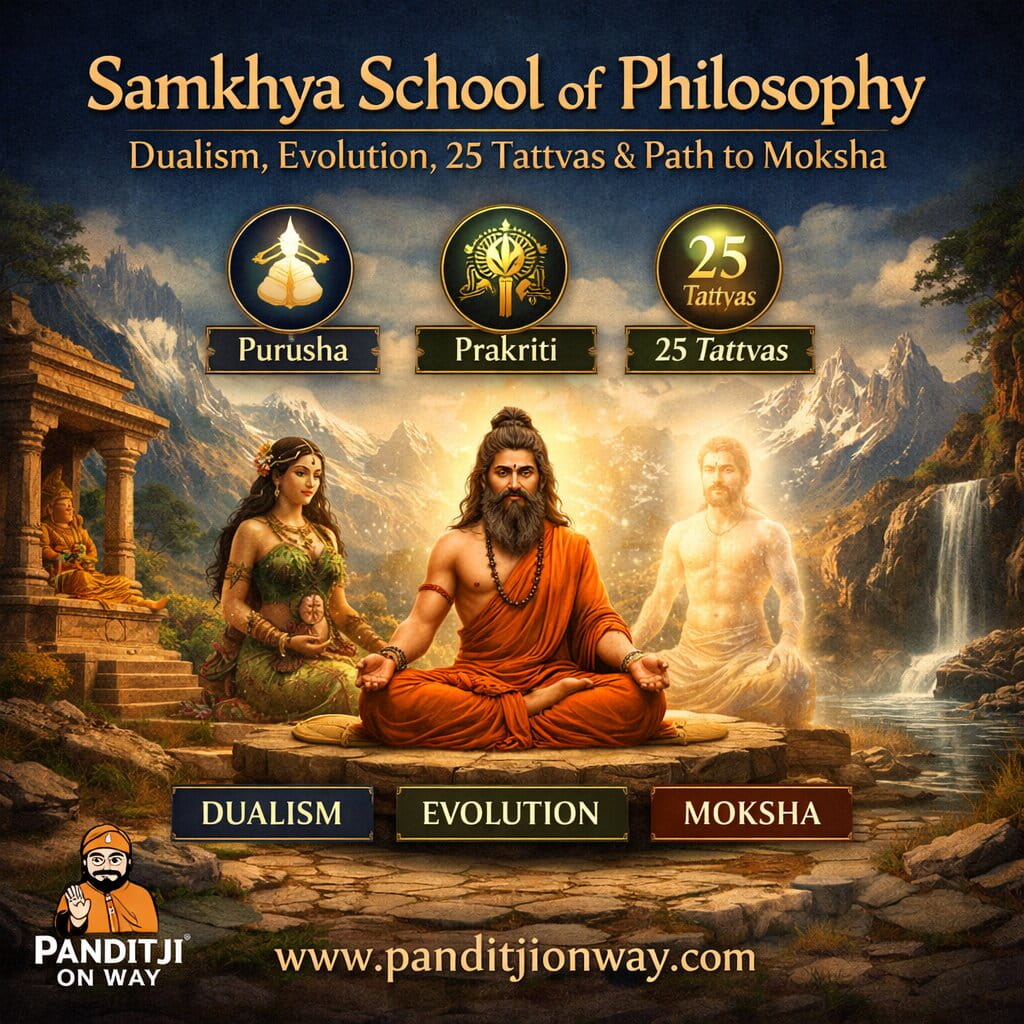
Core Doctrine of Samkhya: Dualism (Dvaita)
The Samkhya School of Philosophy is fundamentally dualistic. It recognizes two eternal, independent realities:
| Reality | Nature | Description |
|---|---|---|
| Purusha | Consciousness | Pure, eternal, unchanging witness |
| Prakriti | Matter | Unconscious, dynamic, primal nature |
Purusha (Conscious Self)
- Eternal, passive observer
- Pure consciousness
- Plural (many individual selves)
- Free from change
- Witness of mental and physical phenomena
Purusha is not the doer but the experiencer.
Prakriti (Primordial Matter)
- Unconscious, dynamic principle
- Root cause of the material universe
- Composed of three Gunas
- Evolves into the phenomenal world
When Purusha comes into proximity with Prakriti, evolution begins.
The Three Gunas in Samkhya Philosophy
Prakriti is constituted of three fundamental qualities (Gunas):
| Guna | Meaning | Characteristics | Psychological Effect |
|---|---|---|---|
| Sattva | Purity & Harmony | Light, knowledge, truth, clarity | Wisdom, peace, happiness |
| Rajas | Activity & Passion | Energy, motion, stimulation | Desire, restlessness, ambition |
| Tamas | Inertia & Darkness | Heaviness, ignorance, obstruction | Laziness, confusion, dullness |
As long as the Gunas remain in equilibrium, Prakriti remains unmanifested. Disturbance in equilibrium initiates creation.
Evolution Theory (Parinama) in Samkhya
Samkhya proposes a systematic cosmological evolution called Parinama (transformation theory).
Step-by-Step Evolution from Prakriti:
- Prakriti (Unmanifested Nature)
- Mahat / Buddhi (Intellect)
- Ahamkara (Ego)
- From Ahamkara evolve:
- Mind (Manas)
- Sensory organs
- Action organs
- Subtle elements
- Gross elements
The 25 Tattvas (Principles) of Samkhya Philosophy
Samkhya enumerates 25 Tattvas, explaining cosmic and psychological evolution.
Complete Table of 25 Tattvas
| Category | Tattvas |
|---|---|
| 1 | Prakriti (Primordial Nature) |
| 2 | Purusha (Consciousness) |
| 3 | Buddhi (Intellect) |
| 4 | Ahamkara (Ego) |
| 5 | Manas (Mind) |
| 6–10 | Five Jnanendriyas (Nose, Tongue, Eyes, Skin, Ears) |
| 11–15 | Five Karmendriyas (Hands, Feet, Mouth, Genitals, Excretory Organ) |
| 16–20 | Five Tanmatras (Sound, Touch, Form, Taste, Smell) |
| 21–25 | Five Mahabhutas (Ether, Air, Fire, Water, Earth) |
Total = 25 Principles
This systematic enumeration is why Samkhya is called the “Philosophy of Enumeration.”
Concept of Suffering in Samkhya
Samkhya identifies three types of suffering (Dukha):
| Type | Meaning | Source |
|---|---|---|
| Adhyatmik | Internal suffering | Body & mind |
| Adhibhautik | External suffering | Other beings |
| Adhidaivik | Supernatural suffering | Divine or cosmic forces |
Liberation is freedom from these three forms of suffering.
Moksha (Liberation) in Samkhya Philosophy
Liberation in Samkhya is achieved through discriminative knowledge (Viveka) — realizing that:
- Purusha is separate from Prakriti
- Self is not the ego (Ahamkara)
- Consciousness is beyond mind and intellect
Once this knowledge arises, the Purusha becomes liberated (Kaivalya).
Samkhya accepts three valid sources of knowledge (Pramana):
- Perception (Pratyaksha)
- Inference (Anumana)
- Reliable Testimony (Aptavacana)
Is Samkhya an Atheistic Philosophy?
Samkhya is often debated as atheistic because classical Samkhya does not explicitly posit a creator God (Ishvara). However:
- It accepts spiritual reality (Purusha)
- It aligns with Upanishadic thought
- Later interpretations integrate theistic elements
Scholars like K.C. Bhattacharya argue that Samkhya is a deeply spiritual metaphysical reflection rather than outright atheism.
Relationship Between Samkhya and Yoga
Samkhya and Yoga are sister philosophies.
| Samkhya | Yoga |
|---|---|
| Theoretical framework | Practical discipline |
| Emphasizes knowledge | Emphasizes meditation |
| No explicit Ishvara | Accepts Ishvara |
Yoga philosophy (Patanjali) is deeply influenced by Samkhya metaphysics.
Authoritative Reference:
Stanford Encyclopedia of Philosophy – Indian Philosophy
https://plato.stanford.edu/entries/indian-philosophy/
Influence of Samkhya in Hinduism
The Samkhya School of Philosophy significantly influenced:
- Yoga Darshana
- Tantra traditions
- Vedanta interpretations
- Ayurvedic psychology
- Bhagavad Gita metaphysics
Its concepts of Gunas and Purusha-Prakriti are central to Hindu spiritual discourse.
Practical Relevance of Samkhya Today
Understanding the Three Gunas helps in:
- Mental clarity
- Personality analysis
- Spiritual growth
- Managing emotions
- Achieving balance in life
For spiritual remedies, Vedic rituals, and personalized guidance based on classical philosophy, consult expert Vedic scholars at:
Panditji On Way – India’s First & Largest Online Puja Booking Portal
https://www.panditjionway.com
Frequently Asked Questions for The Samkhya School of Philosophy
1. What is the Samkhya School of Philosophy?
The Samkhya School of Philosophy is one of the six classical systems of Hindu philosophy. It teaches dualism between Purusha (consciousness) and Prakriti (matter) and explains the universe through 25 tattvas and the interaction of the three gunas: Sattva, Rajas, and Tamas.
2. Who founded the Samkhya philosophy?
Samkhya philosophy is traditionally attributed to Rishi Kapila, an ancient sage mentioned in Vedic and Puranic literature. He systematized the doctrine of Purusha and Prakriti and laid the foundation for one of India’s earliest rational philosophical traditions.
3. What are Purusha and Prakriti in Samkhya?
In Samkhya philosophy, Purusha is pure, eternal consciousness, while Prakriti is the unconscious, primordial material cause of the universe. Their interaction leads to cosmic evolution and individual experience.
4. What are the Three Gunas in Samkhya philosophy?
The Three Gunas are fundamental qualities of nature:
-
Sattva (purity and harmony)
-
Rajas (activity and passion)
-
Tamas (inertia and ignorance)
These qualities govern mental states, behavior, and cosmic evolution.
5. How many Tattvas are there in Samkhya philosophy?
Samkhya philosophy enumerates 25 Tattvas (principles), including Purusha, Prakriti, intellect (Buddhi), ego (Ahamkara), mind (Manas), sensory organs, action organs, subtle elements, and five great elements.
6. Is Samkhya philosophy atheistic?
Classical Samkhya does not emphasize a creator God (Ishvara), which leads some scholars to call it atheistic. However, it is deeply spiritual and focuses on liberation through knowledge rather than devotion to a deity.
7. What is the theory of evolution in Samkhya?
Samkhya explains evolution through Parinama (transformation theory), where Prakriti evolves into intellect, ego, mind, senses, and elements when the equilibrium of the three gunas is disturbed.
8. What is Moksha in Samkhya philosophy?
Moksha in Samkhya is achieved through discriminative knowledge (Viveka), realizing that Purusha is distinct from Prakriti. This awareness frees the soul from suffering and the cycle of birth and death.
9. What are the three types of suffering in Samkhya?
Samkhya identifies three forms of suffering:
-
Adhyatmik (internal, physical or mental)
-
Adhibhautik (external, caused by other beings)
-
Adhidaivik (divine or cosmic forces)
Liberation removes these sufferings permanently.
10. What is the relationship between Samkhya and Yoga?
Samkhya provides the theoretical foundation of metaphysics, while Yoga offers practical methods like meditation and discipline to realize the separation of Purusha from Prakriti.
11. Why is Samkhya important in Hindu philosophy?
Samkhya is foundational because it influenced Yoga, Vedanta, Tantra, and the Bhagavad Gita. Its systematic explanation of consciousness, matter, and liberation makes it one of the most rational and structured philosophical systems in India.
12. What does the word “Samkhya” literally mean?
The word “Samkhya” comes from the Sanskrit root Sam (together) and Khya (to reckon or enumerate). It literally means “enumeration” or “systematic analysis,” referring to the philosophical method of listing and explaining the 25 tattvas of reality.
13. How does Samkhya explain the creation of the universe?
Samkhya explains creation through the transformation (Parinama) of Prakriti when the equilibrium of the three Gunas is disturbed. This disturbance leads to the evolution of intellect (Buddhi), ego (Ahamkara), mind, senses, subtle elements, and finally the five great elements.
14. What is the role of Buddhi in Samkhya philosophy?
Buddhi, also called Mahat, is the first evolute of Prakriti. It represents intellect, discrimination, and decision-making power. Buddhi plays a crucial role in realizing the distinction between Purusha and Prakriti, which leads to liberation.
15. What is Ahamkara in Samkhya?
Ahamkara means ego-consciousness or the sense of “I.” It evolves from Buddhi and creates individuality. Ahamkara gives rise to mind, senses, and elements, binding the Purusha to worldly experience until true knowledge arises.
16. Why are there multiple Purushas in Samkhya?
Samkhya holds that Purusha is plural because individual experiences differ. If there were only one Purusha, liberation of one would mean liberation of all. Therefore, multiple conscious selves exist independently.
17. What are Tanmatras in Samkhya philosophy?
Tanmatras are subtle elements that precede the five gross elements. They include sound (Shabda), touch (Sparsha), form (Rupa), taste (Rasa), and smell (Gandha). These subtle qualities evolve into the physical world.
18. How is Samkhya different from Vedanta?
Samkhya is dualistic, recognizing Purusha and Prakriti as two independent realities. Vedanta, especially Advaita Vedanta, teaches non-dualism where Brahman alone is the ultimate reality. Samkhya emphasizes analysis; Vedanta emphasizes unity.
19. What is Kaivalya in Samkhya philosophy?
Kaivalya means absolute isolation of Purusha from Prakriti. It is the final state of liberation where the soul realizes its pure, independent nature, free from suffering and the cycle of birth and death.
20. Does the Bhagavad Gita mention Samkhya?
Yes, the Bhagavad Gita frequently refers to Samkhya, especially in Chapter 2 (Sankhya Yoga). The Gita integrates Samkhya’s knowledge path with Karma Yoga and Bhakti Yoga.
21. What are the valid sources of knowledge in Samkhya?
Samkhya accepts three pramanas (means of knowledge):
- Perception (Pratyaksha)
- Inference (Anumana)
- Reliable testimony (Aptavacana)
These help in attaining discriminative knowledge for liberation.
22. How do the Three Gunas affect human personality?
The dominance of Sattva leads to clarity and wisdom, Rajas produces ambition and restlessness, and Tamas causes ignorance and inertia. Human behavior and mental states are shaped by the balance of these three Gunas.
23. Why is Samkhya considered scientific?
Samkhya is considered scientific because it systematically categorizes reality into 25 principles and explains cosmic evolution through cause-and-effect transformation rather than mythological narratives.
24. Is Samkhya philosophy relevant today?
Yes, Samkhya remains relevant for understanding psychology, self-awareness, personality traits, and spiritual growth. Its concept of Gunas is widely applied in Yoga, Ayurveda, and modern wellness practices.
25. What is the ultimate goal of Samkhya philosophy?
The ultimate goal of Samkhya is freedom from suffering through self-realization. By understanding the difference between Purusha and Prakriti, one attains Moksha or Kaivalya.
Conclusion
The Samkhya School of Philosophy stands as one of the most systematic and rational metaphysical systems in Indian thought. Through its dualistic framework of Purusha and Prakriti, enumeration of 25 Tattvas, and explanation of the Three Gunas, it offers a comprehensive explanation of human suffering and liberation.
Its influence on Yoga, Tantra, and Vedanta makes it foundational in Hindu philosophy. Understanding Samkhya is essential for anyone seeking deep knowledge of Vedic metaphysics and spiritual evolution.
For authentic Vedic rituals, philosophical guidance, and online puja booking services rooted in classical darshanas, visit:


