
Radha Ashtami 2026: Date, Puja Muhurat, Vrat Vidhi, Vrat Katha, Significance and Celebration
Know Radha Ashtami 2026 date, Ashtami Tithi, Madhyahna Puja Muhurat, vrat vidhi, puja samagri, katha, significance and Barsana celebrations.
Radha Ashtami 2026 will be celebrated on Saturday, 19 September 2026. The festival marks the divine appearance or birth anniversary of Shri Radha Rani, the beloved of Lord Krishna and one of the most revered figures in the Vaishnava tradition.
According to the New Delhi Panchang, Radha Ashtami falls on Bhadrapada Shukla Paksha Ashtami. The Ashtami Tithi begins on 18 September 2026 at 1:00 PM and ends on 19 September 2026 at 3:26 PM. The most important worship period is Madhyahna Kala, from 11:01 AM to 1:28 PM on 19 September.
Radha Ashtami is especially celebrated with devotion and grandeur in Barsana, Vrindavan, Mathura and the wider Braj region of Uttar Pradesh. Devotees observe a vrat, perform Radha Rani Puja, listen to Radha Ashtami Vrat Katha, offer flowers and bhog, chant Radha-Krishna mantras and visit temples dedicated to Shri Radha.
Panditji on Way, one of India’s leading online pooja booking platforms, provides devotees with convenient access to experienced pandits for traditional Hindu puja and vrat-related rituals.
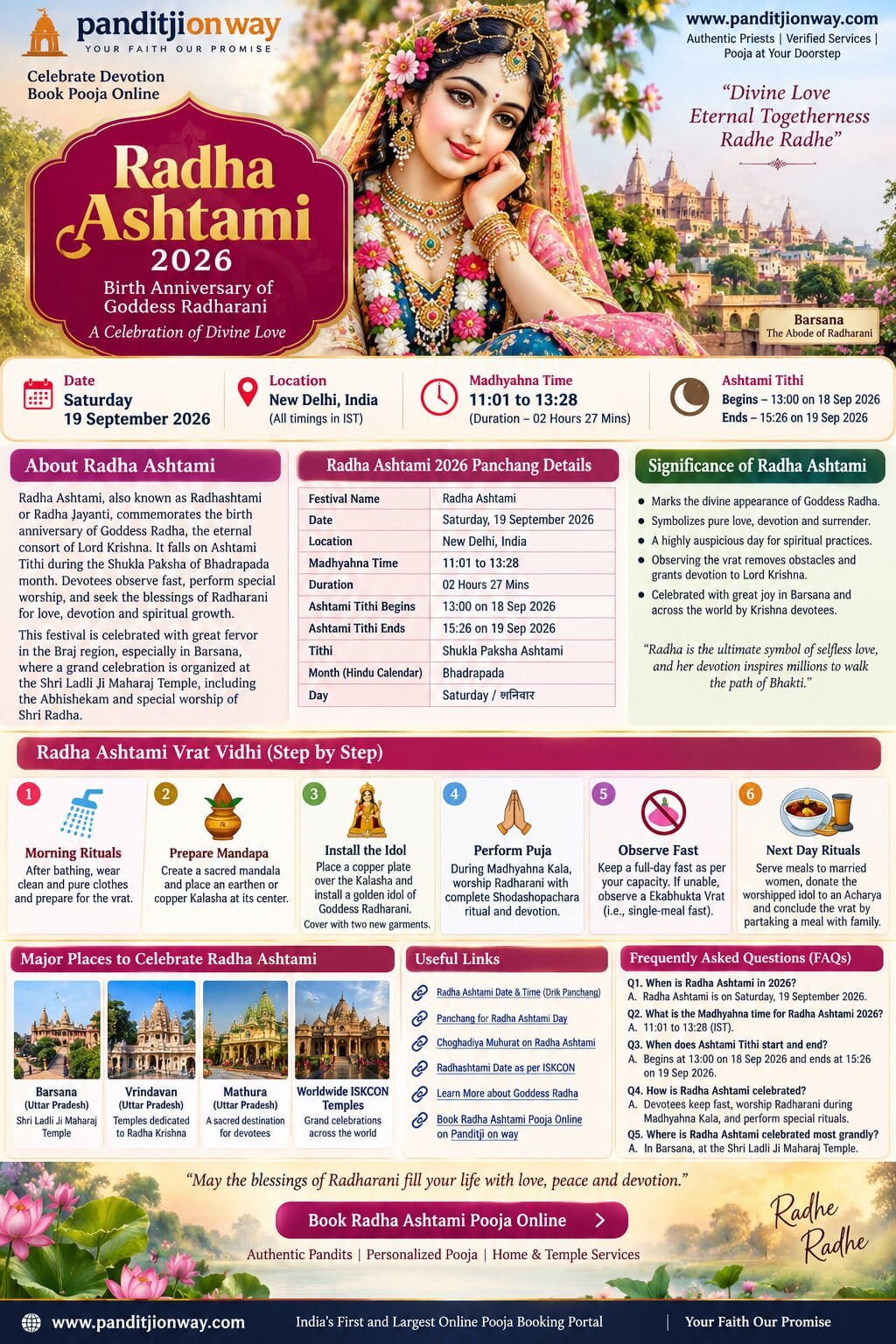
Radha Ashtami 2026 – Quick Overview
| Particular | Details |
|---|---|
| Festival | Radha Ashtami 2026 |
| Date | Saturday, 19 September 2026 |
| Deity | Shri Radha Rani |
| Other Names | Radhashtami, Radha Jayanti |
| Hindu Month | Bhadrapada |
| Paksha | Shukla Paksha |
| Tithi | Ashtami |
| Ashtami Tithi Begins | 1:00 PM, 18 September 2026 |
| Ashtami Tithi Ends | 3:26 PM, 19 September 2026 |
| Madhyahna Puja Muhurat | 11:01 AM – 1:28 PM |
| Madhyahna Duration | 2 Hours 27 Minutes |
| Primary Celebration Region | Braj, Barsana, Vrindavan and Mathura |
| Main Observance | Radha Rani Puja and Vrat |
| 2026 Weekday | Saturday / शनिवार |
Important: Panchang timings vary according to location. The timings above are for New Delhi, India. Devotees in Mumbai, Delhi, Jaipur, Lucknow, Kolkata, Bengaluru, Ahmedabad, Pune or other cities should check the Panchang for their specific location before beginning or concluding a vrat.
When is Radha Ashtami in 2026?
Radha Ashtami 2026 is on Saturday, 19 September 2026.
Radha Ashtami is observed on the Ashtami Tithi of Shukla Paksha in the month of Bhadrapada. The festival is traditionally observed approximately two weeks after Janmashtami.
For New Delhi, the 2026 Ashtami Tithi begins at 1:00 PM on Friday, 18 September and ends at 3:26 PM on Saturday, 19 September. Since the relevant Ashtami prevails on 19 September, Radha Ashtami will be observed on Saturday.
Radha Ashtami 2026 Puja Muhurat
The principal worship of Shri Radha Rani is performed during Madhyahna Kala, the noon period according to the traditional Hindu division of the day.
Radha Ashtami Puja Muhurat – New Delhi
Madhyahna Time: 11:01 AM to 1:28 PM
Total Duration: 2 hours 27 minutes
Devotees can use this period for Radha Rani’s main puja, abhishekam, shringar, offering of flowers and bhog, mantra chanting and aarti.
Because Hindu Panchang calculations are location-sensitive, devotees should use their city’s local Panchang when performing time-specific rituals.
Radha Ashtami 2026 Tithi
| Panchang Detail | Timing |
|---|---|
| Ashtami Tithi Begins | 1:00 PM, 18 September 2026 |
| Ashtami Tithi Ends | 3:26 PM, 19 September 2026 |
| Radha Ashtami | 19 September 2026 |
| Main Puja Period | Madhyahna Kala |
| Madhyahna Muhurat | 11:01 AM – 1:28 PM |
A separate Panchang should be consulted for locations outside New Delhi because sunrise, sunset and tithi calculations can differ from city to city.
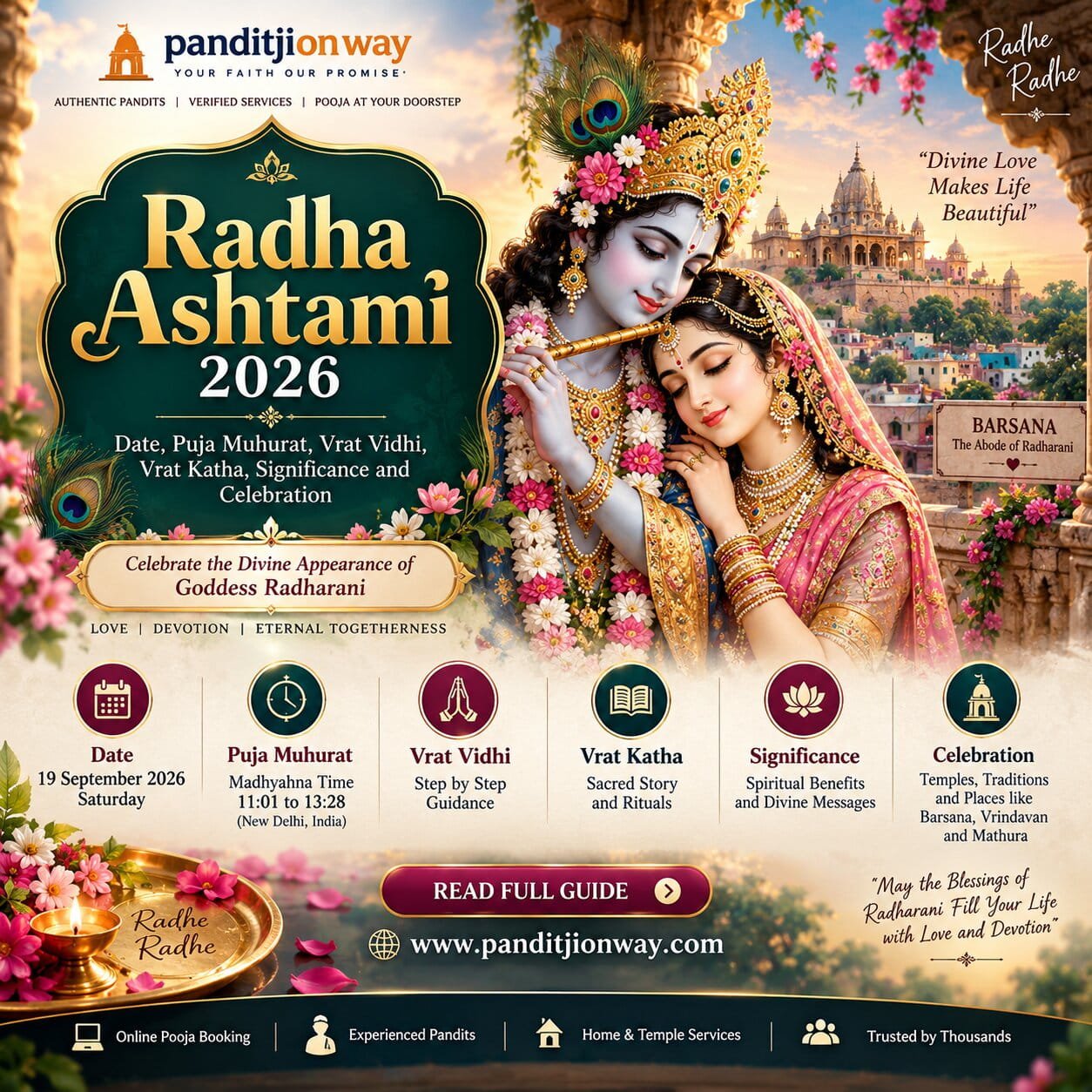
What is Radha Ashtami?
Radha Ashtami is the sacred festival commemorating the appearance of Shri Radha Rani. It is one of the most important devotional occasions for followers of Radha-Krishna, particularly in the Braj region.
In Vaishnava traditions, Shri Radha is revered as the embodiment of divine love and devotion toward Lord Krishna. Her name is inseparably associated with Krishna, and the devotional tradition of Radha-Krishna bhakti gives special importance to worshipping and remembering Radha Rani.
The festival is known as Radhashtami and Radha Jayanti in different devotional contexts.
Why is Radha Ashtami Celebrated?
Radha Ashtami is celebrated to honour Shri Radha Rani and her divine relationship with Lord Krishna.
The festival represents:
- Devotion and unconditional love
- Bhakti toward Shri Radha and Krishna
- Spiritual purity
- Compassion and humility
- The devotional traditions of Braj
- The cultural and religious heritage of Barsana and Vrindavan
For devotees, Radha Ashtami is not simply a calendar festival. It is an opportunity to dedicate the day to naam-japa, prayer, seva, kirtan, temple worship and remembrance of Radha-Krishna.
Radha Ashtami Vrat 2026
Many devotees observe Radha Ashtami Vrat on the festival day.
The type of fasting can differ according to family tradition, sampradaya, personal health and spiritual practice. Some devotees observe a stricter fast, while others follow a fruit-based or single-meal vrat.
A person should not undertake an extreme fast merely because another devotee follows it. Vrat should be observed according to one’s capacity and established family or religious tradition.
For people with medical dietary requirements, medication schedules or other health considerations, appropriate professional advice should be followed.
Radha Ashtami Vrat Vidhi
Traditional descriptions of Radha Ashtami observance include purification, sankalpa, worship of Shri Radha during Madhyahna and charitable or devotional acts.
A practical home puja can be performed as follows.
Step 1: Wake Up Early and Take a Bath
Wake up early on Radha Ashtami and complete your morning routine. Take a bath and wear clean clothes.
If possible, keep the puja area clean and peaceful.
Step 2: Clean the Puja Place
Clean the place where Radha Rani will be worshipped.
Place a clean chowki or altar and cover it with a fresh cloth.
Step 3: Install Shri Radha Rani
Place an idol or image of Shri Radha Rani on the altar.
A Radha-Krishna deity or image can also be worshipped according to the family’s tradition.
Step 4: Kalash Sthapana
Those following a detailed traditional puja may establish a Kalash near the deity.
The Kalash may be decorated with water, mango leaves and other customary items according to the family’s puja tradition.
Step 5: Take Sankalpa
Sit facing the appropriate direction according to your family tradition and take a sankalpa for the Radha Ashtami vrat and puja.
The sankalpa should state your intention to observe the festival with devotion and sincerity.
Step 6: Perform Radha Rani Puja
During Madhyahna Kala, worship Shri Radha Rani with devotion.
Offer:
- Water
- Panchamrit
- Flowers
- Kumkum
- Chandan
- Akshat
- Incense
- Deepak
- Fruits
- Sweets
- Bhog
- New clothes or shringar items, according to tradition
Step 7: Radha-Krishna Mantra Jaap
Devotees may chant Radha-Krishna names or mantras according to their sampradaya.
Common devotional practices include:
“Radhe Radhe”
and chanting the Hare Krishna Mahamantra.
Step 8: Listen to Radha Ashtami Vrat Katha
After the main puja, devotees may listen to or read the Radha Ashtami Vrat Katha and Radha Rani’s glories.
Step 9: Perform Aarti
Perform Radha Rani Aarti and offer bhog.
Family members can participate in kirtan, bhajan and naam-smaran.
Step 10: Charity and Seva
Charity, feeding people, serving cows and helping those in need are commonly associated with devotional observance.
The most important aspect is sincerity rather than the monetary value of the donation.
Radha Ashtami Puja Samagri List
For a simple home Radha Ashtami Puja, devotees can prepare the following items:
| Puja Item | Purpose |
|---|---|
| Radha Rani idol/photo | Main deity |
| Clean cloth | Altar and deity |
| Kalash | Traditional puja |
| Gangajal or clean water | Purification |
| Panchamrit ingredients | Abhishekam |
| Flowers | Offering |
| Tulsi leaves | For Krishna worship where appropriate |
| Chandan | Tilak and offering |
| Kumkum | Shringar |
| Akshat | Traditional offering |
| Incense | Dhupa |
| Ghee/oil lamp | Deepa |
| Fruits | Bhog |
| Sweets | Prasad |
| Betel leaves/nuts | Traditional puja |
| Cotton wicks | Deepak |
| New clothes/shringar items | Deity decoration |
The exact samagri can vary by sampradaya and regional tradition.
Radha Ashtami Vrat Rules
There is no single fasting practice followed by every Radha devotee. The method can vary according to tradition.
Common devotional guidelines include:
- Begin the day with cleanliness and prayer.
- Take a sankalpa before the vrat.
- Avoid unnecessary arguments, anger and negative conduct.
- Spend more time in prayer, naam-japa and devotional reading.
- Avoid intoxicants and non-vegetarian food.
- Follow the fasting method appropriate to your health and tradition.
- Perform Radha Rani Puja during Madhyahna.
- Offer bhog and distribute prasad.
- Perform charity or seva according to your ability.
- Conclude the vrat according to your family’s or sampradaya’s practice.
Radha Ashtami Vrat Katha
Radha Ashtami Vrat Katha is traditionally heard or recited by devotees as part of the observance.
According to the devotional traditions associated with Braj, Shri Radha is connected with Vrishabhanu Maharaj and Kirtida Devi, and Barsana is revered as an important place associated with her appearance.
Different Vaishnava traditions preserve variations in the details of Radha Rani’s appearance and childhood pastimes. Therefore, devotees should distinguish between scriptural traditions, regional narratives and later devotional literature rather than treating every version as identical.
The central devotional message of Radha Ashtami Katha is the glory of pure bhakti, divine love, surrender and devotion to Radha-Krishna.
Radha Ashtami Story: Birth and Appearance of Radha Rani
The sacred traditions of Braj describe Shri Radha as the divine beloved of Lord Krishna and the supreme embodiment of devotional love.
Barsana, located in the Mathura region of Uttar Pradesh, is particularly associated with Shri Radha. The town becomes a major centre of pilgrimage and celebration during Radha Ashtami.
The festival is therefore deeply connected with the living cultural traditions of Braj Bhumi, where Radha-Krishna bhakti is expressed through temple worship, raslila, kirtan, Holi traditions and devotional festivals.
Radha Ashtami in Barsana
Barsana is considered one of the most important pilgrimage destinations associated with Shri Radha.
The Shri Radha Rani Temple, popularly known as Ladli Ji Temple, is situated on Barsana’s sacred hill and is a major devotional centre.
During Radha Ashtami, devotees gather in large numbers for special darshan, abhishekam, shringar, bhajan, kirtan and other religious ceremonies.
If you are planning a Barsana pilgrimage for Radha Ashtami 2026, accommodation, transportation and temple arrangements should be planned well in advance.
Radha Ashtami in Vrindavan and Mathura
Vrindavan and Mathura are also important destinations for Radha-Krishna devotees.
Temples across the Braj region conduct special programmes during Radha Ashtami, including:
- Special Radha Rani shringar
- Abhishekam
- Aarti
- Bhajan and kirtan
- Radha-Krishna darshan
- Spiritual discourses
- Distribution of prasad
- Temple processions and devotional celebrations
The precise schedule differs from temple to temple.
Best Places to Celebrate Radha Ashtami
| Place | Why It Is Important |
|---|---|
| Barsana | Strongest association with Shri Radha and major Radha Rani celebrations |
| Vrindavan | Major Radha-Krishna pilgrimage centre |
| Mathura | Important Krishna pilgrimage city within Braj |
| Rawal | Traditionally associated with Radha Rani in some traditions |
| Gokul | Major Braj pilgrimage destination associated with Krishna |
| Nandgaon | Important site connected with Krishna’s Braj pastimes |
For a first-time Radha Ashtami pilgrimage, Barsana and Vrindavan are among the most significant places to consider.
Radha Ashtami Puja at Home
Devotees who cannot travel to Barsana or Vrindavan can celebrate Radha Ashtami at home.
A simple home observance can include:
Morning: Bath, cleaning and sankalpa
Before noon: Preparation of the altar and puja samagri
Madhyahna: Radha Rani Puja and abhishekam
Afternoon: Katha, mantra jaap and bhajan
Evening: Aarti, bhog and prasad distribution
The spiritual value of the observance is traditionally associated with devotion and sincerity rather than the size or expense of the celebration.
Radha Ashtami Abhishekam
Abhishekam is an important ritual in many temple and home worship traditions.
Depending on the established tradition, the deity may be bathed with:
- Clean water
- Panchamrit
- Milk
- Curd
- Honey
- Ghee
- Sugar
- Fragrant water
After the abhishekam, the deity is dried, dressed and decorated with shringar items.
For a home puja, devotees should follow the instructions appropriate to the material and type of their deity.
Radha Ashtami Shringar
Shringar is an important part of Radha Rani worship.
Devotees may offer:
- New clothes
- Chunari
- Flowers
- Garland
- Chandan
- Kumkum
- Jewellery
- Hair accessories
- Other traditional decorative items
In temples, elaborate shringar may be performed by trained temple sevaks according to established temple traditions.
Radha Ashtami Bhog and Prasad
Devotees may prepare sattvic food and traditional sweets as bhog.
Common offerings may include:
- Fruits
- Mishri
- Milk preparations
- Kheer
- Makhan-mishri
- Pedas
- Laddus
- Panchamrit
- Homemade sweets
The exact food offered should follow the devotee’s family tradition or the rules of the particular temple or sampradaya.
Radha Ashtami Mantra
Devotees can spend time chanting the holy names of Radha and Krishna.
A simple devotional practice is:
Radhe Radhe
Devotees may also chant the Hare Krishna Mahamantra according to their tradition:
Hare Krishna Hare Krishna, Krishna Krishna Hare Hare
Hare Rama Hare Rama, Rama Rama Hare Hare
The purpose of mantra chanting is devotional remembrance, concentration and spiritual practice rather than merely completing a numerical target.
Radha Ashtami Significance
Radha Ashtami holds profound importance in Radha-Krishna devotional traditions.
The festival reminds devotees of:
1. Power of Bhakti
Radha is revered as the embodiment of intense devotion to Krishna.
2. Divine Love
Radha-Krishna devotion represents a central theme of divine love in several Vaishnava traditions.
3. Humility and Surrender
Devotees use the occasion to cultivate humility, seva and surrender.
4. Braj Culture
The festival preserves and celebrates the religious and cultural traditions of Braj.
5. Spiritual Remembrance
Naam-japa, katha, bhajan and temple worship provide opportunities for devotees to focus their minds on the divine.
What Should You Do on Radha Ashtami?
If you want to observe Radha Ashtami simply, follow this checklist:
| Time | Suggested Activity |
|---|---|
| Early Morning | Bath and cleanliness |
| Morning | Sankalpa and altar preparation |
| Morning | Radha-Krishna naam-japa |
| Before Madhyahna | Prepare puja and bhog |
| 11:01 AM–1:28 PM | Main Radha Rani Puja in New Delhi |
| Afternoon | Radha Ashtami Vrat Katha |
| Afternoon/Evening | Bhajan and kirtan |
| Evening | Aarti |
| After Puja | Prasad and charity/seva |
What Not to Do on Radha Ashtami
Devotees generally try to maintain a peaceful and devotional atmosphere.
Avoid:
- Unnecessary arguments
- Intoxicants
- Non-vegetarian food
- Deliberately disrespectful behaviour
- Excessive material distractions
- Treating the vrat as a competition
The purpose of vrat is spiritual discipline and devotion.
Radha Ashtami and Janmashtami: Difference
Radha Ashtami and Janmashtami are closely connected but commemorate different sacred occasions.
| Radha Ashtami | Janmashtami |
|---|---|
| Celebrates Shri Radha | Celebrates Lord Krishna |
| Shukla Paksha Ashtami of Bhadrapada | Krishna Paksha Ashtami of the relevant lunar month |
| Major celebration in Barsana and Braj | Major celebration in Mathura, Vrindavan, Gokul and across India |
| Radha Rani is the principal focus | Krishna is the principal focus |
| Main puja is associated with Madhyahna | Krishna Janmashtami worship is traditionally associated with midnight |
Both festivals are central to Radha-Krishna devotional culture.
Radha Ashtami 2026 for Different Cities
Panchang timings are location-specific. The date may remain the same while exact tithi and puja timings can vary.
Before performing a time-sensitive ritual, devotees in cities such as:
- Delhi
- Mumbai
- Pune
- Jaipur
- Ahmedabad
- Lucknow
- Chandigarh
- Kolkata
- Bengaluru
- Hyderabad
- Chennai
- Indore
- Bhopal
- Patna
- Varanasi
should check the local Panchang or call or mail on Panditjionway@gmail.com .
New Delhi timings in this article should not automatically be applied to another city.
Radha Ashtami Puja Booking with Panditji on Way
Devotees who want to perform Radha Ashtami Puja according to traditional rituals can arrange a qualified pandit through Panditji on Way.
The platform is designed to make traditional pooja services accessible online, allowing devotees to arrange religious ceremonies without needing to personally search for a pandit.
For Radha Ashtami, devotees may consider arranging:
- Radha Ashtami Puja
- Radha-Krishna Puja
- Special devotional puja
- Family sankalpa puja
- Festival-related Hindu rituals
Why Book a Radha Ashtami Puja Online?
Online pooja booking can be useful for devotees who:
- Live away from their hometown
- Cannot travel to Barsana or Vrindavan
- Want a pandit to conduct the ritual
- Have limited time for arranging samagri
- Want to perform a traditional ceremony from home
- Want family members in different locations to participate
The exact ritual, samagri and procedure should be confirmed with the pandit before booking.
Radha Ashtami 2026 – Frequently Asked Questions
When is Radha Ashtami in 2026?
Radha Ashtami will be observed on Saturday, 19 September 2026.
What is the date of Radha Ashtami 2026?
The date of Radha Ashtami 2026 is 19 September 2026.
When does Radha Ashtami Tithi start in 2026?
For New Delhi, Ashtami Tithi begins at 1:00 PM on 18 September 2026.
When does Radha Ashtami Tithi end in 2026?
For New Delhi, Ashtami Tithi ends at 3:26 PM on 19 September 2026.
What is the Radha Ashtami Puja Muhurat in 2026?
For New Delhi, the main Madhyahna Puja Muhurat is 11:01 AM to 1:28 PM on 19 September 2026.
Who is worshipped on Radha Ashtami?
Shri Radha Rani is the principal deity worshipped on Radha Ashtami. Devotees also worship Radha-Krishna together according to their tradition.
Why is Radha Ashtami important?
Radha Ashtami commemorates Shri Radha’s appearance and is an important festival of Radha-Krishna devotion, particularly in the Braj region.
Where is Radha Ashtami celebrated most prominently?
Barsana, Vrindavan and the wider Braj region are among the most prominent places for Radha Ashtami celebrations.
Is Radha Ashtami a fasting day?
Yes. Many devotees observe Radha Ashtami Vrat, although the form of fasting varies according to personal capacity, family tradition and sampradaya.
Can Radha Ashtami Puja be performed at home?
Yes. Devotees can perform a simple Radha Rani Puja at home using an idol or image, flowers, bhog, diya, incense and other traditional puja items.
What should be offered to Radha Rani on Radha Ashtami?
Devotees commonly offer flowers, garlands, fruits, sweets, Panchamrit and other sattvic bhog according to their family or temple tradition.
Can I celebrate Radha Ashtami without visiting Barsana?
Yes. Radha Ashtami can be observed at home through puja, naam-japa, katha, bhajan, fasting and devotional service.
Is Radha Ashtami the same as Radha Jayanti?
Yes. Radha Jayanti is another commonly used name for Radha Ashtami, referring to the sacred appearance or birth anniversary of Shri Radha.
What is the best place to celebrate Radha Ashtami?
For devotees seeking the traditional Braj experience, Barsana is especially significant because of its strong association with Shri Radha. Vrindavan and Mathura are also major pilgrimage destinations.
Radha Ashtami 2026 – Important Takeaways
Radha Ashtami 2026 Date: 19 September 2026, Saturday
Deity: Shri Radha Rani
Tithi: Bhadrapada Shukla Ashtami
Ashtami Begins: 1:00 PM, 18 September
Ashtami Ends: 3:26 PM, 19 September
New Delhi Puja Muhurat: 11:01 AM–1:28 PM
Major Celebration Places: Barsana, Vrindavan and Mathura
Main Observance: Radha Rani Puja, Vrat, Katha, Naam-Japa, Bhajan and Seva
Final Words
Radha Ashtami is a deeply devotional festival that celebrates Shri Radha Rani and the timeless tradition of Radha-Krishna bhakti.
On 19 September 2026, devotees can observe the occasion by keeping a vrat according to their capacity, performing Radha Rani Puja during the appropriate Madhyahna period, listening to Radha Ashtami Katha, chanting Radha-Krishna’s holy names, offering bhog and participating in seva.
For devotees who cannot travel to Barsana or Vrindavan, a sincere Radha Ashtami Puja can also be performed at home.
Panditji on Way helps devotees arrange traditional Hindu puja services online, making it easier to connect with pandits and conduct auspicious ceremonies from home.
Radhe Radhe.
Authoritative External Resources
For Panchang and festival verification, readers can consult established Hindu calendar and religious resources such as: