

Pratipada Shraddha 2026: Date, Time, Muhurat, Tithi, Puja Vidhi, Pind Daan, Tarpan & Significance
Pratipada Shraddha 2026 is on September 27. Check Delhi Muhurat, Tithi timings, Tarpan, Pind Daan, Shraddha Vidhi, Samagri, significance and FAQs.
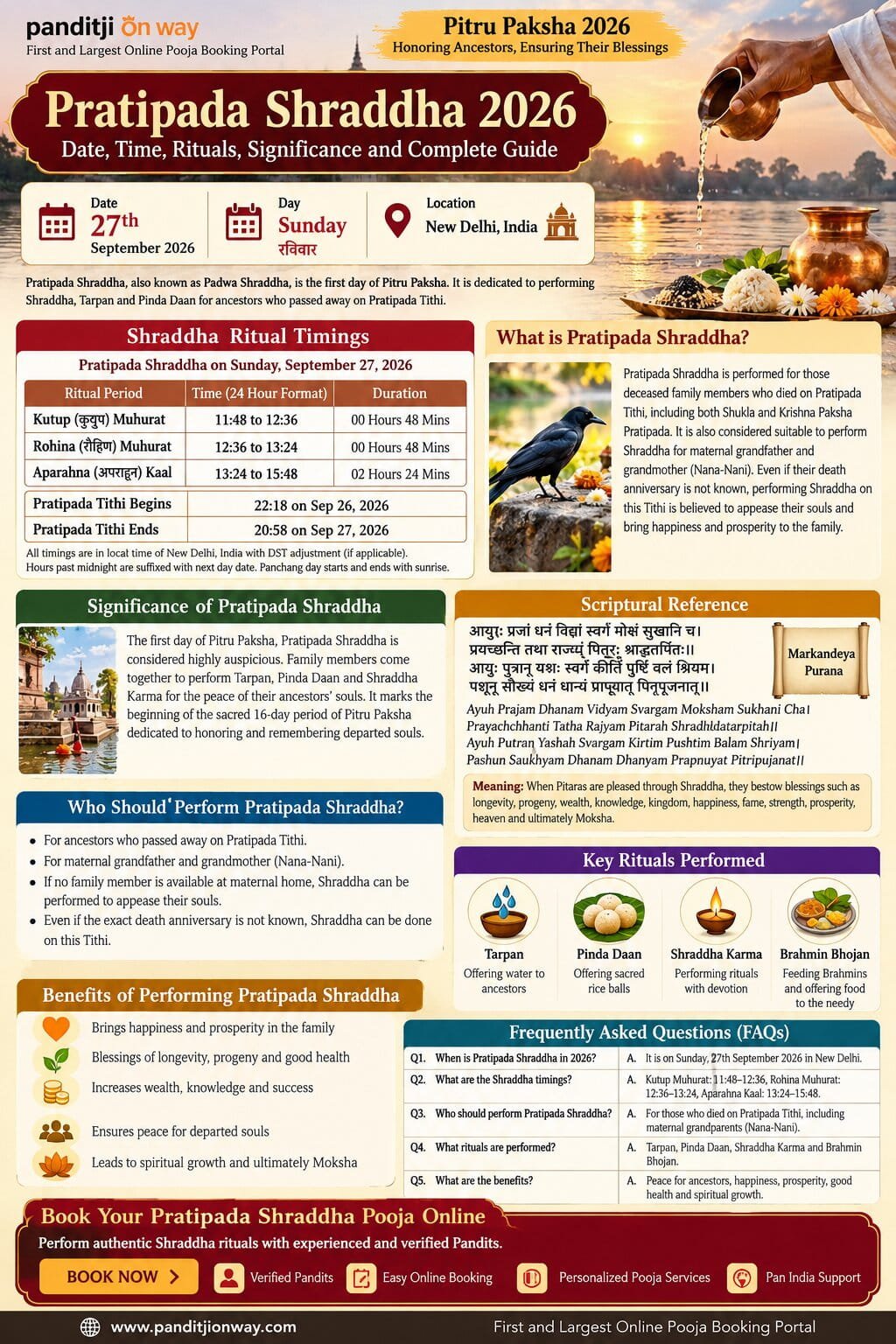
Pratipada Shraddha 2026 will be observed on Sunday, September 27, 2026, during Pitru Paksha. In New Delhi, India, Pratipada Tithi continues until 8:58 PM, making September 27 an important day for performing Shraddha, Tarpan and Pind Daan for ancestors associated with Pratipada Tithi.
Pratipada Shraddha is also commonly known as Padwa Shraddha or Padwa Shradh. It is traditionally performed for deceased family members whose death occurred on Pratipada Tithi of either Shukla Paksha or Krishna Paksha.
According to traditional Hindu practice, Pitru Paksha is a dedicated period for remembering and honoring departed ancestors through rituals such as Shraddha, Tarpan and Pind Daan. The Ministry of Tourism’s Utsav portal also describes Pitru Paksha as a period dedicated to paying homage to ancestors and notes the traditional practice of performing Shraddha, Tarpan and Pind Daan.
For families looking for a qualified priest, Panditji On Way provides online Pandit booking services for Hindu rituals, including Shraddha-related services and other Vedic ceremonies.
Pratipada Shraddha 2026: Quick Overview
| Details | Information |
|---|---|
| Pratipada Shraddha Date | Sunday, September 27, 2026 |
| Festival / Observance | Pitru Paksha |
| Shraddha Name | Pratipada Shraddha / Padwa Shraddha |
| Location for Timings | New Delhi, India |
| Paksha | Krishna Paksha |
| Tithi | Pratipada |
| Pratipada Tithi Begins | September 26, 2026 at 10:18 PM |
| Pratipada Tithi Ends | September 27, 2026 at 8:58 PM |
| Kutup Muhurat | 11:48 AM – 12:36 PM |
| Rohina Muhurat | 12:36 PM – 1:24 PM |
| Aparahna Kaal | 1:24 PM – 3:48 PM |
| Main Rituals | Shraddha, Pind Daan, Tarpan and Brahmin Bhojan |
| Other Name | Padwa Shraddha / Padwa Shradh |
The New Delhi Panchang data lists September 27, 2026 as Krishna Paksha Pratipada and gives the day’s sunrise as 6:12 AM and sunset as 6:12 PM.
Important: Panchang timings can vary by city because sunrise, sunset and local astronomical calculations differ. Always check the Panchang for the location where the ritual will actually be performed.


When Is Pratipada Shraddha in 2026?
Pratipada Shraddha 2026 falls on Sunday, September 27, 2026.
The Pratipada Tithi begins at 10:18 PM on September 26 and ends at 8:58 PM on September 27 in the New Delhi calculation.
Pratipada Shraddha is a Tithi-based Shraddha, meaning that the lunar Tithi associated with the ancestor’s death is important when determining the appropriate Shraddha day.
Drik Panchang’s 2026 data identifies September 27 as Pratipada Shraddha and explains that Pratipada Shraddha is traditionally performed for deceased family members who passed away on Pratipada Tithi.
Pratipada Shraddha 2026 Muhurat in New Delhi
The principal Shraddha period falls during the daytime, particularly around Kutup Muhurat, Rohina Muhurat and Aparahna Kaal.
1. Kutup Muhurat
11:48 AM to 12:36 PM
Duration: 48 minutes
Kutup Muhurat is traditionally regarded as an important period for Parvan Shraddha rituals.
2. Rohina Muhurat
12:36 PM to 1:24 PM
Duration: 48 minutes
Rohina Muhurat follows Kutup Muhurat and is also traditionally associated with Parvan Shraddha observances.
3. Aparahna Kaal
1:24 PM to 3:48 PM
Duration: 2 hours 24 minutes
Shraddha-related activities may traditionally continue during the appropriate Aparahna period.
Drik Panchang describes Pitru Paksha Shraddhas as Parvan Shraddhas and identifies Kutup, Rohina and the period extending through Aparahna as relevant ritual periods.
Pratipada Shraddha Muhurat Table
| Muhurat / Period | New Delhi Timing | Duration |
|---|---|---|
| Kutup Muhurat | 11:48 AM – 12:36 PM | 48 minutes |
| Rohina Muhurat | 12:36 PM – 1:24 PM | 48 minutes |
| Aparahna Kaal | 1:24 PM – 3:48 PM | 2 hours 24 minutes |
What Is Pratipada Shraddha?
Pratipada Shraddha is the Shraddha performed during Pitru Paksha for an ancestor whose death occurred on Pratipada Tithi.
The term can be understood as:
- Pratipada – the first lunar Tithi of a Paksha
- Shraddha – a ritual of reverence, remembrance and offerings for ancestors
- Pitru – ancestors or departed forefathers
- Tarpan – ritual offering of water
- Pind Daan – offering of symbolic food preparations, traditionally rice-based Pindas
Pratipada Shraddha is also known as Padwa Shraddha or Padwa Shradh.
The observance forms part of the broader Pitru Paksha tradition, during which families remember their departed ancestors and perform prescribed rituals according to their family traditions.

Who Should Perform Pratipada Shraddha?
Traditionally, Pratipada Shraddha is performed for deceased family members whose death occurred on Pratipada Tithi.
This can include ancestors who passed away on:
- Shukla Paksha Pratipada
- Krishna Paksha Pratipada
The exact application of Shraddha rules can vary according to regional traditions, family customs and the guidance of the family’s priest.
For this reason, families should confirm the appropriate Tithi with a knowledgeable priest if there is uncertainty about the death date, lunar Tithi or applicable Shraddha rule.
Is Pratipada Shraddha Also Performed for Maternal Grandparents?
Some Hindu traditions associate Pratipada Shraddha with remembrance of maternal grandparents, commonly referred to as Nana-Nani.
Where a family tradition prescribes it, Pratipada can therefore be observed for maternal grandparents, particularly when their death Tithi is unknown or when the family follows a tradition assigning this observance to Pratipada.
However, this is not a universal rule for every Hindu family or regional tradition. The appropriate practice should be determined according to the family’s Sampradaya, regional custom and priestly guidance.
Why Is Pratipada Shraddha Important?
Pratipada Shraddha has importance because it provides a traditional framework for families to remember and honor departed ancestors.
The observance commonly emphasizes:
- Pitru Smaran – remembering ancestors
- Shraddha – expressing reverence
- Tarpan – offering water
- Pind Daan – making prescribed offerings
- Brahmin Bhojan or Dana – charitable or traditional offerings where prescribed
- Family remembrance – maintaining continuity between generations
The Ministry of Tourism’s Utsav portal describes Pitru Paksha as a period for paying homage to ancestors and notes the traditional performance of Shraddha, Tarpan and Pind Daan.
Pratipada Shraddha Puja Vidhi: Step-by-Step
The precise procedure can differ by region and family tradition, but a traditional Shraddha observance may broadly include the following stages.
1. Sankalpa
The performer takes a Sankalpa, stating the intention of performing Shraddha for the departed ancestor.
The priest may specify the:
- Gotra
- Name of the ancestor
- Relationship with the performer
- Tithi
- Place
- Date
- Purpose of the ritual
2. Preparation of the Ritual Space
The place of worship is cleaned and prepared.
Required materials are arranged according to the priest’s prescribed Vidhi.
3. Tarpan
Tarpan involves offering water while remembering the ancestors.
The exact mantras, direction, vessels and procedure can vary according to tradition.
4. Pind Daan
Pindas are prepared and offered as part of the Shraddha ceremony.
The ingredients and procedure may vary according to regional and family customs.
5. Shraddha Mantras and Offerings
The priest conducts the prescribed mantras and offerings according to the relevant Shraddha Vidhi.
6. Brahmin Bhojan or Dana
In traditions where it is prescribed, food is offered to invited Brahmins and/or charity is performed.
7. Final Tarpan and Prayers
The ceremony concludes with the prescribed offerings, Tarpan and prayers for the departed.
Pratipada Shraddha Samagri List
The exact Samagri list should be confirmed with the priest because requirements vary according to the regional tradition and form of Shraddha being performed.
A general list may include:
| Samagri | Traditional Use |
|---|---|
| Kusha / Darbha | Ritual purification and offerings |
| Black sesame seeds | Tarpan and offerings |
| Barley | Traditional ritual offering |
| Rice | Pinda preparation and offerings |
| Ghee | Ritual offering |
| Milk | Traditional offering |
| Water | Tarpan |
| Flowers | Puja |
| Fruits | Offering |
| Sandalwood | Ritual use |
| Incense | Puja |
| Diya | Sacred lamp |
| Clean cloth | Ritual purposes |
| Pinda ingredients | Pind Daan |
| Food preparations | Naivedya / traditional offerings |
| Dakshina | Offering to priest |
Not every family uses exactly the same ingredients. The safest approach is to obtain the Samagri list from the Pandit performing the ceremony.
Pratipada Shraddha Pind Daan
Pind Daan is one of the important components associated with many forms of Hindu Shraddha.
Pindas are traditionally prepared using prescribed ingredients and offered as part of the ancestor ritual.
The purpose, according to Hindu ritual tradition, is to express reverence and make prescribed offerings to departed ancestors.
Families planning Pind Daan should consult their priest regarding:
- Number of Pindas
- Ingredients
- Mantras
- Direction
- Place of offering
- Sequence of rituals
- Whether additional rituals are required
Pratipada Shraddha Tarpan
Tarpan means making a ritual offering, particularly of water, as part of the prescribed ancestor rites.
During Pitru Paksha, Tarpan is traditionally performed in remembrance of the ancestors.
For a complete ceremony, the performer should follow the instructions of the priest because the procedure can differ according to:
- Family tradition
- Regional custom
- Gotra
- Ritual type
- Place of performance
Pratipada Shraddha: What Food Is Offered?
Food offerings are an important part of many traditional Shraddha ceremonies.
Families may prepare Satvik food according to their customary practice and the priest’s instructions.
Commonly associated preparations can include:
- Rice
- Dal
- Seasonal vegetables
- Kheer
- Fruits
- Other traditional preparations
Food customs can differ significantly between communities and regions. Therefore, there is no single universal menu that applies to every Hindu family.
What Should You Avoid During Pratipada Shraddha?
Traditional observances commonly emphasize simplicity, cleanliness and devotion.
Depending on family and regional customs, devotees may avoid:
- Alcohol
- Non-vegetarian food
- Unnecessary celebrations
- Excessive entertainment
- Anger and arguments
- Disrespectful behavior toward elders or guests
Food restrictions vary by tradition. For example, Bihar Tourism notes several dietary restrictions associated with Pitru Paksha, illustrating that regional customs can differ.
Therefore, families should follow their established tradition rather than treating one regional practice as a universal rule.
Can Pratipada Shraddha Be Performed at Home?
Yes. Many families perform ancestor rituals at home with the guidance of a qualified priest.
Depending on the family’s tradition, Shraddha may also be performed at:
- Home
- Temple
- Holy riverbank
- Tirtha
- Ghat
- Other prescribed religious locations
The appropriate location depends on the ritual being performed and the family’s tradition.
If you need a priest for Shraddha, Tarpan or Pind Daan, you can explore Panditji On Way’s online Pandit booking services. Its website lists Shradh Puja among the Hindu rituals for which priest services are provided.
Pratipada Shraddha in Different Cities
Because Hindu Panchang timings are location-sensitive, the New Delhi timings should not automatically be used in other cities.
For example, published 2026 Panchang calculations show different Kutup and Aparahna timings for cities outside Delhi.
Before beginning the ceremony, verify the local:
- Sunrise
- Sunset
- Tithi ending time
- Kutup Muhurat
- Rohina Muhurat
- Aparahna Kaal
Major Locations Where Families May Perform Shraddha
- New Delhi
- Mumbai
- Pune
- Nashik
- Varanasi
- Gaya
- Haridwar
- Prayagraj
- Hyderabad
- Bengaluru
- Ahmedabad
- Jaipur
- Kolkata
- Chennai
- Other locations according to family tradition
For Gaya-related Pitru Paksha observances, Bihar Tourism specifically identifies the Falgu River and Vishnupad Temple among traditional locations associated with these rituals.
Pratipada Shraddha 2026 in New Delhi: Complete Timetable
| Event | Date / Time |
|---|---|
| Pratipada Tithi Begins | September 26, 2026 – 10:18 PM |
| Pratipada Shraddha | September 27, 2026 |
| Day | Sunday |
| Kutup Muhurat | 11:48 AM – 12:36 PM |
| Rohina Muhurat | 12:36 PM – 1:24 PM |
| Aparahna Kaal | 1:24 PM – 3:48 PM |
| Pratipada Tithi Ends | September 27, 2026 – 8:58 PM |
| Sunrise | 6:12 AM |
| Sunset | 6:12 PM |
These timings are for New Delhi and should not be treated as universal timings for India.
Pratipada Shraddha and Pitru Paksha
Pitru Paksha is the traditional period dedicated to ancestors. Shraddha ceremonies are performed during this period according to the relevant lunar Tithi.
The first day associated with Pratipada Shraddha has particular relevance for families whose ancestor’s applicable death Tithi is Pratipada.
The Government of India’s Utsav portal describes Pitru Paksha as a Hindu tradition dedicated to paying homage to ancestors and notes Shraddha, Tarpan and Pind Daan as associated practices.
Spiritual Significance of Pratipada Shraddha
In Hindu tradition, ancestors are remembered not merely as deceased family members but as part of the continuing lineage of the family.
Pratipada Shraddha therefore provides an opportunity to:
- Remember departed family members
- Express gratitude toward previous generations
- Perform traditional ancestor rites
- Preserve family customs
- Teach younger generations about ancestral traditions
- Practice charity and remembrance
- Pray for peace and spiritual well-being
Traditional Hindu texts and practices associate Shraddha with benefits such as blessings, prosperity and spiritual merit. These are religious beliefs and traditional interpretations, rather than scientifically established outcomes.
Markandeya Purana and the Significance of Pitru Worship
Traditional Hindu literature gives significant importance to Pitru worship.
The following verses are traditionally associated with the benefits attributed to honoring ancestors:
आयुः प्रजां धनं विद्यां स्वर्गं मोक्षं सुखानि च।
प्रयच्छन्ति तथा राज्यं पितरः श्राद्धतर्पिताः॥
आयुः पुत्रान् यशः स्वर्गं कीर्तिं पुष्टिं बलं श्रियम्।
पशून् सौख्यं धनं धान्यं प्राप्नुयात् पितृपूजनात्॥
The traditional interpretation associates Pitru worship with blessings such as longevity, progeny, prosperity, knowledge, strength, happiness and spiritual welfare.
These statements should be understood within their religious and scriptural context.
Pratipada Shraddha: Do’s and Don’ts
| Do’s | Don’ts |
|---|---|
| Perform the ritual according to family tradition | Do not randomly change prescribed rituals |
| Confirm the local Panchang timing | Do not use another city’s Muhurat |
| Keep the ritual space clean | Avoid unnecessary disturbance |
| Follow the priest’s instructions | Do not improvise mantras if unsure |
| Prepare Samagri beforehand | Do not wait until the ritual begins |
| Offer Tarpan properly | Do not treat Tarpan as an ordinary water offering |
| Observe simplicity and devotion | Avoid unnecessary festivities |
| Consider charity where tradition prescribes it | Do not force one regional custom on every family |
Common Mistakes to Avoid on Pratipada Shraddha
1. Using the Wrong City’s Panchang
This is one of the most common practical mistakes. Muhurat can vary by location.
2. Confusing Pratipada Tithi With the Gregorian Date
Shraddha is based on the lunar Tithi, not simply the English calendar date.
3. Performing the Ritual Without Checking Family Tradition
Different communities follow different Shraddha procedures.
4. Buying the Wrong Samagri
Ask the priest for the exact list before purchasing materials.
5. Ignoring the Tithi Ending Time
The Tithi’s start and end are important when determining the appropriate observance.
6. Treating Regional Customs as Universal
Practices concerning food, Pind Daan, Brahmin Bhojan and other offerings can differ.
How to Book a Pandit for Pratipada Shraddha 2026
If you want professional assistance for Pratipada Shraddha, Shraddha Puja, Tarpan or Pind Daan, Panditji On Way provides online priest-booking services.
Booking Process
- Visit Panditji On Way.
- Select the relevant ritual or contact the booking team.
- Share your city and ceremony location.
- Provide the Shraddha date.
- Explain your family tradition and ritual requirements.
- Confirm whether you need Puja Samagri.
- Confirm the Pandit and ceremony timing.
Panditji On Way’s website states that it provides Pandit services for Hindu rituals including Shradh Puja and other Vedic ceremonies.
For families in Maharashtra, its published service information also lists Pind Daan, Tarpan, Shraddh and Pitru-related rituals among its services.
Why Choose Panditji On Way for Shraddha Services?
Panditji On Way presents itself as an online platform for booking Pandits for Hindu religious ceremonies.
Its website lists services including:
- Shradh Puja
- Pind Daan
- Tarpan
- Havan
- Jaap
- Katha
- Griha Pravesh
- Vastu Shanti
- Satyanarayan Puja
- Marriage rituals
- Other Hindu Sanskars
The platform states that its Pandits can perform rituals at homes, offices, temples and other preferred locations.
For users in Mumbai, its published service page specifically includes Shradh-related services among its available priest services.
Frequently Asked Questions About Pratipada Shraddha 2026
1. When is Pratipada Shraddha in 2026?
Pratipada Shraddha will be observed on Sunday, September 27, 2026. In the New Delhi Panchang calculation, Pratipada Tithi ends at 8:58 PM on September 27.
2. What is Pratipada Shraddha?
Pratipada Shraddha is a traditional Pitru Paksha Shraddha performed for ancestors whose applicable death Tithi is Pratipada.
3. What is another name for Pratipada Shraddha?
Pratipada Shraddha is also known as Padwa Shraddha or Padwa Shradh.
4. What is the Pratipada Shraddha Muhurat in Delhi in 2026?
For New Delhi, the listed Kutup Muhurat is 11:48 AM to 12:36 PM, Rohina Muhurat is 12:36 PM to 1:24 PM, and Aparahna Kaal is 1:24 PM to 3:48 PM.
5. When does Pratipada Tithi begin in 2026?
In the New Delhi Panchang calculation, Pratipada Tithi begins at 10:18 PM on September 26, 2026.
6. When does Pratipada Tithi end in 2026?
Pratipada Tithi ends at 8:58 PM on September 27, 2026 in New Delhi.
7. Who should perform Pratipada Shraddha?
Traditionally, Pratipada Shraddha is performed for deceased ancestors whose relevant death Tithi was Pratipada. The exact procedure depends on family and regional tradition.
8. Can Pratipada Shraddha be performed for maternal grandparents?
Some traditions associate Pratipada with remembrance of maternal grandparents, but this practice varies. Families should follow their own tradition or consult their family priest.
9. What rituals are performed on Pratipada Shraddha?
Common rituals can include Sankalpa, Tarpan, Pind Daan, Shraddha offerings, Brahmin Bhojan or Dana and concluding prayers, depending on the tradition.
10. What is Tarpan in Pitru Paksha?
Tarpan is a traditional ritual offering, particularly involving water, made in remembrance of ancestors.
11. What is Pind Daan?
Pind Daan is a traditional Hindu ancestor ritual involving prescribed Pind offerings as part of Shraddha ceremonies.
12. Can Pratipada Shraddha be performed at home?
Yes. Many families perform Shraddha at home under the guidance of a priest. Other families perform it at temples, ghats or traditional pilgrimage locations.
13. Can I perform Pratipada Shraddha without a Pandit?
The answer depends on your family tradition and the form of ritual being performed. Some simple remembrance practices may be performed personally, while formal Shraddha procedures are commonly conducted with priestly guidance.
14. What Samagri is required for Pratipada Shraddha?
Common materials can include Kusha/Darbha, black sesame, rice, barley, ghee, milk, water, flowers, fruits, incense, diya and ingredients for Pindas. The exact list should be confirmed with the priest.
15. Is Pratipada Shraddha the same as Pitru Paksha?
Not exactly. Pitru Paksha is the broader ancestral fortnight, while Pratipada Shraddha is the Shraddha associated with Pratipada Tithi within that period.
16. What is the best time for Pratipada Shraddha?
Traditional Parvan Shraddha is generally associated with the Kutup and Rohina Muhurats and the Aparahna period. The exact timing must be calculated for the local city.
17. Can Pratipada Shraddha be performed in Gaya?
Gaya is one of the major traditional pilgrimage locations associated with Pitru rituals. Bihar Tourism identifies the Falgu River and Vishnupad Temple as important locations for Pitru Paksha observances.
18. Is food restriction necessary during Pratipada Shraddha?
Food customs vary among families and regions. Many families observe a simple or Satvik diet, while specific restrictions should be followed according to one’s tradition.
19. How can I book a Pandit for Pratipada Shraddha?
You can contact Panditji On Way and provide your location, date, ritual requirements and whether you require Samagri. The platform lists Shradh Puja and other Hindu rituals among its services.
20. Why are local Panchang timings important for Shraddha?
Panchang calculations depend on the location’s sunrise, sunset and astronomical calculations. Published 2026 data demonstrates that Pratipada Shraddha timings differ between cities.
Pratipada Shraddha 2026: Quick Answer
Pratipada Shraddha 2026 will be observed on Sunday, September 27, 2026. In New Delhi, Pratipada Tithi begins at 10:18 PM on September 26 and ends at 8:58 PM on September 27. The Kutup Muhurat is 11:48 AM–12:36 PM, Rohina Muhurat is 12:36 PM–1:24 PM, and Aparahna Kaal is 1:24 PM–3:48 PM. Pratipada Shraddha is traditionally performed during Pitru Paksha for ancestors associated with Pratipada Tithi.
Pratipada Shraddha 2026: Key Takeaways
- Date: September 27, 2026
- Day: Sunday
- Observance: Pratipada Shraddha / Padwa Shraddha
- Festival period: Pitru Paksha
- Location-specific timings: New Delhi
- Kutup Muhurat: 11:48 AM–12:36 PM
- Rohina Muhurat: 12:36 PM–1:24 PM
- Aparahna Kaal: 1:24 PM–3:48 PM
- Tithi ends: 8:58 PM
- Main rituals: Shraddha, Tarpan and Pind Daan
- Important consideration: Confirm the Muhurat for the actual city where the ritual will be performed.
Book a Pandit for Pratipada Shraddha 2026
Honoring ancestors is an important part of Hindu family tradition. If you need assistance with Pratipada Shraddha, Pitru Paksha Shraddha, Tarpan, Pind Daan or other ancestor rituals, you can explore the priest-booking services offered by Panditji On Way.
Panditji On Way – Online Pooja & Pandit Booking Portal
Choose your city, ritual and preferred date, and confirm the ceremony requirements with the Pandit before the Shraddha.
Conclusion
Pratipada Shraddha 2026 falls on September 27, 2026, Sunday. It is an important day within Pitru Paksha for families observing Shraddha according to Pratipada Tithi.
For New Delhi, the principal Shraddha periods are Kutup Muhurat from 11:48 AM to 12:36 PM, Rohina Muhurat from 12:36 PM to 1:24 PM and Aparahna Kaal from 1:24 PM to 3:48 PM.
The most important practical point is to use the local Panchang for the city where the ceremony will take place, because Shraddha Muhurats can differ from one location to another.
For families who prefer priestly guidance, Panditji On Way offers online Pandit-booking services for Hindu rituals, including Shradh-related ceremonies.
Suggested Puja from Panditji On Way
- Book a Pandit for Puja
- Pandit for Puja in Mumbai
- Pandit for Puja in Navi Mumbai
- Pandit for Puja in Maharashtra
Suggested Authoritative External Links
For references: