Navdurga – The Nine Goddesses of Navratri
Navdurga means the nine sacred manifestations of Maa Durga, worshipped during Navratri. These forms originate from Goddess Parvati, the supreme feminine energy (Adi Shakti). Each form represents a distinct life phase, power, and spiritual teaching, guiding devotees toward strength, wisdom, purity, and liberation.
Navdurga worship is performed during all four Navratris observed annually in Hindu tradition:
- Chaitra Navratri
- Sharad Navratri
- Magha (Gupt) Navratri
- Ashadha (Gupt) Navratri
What is Navdurga?
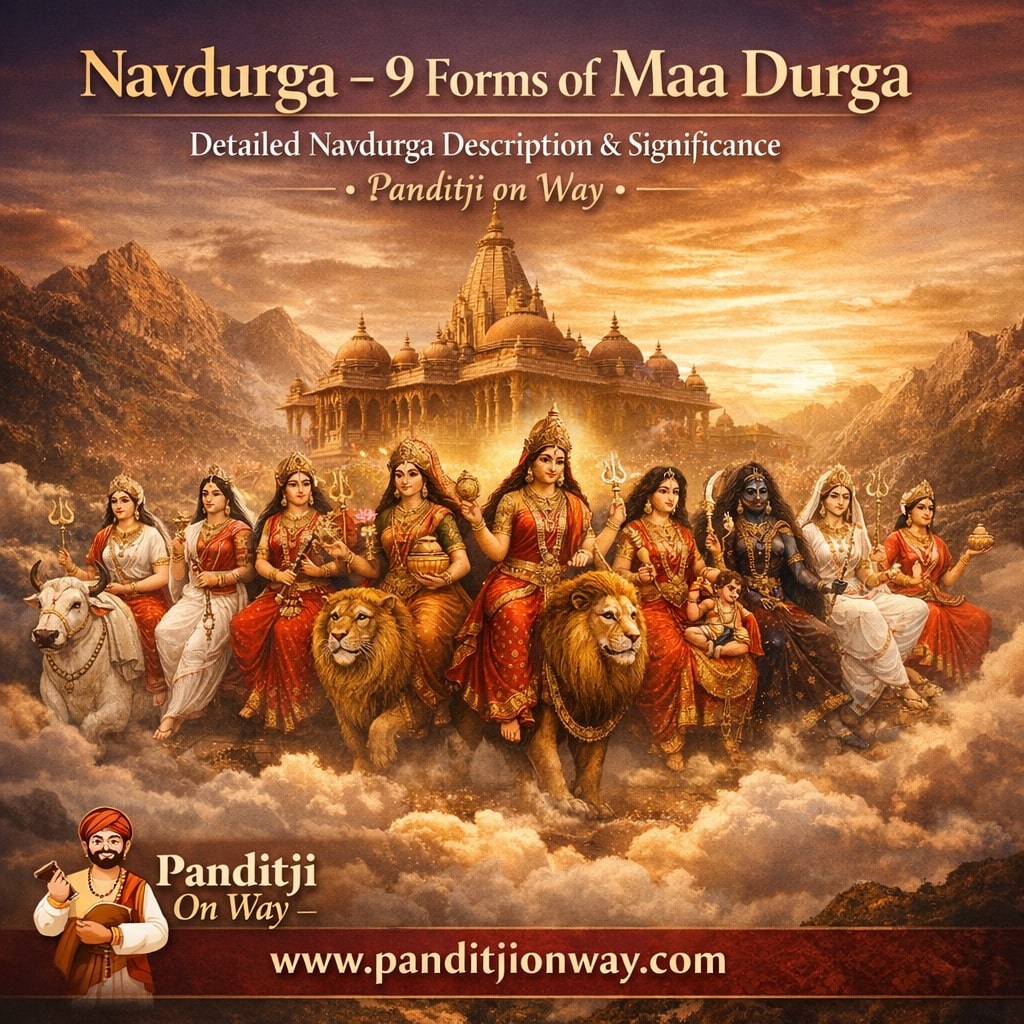
Navdurga refers to the nine divine forms of Maa Durga, each symbolizing a unique aspect of cosmic power, devotion, courage, and spiritual evolution. These forms are worshipped on the nine days of Navratri to remove negativity, grant prosperity, and attain moksha.
List of Navdurga – Nine Forms of Maa Durga
| Day | Goddess Name | Meaning | Form of Power | Spiritual Significance |
|---|---|---|---|---|
| 1 | Shailputri | Daughter of the Mountain | Stability & Strength | Foundation of spiritual journey |
| 2 | Brahmacharini | The Ascetic Goddess | Tapasya & Discipline | Devotion, penance, self-control |
| 3 | Chandraghanta | Moon-Bell Goddess | Courage & Grace | Protection from negativity |
| 4 | Kushmanda | Creator of Universe | Cosmic Energy | Creation and vitality |
| 5 | Skandamata | Mother of Skanda | Motherhood & Compassion | Blessings and wisdom |
| 6 | Katyayani | Warrior Goddess | Valor & Justice | Destruction of evil |
| 7 | Kalaratri | Dark Night Goddess | Fierce Protection | Removal of fear & ignorance |
| 8 | Mahagauri | The Radiant Goddess | Purity & Peace | Spiritual cleansing |
| 9 | Siddhidatri | Giver of Siddhis | Divine Fulfillment | Attainment of perfection |
Detailed Description of Navdurga Forms
The Navdurga represent the complete spiritual and cosmic journey of Goddess Parvati, from birth and penance to marriage, motherhood, fierce protection, purity, and ultimate liberation. Each form is worshipped on a specific day of Navratri and holds unique spiritual, symbolic, and astrological significance.
1. Devi Shailputri – Goddess of Stability and Strength
Devi Shailputri is the first form of Navdurga and symbolizes the foundation of spiritual life. After self-immolation as Sati, Goddess Parvati was reborn as the daughter of the Himalayas, earning the name Shailputri (Daughter of the Mountain). She rides a bull (Nandi) and carries a trident and lotus.
Spiritual Significance:
She represents purity, grounding energy, and inner strength. Worshipping Shailputri balances the Muladhara Chakra, providing stability, courage, and freedom from fear.
2. Devi Brahmacharini – Goddess of Penance and Devotion
Devi Brahmacharini is the unmarried ascetic form of Goddess Parvati. In this form, she performed intense tapasya to attain Lord Shiva as her consort. She holds a rosary and a kamandalu, symbolizing discipline and self-restraint.
Spiritual Significance:
She embodies devotion, patience, and sacrifice. Her worship enhances mental focus, spiritual discipline, and resilience during hardships.
3. Devi Chandraghanta – Goddess of Courage and Protection
After marriage, Goddess Parvati adorned a crescent moon shaped like a bell on her forehead, becoming Chandraghanta. She rides a lion and is always ready for battle to protect her devotees.
Spiritual Significance:
This form signifies bravery, grace, and fearlessness. Worshipping Chandraghanta removes negative energies and instills confidence, especially during difficult life phases.
4. Devi Kushmanda – Goddess of Cosmic Creation
Devi Kushmanda is believed to have created the universe with her divine smile. She resides in the core of the Sun, radiating immense cosmic energy. Her name comes from Ku (little), Ushma (energy), and Anda (cosmic egg).
Spiritual Significance:
She governs health, vitality, and creative power. Her worship removes chronic illness, lethargy, and darkness from life while boosting spiritual illumination.
5. Devi Skandamata – Goddess of Motherhood and Wisdom
When Goddess Parvati became the mother of Lord Kartikeya (Skanda), she was known as Skandamata. She holds her son on her lap, symbolizing divine motherhood.
Spiritual Significance:
She blesses devotees with wisdom, prosperity, protection of children, and maternal grace. Worshipping Skandamata strengthens emotional balance and nurturing qualities.
6. Devi Katyayani – Goddess of Righteous War
Devi Katyayani is the warrior form of Goddess Parvati, created to destroy the demon Mahishasura. She is fierce, powerful, and rides a lion, holding multiple weapons.
Spiritual Significance:
She represents justice, courage, and decisive action. This form is especially worshipped by devotees seeking success in marriage, career, and victory over obstacles.
7. Devi Kalaratri – Goddess of Destruction of Darkness
Devi Kalaratri is the most ferocious form of Navdurga. When Parvati removed her golden skin to destroy demons Shumbha and Nishumbha, she appeared dark, fearless, and immensely powerful.
Spiritual Significance:
She destroys fear, ignorance, evil forces, and negative karmas. Her worship provides protection from accidents, enemies, and hidden dangers.
8. Devi Mahagauri – Goddess of Purity and Peace
Devi Mahagauri symbolizes absolute purity and serenity. Her radiant white complexion reflects inner peace and spiritual cleansing. She represents Parvati after intense penance that washed away all impurities.
Spiritual Significance:
Worshipping Mahagauri removes past sins, mental stress, and emotional burdens, granting peace, harmony, and spiritual upliftment.
9. Devi Siddhidatri – Goddess of Divine Perfection
Devi Siddhidatri is the final and most powerful form of Navdurga. She grants eight siddhis and nine nidhis. According to scriptures, she emerged from the left half of Lord Shiva, completing cosmic creation.
Spiritual Significance:
She bestows spiritual perfection, wisdom, and moksha. Worshipping Siddhidatri fulfills desires and leads devotees toward ultimate liberation.
Why Understanding Navdurga Forms is Spiritually Important
Understanding each Nav durga form helps devotees:
- Align worship with specific life challenges
- Gain maximum spiritual and material benefits
- Experience the complete essence of Navratri
For authentic Nav durga Puja with proper rituals, mantras, and muhurat, book experienced Vedic pandits through
👉 https://www.panditjionway.com
Navdurga Worship Benefits
- Removes negative karma and obstacles
- Grants health, prosperity, and protection
- Enhances spiritual growth and inner strength
- Bestows success, peace, and divine blessings
How to Perform Navdurga Puja Properly
For accurate rituals, mantras, and muhurat, it is advised to consult expert Vedic Pandits.
Book Navratri & Nav durga Puja Online:
👉 Panditji on way: https://www.panditjionway.com
India’s trusted and largest online pandit booking platform for Puja, Havan, Jaap, Katha, and Navratri rituals.
Locations to Target
- Nav durga Puja in Mumbai
- Navratri Pandit in Delhi
- Durga Puja Pandit in Pune
- Navratri Puja Booking in Bangalore
- Online Nav durga Puja Services in India
Authoritative External References
Nav durga – The Nine Goddesses of Navratri FAQs
What is Navdurga in Hinduism?
Navdurga refers to the nine divine forms of Maa Durga, worshipped during Navratri. Each form represents a distinct cosmic power, life stage, and spiritual energy of Goddess Parvati, symbolizing creation, protection, destruction of evil, and liberation.
Why are nine forms of Durga worshipped during Navratri?
The nine forms signify the complete spiritual evolution of a devotee, from stability and devotion to wisdom and ultimate enlightenment. Worshipping all nine Navdurga ensures holistic spiritual, mental, and material balance.
Which Navratri is best for Navdurga Puja?
Sharad Navratri is considered the most powerful and widely celebrated Navratri for Navdurga Puja. However, Navdurga worship during Chaitra, Magha (Gupt), and Ashadha (Gupt) Navratri is also highly auspicious.
What are the names of the nine Nav durga?
The nine forms of Navdurga are:
Shailputri, Brahmacharini, Chandraghanta, Kushmanda, Skandamata, Katyayani, Kalaratri, Mahagauri, and Siddhidatri.
What is the spiritual significance of Nav durga Puja?
Navdurga Puja removes negative karma, fear, and obstacles, while blessing devotees with health, prosperity, protection, courage, and moksha. Each day’s worship activates a specific divine energy.
Can Navdurga Puja be done at home?
Yes, Navdurga Puja can be performed at home. However, Vedic procedures, correct mantras, and precise muhurat followed by an experienced pandit significantly enhance the spiritual benefits.
Which goddess is worshipped on which day of Navratri?
Each day of Navratri is dedicated to one form of Navdurga, starting with Shailputri on Day 1 and concluding with Siddhidatri on Day 9, ensuring complete spiritual alignment.
What are the benefits of worshipping all nine Navdurga?
Worshipping all nine Navdurga grants:
- Protection from negative energies
- Success in career and relationships
- Mental peace and emotional strength
- Fulfillment of desires and spiritual growth
Who should perform Navdurga Puja?
Navdurga Puja is beneficial for everyone, especially those facing obstacles, health issues, financial instability, marriage delays, or seeking spiritual upliftment.
Which mantra is most powerful for Navdurga?
The Durga Saptashati, Navdurga Beej Mantras, and Argala Stotra are considered most powerful. Mantras should be chanted under proper guidance for maximum effect.
Is Navdurga Puja different from Durga Puja?
Yes. Navdurga Puja focuses on the nine individual forms of Maa Durga across nine days, while Durga Puja primarily celebrates the victory of Durga over Mahishasura.
How long does Navdurga Puja take?
A complete Navdurga Puja usually spans 9 days, but single-day or customized pujas can also be performed depending on devotion and time availability.
Where can I book Navdurga Puja with a verified pandit online?
You can book authentic Navdurga Puja with experienced Vedic pandits through
👉 https://www.panditjionway.com
India’s trusted online platform for Navratri Puja, Havan, Jaap, and Katha services.
Is online Navdurga Puja effective?
Yes. Online Navdurga Puja performed by qualified pandits with proper sankalp and rituals is spiritually effective and widely accepted, especially for devotees unable to attend physically.
Does Nav durga Puja help remove doshas and negative energies?
Yes, Nav durga Puja is highly effective in reducing planetary doshas, fear, evil eye, and negative influences, while strengthening positive cosmic energies.
What offerings are best for Nav durga Puja?
Common offerings include flowers, fruits, coconut, red cloth, kumkum, diya, and bhog. Each Navdurga form has specific symbolic offerings.
Is Nav durga Puja suitable for beginners?
Yes. Nav durga Puja is suitable for beginners when performed with simple rituals or guided by expert pandits, making it accessible and powerful for all devotees.
Conclusion
Nav durga worship during Navratri is a complete spiritual journey, representing creation, preservation, and liberation. Each goddess removes specific obstacles and grants divine strength. For authentic Nav durga Puja with proper mantras and rituals, trust Panditji On Way, your reliable partner for sacred Hindu ceremonies.
Book Today. Worship Correctly. Receive Divine Blessings.