

Lord Ganesha: Complete Guide to Shri Ganesh, Ganapati, Vinayaka, Family, Forms, Symbolism, Puja, Mantras and Ganesh Chaturthi
Learn about Lord Ganesha, his birth story, family, names, symbolism, 8 incarnations, 32 forms, Ganesh Puja, mantras, Ganesh Chaturthi, temples, offerings and spiritual significance.
Shri Ganesha
Shri Ganesha, also known as Ganapati, Vinayaka, Vighneshvara, Vighnaharta and Gajanana, is one of the most widely worshipped deities in Hindu traditions. He is traditionally associated with wisdom, intellect, auspicious beginnings and the removal of obstacles.
Ganesha is recognizable by his elephant head, large ears, prominent belly, broken tusk and mouse vehicle, known as Mushika. He is commonly worshipped before beginning important religious ceremonies, journeys, studies, business ventures, marriages and other auspicious activities.
The Metropolitan Museum of Art describes Ganesha as the son of Shiva and Parvati and a deity associated with clearing paths and removing obstacles. Its collection also documents the long artistic history of Ganesha imagery in India and beyond. (The Metropolitan Museum of Art)
For devotees looking to arrange an authentic Ganesh Puja, Ganesh Chaturthi Puja, Ganesh Sthapana or Visarjan, PanditJiOnWay provides online pandit-booking services.
Book Ganesh Chaturthi Puja with PanditJiOnWay

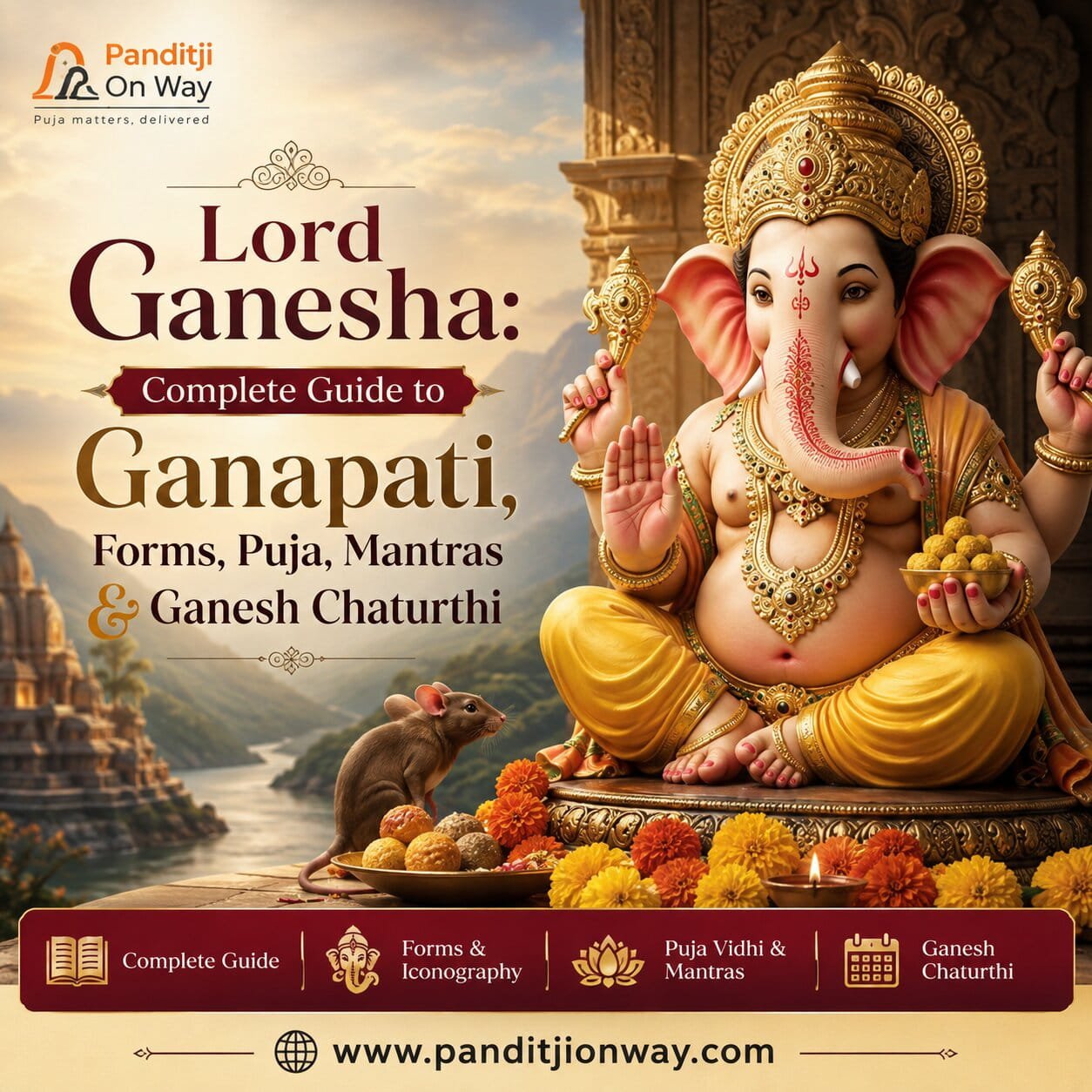
Who Is Lord Ganesha?
Lord Ganesha is one of the principal deities of Hindu religious traditions. He is particularly revered as the Lord of Beginnings, Remover of Obstacles, and a deity associated with wisdom and intellect.
Ganesha is traditionally described as the son of Lord Shiva and Goddess Parvati and the brother of Lord Kartikeya. Different Hindu scriptures and regional traditions preserve different accounts of his birth, family relationships and manifestations. Therefore, stories about Ganesha should be understood within the particular Purana, tradition or sampradaya in which they occur.
His elephant-headed form is one of the most recognizable images in Indian religious art. Historical collections demonstrate that Ganesha’s iconography developed across centuries and spread beyond India into parts of South and Southeast Asia.
Lord Ganesha at a Glance
| Attribute | Information |
|---|---|
| Name | Ganesha |
| Sanskrit | गणेश |
| Other Names | Ganapati, Vinayaka, Gajanana, Ekadanta, Vighneshvara |
| Parents | Lord Shiva and Goddess Parvati |
| Brother | Kartikeya |
| Vehicle | Mushika, the mouse |
| Primary Associations | Wisdom, intellect, auspicious beginnings, removal of obstacles |
| Popular Festival | Ganesh Chaturthi |
| Popular Offering | Modak |
| Iconography | Elephant head and human body |
| Sacred Symbolism | Wisdom, discrimination, strength, humility and overcoming obstacles |
| Important Scriptures | Ganesha Purana, Mudgala Purana and various Shaiva and other Hindu texts |
| Major Forms | Eight important incarnations in the Mudgala Purana; 32 forms in traditions associated with Ganesha worship |
| Common Mantra | Om Gan Ganapataye Namah |
| Famous Title | Vighnaharta |
| Worship | Home, temple, public festivals and auspicious ceremonies |
Meaning of the Name Ganesha
The Sanskrit name Ganesha is generally interpreted as a combination of gana and isha, meaning the lord or master of the ganas.
He is therefore also known as Ganapati, another important Sanskrit name meaning Lord of the Ganas.
The names associated with Ganesha often highlight particular qualities or aspects of his divine personality.
Important Names of Lord Ganesha
| Name | Common Meaning |
|---|---|
| Ganesha | Lord of the Ganas |
| Ganapati | Lord or leader of the Ganas |
| Vinayaka | A revered and distinguished leader |
| Vighnaharta | Remover of obstacles |
| Vighneshvara | Lord of obstacles |
| Gajanana | Elephant-faced one |
| Ekadanta | One-tusked one |
| Lambodara | One with a large or hanging belly |
| Vakratunda | One with a curved trunk |
| Siddhivinayaka | Vinayaka associated with accomplishment |
| Dhumravarna | Smoke-coloured form |
| Heramba | A particular protective form of Ganesha |
Why Is Lord Ganesha Worshipped First?
One of the most widely recognized Hindu traditions is remembering or worshipping Ganesha at the beginning of an auspicious undertaking.
This association explains titles such as Vighnaharta, the remover of obstacles, and Vighneshvara, the lord of obstacles.
Ganesha is therefore commonly invoked before:
- Hindu religious ceremonies
- Weddings
- Griha Pravesh
- Business openings
- Educational activities
- Examinations
- New projects
- Journeys
- Important family functions
- Other auspicious beginnings
The practice is not merely about material success. In devotional interpretation, Ganesha represents the wisdom and discrimination necessary to recognize and overcome obstacles.
The Metropolitan Museum notes that offerings to Ganesha are traditionally made before important tasks, reflecting his association with beginnings and the removal of obstacles. (The Metropolitan Museum of Art)
Lord Ganesha Family
The family of Lord Ganesha is an important part of Hindu mythology and religious storytelling.
Lord Shiva
Lord Shiva is traditionally described as Ganesha’s father.
Goddess Parvati
Goddess Parvati is traditionally described as Ganesha’s mother.
Lord Kartikeya
Lord Kartikeya, also known as Skanda, Murugan or Subrahmanya, is traditionally regarded as Ganesha’s brother.
Riddhi and Siddhi
Some Puranic and later traditions associate Ganesha with Riddhi and Siddhi, personifications associated with prosperity/accomplishment and spiritual or intellectual attainment. Traditions differ regarding how these relationships are presented.
Shubh and Labh
Some traditions describe Shubh and Labh as sons associated with Ganesha’s family, representing auspiciousness and gain/profit.
Because Hindu mythology contains multiple textual and regional traditions, these relationships should not always be presented as a single universally accepted family tree.
Lord Ganesha Birth Story
The birth of Ganesha is described through different versions in Hindu literature.
One of the best-known narratives appears in traditions associated with the Shiva Purana.
According to this account, Goddess Parvati created Ganesha and instructed him to guard the entrance while she was bathing. Lord Shiva subsequently arrived and attempted to enter. Ganesha, following his mother’s command, prevented him from entering.
A confrontation followed, and Shiva severed Ganesha’s head. When Parvati learned what had happened, she became enraged and demanded that Ganesha be restored.
Shiva then caused an elephant’s head to be placed upon Ganesha, restoring him to life.
This story explains the distinctive elephant-headed form of Ganesha.
The Metropolitan Museum also records a version of the elephant-head story in which Shiva accidentally kills Ganesha and subsequently restores him with an elephant’s head. (The Metropolitan Museum of Art)
Important Note
There are multiple versions of Ganesha’s birth and elephant-head story across Hindu texts and traditions. A high-quality reference article should therefore identify the relevant tradition instead of presenting one version as the only account.
Ganesha Iconography and Symbolism
Lord Ganesha’s physical form is filled with symbolic interpretations.


Elephant Head
The elephant is commonly associated with intelligence, strength, memory and wisdom. Ganesha’s elephant head therefore represents qualities necessary for spiritual and worldly progress.
Large Ears
His large ears are traditionally interpreted as a reminder to listen carefully and distinguish useful knowledge from unnecessary noise.
Single Tusk
Ganesha is often depicted with one complete tusk and one broken tusk, giving him the name Ekadanta.
The broken tusk has several traditional interpretations. One famous narrative connects it with the writing of the Mahabharata, while other traditions offer different explanations.
Large Belly
Ganesha’s large belly is interpreted in different ways, including the ability to contain and assimilate the experiences of life.
Trunk
The trunk represents adaptability and strength. Its flexibility is often used symbolically to explain the importance of balancing strength with discrimination.
Mouse or Mushika
Ganesha’s vehicle is traditionally the Mushika, or mouse.
The pairing of the enormous elephant-headed deity with a tiny mouse is frequently interpreted symbolically as mastery over desires, restlessness and the mind.
Modak
The modak is one of the most famous offerings associated with Ganesha.
It is commonly interpreted as representing the sweetness of spiritual knowledge and the rewards of disciplined effort.
Four Hands of Lord Ganesha
Many traditional representations depict Ganesha with four arms.
Common attributes include:
- Ankusha, or goad
- Pasha, or noose
- Modak
- Broken tusk
- Abhaya Mudra
- Other ritual or symbolic objects depending upon the form
Iconographic details vary according to the specific form, temple tradition and artistic period.
Ganesha and Buddhi, Siddhi and Riddhi
Ganesha is strongly associated with Buddhi, meaning intelligence, understanding or discrimination.
In some traditions, Siddhi and Riddhi are personified as divine feminine figures associated with accomplishment and prosperity.
This gives rise to an important conceptual interpretation:
| Concept | Associated Meaning |
|---|---|
| Buddhi | Intelligence, understanding, discrimination |
| Siddhi | Accomplishment, attainment |
| Riddhi | Prosperity, growth or abundance |
The symbolism expresses a broader idea: wisdom should guide achievement and prosperity.
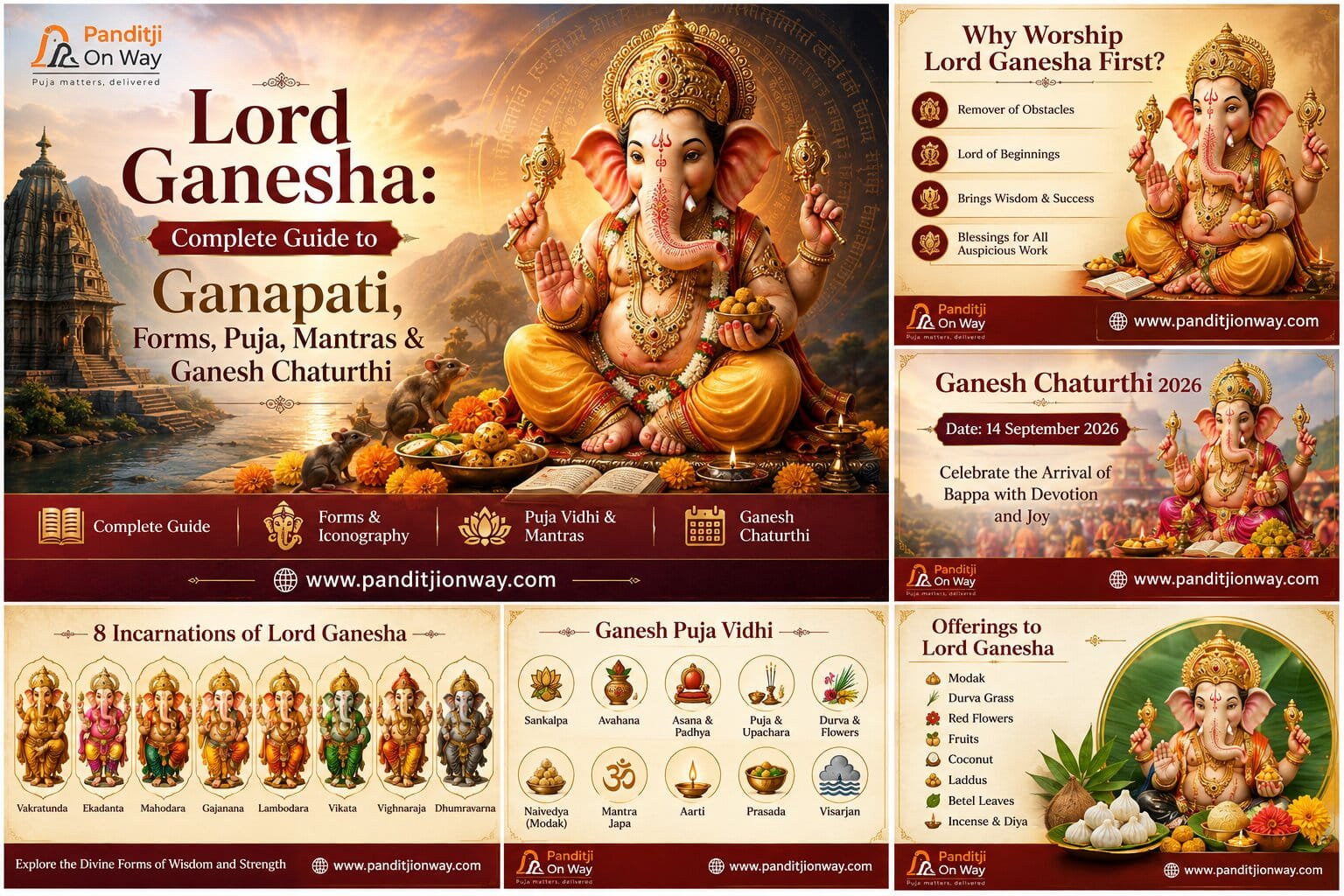
Eight Important Incarnations of Lord Ganesha
The Mudgala Purana is a major Ganesha-related Purana and describes eight important incarnations of Ganesha. These are distinct from the four incarnations presented in another Ganesha-related textual tradition. (Wikipedia)
The eight commonly listed forms are:
| No. | Incarnation | Associated Opponent | Symbolic Theme |
|---|---|---|---|
| 1 | Vakratunda | Matsarasura | Jealousy |
| 2 | Ekadanta | Madasura | Pride/intoxication |
| 3 | Mahodara | Mohasura | Delusion |
| 4 | Gajanana / Gajavaktra | Lobhasura | Greed |
| 5 | Lambodara | Krodhasura | Anger |
| 6 | Vikata | Kamasura | Uncontrolled desire |
| 7 | Vighnaraja | Mamasura | Attachment |
| 8 | Dhumravarna | Ahankarasura | Ego |
These stories can be understood not simply as mythological battles but also as symbolic teachings about the inner obstacles that affect human conduct. (Dharma Renaissance Blog)
Important distinction
The eight incarnations of Ganesha should not be confused with the 32 forms of Ganesha. They come from different classificatory traditions.
32 Forms of Lord Ganesha
Ganesha worship also includes traditions describing 32 forms of Ganesha.
Among the commonly cited forms are:
- Bala Ganapati
- Taruna Ganapati
- Bhakti Ganapati
- Vira Ganapati
- Shakti Ganapati
- Dvija Ganapati
- Siddhi Ganapati
- Ucchishta Ganapati
- Vighna Ganapati
- Kshipra Ganapati
- Heramba Ganapati
- Lakshmi Ganapati
- Maha Ganapati
- Vijaya Ganapati
- Nritya Ganapati
- Urdhva Ganapati
- Ekakshara Ganapati
- Varada Ganapati
- Tryakshara Ganapati
- Kshipra Prasada Ganapati
- Haridra Ganapati
- Ekadanta Ganapati
- Srishti Ganapati
- Uddanda Ganapati
- Rinamochana Ganapati
- Dhundhi Ganapati
- Dvimukha Ganapati
- Trimukha Ganapati
- Simha Ganapati
- Yoga Ganapati
- Durga Ganapati
- Sankatahara Ganapati
The exact spelling, order and textual classification can vary between sources and traditions.
Ganesha Chaturthi
Ganesha Chaturthi, also known as Vinayaka Chaturthi, is the major festival dedicated to Lord Ganesha.
It is observed according to the Hindu lunar calendar and is particularly prominent in Maharashtra, where public Ganeshotsav became an important cultural tradition.
The festival commonly includes:
- Ganesha idol installation
- Prana Pratishtha
- Daily worship
- Mantra chanting
- Aarti
- Offerings
- Modak and other prasada
- Cultural programs
- Processions
- Ganesh Visarjan
The Government of India’s Ministry of Culture has documented Ganesh Chaturthi as a major annual festival, particularly associated with Maharashtra.
In 2026, Ganesh Chaturthi falls on 14 September 2026 according to commonly published Hindu calendar calculations. (Wikipedia)
Ganesh Sthapana
Ganesh Sthapana is the ritual installation of a Ganesha murti for worship.
Depending upon family, regional and sampradaya traditions, the ceremony may include:
- Sankalpa
- Kalasha Sthapana
- Ganapati Avahana
- Prana Pratishtha
- Shodashopachara or other forms of worship
- Mantra chanting
- Pushpa and Durva offerings
- Naivedya
- Aarti
- Prasada
The exact procedure can differ according to the ritual tradition followed by the family.
Ganesh Visarjan
Ganesh Visarjan marks the conclusion of a temporary Ganesha worship cycle.
The murti is ceremonially carried in procession and immersed according to local tradition and applicable environmental regulations.
Symbolically, visarjan is often interpreted as a reminder of the temporary nature of material forms and the cycle of manifestation and dissolution.
For a professionally arranged Ganesh Sthapana and Visarjan Puja, PanditJiOnWay offers a dedicated service with customizable arrangements. (Panditji on way)
Book Ganesh Sthapana and Visarjan Puja
Ganesh Puja Vidhi
The exact Ganesh Puja Vidhi varies according to regional and family traditions. A simplified household worship sequence may include:
1. Preparation
Clean the puja space and arrange the murti or image of Lord Ganesha.
2. Sankalpa
The devotee makes a spiritual resolve for the puja.
3. Avahana
Ganesha is invoked through appropriate prayers and mantras.
4. Asana and Upachara
Traditional offerings are made to the deity.
5. Durva Offering
Durva grass is traditionally offered to Ganesha.
6. Flowers
Flowers, commonly including red flowers in many traditions, are offered.
7. Naivedya
Modak, fruits and other appropriate offerings may be presented.
8. Mantra Japa
Ganesha mantras are recited according to the devotee’s tradition.
9. Aarti
The puja concludes with Ganesha Aarti.
10. Prasada
The offerings are distributed as prasada.
For a complete Vedic ceremony, devotees may choose to consult a qualified Pandit who can conduct the ritual according to their family tradition, regional practice and sankalpa.
Important Lord Ganesha Mantras
1. Om Gan Ganapataye Namah
ॐ गं गणपतये नमः
This is one of the most widely used Ganesha mantras.
It is traditionally chanted in devotion to Lord Ganapati and is commonly used before auspicious activities.
2. Vakratunda Mahakaya
वक्रतुण्ड महाकाय सूर्यकोटि समप्रभ।
निर्विघ्नं कुरु मे देव शुभकार्येषु सर्वदा॥
The prayer asks Lord Ganesha to remove obstacles and make auspicious activities successful.
3. Ganesha Gayatri Mantra
A commonly recited version is:
ॐ एकदन्ताय विद्महे
वक्रतुण्डाय धीमहि
तन्नो दन्तिः प्रचोदयात्॥
Different traditions may preserve variations in pronunciation and wording.
What Is Offered to Lord Ganesha?
Common offerings include:
| Offering | Traditional Association |
|---|---|
| Modak | Sweetness and spiritual attainment |
| Durva Grass | Traditional Ganesha offering |
| Red Flowers | Common devotional offering |
| Coconut | Traditional puja offering |
| Fruits | Naivedya |
| Laddu | Common festive offering |
| Betel Leaves | Used in many Hindu rituals |
| Incense | Part of traditional worship |
| Ghee Lamp | Used during puja and aarti |
Offerings differ according to region and family tradition.
Why Is Modak Associated With Ganesha?
Modak is one of the most recognizable foods associated with Lord Ganesha.
The sweet is traditionally offered as naivedya during Ganesha worship, particularly during Ganesh Chaturthi.
Beyond the literal food offering, the modak is often interpreted symbolically as the sweetness of spiritual knowledge and the reward obtained through disciplined effort.
Ganesha Puja for New Beginnings
Ganesha is particularly associated with auspicious beginnings.
Devotees may traditionally invoke Ganesha before:
- Starting a new business
- Opening an office
- Purchasing a home
- Griha Pravesh
- Marriage ceremonies
- Beginning education
- Starting a new project
- Performing another major puja
- Beginning a journey
This is why Ganesh Puja is frequently included at the beginning of larger Hindu ceremonies.
Ganesh Puja for Business and New Ventures
Lord Ganesha is traditionally associated with success, intelligence and overcoming obstacles.
Many business owners therefore begin new ventures with Ganesh Puja.
A business-oriented Ganesh Puja may include:
- Ganapati Puja
- Sankalpa
- Kalasha Sthapana
- Lakshmi-Ganesh worship
- Mantra chanting
- Havan
- Aarti
- Prasada
Religious belief should be distinguished from guaranteed business outcomes: puja is a spiritual practice, not a substitute for sound financial, legal or business decisions.
Ganesh Puja for Griha Pravesh
Ganesha is commonly worshipped during Griha Pravesh, the Hindu house-entry ceremony.
The purpose of including Ganesha worship is traditionally connected with auspicious beginnings and removal of obstacles.
Depending upon the family’s tradition, Griha Pravesh may also include:
- Vastu Puja
- Kalasha Sthapana
- Navagraha Puja
- Ganesh Puja
- Havan
- Lakshmi Puja

Major Temples and Pilgrimage Traditions Associated With Ganesha
India has numerous important Ganesha temples and pilgrimage traditions.
Some particularly well-known examples include:
| Temple / Tradition | Location |
|---|---|
| Shree Siddhivinayak Temple | Mumbai, Maharashtra |
| Dagdusheth Halwai Ganpati | Pune, Maharashtra |
| Ashtavinayak Temples | Maharashtra |
| Ganpatipule Temple | Ratnagiri, Maharashtra |
| Morgaon Mayureshwar | Maharashtra |
| Siddhatek Siddhivinayak | Maharashtra |
| Pali Ballaleshwar | Maharashtra |
| Mahad Varadvinayak | Maharashtra |
| Theur Chintamani | Maharashtra |
| Lenyadri Girijatmaj | Maharashtra |
| Ozar Vighneshwar | Maharashtra |
| Ranjangaon Mahaganapati | Maharashtra |
Ganesh Chaturthi and related celebrations are particularly prominent in Maharashtra. Contemporary reporting also highlights major celebrations in Mumbai, Pune and Ganpatipule.
What Is Ashtavinayak?
Ashtavinayak refers to a traditional pilgrimage circuit of eight important Ganesha temples in Maharashtra.
The eight are:
- Mayureshwar — Morgaon
- Siddhivinayak — Siddhatek
- Ballaleshwar — Pali
- Varadvinayak — Mahad
- Chintamani — Theur
- Girijatmaj — Lenyadri
- Vighneshwar — Ozar
- Mahaganapati — Ranjangaon
The Ashtavinayak pilgrimage is an important part of Maharashtrian Ganesha devotion.
Lord Ganesha in Art and Culture
Ganesha has been represented in sculpture, painting, manuscripts, temple architecture, music and popular culture for centuries.
The historical record shows Ganesha imagery across India as well as regions of South and Southeast Asia. The Metropolitan Museum’s collections include Ganesha sculptures from India and Cambodia, demonstrating the geographical spread of his iconography. (The Metropolitan Museum of Art)
Ganesha’s recognizable elephant-headed form has consequently become one of the most prominent symbols of Indian religious art.
Ganesha in Southeast Asia
Although Ganesha is primarily associated with Hindu traditions, his iconography also appears in Buddhist and other cultural contexts across parts of Asia.
Historical objects from Cambodia, Nepal and other regions demonstrate that Ganesha imagery travelled beyond the Indian subcontinent through religious, artistic and cultural exchange.
Spiritual Significance of Lord Ganesha
The significance of Ganesha extends beyond the simple idea of “removing obstacles.”
His iconography can be understood as a philosophical teaching about:
- Wisdom
- Discrimination
- Self-control
- Adaptability
- Humility
- Concentration
- Knowledge
- Courage
- Beginning again after failure
The elephant head symbolizes wisdom and strength, while the mouse and other attributes provide contrasting imagery that encourages devotees to reflect on the relationship between power, desire and control.
Lord Ganesha and the Removal of Obstacles
The title Vighnaharta literally refers to the remover of obstacles.
In devotional understanding, an obstacle can be external or internal.
External obstacles
These may include:
- Delays
- Difficult circumstances
- Practical difficulties
- Uncertainty
Internal obstacles
These can include:
- Ego
- Anger
- Greed
- Jealousy
- Attachment
- Confusion
- Lack of discipline
The eight incarnations described in the Mudgala Purana can be read symbolically as narratives concerning these inner tendencies.
Difference Between Ganesha Purana and Mudgala Purana
This distinction is important for an accurate encyclopedia-style article.
| Feature | Ganesha Purana | Mudgala Purana |
|---|---|---|
| Focus | Ganesha theology, stories and worship | Ganesha theology, manifestations and spiritual teachings |
| Ganesha incarnations | Contains a four-incarnation tradition | Famous for eight major incarnations |
| Relationship to Ganapatya tradition | Important | Important |
| Forms of Ganesha | Discusses multiple manifestations | Associated with numerous forms and eight principal incarnations |
The Mudgala Purana is one of the principal Puranic texts devoted specifically to Ganesha. (Wikipedia)
Ganesha Puja Samagri List
A basic Ganesh Puja Samagri List may require:
| Puja Item | Purpose |
|---|---|
| Ganesha Murti/Image | Main deity |
| Kalasha | Ritual vessel |
| Coconut | Traditional offering |
| Durva Grass | Ganesha offering |
| Flowers | Worship |
| Fruits | Naivedya |
| Modak | Traditional Ganesha offering |
| Incense | Ritual offering |
| Diya | Light |
| Ghee/Oil | Lamp |
| Kumkum | Tilak and worship |
| Chandan | Ritual application |
| Akshat | Sacred rice |
| Betel Leaves | Ritual offering |
| Supari | Traditional puja item |
| Red Cloth | Traditional devotional use |
| Panchamrit | Abhisheka/naivedya depending on tradition |
The exact samagri list should be confirmed with the Pandit because requirements vary according to the type of puja.
How to Book a Ganesh Puja Online
Devotees who want a traditional Ganesh Puja at home, office, temple or another venue can arrange a Pandit in advance.
PanditJiOnWay offers Ganesh Puja and Ganesh Chaturthi services with options for customized rituals and puja arrangements. Its current Ganesh Chaturthi service page lists packages and arrangements for Ganesh worship. (Panditji on way)
Online booking process
- Visit PanditJiOnWay.
- Select the required Ganesh Puja service.
- Choose your preferred date and location.
- Provide details about the puja and sankalpa.
- Confirm the booking.
- Coordinate samagri requirements with the service team.
- The assigned Pandit conducts the ceremony according to the agreed tradition.
PanditJiOnWay – Online Puja and Pandit Booking
Ganesh Chaturthi Puja Booking
For devotees planning Ganesh Chaturthi celebrations, PanditJiOnWay offers a dedicated Ganesh Chaturthi Puja service.
Ganesh Chaturthi Puja – PanditJiOnWay
For complete installation and immersion arrangements:
Ganesh Sthapana and Visarjan Puja – PanditJiOnWay
Why Choose PanditJiOnWay for Ganesh Puja?
PanditJiOnWay positions itself as an online platform for booking Pandits and arranging Hindu pujas, including Ganesh Puja and Ganesh Chaturthi services. Its website states that it provides services across multiple major Indian cities and offers customized puja arrangements. (Panditji on way)
For a Ganesh Puja booking, devotees should look for:
- Experienced Pandit
- Clear ritual requirements
- Transparent pricing
- Samagri information
- Date and time confirmation
- Regional ritual preferences
- Language preference
- Venue requirements
- Sankalpa details
Frequently Asked Questions About Lord Ganesha
Who is Lord Ganesha?
Lord Ganesha is a major Hindu deity traditionally associated with wisdom, auspicious beginnings and the removal of obstacles. He is traditionally described as the son of Shiva and Parvati.
What is Lord Ganesha famous for?
Ganesha is especially known as the Remover of Obstacles, Lord of Beginnings and a deity associated with wisdom and intellect.
What is another name for Lord Ganesha?
Important names include Ganapati, Vinayaka, Gajanana, Ekadanta, Vighnaharta and Vighneshvara.
Who are the parents of Lord Ganesha?
Lord Ganesha is traditionally described as the son of Lord Shiva and Goddess Parvati.
Who is Lord Ganesha’s brother?
Kartikeya, also known as Skanda, Murugan or Subrahmanya, is traditionally described as Ganesha’s brother.
What is Ganesha’s vehicle?
Ganesha’s vehicle is traditionally called Mushika, the mouse.
Why does Ganesha have an elephant head?
Different Hindu traditions preserve different versions of the story. In a well-known Shiva Purana tradition, Shiva replaces Ganesha’s severed head with an elephant’s head.
Why is Ganesha worshipped first?
Ganesha is traditionally invoked before auspicious activities because of his association with beginnings and the removal of obstacles.
What is Ganesha’s favourite food?
Modak is traditionally regarded as one of the principal sweets offered to Lord Ganesha.
What should be offered to Lord Ganesha?
Common offerings include Durva grass, flowers, modak, fruits, coconut and other traditional naivedya, depending on regional practice.
What is the most common Ganesha mantra?
One widely used mantra is:
Om Gan Ganapataye Namah.
What is Ganesh Chaturthi?
Ganesh Chaturthi is an annual Hindu festival dedicated to Lord Ganesha. It is particularly prominent in Maharashtra and includes Ganesha idol installation, worship and, traditionally, immersion.
When is Ganesh Chaturthi in 2026?
Ganesh Chaturthi is observed on 14 September 2026 according to commonly published Hindu calendar calculations.
What are the eight incarnations of Ganesha?
The eight major incarnations described in the Mudgala Purana tradition are Vakratunda, Ekadanta, Mahodara, Gajanana/Gajavaktra, Lambodara, Vikata, Vighnaraja and Dhumravarna.
Are the eight incarnations and 32 forms the same?
No. They are separate classifications. The eight major incarnations are associated particularly with the Mudgala Purana, while traditions describing 32 forms classify Ganesha manifestations differently.
What is Ashtavinayak?
Ashtavinayak refers to eight important Ganesha temples in Maharashtra that form a traditional pilgrimage circuit.
Can I book a Ganesh Puja online?
Yes. Services such as Ganesh Puja, Ganesh Chaturthi Puja, Ganesh Sthapana and Visarjan can be arranged online. PanditJiOnWay provides dedicated booking services for these ceremonies. (Panditji on way)
Quick Answer: Who Is Lord Ganesha?
Lord Ganesha is the elephant-headed Hindu deity traditionally worshipped as the remover of obstacles, Lord of Beginnings and a symbol of wisdom and intellect. He is traditionally regarded as the son of Lord Shiva and Goddess Parvati. His principal festival is Ganesh Chaturthi, and he is commonly worshipped before auspicious activities, ceremonies and new ventures.
Quick Reference: Lord Ganesha
| Question | Answer |
|---|---|
| Who is Ganesha? | Hindu deity associated with wisdom, beginnings and removal of obstacles |
| Father | Lord Shiva |
| Mother | Goddess Parvati |
| Brother | Kartikeya |
| Vehicle | Mushika |
| Favourite traditional offering | Modak |
| Festival | Ganesh Chaturthi |
| Popular mantra | Om Gan Ganapataye Namah |
| Eight major incarnations | Vakratunda to Dhumravarna |
| Important pilgrimage | Ashtavinayak |
| Common title | Vighnaharta |
| Main symbolism | Wisdom, discrimination and overcoming obstacles |
Related Guides on PanditJiOnWay
- Ganesh Chaturthi Puja
- Ganesh Sthapana Puja
- Ganesh Visarjan Puja
- Ganesh Puja Vidhi
- Ganesh Puja Samagri
- Ganesh Mantra
- Ganesh Chaturthi Date and Muhurat
- Ashtavinayak Yatra
- Griha Pravesh Puja
- Vastu Puja
- Lakshmi Ganesh Puja
- Satyanarayan Puja
- Navagraha Shanti Puja
Explore PanditJiOnWay Puja Services
Recommended External References
For credibility and editorial depth, link naturally to established cultural, museum and reference resources rather than adding dozens of low-quality directory links.
- The Metropolitan Museum of Art – Ganesha: Lord of New Beginnings
- The Metropolitan Museum of Art – Ganesha Collection Object
- Ministry of Culture, Government of India
- Mudgala Purana reference overview
Lord Ganesha → Ganesha mythology → Ganesha family → Ganesha symbolism → 8 incarnations → 32 forms → Ganesh Chaturthi → Ganesh Puja → Ganesh Sthapana → Ganesh Visarjan → Ashtavinayak → Mantras → Puja Samagri → Online Pandit Booking
Learn about Lord Ganesha first → understand the ritual → explain when Ganesh Puja is performed → provide practical requirements → offer Pandit booking.