Lord Buddha: Vishnu Avatar, Life of Gautama Buddha, Teachings, Family, Temples & Sacred Places
Lord Buddha is described as an incarnation of Lord Vishnu in several Hindu and Vaishnava traditions. The Srimad Bhagavatam 1.3.24 mentions Buddha appearing in the region of Kikata/Gaya. In Buddhism, Siddhartha Gautama is the historical Buddha whose teachings became the foundation of Buddhism. Because the Puranic Buddha and historical Gautama Buddha are discussed in different religious and historical contexts, they should not automatically be treated as identical figures. Discover Lord Buddha in Hindu scriptures, the story of Siddhartha Gautama, Buddhavatara, Buddha’s family, enlightenment, teachings, festivals, mantras and famous Buddhist pilgrimage places in India.
Lord Buddha: Introduction
Lord Buddha occupies a distinctive place in Indian spiritual history and religious literature. In several Hindu traditions, Buddha is described as an incarnation or manifestation of Lord Vishnu, while Buddhism identifies Siddhartha Gautama, the Buddha, as the historical teacher whose teachings became the foundation of Buddhism.
This distinction is important because the word “Buddha” means an awakened or enlightened one, and Buddhist traditions recognize the possibility of Buddhas across different periods. Modern scholarship generally identifies Gautama Buddha as the historical founder of the Buddhist tradition. (Stanford Encyclopedia of Philosophy)
At the same time, the Srimad Bhagavatam (Bhagavata Purana 1.3.24) contains a famous reference to Buddha appearing in Kikata, traditionally associated with the Gaya region, as the son of Añjanā.
Therefore, when discussing Lord Buddha as Vishnu Avatar, it is best to explain both perspectives rather than presenting a disputed identification as an uncontested historical fact.

Is Lord Buddha an Avatar of Lord Vishnu?
According to Vaishnava Hindu traditions and Puranic literature, Buddha is described as an incarnation of Lord Vishnu. The Srimad Bhagavatam mentions Buddha among the divine manifestations of the Lord.
The relevant verse from Srimad Bhagavatam 1.3.24 states:
ततः कलौ सम्प्रवृत्ते सम्मोहाय सुरद्विषाम् ।
बुद्धो नाम्नाञ्जनसुतः कीकटेषु भविष्यति ॥
A commonly given translation explains that at the beginning of Kali Yuga, Buddha would appear in the region of Kikata/Gaya as the son of Añjanā.
Some Vaishnava interpretations understand this appearance as having a specific divine purpose connected with stopping the misuse of sacrificial practices and misleading those who were hostile to the devas. (ISKCON Desire Tree)
Important distinction
The Puranic Buddha and Siddhartha Gautama should not automatically be treated as identical historical figures.
| Aspect | Buddha in Puranic Hindu Tradition | Siddhartha Gautama |
|---|---|---|
| Religious context | Hindu/Vaishnava scriptures | Buddhism |
| Description | Associated with Vishnu’s avatar tradition | Historical Buddha |
| Major source tradition | Puranic literature | Buddhist Nikāyas/Āgamas and later Buddhist traditions |
| Location associated with appearance/life | Kikata/Gaya in the Bhagavatam passage | Lumbini, Bodh Gaya, Sarnath and Kushinagar traditions |
| Father | Puranic verse identifies him as son of Añjanā’s lineage/name tradition | Śuddhodana |
| Mother | Añjanā in the Bhagavatam verse | Māyā |
| Spiritual role | Divine appearance interpreted within Vaishnava theology | Teacher whose teachings became the basis of Buddhism |
Modern scholarship treats Gautama Buddha as the historical individual associated with the foundation of Buddhism, while the identification of that figure with the Puranic Buddha is a matter of religious interpretation and tradition.
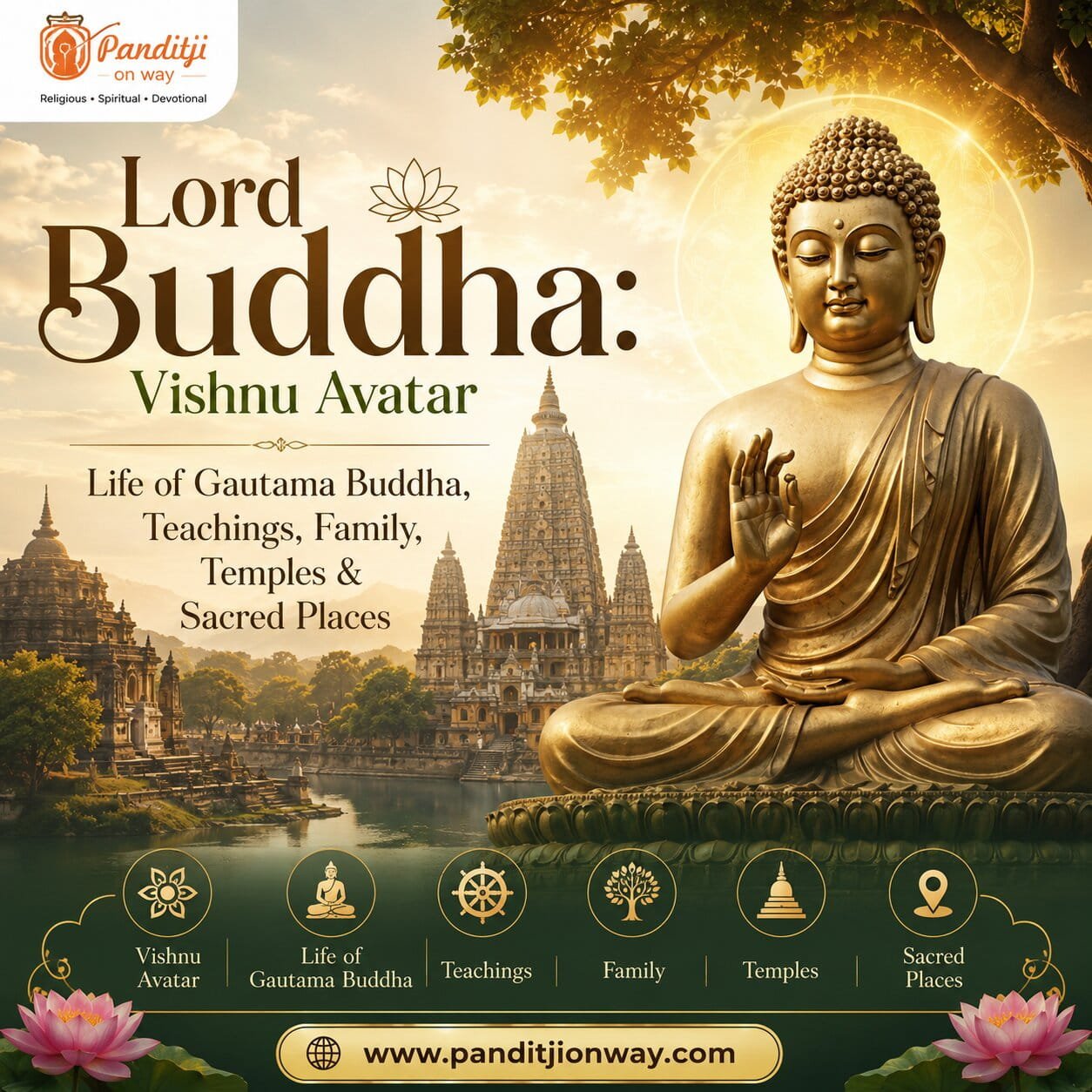
Lord Buddha Origin According to Srimad Bhagavatam
One of the most important scriptural references to Buddhavatara occurs in Srimad Bhagavatam 1.3.24.
Sanskrit
ततः कलौ सम्प्रवृत्ते सम्मोहाय सुरद्विषाम्।
बुद्धो नाम्नाञ्जनसुतः कीकटेषु भविष्यति॥
Transliteration
Tataḥ kalau sampravṛtte sammohāya sura-dviṣām
buddho nāmnāñjana-sutaḥ kīkaṭeṣu bhaviṣyati
The verse refers to Buddha appearing in Kikata, a region traditionally connected with Gaya.
This passage is particularly significant for discussions about Buddha Avatar of Vishnu, because it is one of the principal Puranic texts cited by Vaishnava traditions when identifying Buddha as a divine incarnation.
Why Did Lord Vishnu Take the Form of Buddha?
According to a Vaishnava interpretation of the Puranic account, powerful beings had begun using Vedic sacrificial practices to increase their strength. Their growing power disturbed the cosmic order and threatened the devas.
Lord Vishnu therefore manifested as Buddha and taught a doctrine emphasizing non-violence and discouraging sacrificial practices involving the killing of living beings.
The theological interpretation is that this caused the powerful beings to abandon the practices that were increasing their strength, eventually allowing the devas to regain their position.
This is a Puranic theological narrative, and it should be presented as such rather than as a historical account of the origins of Buddhism.
Gautama Buddha: The Historical Buddha
The historical Buddha is generally known as Siddhartha Gautama, Gautama Buddha, or Shakyamuni Buddha.
According to Buddhist tradition, he was born into the Shakya clan in the region of present-day Nepal and northern India. Modern academic sources emphasize that the precise dates of his life remain debated. The Stanford Encyclopedia of Philosophy notes that scholars have proposed different chronologies, while placing his activity broadly in the middle of the first millennium BCE.
The Buddha’s teachings were preserved through Buddhist textual traditions, including the Nikāyas and Āgamas, and became the foundation of Buddhist philosophy and religious practice.
Lord Buddha Birth and Early Life
According to Buddhist tradition, Siddhartha Gautama was born into the Shakya royal family.
His father was King Śuddhodana, while his mother was Queen Māyā.
Traditional accounts describe a privileged childhood in which Siddhartha was protected from many of life’s difficulties. The purpose of this upbringing was to keep him attached to worldly life.
However, the sheltered life could not prevent Siddhartha from eventually confronting the realities of existence.
The Four Sights Seen by Siddhartha
One of the best-known stories in the life of Gautama Buddha concerns the Four Sights.
According to Buddhist tradition, Siddhartha encountered:
- An old man
- A sick person
- A dead person
- An ascetic
These experiences caused him to reflect deeply on old age, disease, death and the possibility of spiritual liberation.
The traditional account of the Four Sights became a central part of the Buddha’s biography.
Why Did Siddhartha Leave His Palace?
Siddhartha became increasingly concerned with the problem of human suffering.
Although he had access to wealth, comfort and family life, he realized that worldly pleasures could not permanently protect a person from:
- Old age
- Illness
- Death
- Separation
- Suffering
- Impermanence
He therefore renounced his princely life and began searching for a path beyond suffering.
Siddhartha Gautama’s Wife and Son
According to Buddhist tradition, Siddhartha was married to Yashodhara and had a son named Rahula.
His decision to leave household life and pursue spiritual liberation is traditionally regarded as one of the major turning points in his life.
Later Buddhist tradition preserves extensive accounts of his family and their subsequent connection with the Buddhist Sangha.
Buddha’s Journey to Enlightenment
After renouncing his princely life, Siddhartha studied with spiritual teachers and practiced severe asceticism.
Eventually, he rejected extreme asceticism and adopted what Buddhist tradition calls the Middle Way.
He then meditated at Bodh Gaya in present-day Bihar, where tradition holds that he attained enlightenment beneath the Bodhi Tree.
The Mahabodhi Temple Complex at Bodh Gaya is recognized by UNESCO as a major sacred site associated with Buddha’s enlightenment. (UNESCO World Heritage Centre)
Where Did Buddha Attain Enlightenment?
Gautama Buddha is traditionally believed to have attained enlightenment at Bodh Gaya, Bihar, beneath the Bodhi Tree.
Today, the Mahabodhi Temple Complex marks this sacred location.
UNESCO describes Bodh Gaya as one of the four major holy sites connected with the Buddha’s life and particularly with his enlightenment. The present temple complex contains the Mahabodhi Temple, the sacred Bodhi Tree and other associated sacred sites. (UNESCO World Heritage Centre)
You can Get all Answer of Bodh Gaya Like
- Mahabodhi Temple Bodh Gaya
- Buddha enlightenment place
- Gautama Buddha enlightenment
- Buddha temple in Bihar
- Buddhist pilgrimage in Bihar
- Bodhi Tree Bodh Gaya
- Buddhist places in India
Buddha’s First Sermon at Sarnath
After attaining enlightenment, Buddha began teaching others.
According to Buddhist tradition, his first sermon was delivered at Sarnath, near Varanasi in Uttar Pradesh.
Sarnath is associated with the beginning of Buddha’s teaching career and the formation of his early community of disciples.
UNESCO describes Sarnath as the sacred site where the Buddha is believed to have delivered his first sermon and met his earliest disciples. (UNESCO World Heritage Centre)
Sarnath also became an important archaeological and pilgrimage centre containing monuments such as the Dhamekh Stupa.
In a significant recent development, UNESCO inscribed the Ancient Buddhist Site of Sarnath on the World Heritage List in July 2026. (UNESCO)
You can search Sarnath like
- Sarnath Buddha temple
- Buddha first sermon place
- Buddhist places near Varanasi
- Dhamekh Stupa
- Sarnath Buddhist pilgrimage
- Buddha temple in Uttar Pradesh
Buddha’s Teachings
The central purpose of Gautama Buddha’s teaching was to understand suffering and discover a path leading to its cessation.
Among the most important teachings are the Four Noble Truths:
| Four Noble Truth | Meaning |
|---|---|
| Dukkha | Life involves suffering, dissatisfaction and unsatisfactoriness |
| Origin of Dukkha | Suffering arises through craving and related causes |
| Cessation | Suffering can cease |
| Path | There is a path leading toward the cessation of suffering |
The Buddhist philosophical tradition also places considerable emphasis on impermanence, non-self, karma, rebirth, meditation and liberation.
Noble Eightfold Path
The path taught by Buddha is traditionally expressed as the Noble Eightfold Path.
It includes:
- Right View
- Right Intention
- Right Speech
- Right Action
- Right Livelihood
- Right Effort
- Right Mindfulness
- Right Concentration
These principles form an important framework for Buddhist ethical conduct, mental cultivation and wisdom.
Buddha and Ahimsa
Non-violence and compassion are strongly associated with Buddha’s teachings.
The Puranic account of Buddhavatara also emphasizes opposition to the killing of living beings through sacrificial practices. Some Vaishnava interpretations specifically connect this aspect with the purpose of Vishnu’s Buddha incarnation.
This makes Buddha, Ahimsa, compassion and spiritual discipline important themes when discussing the religious significance of Buddhavatara.
Lord Buddha Iconography
Buddha is commonly represented as an enlightened ascetic seated in meditation.
Typical features include:
- Padmasana or lotus posture
- Meditative expression
- Monastic robe
- Ushnisha or topknot-like cranial feature
- Elongated earlobes
- Different mudras representing particular episodes or teachings
One of the most famous representations is Buddha in the Bhumisparsha Mudra, in which the right hand reaches toward the earth.
The Mahabodhi Temple at Bodh Gaya contains a celebrated seated Buddha image associated with this gesture.
Lord Buddha Mantra
Several mantras are popularly associated with Buddha in different Buddhist traditions.
A widely known Buddhist mantra is:
ॐ मणि पद्मे हूँ
Om Mani Padme Hum
However, it is important to understand that this mantra is particularly associated with Avalokiteshvara/Chenrezig in Tibetan Buddhism, rather than being a universally defined personal mantra of historical Gautama Buddha.
For an SEO article, this distinction is preferable to presenting every Buddha-associated mantra as an ancient personal mantra of Gautama Buddha.
Buddha Jayanti and Buddha Purnima
Buddha Purnima, also known as Buddha Jayanti, is one of the most important Buddhist observances associated with Gautama Buddha.
The festival is traditionally connected with major events in Buddha’s life, particularly his birth, enlightenment and, in many traditions, Mahaparinirvana.
Dates vary according to the lunar calendar, so the exact Gregorian date changes each year.
For current-year festival dates, Panditji on Way can create a dedicated annual page targeting:
Buddha Purnima 2027 Date, Time, Tithi and Puja Muhurat
This creates an excellent evergreen + annual SEO content cluster.
Mahaparinirvana of Buddha
According to Buddhist tradition, Gautama Buddha attained Mahaparinirvana at Kushinagar, in present-day Uttar Pradesh.
Kushinagar is therefore one of the most important Buddhist pilgrimage destinations.
The sacred landscape associated with Buddha’s final days includes the Mahaparinirvana Temple and Ramabhar Stupa.
Famous Buddhist Places Associated with Buddha in India
India contains several important Buddhist pilgrimage destinations.
| Place | State | Significance |
|---|---|---|
| Bodh Gaya | Bihar | Buddha’s enlightenment |
| Sarnath | Uttar Pradesh | First sermon |
| Kushinagar | Uttar Pradesh | Mahaparinirvana |
| Rajgir | Bihar | Important place in Buddha’s life and Buddhist history |
| Shravasti | Uttar Pradesh | Major Buddhist teaching centre |
| Vaishali | Bihar | Important Buddhist historical site |
| Sankassa | Uttar Pradesh | Traditional Buddhist pilgrimage site |
The Government of India’s tourism portal describes Bodh Gaya as the place associated with Buddha’s enlightenment and provides information about the wider Buddhist pilgrimage landscape. (Incredible India)
1. Mahabodhi Temple, Bodh Gaya, Bihar
Mahabodhi Temple, Bodh Gaya is arguably the most important pilgrimage destination associated with Buddha’s enlightenment.
The temple complex is a UNESCO World Heritage Site, inscribed in 2002. UNESCO identifies it as one of the four holy sites connected with Buddha’s life and specifically with enlightenment. (UNESCO World Heritage Centre)
UNESCO: Mahabodhi Temple Complex
2. Sarnath, Varanasi, Uttar Pradesh
Sarnath is approximately 10 km from Varanasi and is traditionally associated with Buddha’s first sermon.
Its important monuments include:
- Dhamekh Stupa
- Chaukhandi Stupa
- Archaeological remains
- Buddhist monasteries
- Sarnath Museum area
The site received UNESCO World Heritage status in July 2026. (UNESCO)
UNESCO: Ancient Buddhist Site of Sarnath
3. Kushinagar, Uttar Pradesh
Kushinagar is traditionally identified as the place where Gautama Buddha attained Mahaparinirvana.
Important pilgrimage attractions include:
- Mahaparinirvana Temple
- Reclining Buddha
- Ramabhar Stupa
- Buddhist monasteries
“Kushinagar Buddha Temple: History, Mahaparinirvana Temple, Timings and Complete Travel Guide.”
4. Dungeshwari Hills, Bihar
Dungeshwari Hills near Gaya are associated with the period of Siddhartha’s severe ascetic practices before he reached Bodh Gaya.
The Government of India’s tourism information identifies caves in the Dungeshwari Hills with traditions concerning Buddha’s meditation before his arrival at Bodh Gaya. (Incredible India)
5. Rajgir, Bihar
Rajgir is another major destination within the Buddhist circuit of Bihar.
Its association with Buddha and the early Buddhist community makes it valuable for travelers exploring the broader Buddhist Circuit of India.
Lord Buddha Family
| Family Member | Name |
|---|---|
| Father | King Śuddhodana |
| Mother | Queen Māyā |
| Wife | Yashodhara |
| Son | Rahula |
| Clan | Shakya |
These details belong primarily to the traditional biography of Siddhartha Gautama, and should not be automatically transferred to the Buddha described in the Puranic verse, which gives a different parentage tradition.
Lord Buddha’s Major Life Events
| Event | Traditional Location | Significance |
|---|---|---|
| Birth | Lumbini region | Birth of Siddhartha Gautama |
| Palace life | Kapilavastu tradition | Protected royal upbringing |
| Four Sights | Near the palace | Awakening to suffering |
| Renunciation | Northern India | Beginning of spiritual quest |
| Ascetic practices | Magadha region | Search for liberation |
| Enlightenment | Bodh Gaya | Attainment of Buddhahood |
| First Sermon | Sarnath | Beginning of Buddha’s teaching mission |
| Final days | Kushinagar | Mahaparinirvana |
Four Most Important Buddhist Pilgrimage Sites
The four principal pilgrimage locations traditionally connected with the life of Gautama Buddha are:
Lumbini – Birth
Bodh Gaya – Enlightenment
Sarnath – First Sermon
Kushinagar – Mahaparinirvana
For Indian pilgrimage SEO, the strongest cluster is:
Bodh Gaya → Sarnath → Kushinagar
while Lumbini is located in present-day Nepal.
Lord Buddha’s Importance in Hinduism
The position of Buddha within Hindu traditions is particularly interesting.
In Vaishnava literature, Buddha is included among manifestations of Vishnu. The Bhagavatam reference to Buddha is one of the major scriptural passages used in this discussion.
However, Hindu traditions are diverse, and different texts, sects and commentators interpret the identity and purpose of Buddhavatara differently.
Therefore, a balanced explanation is:
“Buddha is recognized as an incarnation of Vishnu in several Hindu traditions, while Buddhists understand Gautama Buddha through the framework of Buddhist teachings and traditions.”
This wording is more accurate and avoids unnecessarily presenting a complex interreligious question as settled history.
Lord Buddha vs Gautama Buddha: Are They the Same?
This is one of the most searched questions surrounding Buddhavatara.
Short answer
It depends on the religious and interpretive framework.
The Buddha described in the Srimad Bhagavatam is presented within a Puranic account and is associated with the region of Kikata/Gaya.
Siddhartha Gautama, on the other hand, is the historical Buddha whose teachings formed the foundation of Buddhism. Modern scholarship studies him as a historical religious teacher, while acknowledging that the surviving Buddhist textual traditions were transmitted and written down later.
Consequently, an article should distinguish scriptural theology from historical scholarship rather than declaring that the two figures are definitely identical or definitely unrelated.
Lord Buddha’s Message
The enduring message associated with Buddha can be summarized through several principles:
- Understand the nature of suffering.
- Avoid destructive craving and attachment.
- Practice ethical conduct.
- Develop mindfulness.
- Cultivate wisdom.
- Practice compassion.
- Follow the Middle Way.
- Seek liberation through disciplined spiritual practice.
These ideas have had an enormous influence on Asian philosophy, religion, meditation traditions and culture.
Lord Buddha Frequently Asked Questions
Is Lord Buddha an avatar of Lord Vishnu?
According to several Hindu and Vaishnava traditions, Buddha is described as an incarnation or manifestation of Lord Vishnu. The Srimad Bhagavatam 1.3.24 is one of the principal scriptural references cited for Buddhavatara.
Who was Gautama Buddha?
Gautama Buddha, traditionally known as Siddhartha Gautama or Shakyamuni, was the historical Buddha whose teachings became the foundation of Buddhism.
Where was Buddha born?
Buddhist tradition identifies Lumbini, in present-day Nepal, as the birthplace of Siddhartha Gautama.
Where did Buddha attain enlightenment?
Gautama Buddha is traditionally believed to have attained enlightenment at Bodh Gaya in Bihar, beneath the Bodhi Tree. The Mahabodhi Temple Complex commemorates this sacred event.
Where did Buddha give his first sermon?
Buddha is traditionally believed to have delivered his first sermon at Sarnath near Varanasi, Uttar Pradesh.
Where did Buddha attain Mahaparinirvana?
Buddhist tradition identifies Kushinagar in Uttar Pradesh as the place of Buddha’s Mahaparinirvana.
Who was Buddha’s father?
According to the traditional biography of Siddhartha Gautama, his father was King Śuddhodana.
Who was Buddha’s mother?
His mother was Queen Māyā, also known as Maya Devi.
Who was Buddha’s wife?
Traditional Buddhist biographies identify Yashodhara as Siddhartha Gautama’s wife.
Who was Buddha’s son?
His son was Rahula, according to Buddhist tradition.
What are the Four Noble Truths?
The Four Noble Truths explain suffering, its origin, its cessation and the path leading toward its cessation.
What is the Noble Eightfold Path?
The Noble Eightfold Path consists of Right View, Right Intention, Right Speech, Right Action, Right Livelihood, Right Effort, Right Mindfulness and Right Concentration.
What is Buddha Purnima?
Buddha Purnima, also called Buddha Jayanti, is an important Buddhist festival associated with Gautama Buddha.
What is the most important Buddha temple in India?
The Mahabodhi Temple at Bodh Gaya, Bihar, is among the most important Buddhist pilgrimage sites in India and is particularly associated with Buddha’s enlightenment. UNESCO recognizes the Mahabodhi Temple Complex as a World Heritage Site.
Is Sarnath a UNESCO World Heritage Site?
Yes. UNESCO inscribed the Ancient Buddhist Site of Sarnath on the World Heritage List in July 2026.
What does the word Buddha mean?
“Buddha” means “awakened” or “enlightened one.” In Buddhist usage, it is a title rather than simply a personal name.
Top Buddhist Pilgrimage Places in India
For a strong location-based SEO cluster, Panditji on Way should create dedicated pages for:
| Location | Recommended Temple |
|---|---|
| Bodh Gaya, Bihar | Mahabodhi Temple & Buddha Enlightenment |
| Gaya, Bihar | Buddha Places and Buddhist Pilgrimage Guide |
| Rajgir, Bihar | Buddha and Buddhist Sites in Rajgir |
| Nalanda, Bihar | Nalanda Buddhist University & Heritage |
| Sarnath, Uttar Pradesh | Buddha’s First Sermon & Buddhist Temples |
| Kushinagar, Uttar Pradesh | Mahaparinirvana Temple & Buddha’s Final Journey |
| Shravasti, Uttar Pradesh | Buddha’s Teachings and Buddhist Monasteries |
| Vaishali, Bihar | Buddhist Heritage of Vaishali |
| Lumbini, Nepal | Buddha Birthplace Travel & Pilgrimage Guide |
The Government of India’s Buddhist itinerary specifically connects places such as Bodh Gaya, Kushinagar and Sarnath with Buddha’s life and journey.
Panditji on Way – The Worlds First and Trusted Platform
Lord Buddha: Vishnu Avatar, Gautama Buddha Life, Teachings, Temples & Sacred Places
You can Explore more about Lord Buddha
- Buddha Purnima Date and Time
- Buddha Jayanti Date and Puja Muhurat
- Buddha Purnima Puja Vidhi
- Buddha Purnima Mantra
- Lord Vishnu Dashavatara
- 24 Avatars of Lord Vishnu
- Buddha Avatar of Vishnu
- Gautama Buddha Life Story
- Mahabodhi Temple Bodh Gaya
- Sarnath Buddha Temple
- Kushinagar Mahaparinirvana Temple
- Buddhist Pilgrimage Places in India
- Buddha Purnima Puja Online
- Vishnu Puja Online
- Vishnu Sahasranama Puja
- Spiritual Puja Services
Final SEO Conclusion
Lord Buddha and the Spiritual Legacy of Buddha
Lord Buddha represents a fascinating meeting point between Hindu religious literature, Vaishnava theology, Buddhist philosophy and India’s ancient spiritual heritage.
In Hindu Puranic traditions, Buddha is associated with the manifestations of Lord Vishnu, with the Srimad Bhagavatam 1.3.24 providing an important scriptural reference to Buddha’s appearance in Kikata/Gaya.
In Buddhist tradition and modern historical scholarship, Siddhartha Gautama is remembered as the Buddha whose teachings addressed suffering, its causes and the path toward liberation.
From Lumbini to Bodh Gaya, Sarnath and Kushinagar, the story of Buddha is deeply connected with the cultural and spiritual heritage of South Asia. Bodh Gaya remains one of the world’s most important Buddhist pilgrimage destinations, while Sarnath’s 2026 UNESCO inscription further highlights the global heritage significance of India’s Buddhist sites.
For readers interested in Hindu spirituality, sacred traditions, festivals, puja services and religious knowledge, Panditji on Way can serve as a comprehensive resource connecting scriptural knowledge with practical spiritual services.
Lord Buddha is associated with Vishnu’s incarnations in several Hindu traditions, while Siddhartha Gautama is recognized as the historical Buddha and founder of the Buddhist tradition. Explore Buddhavatara, Gautama Buddha’s life, enlightenment at Bodh Gaya, first sermon at Sarnath, Mahaparinirvana at Kushinagar, family, teachings, festivals, temples and major Buddhist pilgrimage sites.
One important correction to your original draft: I would change “Lord Buddha is described as the 23rd incarnation of Lord Vishnu” to “Buddha is described among the manifestations/incarnations of Lord Vishnu in several Hindu traditions.” Numbering varies across different avatar lists, so presenting “23rd” as universally fixed can create an avoidable factual issue. The Bhagavatam passage itself is the stronger citation to lead with.