

Janmashtami
Krishna Janmashtami, also known as Gokulashtami, Shrikrishna Jayanti and Janmashtami, is one of the most important Hindu festivals dedicated to Lord Krishna. The festival commemorates the divine birth of Lord Krishna, the eighth avatar of Lord Vishnu, who was born at midnight in Mathura to Devaki and Vasudeva.
Janmashtami is celebrated with great devotion across India and among Hindu communities worldwide. Devotees observe fasting, perform midnight puja, sing devotional songs, visit Krishna temples and celebrate the birth of Bal Gopal.
In Gujarat, the festival is popularly associated with Satam Atham, while in Kerala and parts of South India it is widely known as Ashtami Rohini.

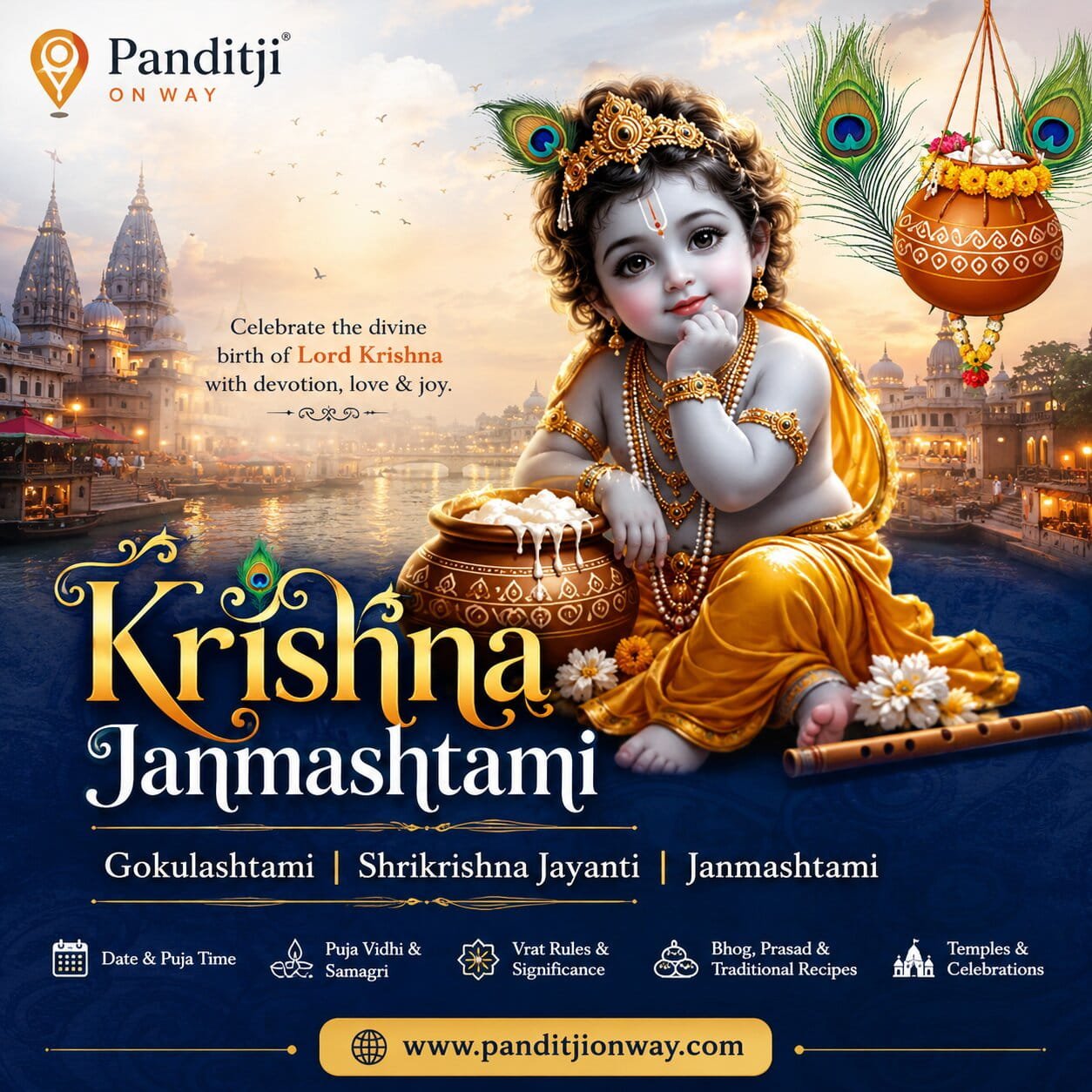
Krishna Janmashtami
Krishna Janmashtami is observed on Krishna Paksha Ashtami, the eighth tithi of the dark fortnight of the Hindu month of Bhadrapada according to the Purnimanta calendar.
The exact Janmashtami date, Nishita Kaal, Ashtami Tithi and Rohini Nakshatra timings can vary by location. Devotees generally consider the midnight period especially auspicious because Lord Krishna is traditionally believed to have been born at midnight.
Tip for Panditji On Way: Add a dynamic city-wise timings section here, such as Delhi, Mumbai, Jaipur, Kolkata, Bengaluru, Chennai and Ahmedabad, rather than presenting one generic puja time.
Janmashtami Pujan
The central ritual of Krishna Janmashtami is the midnight worship of Lord Krishna.
Devotees prepare a small cradle or jhula for Bal Gopal and decorate it with flowers, clothes and ornaments. At midnight, the idol of baby Krishna is ceremonially bathed, dressed and placed in the cradle.
The puja commonly includes:
- Shri Krishna idol or Bal Gopal
- Panchamrit
- Milk, curd, ghee and honey
- Tulsi leaves
- Butter and mishri
- Fruits
- Sweets
- Flowers
- Incense and diya
- New clothes and ornaments for Bal Gopal
- Krishna cradle or jhula
After the midnight puja, devotees offer bhog and perform Krishna aarti.
Krishna Janmashtami Origin and Significance
According to Hindu scriptures, Lord Krishna was born in Mathura to Devaki and Vasudeva during a period when the cruel king Kansa ruled the region.
A divine prophecy had foretold that Devaki’s eighth child would become the cause of Kansa’s downfall. Krishna was therefore born in prison under extraordinary circumstances.
Vasudeva subsequently carried the newborn Krishna across the Yamuna and brought him to Gokul, where he was raised by Nanda Maharaj and Yashoda.
The birth of Krishna is therefore celebrated not simply as a birthday but as the arrival of dharma, divine consciousness and hope over adharma.
Why is Krishna’s birth celebrated at midnight?
According to the traditional account, Lord Krishna was born at midnight. Therefore, the most important Janmashtami puja is performed around Nishita Kaal, the midnight period.
How Old Is Janmashtami?
Janmashtami is traditionally connected with the birth of Lord Krishna and therefore has an extremely ancient religious tradition.
Traditional Hindu chronology places Krishna’s birth in Dvapara Yuga. Different traditional and modern approaches to chronology produce different calculations, so claims such as an exact number of years should ideally be presented as traditional chronology rather than established historical dating.
Janmashtami Deities
The principal deity worshipped during Janmashtami is Lord Krishna, particularly his child form.
Bal Gopal
The infant form of Krishna is affectionately known as Bal Gopal and Laddu Gopal. Devotees dress the deity in beautiful clothes, decorate him with jewellery and place him in a decorated cradle.
Other members of Krishna’s family and childhood tradition may also be included in worship, including:
- Vasudeva
- Devaki
- Nanda
- Yashoda
- Balarama
- Subhadra
Janmashtami Vrat
Many devotees observe a day-long fast on Janmashtami and break the fast after the midnight celebration, according to their family tradition and local religious practice.
The nature of the fast differs from person to person. Some devotees consume only fruits and milk, while others observe a stricter fast.
Common fasting foods may include:
- Fruits
- Milk
- Curd
- Makhana
- Sabudana
- Singhara flour
- Kuttu flour
- Potatoes
- Dry fruits
Devotees should follow their family tradition, sampradaya and local Panchang when determining the appropriate fasting rules.
Janmashtami Puja Vidhi
A simple traditional Janmashtami puja can be performed in the following order:
1. Sankalp
Begin the puja with a devotional sankalp for observing Janmashtami vrat and worship.
2. Clean the Puja Space
Clean the place of worship and decorate it with flowers, rangoli and diyas.
3. Place Bal Gopal
Place the idol of Bal Krishna on a decorated chowki or cradle.
4. Abhishek
Perform the ceremonial bathing of Bal Gopal using water and Panchamrit, according to your tradition.
5. Dress and Decorate Krishna
Dress Bal Gopal in new clothes and decorate him with jewellery, flowers and a small crown.
6. Offer Bhog
Offer milk, butter, mishri, fruits and traditional sweets.
7. Midnight Celebration
At midnight, perform Krishna’s birth celebration, ring bells and sing devotional songs.
8. Aarti
Complete the puja with Shri Krishna Aarti and distribute prasad among family members and devotees.
Janmashtami Bhog and Prasad
Food plays an important role in Janmashtami celebrations. Since Krishna is traditionally associated with makhan (butter), mishri, milk and dairy products, devotees prepare a variety of milk-based sweets and bhog.
Popular Janmashtami offerings include:
- Makhan Mishri
- Panchamrit
- Makhana Kheer
- Doodh-Pak
- Pedas
- Rabri
- Kheer
- Dhaniya Panjiri
- Fruit preparations
- Laddus
- Homemade sweets
In different regions, the food traditions can vary considerably.
Janmashtami Celebrations in India
Janmashtami is celebrated differently across India, with each region adding its own cultural traditions.
Mathura
Mathura, traditionally regarded as the birthplace of Krishna, hosts elaborate religious celebrations. Temples are decorated and devotees gather for midnight celebrations.
Vrindavan
Vrindavan is closely associated with Krishna’s childhood and youthful pastimes. Temples conduct special pujas, devotional singing and elaborate decorations.
Gokul
Gokul is associated with Krishna’s childhood after Vasudeva brought him there. Janmashtami celebrations here focus heavily on the traditions surrounding Nanda and Yashoda.


Dwarka
Dwarka is traditionally associated with Krishna’s later life as the ruler of Dwarka. Janmashtami is celebrated with special temple rituals and devotional programs.
Maharashtra
In Maharashtra, Janmashtami is strongly associated with Dahi Handi, in which teams form human pyramids to break a suspended pot filled with curd or other items.


Gujarat
In Gujarat, Krishna Janmashtami is popularly known as Satam Atham in many traditions. Krishna temples and homes are decorated, devotional programs are organised and devotees observe fasting and puja.
Kerala
In Kerala, Krishna Janmashtami is popularly known as Ashtami Rohini. Celebrations follow the regional calendar tradition and often include special temple worship.
Tamil Nadu
In Tamil Nadu, Krishna Jayanti or Gokulashtami is celebrated by preparing special offerings and decorating homes. Small footprints representing baby Krishna entering the house are a popular tradition.
Janmashtami and Dahi Handi
Although both are associated with Krishna celebrations, Janmashtami and Dahi Handi are not exactly the same observance.
Janmashtami commemorates Krishna’s birth, while Dahi Handi celebrates the playful childhood tradition associated with Krishna and his friends stealing butter and curd.
During Dahi Handi, a pot is suspended high above the ground and participants form a human pyramid to reach and break it.
Janmashtami Regional Names
| Region | Popular Name |
|---|---|
| North India | Krishna Janmashtami |
| Gujarat | Satam Atham |
| Kerala | Ashtami Rohini |
| Tamil Nadu | Gokulashtami / Krishna Jayanti |
| Maharashtra | Gokulashtami / Janmashtami |
| Karnataka | Krishna Janmashtami / Gokulashtami |
Janmashtami Celebrations at Home
Families can celebrate Janmashtami by creating a small Krishna-themed devotional setup at home.
Some popular traditions include:
- Decorating a Krishna jhula
- Dressing Bal Gopal
- Making tiny Krishna footprints
- Preparing homemade bhog
- Reading or listening to Krishna stories
- Chanting the Hare Krishna mantra
- Singing bhajans
- Performing midnight aarti
- Sharing prasad with family
Why Do Devotees Keep a Fast on Janmashtami?
Fasting is traditionally observed as an expression of devotion, discipline and spiritual focus. Devotees dedicate the day to prayer, meditation and remembrance of Lord Krishna rather than ordinary daily activities.
The exact rules for beginning and ending the fast differ according to tradition and Panchang.
Janmashtami Public Holiday
Janmashtami is observed as a public holiday in various parts of India, although the holiday status can differ by state, institution and year. Government offices, schools and other institutions may remain closed depending on the official holiday calendar.
Janmashtami Mantras
Devotees commonly chant Krishna’s names and mantras during the festival.
Hare Krishna Mahamantra
Hare Krishna Hare Krishna,
Krishna Krishna Hare Hare,
Hare Rama Hare Rama,
Rama Rama Hare Hare.
Another popular Krishna mantra is:
ॐ नमो भगवते वासुदेवाय।
Janmashtami: Dos and Don’ts
Do
- Observe the vrat according to your tradition.
- Keep the puja area clean.
- Offer fresh and sattvic food.
- Perform midnight worship with devotion.
- Listen to or read Krishna-related scriptures and stories.
Don’t
- Treat fasting as a competition.
- Waste food used for bhog.
- Perform rituals without understanding their basic significance.
- Ignore health requirements while fasting.
Krishna Janmashtami FAQs
When is Krishna Janmashtami celebrated?
Janmashtami is observed on Krishna Paksha Ashtami of the Hindu lunar month associated with Bhadrapada.
Why is Janmashtami celebrated?
It commemorates the birth of Lord Krishna.
Why is Krishna Janmashtami celebrated at midnight?
Traditional accounts describe Krishna’s birth as taking place at midnight, which is why Nishita Kaal is especially important for the puja.
What is Bal Gopal?
Bal Gopal is the child form of Lord Krishna and is commonly worshipped during Janmashtami.
Is Dahi Handi the same as Janmashtami?
No. Dahi Handi is a related Krishna festival tradition, particularly prominent in Maharashtra, while Janmashtami specifically commemorates Krishna’s birth.
What should be offered to Lord Krishna on Janmashtami?
Popular offerings include makhan-mishri, milk, curd, Panchamrit, fruits, sweets and Tulsi leaves, according to one’s tradition.
Which places are famous for Janmashtami celebrations?
Mathura, Vrindavan, Gokul and Dwarka are among the most important Krishna-related pilgrimage destinations for Janmashtami.
Krishna Janmashtami at Panditji On Way
For Panditji On Way,
Krishna Janmashtami 2026: Date, Puja Time, Vrat Vidhi, Significance, Bhog & Dahi Handi
Useful references can include:
- Incredible India – Ministry of Tourism for Indian cultural and tourism context.
- ISKCON official website for Vaishnava/ISKCON-related information.