


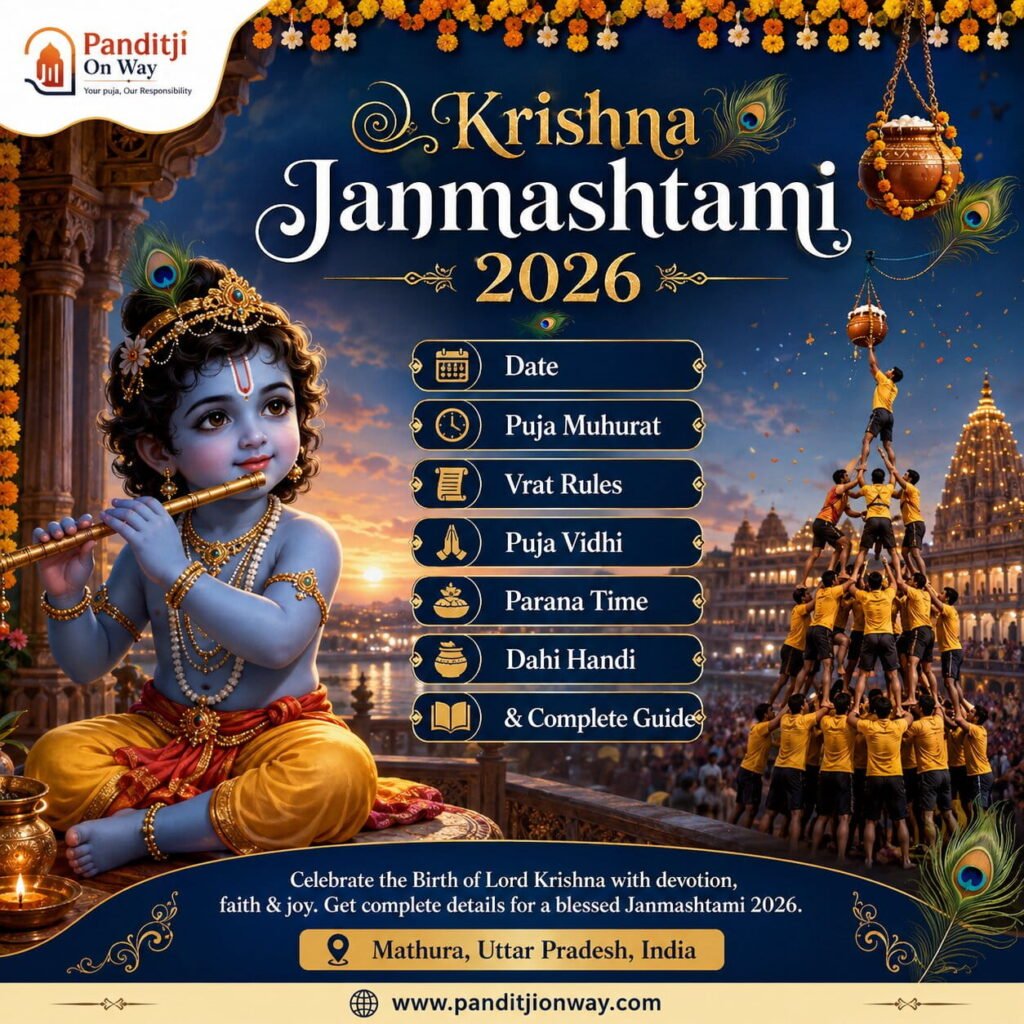
Krishna Janmashtami 2026: Date, Puja Muhurat, Vrat Rules, Puja Vidhi, Parana Time, Dahi Handi & Complete Guide
Krishna Janmashtami 2026 is on September 4. Check date, Nishita Puja Muhurat, Ashtami Tithi, Rohini Nakshatra, fasting rules, Parana, Puja Vidhi, Dahi Handi and city-wise timings.
Krishna Janmashtami 2026 will be observed on Friday, 4 September 2026 in New Delhi according to the Smarta calculation. The principal celebration takes place around Nishita Kaal, the sacred midnight period associated with the birth of Lord Krishna. For New Delhi, the Nishita Puja Muhurat is 11:57 PM on September 4 to 12:43 AM on September 5.
The festival commemorates the divine birth of Lord Krishna, the eighth incarnation of Lord Vishnu according to Hindu tradition. Devotees observe fasting, perform Krishna Puja, sing bhajans, conduct midnight Abhishekam, offer Makhan-Mishri and Tulsi, and celebrate the birth of Krishna at midnight.
Quick Answer: Krishna Janmashtami 2026 is on Friday, September 4, 2026. In New Delhi, Nishita Puja is from 11:57 PM to 12:43 AM, spanning September 4–5. Dahi Handi is generally celebrated on Saturday, September 5, 2026.
Krishna Janmashtami 2026: Important Details at a Glance
| Particular | Details |
|---|---|
| Festival | Krishna Janmashtami 2026 |
| Date | Friday, September 4, 2026 |
| Hindu Tithi | Krishna Paksha Ashtami |
| Deity | Lord Krishna |
| Birthplace in tradition | Mathura |
| Childhood home | Gokul |
| Birth Nakshatra | Rohini |
| Main Puja | Nishita Kaal / Midnight |
| New Delhi Nishita Puja | 11:57 PM – 12:43 AM |
| Mid-Night Moment | Around midnight |
| Ashtami Tithi Begins | 2:25 AM, September 4 |
| Ashtami Tithi Ends | Around 12:13 AM, September 5 |
| Rohini Nakshatra Begins | 12:29 AM, September 4 |
| Rohini Nakshatra Ends | 11:04 PM, September 4 |
| Dahi Handi | Saturday, September 5, 2026 |
| Main Celebration | Midnight of September 4–5 |
| Festival also known as | Gokulashtami, Krishnashtami, Srikrishna Jayanti, Sree Jayanthi |
Timings can differ between cities because Panchang calculations depend on the local sunrise, sunset and geographical location.
When Is Krishna Janmashtami in 2026?
Krishna Janmashtami 2026 falls on Friday, September 4, 2026.
The festival is associated with the Krishna Paksha Ashtami Tithi of the month of Bhadrapada in the traditional lunar calendar. The exact date is determined through Panchang calculations, particularly the relationship between Ashtami Tithi, Rohini Nakshatra and Nishita Kaal.
In 2026, the Ashtami Tithi begins during the early hours of September 4 and continues past midnight into September 5. This is why devotees may see some Janmashtami rituals extending into September 5.
Krishna Janmashtami 2026 Puja Muhurat in New Delhi
For New Delhi, the main Krishna Janmashtami Nishita Puja Muhurat is:
Nishita Puja Muhurat
11:57 PM, September 4, 2026 to 12:43 AM, September 5, 2026
Duration: Approximately 46 minutes.
Nishita Kaal is the midnight period considered particularly important for Janmashtami worship because Krishna’s birth is traditionally celebrated at midnight.
Important Panchang Timings
| Panchang Event | New Delhi Timing |
|---|---|
| Ashtami Tithi Begins | 2:25 AM, September 4 |
| Ashtami Tithi Ends | 12:13 AM, September 5 |
| Rohini Nakshatra Begins | 12:29 AM, September 4 |
| Rohini Nakshatra Ends | 11:04 PM, September 4 |
| Nishita Puja | 11:57 PM – 12:43 AM |
| Dahi Handi | September 5 |
For personal religious observance, devotees should preferably use the Panchang calculated for their own city rather than applying New Delhi timings everywhere.
Krishna Janmashtami 2026: City-Wise Puja Muhurat
The following timings are useful for devotees in major Indian cities.
| City | Nishita Puja Muhurat |
|---|---|
| New Delhi | 11:57 PM – 12:43 AM |
| Pune | 12:10 AM – 12:57 AM |
| Chennai | 11:45 PM – 12:31 AM |
| Jaipur | 12:03 AM – 12:49 AM |
| Hyderabad | 11:52 PM – 12:38 AM |
| Gurgaon | 11:58 PM – 12:44 AM |
| Chandigarh | 11:59 PM – 12:45 AM |
| Kolkata | 11:13 PM – 11:59 PM |
| Mumbai | 12:14 AM – 1:01 AM |
| Bengaluru | 11:55 PM – 12:42 AM |
| Ahmedabad | 12:16 AM – 1:02 AM |
| Noida | 11:57 PM – 12:42 AM |
These are local-city timings and should not be treated as a single nationwide Janmashtami muhurat.
Why Is Krishna Janmashtami Celebrated?
Krishna Janmashtami celebrates the birth of Lord Krishna, who is revered as an incarnation of Lord Vishnu and, in Vaishnava traditions, as the Supreme Personality of Godhead.
According to the traditional account, Krishna was born in Mathura to Devaki and Vasudeva when the region was ruled by the tyrannical King Kansa.
A prophecy had foretold that Devaki’s eighth son would become the cause of Kansa’s downfall. To prevent this, Kansa imprisoned Devaki and Vasudeva.
When Krishna was born at midnight, Vasudeva carried the newborn Krishna from the prison toward Gokul, crossing the Yamuna and taking him to the home of Nanda and Yashoda.
This is why one of the most iconic visual representations of Janmashtami is Vasudeva carrying baby Krishna across the Yamuna River during the stormy night.


The Story of Krishna’s Birth
The traditional Krishna Janmashtami story begins with Devaki and Vasudeva.
Kansa, the ruler of Mathura, learned through a divine prophecy that Devaki’s eighth son would bring about his death. He therefore imprisoned Devaki and Vasudeva and killed their newborn children.
When Krishna was born, however, divine events enabled Vasudeva to leave the prison with the infant.
He carried Krishna through the night toward Gokul. The Yamuna River is traditionally described as swelling during the journey, while divine protection enabled Vasudeva to safely cross.
Vasudeva eventually reached Gokul and exchanged Krishna with the newborn daughter of Yashoda.
Krishna was subsequently raised in the pastoral community of Gokul and Vrindavan, where his childhood stories became central to Krishna bhakti traditions.
Why Was Krishna Born at Midnight?
Midnight, known as Nishita Kaal, has special significance in Janmashtami worship.
The traditional narrative places Krishna’s birth at midnight in the prison of Kansa. Therefore, devotees commonly keep their fast throughout the day and perform the principal worship around midnight.
At the moment of Krishna’s symbolic birth, temples and homes may perform:
- Krishna Abhishekam
- Panchamrita Snan
- Shringar
- Offering of Makhan-Mishri
- Tulsi offering
- Krishna Mantra chanting
- Krishna Aarti
- Shankh Naad
- Bhajan and Kirtan
- Jhula ceremony
- Distribution of Prasad
Krishna Janmashtami Puja Vidhi 2026
Devotees can perform Janmashtami Puja at home or arrange a traditional priest-led Puja.
A simplified sequence is:
1. Clean the Puja Area
Clean the worship area and place a clean cloth on the altar.
2. Install the Krishna Idol
Place a Krishna or Laddu Gopal idol on a clean platform.
3. Take Sankalpa
Devotees formally resolve to observe the Janmashtami fast and worship Lord Krishna.
4. Perform Ganesh Puja
Many traditional Hindu pujas begin with invocation of Lord Ganesha.
5. Invoke Krishna
Offer flowers, incense, diya and devotional prayers.
6. Perform Abhishekam
At Nishita Kaal, the Krishna idol may be bathed according to the family’s tradition.
Common Abhishek materials include:
- Water
- Milk
- Curd
- Ghee
- Honey
- Sugar
- Panchamrita
7. Dress and Decorate Krishna
After Abhishekam, devotees dress the idol in new clothes and decorate it with ornaments, flowers and a crown.
8. Offer Bhog
Popular offerings include:
- Makhan-Mishri
- Panchamrit
- Fruits
- Milk
- Makhana
- Dhaniya preparations
- Sweets
- Tulsi leaves
9. Perform Krishna Aarti
Conclude the midnight worship with Krishna Aarti and devotional chanting.
10. Celebrate Krishna’s Birth
At midnight, devotees traditionally celebrate Krishna’s appearance with bells, conch shells, chanting and devotional songs.
Shodashopachara Puja on Janmashtami
A more elaborate Krishna Janmashtami Puja can follow the Shodashopachara tradition, involving sixteen traditional forms of worship.
These may include:
- Avahana
- Asana
- Padya
- Arghya
- Achamana
- Snana
- Vastra
- Abharana
- Gandha
- Pushpa
- Dhupa
- Dipa
- Naivedya
- Tambula
- Dakshina
- Pradakshina and Namaskara
The exact procedure can vary according to sampradaya, family tradition and priestly practice.
For a formal ritual, devotees may prefer to have a qualified Pandit conduct the Puja according to the applicable tradition.
Janmashtami Vrat 2026: Fasting Rules
Fasting is an important part of Krishna Janmashtami observance.
Traditional fasting practices vary between communities, but commonly include avoiding grains during the fast and consuming permitted vrat foods according to one’s tradition.
Commonly Used Vrat Foods
Depending on the tradition, devotees may consume:
- Fruits
- Milk
- Curd
- Makhana
- Sabudana
- Singhara flour
- Rajgira
- Potatoes
- Samak rice
- Nuts
- Coconut
- Vrat-friendly preparations
Foods Commonly Avoided
Traditional Janmashtami fasting generally avoids:
- Grains
- Regular rice
- Wheat
- Lentils
- Beans
- Meat
- Alcohol
- Foods prohibited by the devotee’s particular vrat tradition
People with medical, dietary or age-related considerations should not undertake prolonged fasting without appropriate professional guidance.
When Should You Break the Janmashtami Fast?
Parana means breaking the fast.
There are different approaches depending upon the religious tradition being followed.
According to the Panchang information supplied for New Delhi, the Dharma Shastra-based Parana is associated with the period after the relevant Tithi and Nakshatra conditions are fulfilled, while a modern practice followed in some communities allows Parana after the midnight Janmashtami Puja.
This distinction is important because there is no single fasting rule that every Krishna devotee follows.
Traditional Approach
Some devotees wait until after sunrise on the following day and consider the relevant Ashtami Tithi and Rohini Nakshatra conditions before breaking the fast.
Midnight/Modern Practice
Some devotees break their fast after completing the midnight worship.
Therefore, devotees should follow the rules of their sampradaya, family tradition or appointed Pandit rather than combining rules from different traditions.
Smarta vs Vaishnava Janmashtami: Why Are There Sometimes Two Dates?
One of the most frequently searched questions is:
“Why does Janmashtami sometimes appear on two different dates?”
The answer is that different Hindu traditions can use different criteria for determining the festival day.
The Smarta calculation places significant emphasis on the presence of Ashtami during Nishita Kaal, along with other Panchang conditions.
Vaishnava traditions give particular importance to Ashtami Tithi and Rohini Nakshatra and may follow a different observance date.
Consequently, devotees may sometimes see Janmashtami listed on two consecutive dates.
For 2026, the New Delhi Smarta date is September 4. Some Vaishnava/ISKCON observances can have different calendars, so devotees following a specific sampradaya should follow that institution’s official calendar.
Krishna Janmashtami and ISKCON
International Society for Krishna Consciousness follows a Vaishnava devotional tradition centered on Krishna bhakti.
ISKCON temples around the world generally conduct elaborate Janmashtami celebrations featuring:
- Maha Abhishek
- Kirtan
- Bhagavad Gita readings
- Krishna Janma celebrations
- Temple decorations
- Devotional performances
- Midnight Aarti
- Prasad distribution
Importantly, devotees should distinguish between the general civil/festival date and the date prescribed by the particular religious calendar they follow.
Dahi Handi 2026
Dahi Handi 2026 is expected to be celebrated on Saturday, September 5.
Dahi Handi is particularly prominent in Maharashtra, where groups known as Govindas form human pyramids to reach and break a suspended pot.
The tradition recalls Krishna’s childhood association with butter and his playful attempts to obtain butter and curd.


Krishna Janmashtami in Mathura and Vrindavan
The Mathura-Vrindavan region holds a special place in Krishna devotion.
Mathura is traditionally regarded as Krishna’s birthplace, while Gokul, Vrindavan, Nandgaon and Govardhan are closely associated with stories from Krishna’s childhood and youth.
During Janmashtami, devotees visit temples, participate in kirtans, attend special darshan and take part in midnight celebrations.
Important pilgrimage destinations associated with Krishna include:
| Place | Krishna Tradition |
|---|---|
| Mathura | Birthplace of Krishna |
| Gokul | Childhood home and Nanda-Yashoda tradition |
| Vrindavan | Krishna’s childhood and devotional pastimes |
| Nandgaon | Associated with Nanda Maharaj |
| Govardhan | Govardhan Hill and Krishna tradition |
| Barsana | Associated with Radha tradition |


Best Places to Celebrate Krishna Janmashtami in India
For devotees planning a pilgrimage, these destinations are among the most significant:
1. Mathura, Uttar Pradesh
Mathura is traditionally revered as the birthplace of Lord Krishna.
The Shri Krishna Janmabhoomi area becomes a major center of devotional activity around Janmashtami.
2. Vrindavan, Uttar Pradesh
Vrindavan is closely associated with Krishna bhakti and attracts large numbers of pilgrims during Janmashtami.
3. Gokul, Uttar Pradesh
Gokul is associated with Krishna’s childhood and the household of Nanda and Yashoda.
4. Mumbai, Maharashtra
Mumbai is particularly famous for its energetic Dahi Handi celebrations.
5. Dwarka, Gujarat
Dwarka is traditionally associated with Krishna’s later life as the king of Dwaraka.
6. Jaipur, Rajasthan
Krishna temples across Jaipur conduct special Janmashtami celebrations, devotional music and midnight worship.
7. Delhi-NCR
Temples throughout Delhi, Noida and Gurgaon conduct special Janmashtami programs, including midnight Krishna Puja.
Krishna Janmashtami 2026: What to Keep Ready for Puja?
A basic Janmashtami Puja Samagri list may include:
| Puja Item | Purpose |
|---|---|
| Krishna/Laddu Gopal idol | Main deity |
| Panchamrita | Abhishekam |
| Milk | Abhishekam/Bhog |
| Curd | Abhishekam |
| Honey | Panchamrita |
| Ghee | Panchamrita |
| Sugar | Panchamrita |
| Tulsi leaves | Krishna offering |
| Makhan-Mishri | Traditional Bhog |
| Flowers | Puja |
| Incense | Dhupa |
| Diya | Deepa |
| New clothes | Krishna Shringar |
| Crown | Krishna decoration |
| Flute | Krishna Shringar |
| Fruits | Naivedya |
| Sweets | Bhog |
| Bell and conch | Aarti |
| Puja thali | Worship |
The exact requirements depend upon whether the family is performing a simple home Puja or a complete traditional Janmashtami ritual.
How to Celebrate Krishna Janmashtami at Home
A family can observe Janmashtami at home in a simple and devotional manner.
Morning
- Clean the home and Puja space.
- Bathe and wear clean clothes.
- Place Krishna/Laddu Gopal on the altar.
- Take the fasting Sankalpa if observing a vrat.
Afternoon
- Prepare vrat-friendly food.
- Decorate the Krishna altar.
- Prepare Bhog.
- Read or listen to Krishna Janma Katha.
Evening
- Begin devotional chanting.
- Sing Krishna bhajans.
- Prepare for the midnight Puja.
- Arrange Panchamrita and other Puja Samagri.
Midnight
- Perform Krishna Abhishekam.
- Dress and decorate Krishna.
- Offer Bhog.
- Chant Krishna Mantras.
- Perform Aarti.
- Celebrate the birth of Krishna.
Next Day
- Follow the Parana rules of your tradition.
- Distribute Prasad.
- Participate in Nandotsav or Dahi Handi celebrations where applicable.
Krishna Janmashtami Puja Mantras
Devotees may chant simple Krishna mantras such as:
“Om Namo Bhagavate Vasudevaya”
This is one of the most widely known Krishna/Vasudeva mantras.
Another devotional invocation is:
“Hare Krishna Hare Krishna, Krishna Krishna Hare Hare,
Hare Rama Hare Rama, Rama Rama Hare Hare.”
Devotees can also recite Krishna Ashtakam, Vishnu Sahasranama, Bhagavad Gita chapters or other texts according to their tradition.
Krishna Janmashtami 2026: Spiritual Significance
Janmashtami represents more than the celebration of a divine birth.
For devotees, it is an opportunity to reflect on:
- Dharma
- Bhakti
- Compassion
- Truth
- Self-discipline
- Devotion
- Detachment
- Righteous action
Krishna’s teachings in the Bhagavad Gita emphasize performing one’s duty with devotion and without attachment to the fruits of action.
Therefore, Janmashtami can be observed not only through ritual but also through spiritual study, charity, service and remembrance of Krishna.
Krishna Janmashtami 2026 for Families and Children
Janmashtami is especially popular among children because Krishna’s childhood stories are filled with memorable characters and traditions.
Families can introduce children to the festival through:
- Krishna dress-up
- Jhanki decoration
- Krishna cradle/Jhula
- Bhagavad Gita stories
- Krishna Janma Katha
- Bhajan competitions
- Drawing and craft activities
- Makhan-Mishri Bhog
- Temple visits
These activities can help children understand the cultural and spiritual significance of Janmashtami.
Krishna Janmashtami Puja Booking with Panditji on Way
For devotees who want a traditional Krishna Janmashtami Puja performed by a Pandit, Panditji on Way can be positioned as an online Puja-booking platform connecting devotees with priests for religious ceremonies.
Instead of trying to perform a complex ritual without knowing the required procedure, devotees can arrange a Pandit according to their preferred Puja requirements, location and tradition.
Panditji on Way — First and Largest Online Pooja Booking Portal can serve devotees looking for assistance with:
- Krishna Janmashtami Puja
- Laddu Gopal Puja
- Krishna Abhishekam
- Janmashtami Vrat Puja
- Griha Puja
- Hindu festival rituals
- Special Sankalp Puja
- Online Puja arrangements
Book Krishna Janmashtami Puja with a Pandit
Krishna Janmashtami 2026: Quick Facts
| Question | Short Answer |
|---|---|
| When is Janmashtami 2026? | Friday, September 4, 2026 |
| What is Krishna Janmashtami? | Hindu festival celebrating Lord Krishna’s birth |
| What time is Krishna Puja? | During Nishita Kaal, around midnight |
| New Delhi Puja time? | 11:57 PM–12:43 AM |
| When is Dahi Handi 2026? | Saturday, September 5 |
| Which Tithi is Janmashtami? | Krishna Paksha Ashtami |
| Which Nakshatra is associated with Krishna’s birth? | Rohini |
| Where was Krishna born? | Mathura, according to Hindu tradition |
| Where did Vasudeva take Krishna? | Gokul |
| Why fast on Janmashtami? | As a devotional observance associated with Krishna worship |
| Can Janmashtami fall on two dates? | Yes, different traditions can calculate observance differently |
| What is Nishita Kaal? | The midnight period used for Janmashtami worship |
| What is Dahi Handi? | A celebration inspired by Krishna’s childhood butter/curd traditions |
Frequently Asked Questions About Krishna Janmashtami 2026
When is Krishna Janmashtami 2026?
Krishna Janmashtami 2026 will be observed on Friday, September 4, 2026, according to the New Delhi Smarta calculation.
What is the Janmashtami Puja Muhurat in Delhi in 2026?
The Nishita Puja Muhurat in New Delhi is 11:57 PM on September 4 to 12:43 AM on September 5, 2026.
When does Krishna Janmashtami fasting begin?
Devotees traditionally take Sankalpa after morning rituals and observe the fast throughout the day, according to their chosen fasting tradition.
When should Janmashtami fasting be broken?
Parana rules differ by tradition. Some devotees wait until after sunrise and the relevant Tithi/Nakshatra conditions, while others break the fast after midnight worship. Devotees should follow their sampradaya or family tradition.
Is Janmashtami on September 4 or September 5 in 2026?
The New Delhi Smarta date is September 4. Some Vaishnava calendars may prescribe September 5. The difference results from different calendar rules and observance traditions.
What is Nishita Kaal?
Nishita Kaal refers to the midnight period in Hindu timekeeping. It is particularly important for Janmashtami because Krishna’s birth is traditionally celebrated at midnight.
What should be offered to Lord Krishna on Janmashtami?
Common offerings include Makhan-Mishri, Panchamrit, milk, fruits, sweets and Tulsi leaves, according to the devotee’s tradition.
Can we perform Krishna Janmashtami Puja at home?
Yes. A simple home Puja can include Krishna’s Abhishekam, Shringar, Bhog, mantra chanting and Aarti. A more elaborate Puja can be performed with the assistance of a qualified Pandit.
Why is Dahi Handi celebrated?
Dahi Handi is associated with Krishna’s childhood stories of butter and curd and is particularly popular in Maharashtra.
Where is Krishna Janmashtami celebrated most prominently?
Mathura, Vrindavan and Gokul are especially important pilgrimage destinations, while Mumbai is particularly famous for Dahi Handi.
What are other names for Janmashtami?
The festival is also known as Krishnashtami, Gokulashtami, Srikrishna Jayanti and Sree Jayanthi.
People Also Ask: Krishna Janmashtami 2026
Janmashtami kab hai 2026?
Janmashtami 2026 Friday, 4 September ko hai.
Krishna Janmashtami 2026 mein puja ka samay kya hai?
New Delhi mein Nishita Puja 4 September ki raat 11:57 PM se 5 September 12:43 AM tak hai.
Janmashtami 2026 ka vrat kab khulega?
Parana ka samay parampara aur Panchang ke anusaar alag ho sakta hai. Apne sampradaya ke niyam follow karna chahiye.
2026 mein Dahi Handi kab hai?
Dahi Handi Saturday, September 5, 2026 ko manayi jayegi.
Krishna ka janm kis samay hua tha?
Parampara ke anusaar Lord Krishna ka janm Nishita Kaal, arthaat madhyaratri mein hua tha.
Krishna Janmashtami par kya khana chahiye?
Vrat rakhne wale devotees apni parampara ke anusaar fruits, milk, makhana, sabudana, singhara flour, rajgira aur anya vrat-friendly foods le sakte hain.
Kya Janmashtami par anaj kha sakte hain?
Traditional Janmashtami fasting commonly avoids grains. However, specific fasting rules vary according to sampradaya and family tradition.
Krishna Janmashtami 2026: Important Dates
| Year | Janmashtami |
|---|---|
| 2023 | September 6 |
| 2024 | August 26 |
| 2025 | August 15 |
| 2026 | September 4 |
| 2027 | August 25 |
| 2028 | August 13 |
| 2029 | September 1 |
| 2030 | August 21 |
The festival date changes annually because it follows the Hindu lunar calendar.
How Panditji on Way Can Help With Janmashtami Puja
A well-organized Janmashtami Puja can involve several ritual steps, especially when a devotee wants to perform a complete traditional ceremony.
Panditji on Way can make the process easier by helping devotees arrange a Pandit for their required Puja.
Recommended website conversion section
Celebrate Krishna Janmashtami 2026 with Traditional Puja
Invite the divine blessings of Lord Krishna into your home with a traditional Janmashtami Puja performed according to Hindu rituals.
Book a Pandit for Krishna Janmashtami Puja through Panditji on Way.
We are Available on this Cities Too:-
- Krishna Janmashtami Puja in Delhi
- Krishna Janmashtami Puja in Mumbai
- Krishna Janmashtami Puja in Jaipur
- Krishna Janmashtami Puja in Pune
- Krishna Janmashtami Puja in Ahmedabad
- Krishna Janmashtami Puja in Gurgaon
- Krishna Janmashtami Puja in Noida
- Krishna Janmashtami Puja in Bengaluru
- Krishna Janmashtami Puja in Hyderabad
- Krishna Janmashtami Puja in Chennai
- Krishna Janmashtami Puja in Mathura
- Krishna Janmashtami Puja in Vrindavan
Recommended for Panditji on Way
→ Krishna Janmashtami 2026
→ Krishna Janmashtami Puja Vidhi
→ Janmashtami Vrat Rules
→ Janmashtami Puja Samagri
→ Krishna Abhishekam Vidhi
→ Laddu Gopal Puja
→ Krishna Mantra
→ Dahi Handi 2026
→ Krishna Janmashtami in Mathura
→ Krishna Janmashtami in Vrindavan
→ Krishna Janmashtami Puja Booking
→ Hindu Festival Calendar 2026
Recommended External Authority Links
Useful references can include:
- Incredible India – Ministry of Tourism for Indian cultural and tourism context.
- ISKCON official website for Vaishnava/ISKCON-related information.