

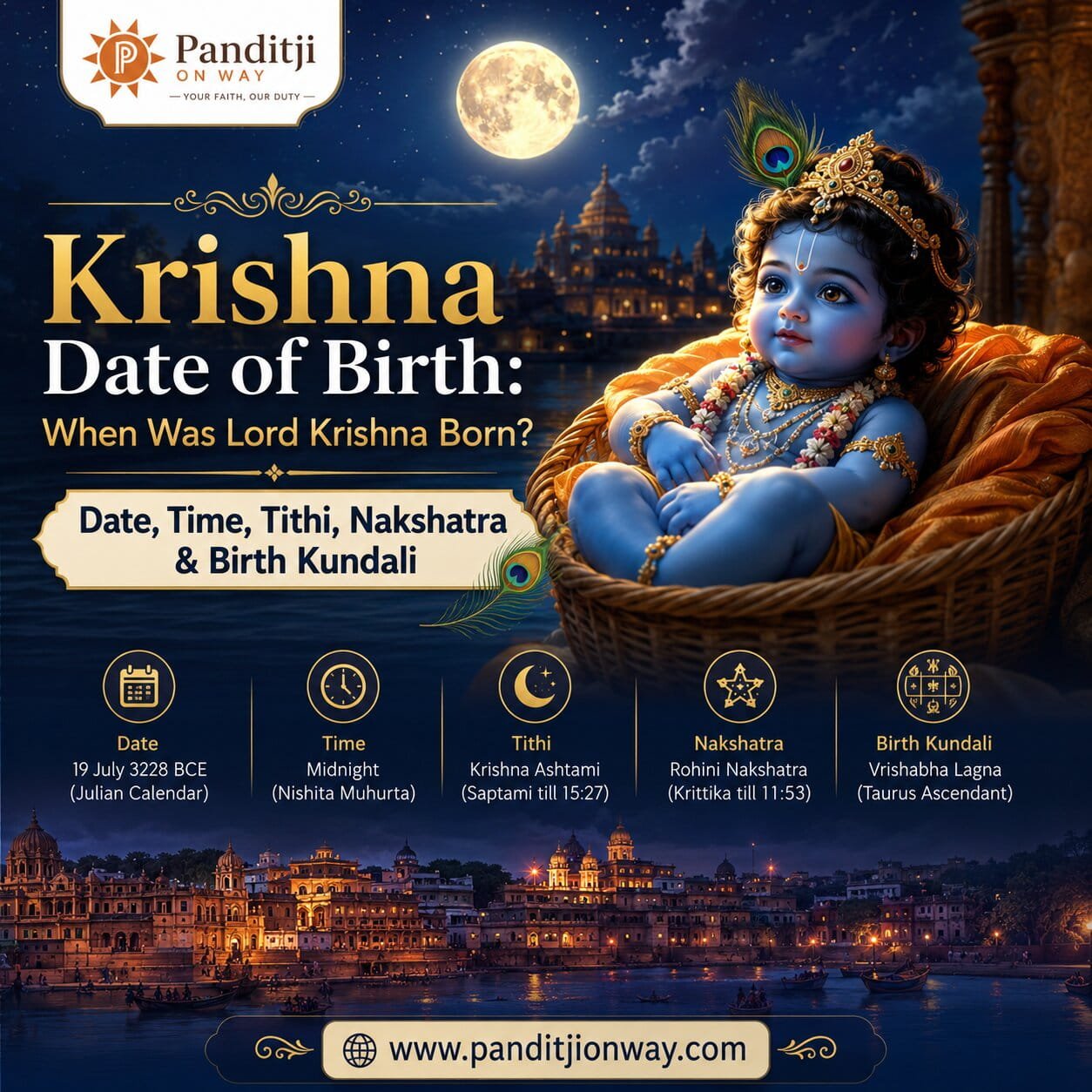
Krishna Date of Birth: When Was Lord Krishna Born? Date, Time, Tithi, Nakshatra & Birth Kundali
Lord Krishna Date of Birth: 19 July 3228 BCE
Birth Tithi: Krishna Paksha Ashtami
Nakshatra: Rohini
Birth Time: Nishita Kaal / Hindu Midnight
Birthplace: Mathura, Uttar Pradesh, India
Age of Lord Krishna: Approximately 126 years, according to the traditional chronology discussed here
Yuga: Dvapara Yuga
Introduction
Lord Krishna, revered as the Purna Purushottama and one of the most worshipped deities in Hinduism, is traditionally believed to have appeared on Krishna Paksha Ashtami, the eighth lunar day of the dark fortnight of the month of Bhadrapada. This sacred occasion is celebrated throughout India and around the world as Krishna Janmashtami, Gokulashtami or Shri Krishna Jayanti.
One chronology used in modern Panchang and astronomical calculations places Krishna’s birth in 3228 BCE, with 19 July 3228 BCE identified as the Janmashtami date. If the birth is interpreted as occurring after midnight, the corresponding civil date can be treated as 20 July 3228 BCE.
However, the exact historical birth date of Shri Krishna cannot be established with modern historical evidence. Therefore, dates such as 3228 BCE should be presented as traditional/astronomical chronology rather than a conclusively proven historical date.

When Was Lord Krishna Born?
According to the chronology discussed in this article, Lord Krishna was born on 19 July 3228 BCE, during the sacred Nishita Kaal, or Hindu midnight.
Because the traditional description places Krishna’s birth around midnight, some interpretations consider the civil date to have crossed into 20 July 3228 BCE.
The important religious combination associated with Krishna Janmashtami is:
- Krishna Paksha
- Ashtami Tithi
- Rohini Nakshatra
- Nishita Kaal
- Mathura as the birthplace
This combination is central to the traditional observance of Krishna Janmashtami.
Lord Krishna Birth Date According to Panchang
Astronomical Panchang calculations for the proposed historical period show that the relevant date corresponds to the sacred combination of Ashtami Tithi and Rohini Nakshatra around the midnight period.
Krishna Janmashtami Panchang
| Panchang Element | Traditional Details |
|---|---|
| Birth Date | 19 July 3228 BCE* |
| Alternative Date | 20 July 3228 BCE after midnight |
| Tithi | Krishna Paksha Ashtami |
| Nakshatra | Rohini |
| Birth Time | Nishita Kaal |
| Birthplace | Mathura |
| Moon Sign | Vrishabha (Taurus) |
| Sun Sign | Simha (Leo) |
| Paksha | Krishna Paksha |
| Lunar Month | Bhadrapada/Purnimanta tradition |
| Festival | Krishna Janmashtami |
*The exact historical date remains a matter of traditional chronology and astronomical interpretation.
What Was the Time of Lord Krishna’s Birth?
According to Shrimad Bhagavatam and the traditional account of Krishna’s appearance, Shri Krishna manifested at midnight, during the spiritually significant Nishita Kaal.
This is why Krishna Janmashtami celebrations traditionally reach their climax around midnight.
Devotees observe fasting throughout the day and perform:
- Krishna Abhishekam
- Panchamrit Snan
- Krishna Janma Puja
- Shodashopachara Puja
- Bhagavad Gita and Bhagavata recitation
- Bhajan and Kirtan
- Jhanki and Krishna cradle ceremonies
At midnight, devotees celebrate the divine appearance of Shri Krishna with “Nand Ke Anand Bhayo, Jai Kanhaiya Lal Ki!”
Why Is Rohini Nakshatra Important?
Rohini Nakshatra has a particularly important association with Lord Krishna.
Traditional Hindu texts and Janmashtami observances associate Krishna’s birth with Ashtami Tithi and Rohini Nakshatra. Rohini is ruled by the Moon and is associated with qualities such as beauty, growth, nourishment and abundance.
The combination of Ashtami + Rohini + Nishita Kaal is therefore regarded as especially sacred in Krishna worship.
Where Was Lord Krishna Born?
According to Hindu scriptures and longstanding tradition, Lord Krishna was born in Mathura, in the prison of King Kamsa.
His parents were:
Father: Vasudeva
Mother: Devaki
Devaki’s brother Kamsa had been warned that Devaki’s eighth son would become the cause of his downfall.
As a result, Devaki and Vasudeva were imprisoned, and their children were killed by Kamsa. When Krishna appeared as their eighth child, Vasudeva secretly carried the newborn Krishna across the Yamuna River to Gokul, where he was raised by Nanda and Yashoda.
Lord Krishna’s Birth Story
According to the traditional account, Krishna appeared at midnight in the prison of Mathura.
At the time of his divine appearance, Vasudeva and Devaki witnessed the extraordinary form of the Lord. Krishna instructed Vasudeva to take him to Gokul and exchange him with the newborn daughter of Yashoda.
Through divine intervention, the prison guards fell asleep and the prison doors opened.
Vasudeva then carried Krishna across the Yamuna to Gokul.
There, Krishna was placed in the care of Nanda Baba and Yashoda Mata.
This event forms the spiritual foundation of the celebration now known as Krishna Janmashtami.
How Old Was Lord Krishna When He Left Earth?
The traditional chronology discussed here places Krishna’s departure from the earthly world at the beginning of Kali Yuga.
According to this calculation:
Krishna’s birth: 3228 BCE
Beginning of Kali Yuga / Krishna’s departure: 3102 BCE
This gives Krishna an earthly lifespan of approximately:
126 years and 5 months
Different Hindu traditions and chronological systems may calculate these dates differently, so this figure should be described as belonging to a specific traditional chronology, rather than as an independently verified historical measurement.
Did Krishna Live for 126 Years?
According to the chronology presented above, yes—approximately 126 years and 5 months.
Traditional Hindu literature also describes Krishna as living for a very long period and undertaking an extensive divine life that included his childhood in Gokul and Vrindavan, his role in Mathura and Dwarka, and his participation in the events of the Mahabharata.
However, calculating his exact age depends on which traditional chronological system is used.
Krishna’s Birth and the Beginning of Kali Yuga
One of the most important chronological traditions in Hindu civilization connects Krishna’s departure from the earthly world with the beginning of Kali Yuga.
The commonly accepted traditional Kali Yuga epoch is:
3102 BCE
This is significant because Hindu astronomical and calendrical traditions have historically used this epoch in their chronological calculations.
According to the chronology discussed here, Krishna’s departure occurred at the beginning of Kali Yuga.
What Would Krishna’s Birth Date Be on the Modern Gregorian Calendar?
This is an interesting but technically complicated question.
Ancient dates cannot simply be converted into the modern Gregorian calendar as though the Gregorian calendar had existed in 3228 BCE. Calendar systems, astronomical conventions and historical year numbering all have to be taken into consideration.
Using the astronomical conversion associated with the chronology discussed here, 19 July 3228 BCE corresponds approximately to 23 June 3227 BCE in a proleptic Gregorian calendar system, with the following day corresponding to 24 June -3227 if the birth is placed after midnight.
The negative year notation can be confusing.
There is no year 0 in traditional BCE/CE historical numbering, while astronomical year numbering includes a year 0. Therefore, different websites and software can display ancient dates differently.
For this reason, Panditji on Way should avoid presenting the Gregorian conversion as an absolute historical date.
Krishna Birth Kundali
Krishna’s birth Kundali is another fascinating part of traditional Jyotisha.
The birth chart is traditionally constructed using:
- Birthplace — Mathura
- Birth date — proposed historical date
- Birth time — Nishita Kaal
- Tithi — Krishna Ashtami
- Nakshatra — Rohini
- Moon sign — Vrishabha
Because the exact historical birth time is not independently documented in a modern astronomical sense, any reconstructed Kundali should be understood as a traditional/astrological reconstruction based on the chosen chronology.
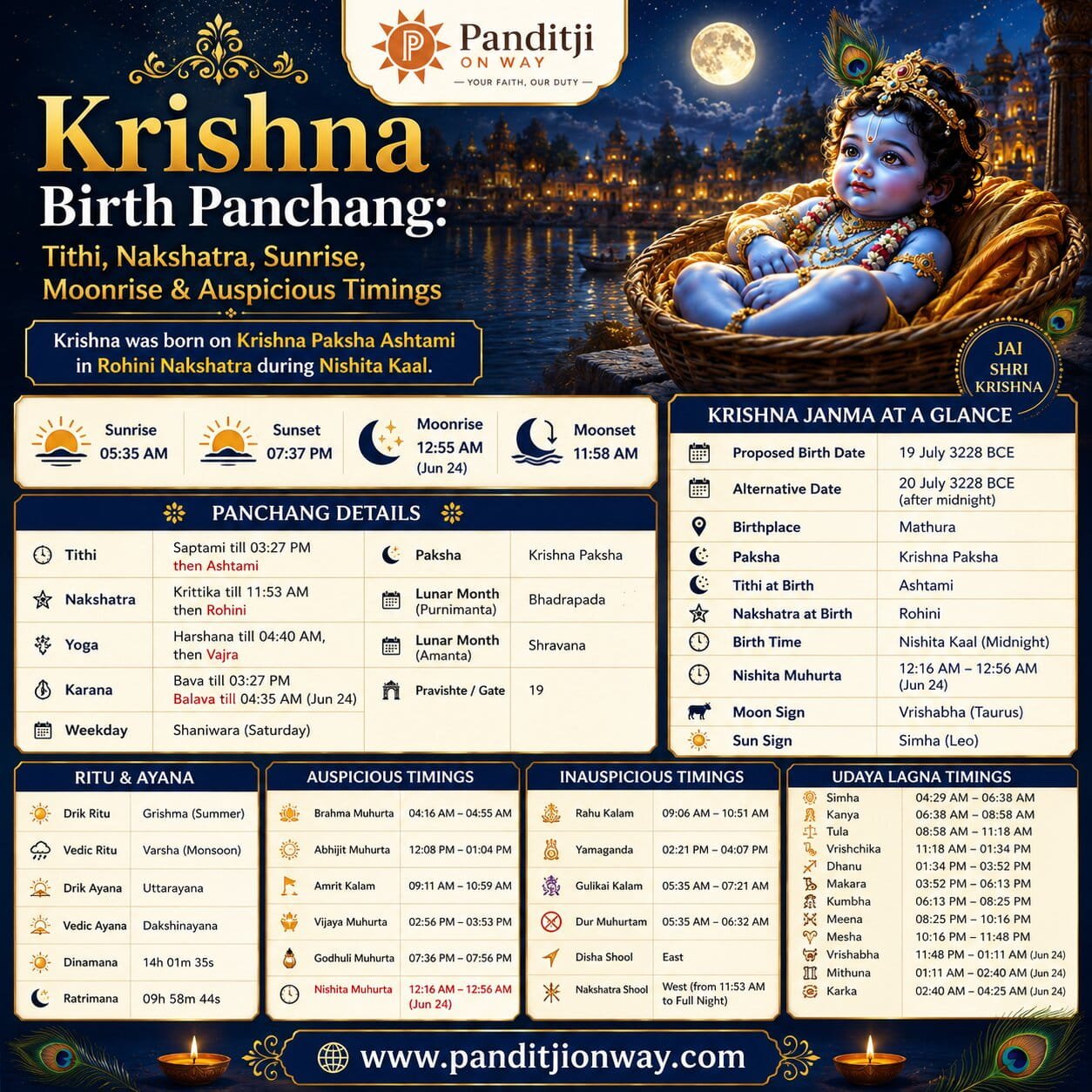
Krishna Birth Panchang: Tithi, Nakshatra, Sunrise, Moonrise & Auspicious Timings
According to the astronomical Panchang calculations for the proposed historical date associated with Lord Krishna’s birth, the day corresponds to Krishna Paksha Ashtami and Rohini Nakshatra around the midnight period.
The following Panchang details are based on calculations for Mathura and the historical date represented in the source as 19 July 3228 BCE. Because ancient calendar conversion involves different calendar systems and astronomical conventions, these details should be understood as part of a traditional/astronomical reconstruction, rather than as independently proven historical records.
🌅 Sunrise, Sunset, Moonrise & Moonset
| Astronomical Event | Time |
|---|---|
| 🌅 Sunrise | 05:35 AM |
| 🌇 Sunset | 07:37 PM |
| 🌙 Moonrise | 12:55 AM, June 24 |
| 🌙 Moonset | 11:58 AM |
| ☀️ Madhyahna | 12:36 PM |
| 🌌 Nishita Muhurta | 12:16 AM – 12:56 AM, June 24 |
Why Nishita Kaal Matters for Krishna Janmashtami
The Nishita Kaal, or Hindu midnight period, holds special importance in Krishna worship because Lord Krishna is traditionally believed to have appeared at midnight.
For the reconstructed Panchang calculation, Nishita Muhurta extends from approximately 12:16 AM to 12:56 AM, making this the most significant period in the day’s Krishna Janma observance.
Krishna Birth Panchang
| Panchang Element | Details |
|---|---|
| Paksha | Krishna Paksha |
| Tithi | Krishna Saptami until 03:27 PM, followed by Krishna Ashtami |
| Nakshatra | Krittika until 11:53 AM, followed by Rohini |
| Yoga | Harshana until 04:40 AM, followed by Vajra |
| Karana | Bava until 03:27 PM |
| Karana | Balava until 04:35 AM, June 24 |
| Weekday | Shaniwara (Saturday) |
| Lunar Month – Purnimanta | Bhadrapada |
| Lunar Month – Amanta | Shravana |
| Pravishte / Gate | 19 |
Krishna Janma Combination
The most significant combination for Krishna Janmashtami is:
Krishna Paksha + Ashtami Tithi + Rohini Nakshatra + Nishita Kaal
This combination is traditionally associated with the divine birth of Shri Krishna.
Tithi & Nakshatra at Krishna’s Birth
The Panchang shows that the day begins with Krishna Saptami, which ends at approximately 03:27 PM. After this, Krishna Ashtami begins.
Similarly, Krittika Nakshatra continues until approximately 11:53 AM, after which Rohini Nakshatra begins.
Therefore, during the midnight period, the important combination is:
| Birth Factor | At Midnight |
|---|---|
| Tithi | 🌙 Krishna Ashtami |
| Nakshatra | ⭐ Rohini |
| Paksha | Krishna Paksha |
| Birth Period | Nishita Kaal |
| Moon Sign | Vrishabha (Taurus) |
This is the principal astronomical combination traditionally associated with Shri Krishna Janmashtami.
Rashi & Nakshatra
| Jyotish Factor | Calculation |
|---|---|
| Moon Sign (Chandra Rashi) | Vrishabha (Taurus) |
| Nakshatra | Krittika → Rohini |
| Sun Sign (Surya Rashi) | Simha (Leo) |
| Surya Nakshatra | Purva Phalguni |
| Rohini Pada | Rohini progresses through its respective padas during the day |
| Chandra Vasa | South |
| Rahu Vasa | East |
The Vrishabha Moon sign and Rohini Nakshatra are particularly noteworthy when discussing the traditional birth chart of Shri Krishna.
Samvat & Ancient Calendar Details
| Calendar / Era | Details |
|---|---|
| Vikram Samvat | -3170, Parthiva |
| Shaka Samvat | -3305, Shrimukha |
| Gujarati Samvat | -3171, Tarana |
| Purnimanta Month | Bhadrapada |
| Amanta Month | Shravana |
| Kali Yuga | -126 Years* |
| Julian Date | July 19, 3228 BCE |
| Julian Day | 542595.5 |
| Kali Ahargana | -45,870 days |
| Lahiri Ayanamsha | 311.695680 |
| National Civil Date | Ashadha 02, -3305 Shaka |
| National Nirayana Date | Ashadha 09, -3305 Shaka |
*Ancient-era calendar notation can appear unusual because modern year numbering and historical BCE/CE notation do not map directly onto ancient Indian calendrical systems.
Ritu & Ayana
| Seasonal / Solar Factor | Details |
|---|---|
| Drik Ritu | Grishma (Summer) |
| Vedic Ritu | Varsha (Monsoon) |
| Drik Ayana | Uttarayana |
| Vedic Ayana | Dakshinayana |
| Dinamana | 14 Hours 01 Minutes 35 Seconds |
| Ratrimana | 09 Hours 58 Minutes 44 Seconds |
The difference between the Drik and Vedic classifications is a reminder that different calendrical and astronomical traditions can use different computational conventions.
Auspicious Timings
The reconstructed Panchang provides several traditional auspicious periods during the day.
| Muhurta / Yoga | Time |
|---|---|
| Brahma Muhurta | 04:16 AM – 04:55 AM |
| Pratah Sandhya | 04:36 AM – 05:35 AM |
| Abhijit Muhurta | 12:08 PM – 01:04 PM |
| Vijaya Muhurta | 02:56 PM – 03:53 PM |
| Godhuli Muhurta | 07:36 PM – 07:56 PM |
| Sayahna Sandhya | 07:37 PM – 08:37 PM |
| Amrit Kalam | 09:11 AM – 10:59 AM |
| Nishita Muhurta | 12:16 AM – 12:56 AM |
| Tri Pushkara Yoga | 05:35 AM – 11:53 AM |
| Sarvartha Siddhi Yoga | 11:53 AM – 05:36 AM, June 24 |
| Amrita Siddhi Yoga | 11:53 AM – 05:36 AM, June 24 |
| Ravi Yoga | 05:35 AM – 11:53 AM |
Most Important Time for Krishna Janma
For a Krishna Janmashtami-focused article, the Nishita Muhurta deserves special attention:
12:16 AM – 12:56 AM
This is the midnight period traditionally associated with the appearance of Lord Krishna.
Inauspicious Timings
| Period | Time |
|---|---|
| Rahu Kalam | 09:06 AM – 10:51 AM |
| Yamaganda | 02:21 PM – 04:07 PM |
| Gulikai Kalam | 05:35 AM – 07:21 AM |
| Dur Muhurtam | 05:35 AM – 06:32 AM |
| Aadal Yoga | 05:35 AM – 11:53 AM |
| Nakshatra Shool | West, from 11:53 AM to midnight |
| Disha Shool | East |
These timings are included for completeness. For a Krishna Janmashtami article, the primary focus should remain on Ashtami Tithi, Rohini Nakshatra and Nishita Kaal.
Panchaka Rahita Muhurta
| Period | Time |
|---|---|
| Mrityu Panchaka | 05:35 AM – 06:38 AM |
| Agni Panchaka | 06:38 AM – 08:58 AM |
| Good Muhurta | 08:58 AM – 11:18 AM |
| Raja Panchaka | 11:18 AM – 11:53 AM |
| Good Muhurta | 11:53 AM – 01:34 PM |
| Chora Panchaka | 01:34 PM – 03:27 PM |
| Good Muhurta | 03:27 PM – 03:52 PM |
| Roga Panchaka | 03:52 PM – 06:13 PM |
| Good Muhurta | 06:13 PM – 08:25 PM |
| Mrityu Panchaka | 08:25 PM – 10:16 PM |
| Roga Panchaka | 10:16 PM – 11:48 PM |
| Good Muhurta | 11:48 PM – 01:11 AM |
| Mrityu Panchaka | 01:11 AM – 02:40 AM |
| Agni Panchaka | 02:40 AM – 04:25 AM |
| Good Muhurta | 04:25 AM – 05:36 AM |
Udaya Lagna
The rising signs calculated for the day are:
| Lagna | Time |
|---|---|
| Simha (Leo) | 04:29 AM – 06:38 AM |
| Kanya (Virgo) | 06:38 AM – 08:58 AM |
| Tula (Libra) | 08:58 AM – 11:18 AM |
| Vrishchika (Scorpio) | 11:18 AM – 01:34 PM |
| Dhanu (Sagittarius) | 01:34 PM – 03:52 PM |
| Makara (Capricorn) | 03:52 PM – 06:13 PM |
| Kumbha (Aquarius) | 06:13 PM – 08:25 PM |
| Meena (Pisces) | 08:25 PM – 10:16 PM |
| Mesha (Aries) | 10:16 PM – 11:48 PM |
| Vrishabha (Taurus) | 11:48 PM – 01:11 AM |
| Mithuna (Gemini) | 01:11 AM – 02:40 AM |
| Karka (Cancer) | 02:40 AM – 04:25 AM |
Chandrabalam & Tarabalam
Chandrabalam
According to the Panchang calculation, favourable Chandrabalam is indicated for:
Vrishabha, Karka, Simha, Vrishchika, Dhanu and Meena Rashis.
Tarabalam
Favourable Tarabalam periods are calculated for various Nakshatras, including:
Ashwini, Bharani, Krittika, Rohini, Mrigashira, Ardra, Pushya, Magha, Uttara Phalguni, Chitra, Swati, Anuradha, Mula, Uttara Ashadha, Dhanishtha, Shatabhisha and Uttara Bhadrapada, depending on the applicable time period.
These calculations are primarily useful in traditional Muhurta and Jyotisha analysis and are not necessary for determining the basic Krishna Janmashtami birth combination.
Key Krishna Birth Panchang at a Glance
For readers who want the most important information quickly, the following summary can be highlighted in a separate information box:
| 🪔 Krishna Janma Details | Information |
|---|---|
| Birthplace | Mathura |
| Proposed Birth Year | 3228 BCE |
| Proposed Birth Date | 19 July 3228 BCE |
| Alternative Civil Date | 20 July, if birth is considered after midnight |
| Paksha | Krishna Paksha |
| Tithi at Birth | Ashtami |
| Nakshatra at Birth | Rohini |
| Moon Sign | Vrishabha (Taurus) |
| Sun Sign | Simha (Leo) |
| Birth Period | Nishita Kaal |
| Nishita Muhurta | 12:16 AM – 12:56 AM |
| Traditional Festival | Krishna Janmashtami |
Important Note About the Historical Date
The date 19 July 3228 BCE should not be presented as an undisputed historical fact.
Ancient Indian chronology involves traditional calendars, astronomical calculations, era systems and different methods of converting dates between calendars. Modern historians and astronomers do not have universally accepted documentary evidence that establishes the exact Gregorian-equivalent date and clock time of Krishna’s birth.
Therefore, Panditji on Way presents this date as a traditional/astronomical reconstruction associated with Krishna Janmashtami, while acknowledging that the exact historical date remains debated.
The religious tradition, however, consistently gives special importance to the sacred combination of:
Krishna Paksha Ashtami + Rohini Nakshatra + Nishita Kaal
This is the central Panchang framework behind the celebration of Shri Krishna Janmashtami.
🦚 Jai Shri Krishna
“नन्द के आनंद भयो, जय कन्हैया लाल की!”
May the divine teachings of Shri Krishna inspire Dharma, Bhakti, wisdom, compassion and righteous action in every life.
Was 19 July 3228 BCE Really Krishna’s Exact Birth Date?
This is perhaps the most important question.
The answer requires some qualification.
There is no modern historical document or archaeological evidence that conclusively establishes 19 July 3228 BCE as the exact birth date of Lord Krishna.
The date comes from attempts to reconcile:
- Traditional Hindu chronology
- Scriptural descriptions
- Panchang calculations
- Astronomical positions
- Kali Yuga chronology
- Ancient calendrical systems
Therefore, it is better to say:
19 July 3228 BCE is a proposed traditional/astronomical date for Krishna Janmashtami, not a date that has been conclusively established by modern historical evidence.
This distinction makes the article more credible and academically responsible.
Krishna Janmashtami vs Krishna’s Historical Birth Date
These two ideas should not be confused.
Krishna Janmashtami is the annual Hindu festival commemorating the divine appearance of Lord Krishna.
The historical date of Krishna’s birth is a chronological question that involves interpretation of ancient texts, calendars and astronomical calculations.
Every year, Janmashtami occurs according to the Hindu lunar calendar and therefore falls on a different Gregorian date.
Thus:
Janmashtami = annual religious observance
while
3228 BCE = one proposed historical/astronomical chronology
Frequently Asked Questions
1. What is the date of Lord Krishna’s birth?
According to the chronology discussed in this article, Krishna was born on 19 July 3228 BCE. If the birth is considered after midnight, the date may be represented as 20 July 3228 BCE.
2. What was Krishna’s birth tithi?
Lord Krishna was born on Krishna Paksha Ashtami.
3. Which Nakshatra was present at Krishna’s birth?
The traditional birth combination is associated with Rohini Nakshatra.
4. What time was Krishna born?
Krishna is traditionally believed to have appeared at midnight, during Nishita Kaal.
5. Where was Krishna born?
Lord Krishna was born in Mathura, in the prison of King Kamsa.
6. Who were Krishna’s parents?
His biological parents were Vasudeva and Devaki. He was raised in Gokul by Nanda Baba and Yashoda Mata.
7. How long did Krishna live?
According to the chronology presented here, Krishna lived approximately 126 years and 5 months.
8. When did Kali Yuga begin?
Traditional Hindu chronology places the beginning of Kali Yuga around 3102 BCE.
9. Is 3228 BCE scientifically proven as Krishna’s birth year?
No. It is a traditional/astronomical chronological proposal, not a date conclusively proven by modern historical evidence.

Final Takeaway
The birth of Lord Krishna occupies a unique place in Hindu tradition, combining scriptural history, Jyotisha, Panchang, astronomy, mythology and spirituality.
The commonly discussed chronology places Krishna’s birth around 3228 BCE, on Krishna Paksha Ashtami, under Rohini Nakshatra, at Nishita Kaal in Mathura.
However, the exact historical date should be presented with appropriate caution. While astronomical and calendrical calculations can reconstruct possible dates, there is no universally accepted historical proof establishing one exact Gregorian-equivalent date for Krishna’s birth.
For devotees, the deeper significance of Janmashtami lies not only in determining a date thousands of years ago, but in celebrating the timeless message of Dharma, Bhakti, Karma and the divine wisdom of Shri Krishna.
Jai Shri Krishna! 🙏
Useful references can include:
- Incredible India – Ministry of Tourism for Indian cultural and tourism context.
- ISKCON official website for Vaishnava/ISKCON-related information.