


January 2026 Assamese Panjika (Bisuddhasiddhanta) – New Delhi, India
This detailed blog is created using January 2026 Assamese Panjika based on Bisuddhasiddhanta calculations for New Delhi, NCT, India. www.panditjionway.com. Assamese Panjika based on Bisuddhasiddhanta for New Delhi January 2026 with daily Panchang, Yoga, Tithi, festivals, Vrat, sunrise sunset and Puja Muhurat details.
Complete Daily Panchang, Yogas, Festivals & Vrat | January 2026
Overview of Assamese Panjika (Bisuddhasiddhanta)
The Assamese Panjika is a traditional Hindu almanac widely followed in Assam and Eastern India. When calculated using Bisuddhasiddhanta, it provides highly precise astronomical results, including:
- Sunrise and Sunset timings
- Tithi, Nakshatra, Yoga, Karana
- Auspicious and inauspicious Yogas
- Festivals, Vrat, and Muhurat
- Daily Panchang aligned with Vedic principles
Bisuddhasiddhanta Panjika is especially trusted for Puja, Havan, Vrat, Graha Shanti, and Muhurat planning.
Location-Specific Panchang Details
Place: New Delhi, NCT, India
Date: 30 January 2026 (Friday)
Assamese Month: Puh – Magh (Maagh) 1432
Bhaskarabda Era: 1432
Sunrise, Sunset, Moonrise & Moonset (New Delhi)
- Sunrise: 07:10
- Sunset: 17:59
- Moonrise: 15:06
- Moonset: 05:54 (next day)
Note: Panchang day begins and ends with sunrise.
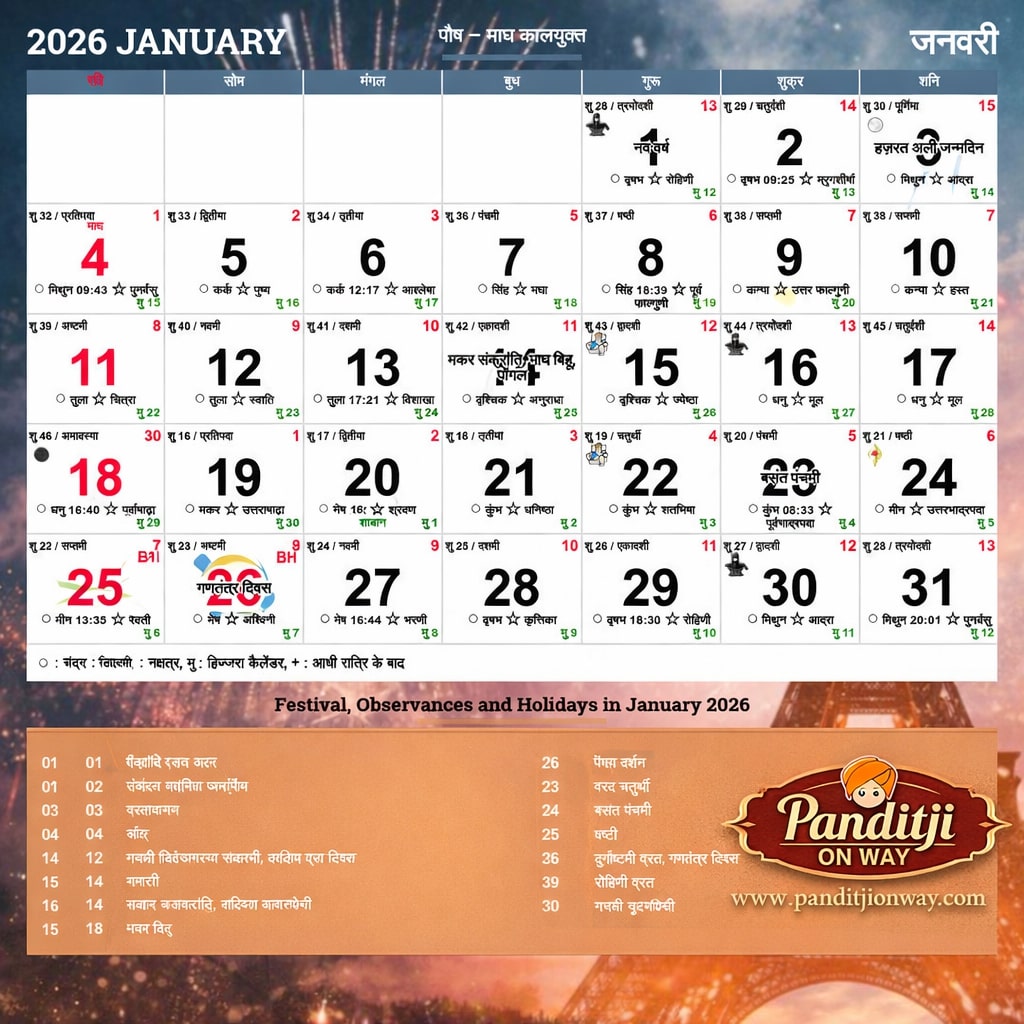
Dainik Panchang – 30 January 2026
Basic Panchang Elements
- Weekday: Shukrawara (Friday)
- Paksha: Shukla Paksha
- Tithi: Dwadashi (up to 11:09)
- Nakshatra: Ardra (up to 03:27, 31 Jan)
- Yoga: Vaidhriti (up to 16:58)
- Karana:
- Balava (up to 11:09)
- Kaulava (up to 21:46)
- Sun Sign (Rashi): Makara (Capricorn)
- Moon Sign (Rashi): Mithuna (Gemini)
Yoga Timings as per Assamese Panjika
Auspicious and Inauspicious Yogas
- Amrita Yoga:
- 07:10 – 08:37
- 13:39 – 15:06
- 16:32 – 17:59
- 19:44 – 21:30
- 04:32 – 05:24 (31 Jan)
- Mahendra Yoga:
- 23:15 – 00:08 (31 Jan)
- 05:24 – 07:10 (31 Jan)
- Vakra Yoga:
- 08:37 – 09:20
- 11:30 – 13:39
- 17:59 – 19:44
- 00:08 – 02:46 (31 Jan)
- Shunya Yoga:
- 09:20 – 11:30
- 15:06 – 16:32
- 21:30 – 23:15
- 02:46 – 04:32 (31 Jan)
Insight:
- Amrita Yoga is ideal for Puja, mantra jaap, and auspicious beginnings.
- Shunya Yoga should be avoided for important tasks.
Festival and Vrat – 30 January 2026
Gandhi Punyatithi
Observed in remembrance of Mahatma Gandhi, this day is marked by prayers, silence, and remembrance ceremonies across India.
January 2026 Assamese Festival Calendar Highlights
- 01 Jan – English New Year
- 02 Jan – Hazarat Ali’s Birthday
- 14 Jan – Makara Sankranti, Shattila Ekadashi
- 15 Jan – Magh Bihu
- 23 Jan – Saraswati Puja, Subhas Chandra Bose Jayanti
- 26 Jan – Republic Day
- 29 Jan – Bhaimi Ekadashi
- 30 Jan – Gandhi Punyatithi
Assamese Panchang Reference Lists (Complete & Authentic)
This section provides a complete reference of Assamese Panchang elements used in Assamese Panjika based on Bisuddhasiddhanta. These lists are essential for understanding Tithi, Nakshatra, Yoga, Karana, Rashi, and month calculations followed by traditional priests.
Assamese Month List (Mas Names with Rashi Mapping)
The Assamese calendar months are aligned with solar Rashi (Zodiac signs) and are widely used in religious observances, festivals, and Muhurat selection.
- Boishakh (Mesha)
- Joishtho (Vrishabha)
- Asharh (Mithuna)
- Srabon (Karka)
- Bhadro (Simha)
- Ashshin (Kanya)
- Kartik (Tula)
- Ogrohaeon (Vrishchika)
- Poush (Dhanu)
- Magh (Makara)
- Falgun (Kumbha)
- Choitro (Meena)
Relevance:
Assamese Month names are frequently searched for festival dates, Vrat timing, and Assamese calendar conversions.
Assamese Nakshatra List (27 Lunar Constellations)
Nakshatras play a vital role in Puja Muhurat, Vrat observance, astrology, and daily Panchang analysis.
- Ashwini
- Bharani
- Krittika
- Rohini
- Mrigashira
- Ardra
- Punarvasu
- Pushya
- Ashlesha
- Magha
- Purva Phalguni
- Uttara Phalguni
- Hasta
- Chitra
- Swati
- Vishakha
- Anuradha
- Jyeshtha
- Mula
- Purva Ashadha
- Uttara Ashadha
- Shravana
- Dhanishtha
- Shatabhisha
- Purva Bhadrapada
- Uttara Bhadrapada
- Revati
Tip:
Nakshatra-based searches are common for marriage, naming ceremony, travel Muhurat, and spiritual activities.
Assamese Yoga Names (27 Yogas)
Yogas indicate the quality of time and determine whether a period is auspicious or inauspicious.
- Vishkambha
- Priti
- Ayushmana
- Saubhagya
- Shobhana
- Atiganda
- Sukarma
- Dhriti
- Shula
- Ganda
- Vriddhi
- Dhruva
- Vyaghata
- Harshana
- Vajra
- Siddhi
- Vyatipata
- Variyana
- Parigha
- Shiva
- Siddha
- Sadhya
- Shubha
- Shukla
- Brahma
- Indra
- Vaidhriti
Key Insight:
- Siddhi, Shubha, Amrita Yoga → highly auspicious
- Vyatipata, Vaidhriti, Ganda → generally avoided
Assamese Karana Names (11 Karanas)
Karana represents half of a Tithi and is important in detailed Panchang analysis.
- Kinstughna
- Bava
- Balava
- Kaulava
- Taitila
- Garaja
- Vanija
- Vishti
- Shakuni
- Chatushpada
- Nagava
Note:
Vishti (Bhadra) Karana is usually avoided for auspicious activities.
Assamese Tithi Names (Shukla & Krishna Paksha)
Shukla Paksha Tithis
- Pratipada
- Dbitiya
- Tritiya
- Chaturthi
- Panchami
- Shashthi
- Saptami
- Ashtami
- Nabami
- Dashami
- Ekadashi
- Dbadashi
- Trayodashi
- Chaturdashi
- Purnima
Krishna Paksha Tithis
- Pratipada
- Dbitiya
- Tritiya
- Chaturthi
- Panchami
- Shashthi
- Saptami
- Ashtami
- Nabami
- Dashami
- Ekadashi
- Dbadashi
- Trayodashi
- Chaturdashi
- Amabasya
Value:
Tithi-based keywords dominate searches for Ekadashi, Amavasya, Purnima, Sankranti, and fasting rules.
Assamese Rashi Names (Zodiac Signs)
Rashi indicates the Sun and Moon position, crucial for astrology and Panchang interpretation.
- Mesha
- Vrishabha
- Mithuna
- Karka
- Simha
- Kanya
- Tula
- Vrishchika
- Dhanu
- Makara
- Kumbha
- Meena
Why These Assamese Panchang Lists Matter
These lists are essential for:
- Accurate daily Panchang reading
- Correct Puja and Vrat observance
- Proper Muhurat selection
- Traditional Astrology and Siddhanta calculations
They are widely used by temple priests, astrologers, and Vedic scholars.
Book Panchang-Based Puja with Expert Pandits
For Puja, Havan, Jaap, Katha, Griha Pravesh, and Vastu Shanti strictly according to Assamese Panjika & Bisuddhasiddhanta Muhurat, book verified Pandits at:
https://www.panditjionway.com
(Panditji on way)
Importance of Bisuddhasiddhanta Panjika in Daily Life
Using Bisuddhasiddhanta-based Panjika ensures:
- Accurate Muhurat selection
- Correct Vrat observance
- Proper alignment with Vedic astronomy
- Success in spiritual and religious activities
This is especially beneficial for people performing Rudrabhishek, Griha Pravesh, Ekadashi Vrat, Navratri Puja, and Graha Shanti rituals.
Why Follow Assamese Panjika for New Delhi?
Although traditionally Assamese, this Panjika is location-adjusted for New Delhi, making it suitable for:
- Delhi NCR residents
- North Indian devotees
- NRIs seeking accurate Indian Panchang
- Online Puja and Pandit booking services
Book Pandit as per Panchang Muhurat
For Puja, Havan, Jaap, Katha, Griha Pravesh, and Vastu Shanti based on accurate Assamese Panjika Muhurat, book verified Vedic Pandits at:
https://www.panditjionway.com (Panditji on way)
- Hindu Panchang concepts and astronomy:
https://en.wikipedia.org/wiki/Panchangam - Vedic astronomy and Siddhanta basics:
https://www.britannica.com/topic/Hindu-calendar
Frequently Asked Questions – Assamese Panjika (Bisuddhasiddhanta) for New Delhi
What is Assamese Panjika based on Bisuddhasiddhanta?
Assamese Panjika based on Bisuddhasiddhanta is a traditional Hindu Panchang calculated using classical Vedic astronomical principles. It provides precise information on Tithi, Nakshatra, Yoga, Karana, sunrise, sunset, festivals, and auspicious timings, making it highly reliable for religious and spiritual practices.
Is Assamese Panjika accurate for New Delhi, India?
Yes. When location-specific coordinates of New Delhi, NCT, India are applied, Assamese Panjika becomes fully accurate. All timings such as sunrise, sunset, moonrise, tithi ending time, and yoga duration are adjusted to New Delhi’s longitude and latitude.
What makes Bisuddhasiddhanta Panjika different from Drik Panchang?
Bisuddhasiddhanta Panjika follows classical Siddhanta calculations rooted in traditional Vedic astronomy, whereas Drik Panchang uses modern astronomical observations. Many priests prefer Bisuddhasiddhanta for Puja, Vrat, Havan, and Muhurat selection due to its ritual authenticity.
Which Yoga is considered most auspicious in Assamese Panjika?
Amrita Yoga and Mahendra Yoga are considered the most auspicious Yogas. These periods are ideal for Puja, mantra jaap, spiritual sadhana, Griha Pravesh, and starting new religious activities.
Which Yoga should be avoided according to Assamese Panjika?
Shunya Yoga is considered inauspicious. Important tasks such as marriage discussions, business beginnings, property purchase, and major Puja rituals should be avoided during Shunya Yoga.
What is the importance of Tithi in Assamese Panjika?
Tithi determines the lunar day and plays a crucial role in fasting (Vrat), festival observance, and ritual timing. Observing Vrat on the correct Tithi ensures maximum spiritual benefit as per Vedic scriptures.
Why is Nakshatra important in daily Panchang?
Nakshatra influences mental state, energy flow, and outcome of actions. Choosing the right Nakshatra enhances success in Puja, travel, education, and spiritual practices.
Can Assamese Panjika be used for Ekadashi and Vrat calculations?
Yes. Assamese Panjika is widely used for Ekadashi, Purnima, Amavasya, Sankranti, and other Vrat calculations, especially by Vaishnav and Shakta traditions.
How is sunrise important in Hindu Panchang?
In Hindu Panchang, the day begins with sunrise, not midnight. Tithi, Vrat, and festival observance are calculated based on sunrise timings, making sunrise a critical factor.
Is Assamese Panjika suitable for Griha Pravesh and Puja Muhurat?
Absolutely. It is highly suitable for Griha Pravesh, Vastu Shanti, Rudrabhishek, Satyanarayan Puja, and Graha Shanti, provided the Muhurat is selected during auspicious Yoga and Nakshatra.
Where can I book a Pandit based on accurate Panchang Muhurat?
You can book experienced Vedic Pandits for Puja, Havan, Jaap, Katha, and Muhurat-based rituals through
https://www.panditjionway.com
India’s first and largest online Puja booking platform.
Is Assamese Panjika useful for NRIs?
Yes. NRIs can use Assamese Panjika with location-specific adjustments to perform rituals according to Indian Vedic time, especially for Ekadashi, Shraddha, and festival observance.
Which month does Magh (Maagh) represent in Assamese calendar?
Magh (Maagh) generally corresponds to January–February and is considered highly auspicious for spiritual discipline, charity, bathing rituals, and festivals like Magh Bihu and Makara Sankranti.
Why should Assamese Panjika be trusted for religious rituals?
Assamese Panjika is trusted because it is:
- Based on ancient Siddhanta calculations
- Followed by traditional priests
- Aligned with scriptural injunctions
- Proven accurate over centuries
Conclusion
The Assamese Panjika based on Bisuddhasiddhanta for New Delhi provides a highly reliable and spiritually aligned Panchang for January 2026. From daily Yogas and Tithi to festivals and Vrat, this Panjika is an essential guide for anyone seeking accuracy, tradition, and success in religious observances. For personalized Puja and Muhurat guidance, Panditji On Way remains the most trusted online solution.