
Ganda Moola Nakshatra February 2026: Timings, Meaning, Effects & Remedies (Complete Guide)
Complete guide to February 2026 Ganda Moola Nakshatra. Check accurate timings, effects, Gandanta zones, remedies, and Ganda Moola Shanti Puja details. Ideal for parents & astrology followers.
February 2026 Ganda Moola Nakshatra Timings (New Delhi, India)
Below are the accurate Ganda Mool periods in February 2026 as per local New Delhi time (24-hour format).
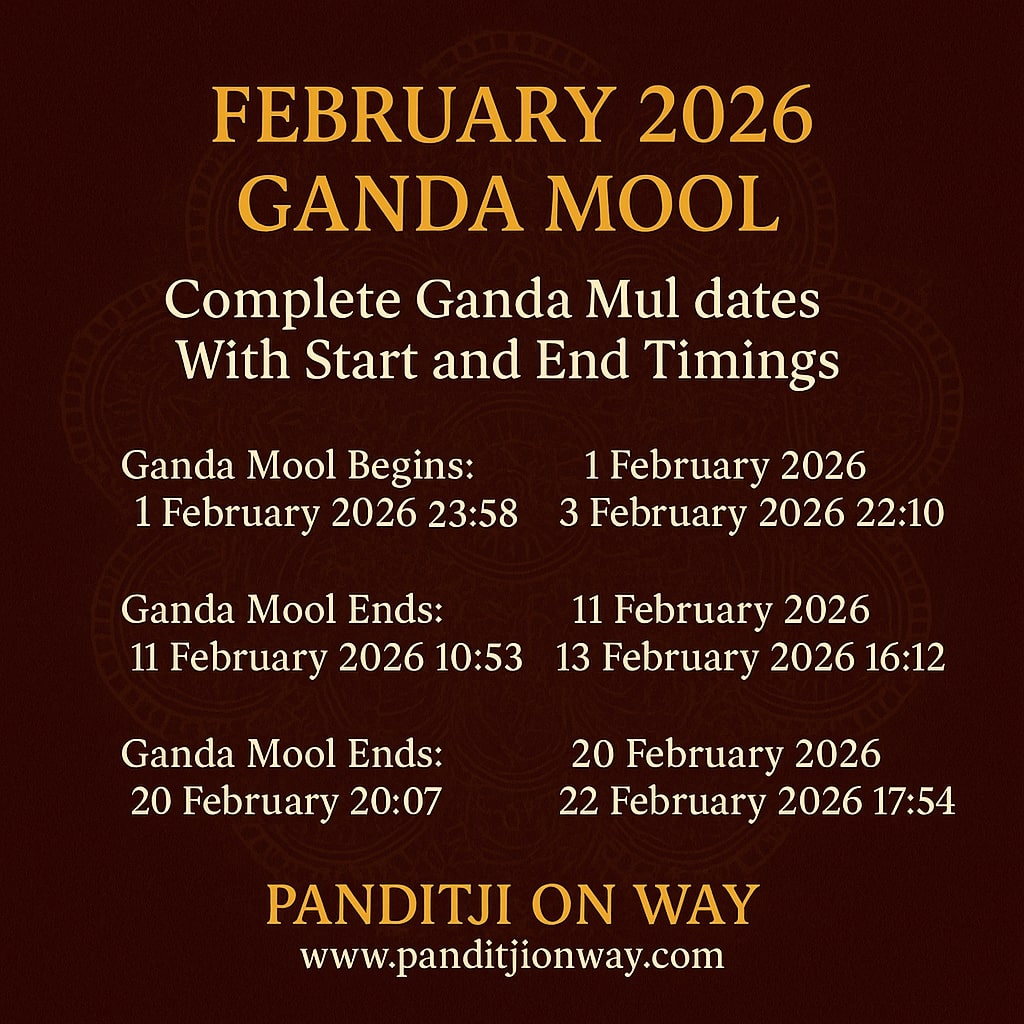
1. First Ganda Mool Period
Ganda Mool Begins:
1 February 2026 (Sunday) at 23:58
Ganda Mool Ends:
3 February 2026 (Tuesday) at 22:10
2. Second Ganda Mool Period
Ganda Mool Begins:
11 February 2026 (Wednesday) at 10:53
Ganda Mool Ends:
13 February 2026 (Friday) at 16:12
3. Third Ganda Mool Period
Ganda Mool Begins:
20 February 2026 (Friday) at 20:07
Ganda Mool Ends:
22 February 2026 (Sunday) at 17:54
Note:
All timings follow 24-hour notation as per New Delhi Panchang. Hours after midnight fall on the next date. A Panchang day begins at sunrise.
What is Ganda Moola Nakshatra?
Ganda Moola (also known as Gandmool) refers to a specific astrological dosha related to the Gandanta zone—a sensitive transition point between water and fire zodiac signs. When a child is born during these Nakshatra transitions, the birth is traditionally considered sensitive and requires remedies.
Ganda Moola Dosha is primarily checked based on:
- Birth Nakshatra
- Pada (quarter)
- Degree of Moon
- Planetary positions and aspects
- Dasha and Antardasha influence
Although ancient texts emphasize its importance, modern astrologers evaluate the entire horoscope before declaring any dosha, as not every Ganda Mool birth is harmful.
List of Ganda Moola Nakshatra(s)
There are six Ganda Moola Nakshatras:
| Sl.No. | Nakshatra | Category | Gandanta Zone | Possible Traditional Effect |
|---|---|---|---|---|
| 1 | Ashwini | Moola | Revati → Ashwini | Impact on Father |
| 2 | Ashlesha | Ganda | Ashlesha → Magha | Impact on Mother |
| 3 | Magha | Moola | Ashlesha → Magha | Impact on Father |
| 4 | Jyeshtha | Ganda | Jyeshtha → Moola | Impact on Younger Siblings |
| 5 | Moola | Moola | Jyeshtha → Moola | Impact on Father/Grandfather |
| 6 | Revati | Ganda | Revati → Ashwini | Impact on Mother |
These effects are traditional beliefs and not universal. Many natives born in these Nakshatra(s) lead healthy, prosperous lives.
Ganda Moola & Gandanta Zones Explained
The Gandanta points occur at the junction of:
- Ashlesha → Magha (Cancer to Leo)
- Jyeshtha → Moola (Scorpio to Sagittarius)
- Revati → Ashwini (Pisces to Aries)
These positions are believed to hold unstable energy due to elemental transitions.
Effects of Ganda Moola Based on Nakshatra
1. Ashwini Nakshatra (Moola Type)
- May indicate sensitivity related to father.
- Strong benefic aspect cancels dosha.
2. Ashlesha Nakshatra (Ganda Type)
- Traditionally linked to mother-related concerns.
- Remedies often nullify dosha completely.
3. Magha Nakshatra (Moola Type)
- Believed to influence father or paternal side.
- Strong lagna lord reduces dosha.
4. Jyeshtha Nakshatra (Ganda Type)
- Associated with younger siblings.
- Benefic Jupiter aspects provide complete protection.
5. Moola Nakshatra (Moola Type)
- Traditionally connected to father or grandfather.
- Most important to check Pada and planetary dignities.
6. Revati Nakshatra (Ganda Type)
- May indicate sensitivity toward mother.
- Generally considered auspicious if well-aspected.
Modern astrology emphasizes not generalizing effects. Only a complete birth chart analysis reveals true outcomes.
Remedies & Shanti for Ganda Moola Dosha
Traditionally, the following rituals are performed:
1. Ganda Moola Shanti Puja
Performed:
- On the 27th day after birth, or
- During the same Nakshatra month cycle
Purpose:
To balance planetary vibrations and protect the child and family.
2. Nakshatra Homa
A fire ritual dedicated to the presiding deity of the birth Nakshatra.
3. Recitation of Specific Mantras
Includes:
- Nakshatra Devata Mantra
- Vedic Sooktas
- Protective Mantras for the child
4. Charity & Brahmin Bhoj
Offering charity and feeding Brahmins is a traditional purifier.
These rituals are performed to neutralize any dosha and bring peace to the family.
Importance of Ganda Moola in Muhurat Selection
Ganda Moola timings are avoided for:
- Marriage Muhurat
- Griha Pravesh
- Business opening
- Naming ceremonies
- Major life events
Knowing these timings helps families avoid inauspicious periods.
February 2026 Ganda Moola Timings (Quick Reference)
| Event | Start Date & Time | End Date & Time | Location |
|---|---|---|---|
| Ganda Moola Period 1 | 1 Feb 2026, 23:58 | 3 Feb 2026, 22:10 | New Delhi |
| Ganda Moola Period 2 | 11 Feb 2026, 10:53 | 13 Feb 2026, 16:12 | New Delhi |
| Ganda Moola Period 3 | 20 Feb 2026, 20:07 | 22 Feb 2026, 17:54 | New Delhi |
Need Ganda Moola Shanti Puja?
For authentic Ganda Moola Shanti Puja, Nakshatra Homa, and online Pandit booking, visit:
https://www.panditjionway.com (Panditji on way)
You can book expert Pandits for:
- Ganda Moola Shanti
- Moola Nakshatra Puja
- Griha Pravesh
- Rudrabhishek
- Grah Shanti
FAQ: Ganda Moola Nakshatra
1. What is Ganda Moola Nakshatra in astrology?
Ganda Moola Nakshatra refers to six birth Nakshatras that fall in the Gandanta zone, where the Moon transitions between water and fire signs. These transitional degrees are considered sensitive and may indicate specific karmic challenges unless neutralized through Ganda Moola Shanti Puja.
2. Which Nakshatras are included in Ganda Moola?
The six Ganda Moola Nakshatras are Ashwini, Ashlesha, Magha, Jyeshtha, Moola, and Revati. These are checked at the time of birth to identify whether the newborn has the Ganda Moola Dosha.
3. What are the effects of Ganda Moola Dosha on the child?
The effects depend on the specific Nakshatra, Pada, and overall horoscope. Traditional beliefs associate Ganda Moola births with sensitivity in areas related to parents or siblings. Modern astrology, however, states that the dosha only matters if supported by planetary afflictions in the Janma Kundli.
4. How can Ganda Moola Dosha be removed?
Ganda Moola Dosha is generally removed through Ganda Moola Shanti Puja, Nakshatra Homa, mantra recitation, and charity. The ritual is ideally performed on the 27th day after birth or when the same nakshatra returns during the lunar cycle.
5. Is Ganda Moola Dosha always harmful?
No. Ganda Moola Dosha is not always harmful. In many charts, the dosha gets naturally cancelled by strong benefic planets, favourable dashas, or supportive aspects. Only a detailed Kundli analysis can confirm whether the dosha has any real impact.
6. Can a child born during Ganda Moola Nakshatra live a normal life?
Yes. Millions of people born in Ganda Moola Nakshatras lead healthy, prosperous, and successful lives. Traditional concerns apply only in rare cases where additional planetary afflictions exist.
7. Why is the 27th day important for Ganda Moola Shanti Puja?
The 27th day marks the completion of one full lunar cycle. It aligns the child’s birth Nakshatra with the cosmic pattern, making it the most effective day to perform Ganda Moola Shanti and remove any associated dosha.
8. Should important ceremonies be avoided during Ganda Moola timings?
Yes. Auspicious activities like marriage, Griha Pravesh, Naamkaran, and business openings are traditionally avoided during Ganda Moola periods because they fall under inauspicious Gandanta timings.
9. What is the remedy for Moola Nakshatra birth?
For a child born in Moola Nakshatra, Moola Nakshatra Shanti, mantra recitation of the Nakshatra deity, and charitable activities are recommended. A qualified astrologer or Pandit performs the ritual to reduce any negative influence.
10. Where can I book Ganda Moola Shanti Puja online?
You can book certified Pandits for Ganda Moola Shanti Puja, Moola Nakshatra Puja, and all Vedic rituals through:
https://www.panditjionway.com
Conclusion
Ganda Moola Nakshatra is a significant concept in Vedic astrology, especially for newborns. Though ancient beliefs associate it with certain sensitivities, modern astrology recommends a holistic view of the entire horoscope. With proper Shanti Puja and remedies, any imbalance can be neutralized.
If you wish to perform Ganda Moola Shanti Puja or consult expert astrologers, you can book an experienced Pandit at:
https://www.panditjionway.com