

Dussehra 2026: Date, Vijayadashami Puja Vidhi, Significance, Ravana Dahan, Traditions and Best Places to Celebrate in India
Discover Dussehra 2026 date, Vijayadashami Tithi, puja vidhi, significance, Ravana Dahan, Shami Puja and famous Dussehra celebrations across India.
Copy meta description
Dussehra 2026, also known as Vijayadashami or Dasara, is one of the most important Hindu festivals in India. It symbolizes the victory of good over evil and marks Lord Rama’s victory over Ravana and Goddess Durga’s victory over Mahishasura, according to Hindu religious traditions. In most parts of India, Dussehra will be celebrated on Tuesday, 20 October 2026, while some regional traditions, including Bengal Vijayadashami and Kerala’s Vijayadashami observances, follow 21 October.
For devotees planning Dussehra Puja, Ravana Dahan, Shami Puja, Durga Visarjan or other religious ceremonies, understanding the festival’s date, significance, rituals and regional customs helps make the occasion more meaningful.
Panditji on Way, an online pooja booking platform, helps devotees explore Hindu puja services and religious guidance for important festivals and auspicious occasions.
Dussehra 2026: Date, Tithi and Important Details
| Festival Detail | Information |
|---|---|
| Festival name | Dussehra, Vijayadashami, Dasara |
| Dussehra 2026 date | Tuesday, 20 October 2026, in most parts of India |
| Bengal Vijayadashami | Wednesday, 21 October 2026 |
| Hindu lunar month | Ashwin (Ashwayuja in some regional calendars) |
| Hindu Paksha | Shukla Paksha |
| Tithi | Dashami |
| Main significance | Victory of good over evil |
| Main deities | Lord Rama and Goddess Durga |
| Important rituals | Ravana Dahan, Shami Puja, Aparajita Puja, Durga Visarjan |
| Major celebrations | Delhi, Varanasi, Ayodhya, Kolkata, Mysuru, Kullu and Bastar |
Important: Festival dates and puja timings can vary according to the local Panchang, sunrise calculations, Dashami Tithi and regional customs. Check the relevant city’s Panchang before planning a specific puja or ceremony.
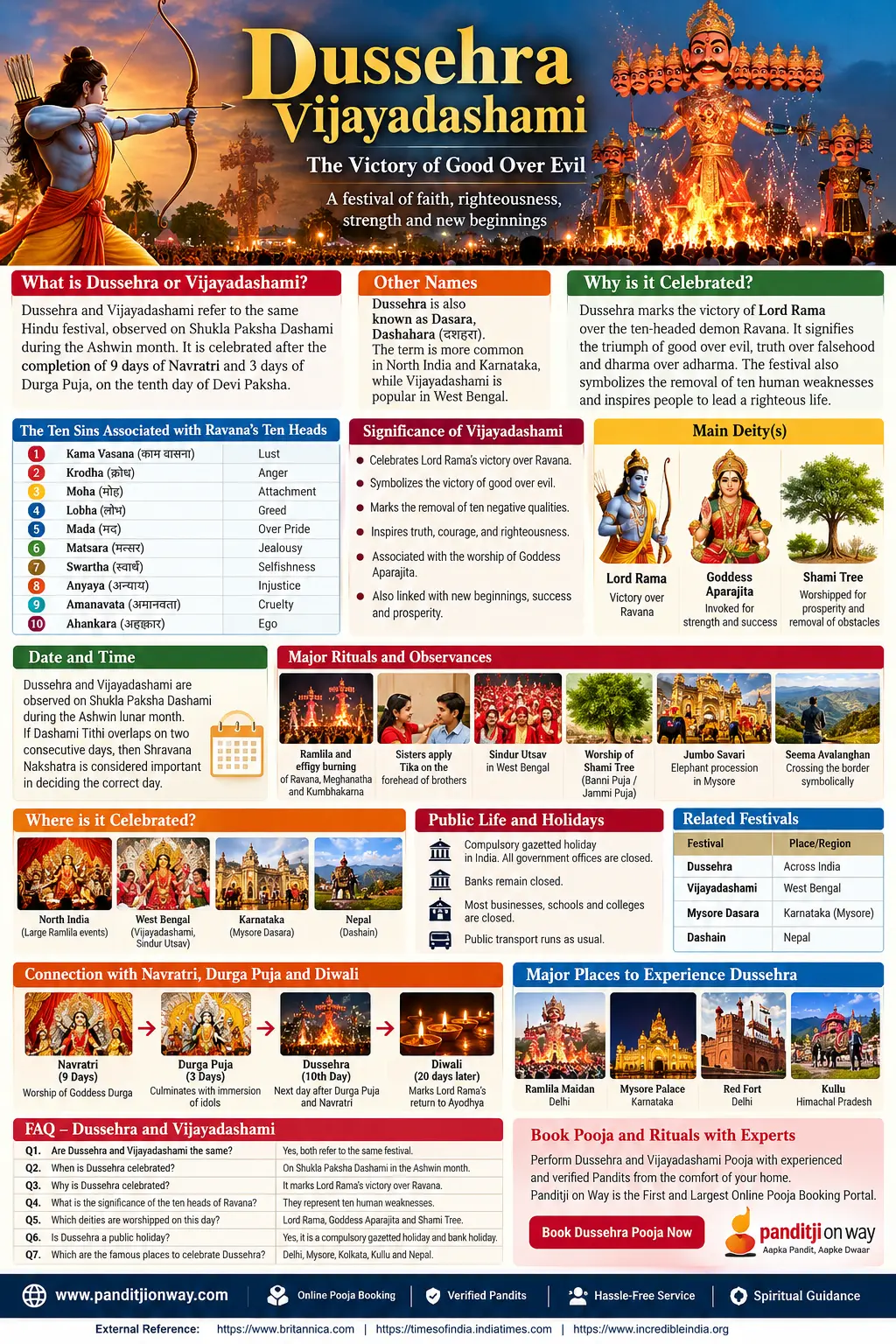

What Is Dussehra and Why Is It Celebrated?
Dussehra is a Hindu festival observed on the tenth day, known as Dashami, of the bright lunar fortnight in the Hindu month of Ashwin. It is celebrated as Vijayadashami because it represents victory, courage, righteousness and the triumph of divine power over evil.
The festival has two major religious associations.
First, it commemorates Lord Rama’s victory over the ten-headed demon king Ravana, as narrated in the Ramayana. The burning of Ravana’s effigy, often accompanied by effigies of Meghnada and Kumbhakarna, represents the destruction of evil and the restoration of righteousness.
Second, Vijayadashami marks Goddess Durga’s victory over Mahishasura in Hindu religious tradition. In West Bengal and several eastern Indian regions, the day concludes the major Durga Puja festivities and is associated with Sindoor Khela, devotional gatherings and the immersion of Goddess Durga’s idols.
Thus, Dussehra is more than a religious celebration. It conveys the enduring message that truth, justice, discipline and righteousness should prevail over arrogance, greed and injustice.
Dussehra and Vijayadashami: Are They the Same Festival?
Yes. Dussehra and Vijayadashami generally refer to the same festival, although regional traditions emphasize different religious stories and observances.
The term Dussehra is widely used in northern India and many other parts of the country. Dasara is a common spelling in Karnataka and other southern regions, while Vijayadashami and Bijoya Dashami are particularly familiar in eastern India.
| Name | Meaning or Association | Popular Regions |
|---|---|---|
| Dussehra | Victory of Lord Rama over Ravana; triumph of good over evil | Delhi, Uttar Pradesh, Rajasthan, Maharashtra |
| Vijayadashami | The victorious tenth day | Across India |
| Dasara | Regional name for the festival | Karnataka and other southern regions |
| Bijoya Dashami | Conclusion of Durga Puja celebrations | West Bengal and Bengali communities |
| Dashain | Related festival with its own traditions | Nepal |
Although these names are commonly associated with the same festival, local customs, religious interpretations and celebration dates can differ.

Dussehra and Vijayadashami Origin and Significance
The significance of Dussehra is rooted in Hindu scriptures, epics and regional religious traditions. The festival is associated with the victory of Lord Rama, the power of Goddess Durga and the symbolic destruction of negative human qualities.
1. Lord Rama’s Victory Over Ravana
According to the Ramayana, Ravana abducted Goddess Sita and took her to Lanka. Lord Rama, supported by Lakshmana, Hanuman and the Vanara army, fought a battle against Ravana to rescue Sita and restore righteousness.
Ravana was ultimately defeated, and his death came to symbolize the triumph of dharma over adharma.
On Dussehra, communities organize Ramlila performances that dramatize important episodes from the Ramayana. These performances often conclude with Ravana Dahan, when large effigies of Ravana, Meghnada and Kumbhakarna are burned.
2. Goddess Durga’s Victory Over Mahishasura
In another important tradition, Vijayadashami celebrates Goddess Durga’s victory over Mahishasura, a powerful demon associated with oppression and disorder.
After a prolonged battle, Goddess Durga defeated Mahishasura, demonstrating the power of divine feminine energy and the restoration of cosmic balance.
This association is particularly important in West Bengal, where Durga Puja is celebrated with elaborate pandals, artistic idols, cultural programmes and devotional ceremonies.
3. The Spiritual Meaning of Vijayadashami
The word Vijayadashami combines the ideas of vijaya, meaning victory, and dashami, meaning the tenth lunar day.
Spiritually, the festival encourages people to overcome negative habits, act ethically, develop self-discipline and pursue their goals with courage.
Dussehra also marks a traditional time for new beginnings. In different regions, people begin educational activities, worship tools and instruments, purchase items for important projects, or undertake other auspicious activities according to their family traditions.
Dussehra and the Ten Heads of Ravana: Ten Negative Qualities to Overcome
Ravana’s ten heads are often interpreted symbolically in popular religious explanations of Dussehra. The burning of his effigy reminds devotees to identify and overcome destructive tendencies within themselves.
The following ten qualities are commonly associated with this interpretation.
| No. | Negative Quality | Hindi Meaning | Lesson |
|---|---|---|---|
| 1 | Lust | काम वासना | Practice self-control and respect |
| 2 | Anger | क्रोध | Develop patience and emotional discipline |
| 3 | Attachment | मोह | Maintain balance and perspective |
| 4 | Greed | लोभ | Value honesty and contentment |
| 5 | Pride | मद | Remain humble despite success |
| 6 | Jealousy | मत्सर | Appreciate others’ achievements |
| 7 | Selfishness | स्वार्थ | Consider the well-being of others |
| 8 | Injustice | अन्याय | Stand for fairness and truth |
| 9 | Cruelty | अमानवता | Practice compassion and kindness |
| 10 | Ego | अहंकार | Cultivate humility and wisdom |
These ten qualities form a popular moral interpretation rather than a single universally prescribed scriptural list. Their central message is that real victory begins with self-improvement.
Dussehra and Vijayadashami Deities
Lord Rama
Lord Rama is one of the principal deities associated with Dussehra. Revered as an ideal of dharma, duty and righteousness, he represents the victory of truth over falsehood and moral responsibility over arrogance.
Devotees worship Lord Rama, visit temples, recite passages from the Ramayana and attend Ramlila performances. In northern India, the festival is especially associated with the dramatic enactment of Rama’s victory and Ravana Dahan.
Goddess Durga
Goddess Durga is central to Vijayadashami celebrations in eastern India and many other regions. Her victory over Mahishasura symbolizes the power of righteousness and divine protection against destructive forces.
On Vijayadashami, devotees participate in farewell ceremonies, prayers and Durga Visarjan. In Bengal, Bijoya Dashami also carries the emotional significance of bidding farewell to the goddess after the annual Durga Puja celebration.
Goddess Aparajita
Goddess Aparajita is associated with victory and the inability of negative forces to overcome righteousness. In certain Hindu traditions, devotees perform Aparajita Puja on Vijayadashami, seeking blessings for success, protection and the successful completion of important undertakings.
The practice and timing of this worship vary by region and family tradition.
Shami Tree
The Shami tree holds special significance in Vijayadashami traditions. A popular association comes from the Mahabharata, in which the Pandavas’ weapons were concealed in a Shami tree during their period of exile.
Shami Puja is performed in several parts of India, including Maharashtra and Karnataka, where related traditions may be known by regional names such as Banni Puja.
The ritual symbolizes courage, preparedness, prosperity and the return of strength at an auspicious time.
Dussehra 2026 Date and Time: Dashami Tithi and Vijay Muhurat
Dussehra is observed on the Dashami Tithi of Shukla Paksha in the Hindu month of Ashwin. Since the Hindu lunar calendar does not align exactly with the Gregorian calendar, the festival usually falls in September or October.
For 2026, the following timings are published for New Delhi.
| Panchang Detail | Time and Date |
|---|---|
| Dussehra in most northern and central Indian traditions | 20 October 2026 |
| Dashami Tithi begins | 20 October, approximately 12:50 PM |
| Dashami Tithi ends | 21 October, approximately 2:11 PM |
| Vijay Muhurat in New Delhi | 1:59 PM to 2:45 PM on 20 October |
| Bengal Vijayadashami | 21 October 2026 |
These timings are location-specific and should not be treated as universal timings for every Indian city.
How Is the Dussehra Date Determined?
The date is determined using Hindu Panchang calculations, including the Dashami Tithi, local sunrise and the traditional rules for observing Vijayadashami.
When Dashami extends across two civil calendar days, the presence of Shravana Nakshatra and the prescribed Aparahna period may be relevant to determining the observance, depending on the applicable tradition.
For the exact puja Muhurat, devotees should consult a Panchang for their city.
Panchang reference: Drik Panchang – Vijayadashami 2026
Dussehra and Vijayadashami Puja Vidhi
The method of observing Dussehra varies across regions and family traditions. A simple home observance can include the following steps.
Step 1: Clean the Puja Area
Clean the home and prepare a clean place for worship. Arrange the images or idols of the deities you intend to worship.
Step 2: Take a Sankalp
Begin with a prayerful intention to perform the puja with devotion. Family traditions may include a Sankalp, Ganesh Puja and other preliminary rituals.
Step 3: Worship Lord Rama or Goddess Durga
Offer flowers, incense, a diya, fruits and other customary offerings according to your tradition. Recite suitable prayers or read passages from the Ramayana or Durga-related devotional texts.
Step 4: Perform Shami Puja or Aparajita Puja
Where these customs are followed, worship the Shami tree or Goddess Aparajita according to the local Panchang and family practice.
Step 5: Participate in Ramlila or Ravana Dahan
In communities where Ravana Dahan is organized, attend the public celebration safely and follow the organizers’ instructions.
Step 6: Offer Prayers for Well-Being and New Beginnings
Conclude the observance with prayers for peace, prosperity, wisdom and the courage to overcome negative qualities.
This is a general outline, not a substitute for a tradition-specific Vedic ritual. Complex pujas, homams and other ceremonies may require a qualified priest and a more detailed procedure.
Looking for a priest for a Hindu puja? Visit Panditji on Way to explore pooja booking services and religious guidance.
Major Dussehra Rituals and Traditions in India
Dussehra is celebrated in different ways across India. Some communities focus on Ravana Dahan, while others emphasize Goddess Durga, royal processions, worship of tools or educational ceremonies.
| Ritual or Tradition | Description | Where It Is Popular |
|---|---|---|
| Ramlila | Dramatic enactment of the Ramayana | Delhi, Ayodhya, Varanasi and other northern Indian cities |
| Ravana Dahan | Burning effigies representing Ravana and other characters | Delhi, Uttar Pradesh, Rajasthan and many other regions |
| Shami Puja | Worship associated with the Shami tree | Maharashtra, Karnataka and other regions |
| Aparajita Puja | Worship for victory and success | Selected regional and family traditions |
| Durga Visarjan | Immersion of Goddess Durga’s idols | West Bengal and eastern India |
| Sindoor Khela | Traditional ritual performed by many married Bengali women | West Bengal |
| Seema Avalanghan | Symbolic crossing of boundaries, associated with victory and new undertakings | Maharashtra and some western Indian traditions |
| Ayudha Puja | Worship of tools, instruments, vehicles and work equipment | Karnataka, Tamil Nadu and other southern regions |
| Vidyarambham | Traditional initiation into learning | Kerala and other regional communities |
| Jumboo Savari | Grand ceremonial procession during Mysuru Dasara | Mysuru, Karnataka |
Not every ritual is performed in every state. Local customs, temple traditions and family practices determine the form of celebration.
Best Places to Celebrate Dussehra in India
India offers a remarkable variety of Dussehra celebrations. Visitors can experience theatrical performances, temple rituals, royal processions, elaborate Durga Puja pandals and distinctive local festivals.
1. Delhi – Ramlila and Ravana Dahan
Delhi is known for its large Ramlila performances and public Ravana Dahan events. Ramlila grounds and community-organized celebrations attract families and visitors who gather to watch episodes from the Ramayana.
The festival is particularly significant around major Ramlila venues, including the historic Ramlila Maidan and other organized grounds across the capital.
Best for: Ramlila, family celebrations, public Ravana Dahan and cultural performances.
Official reference: Delhi Tourism – Dussehra
2. Ayodhya, Uttar Pradesh – The City Associated with Lord Rama
Ayodhya holds special religious importance for devotees of Lord Rama. During the Dussehra period, visitors may attend temple prayers, religious programmes and events associated with the Ramayana tradition.
The city is also a significant destination for pilgrims interested in the life and worship of Lord Rama.
Best for: Lord Rama devotion, temple visits, Ramayana-related religious tourism and pilgrimage.
3. Varanasi, Uttar Pradesh – Traditional Ramlila
Varanasi is associated with longstanding traditions of Ramayana performance and religious observance. Ramlila events in the wider region provide an opportunity to experience devotional theatre, storytelling and community celebrations.
Best for: Traditional Ramlila, religious culture and pilgrimage.
4. Kolkata, West Bengal – Durga Puja and Bijoya Dashami
In Kolkata and across West Bengal, Vijayadashami marks the emotional conclusion of Durga Puja. Elaborately decorated pandals, artistic idols, devotional music and community gatherings form the heart of the celebrations.
On Bijoya Dashami, devotees participate in farewell rituals and Durga Visarjan. Sindoor Khela is another well-known tradition in which participating married women apply vermilion to one another and to the goddess, according to customary practice.
Kolkata’s Durga Puja was inscribed on UNESCO’s Representative List of the Intangible Cultural Heritage of Humanity in 2021.
Best for: Durga Puja pandals, cultural events, traditional rituals and Durga Visarjan.
Official reference: West Bengal Tourism – Durga Puja
5. Mysuru, Karnataka – The Royal Mysuru Dasara Festival
Mysuru Dasara is one of Karnataka’s most prominent annual cultural festivals. The celebrations are associated with Goddess Chamundeshwari’s victory over Mahishasura and include palace illumination, cultural programmes and the famous Jumboo Savari procession.
The festival culminates in Vijayadashami celebrations, bringing together religious ceremonies and regional heritage.
Best for: Royal heritage, palace illumination, traditional processions and Karnataka’s cultural traditions.
Official reference: Mysuru Dasara
6. Kullu, Himachal Pradesh – Kullu Dussehra
Kullu Dussehra is distinguished by its regional traditions and gatherings of local deities. The festival is known for ceremonial processions, devotional participation and the cultural heritage of the Kullu Valley.
Its celebration differs from the familiar Ravana Dahan tradition found in many northern Indian cities.
Best for: Himalayan culture, traditional processions, local deity worship and regional festivals.
7. Bastar, Chhattisgarh – Bastar Dussehra
Bastar Dussehra is a distinctive regional festival associated with Goddess Danteshwari and the cultural traditions of Bastar. It is known for its extended celebrations and the participation of local communities.
Unlike Dussehra celebrations primarily centered on Lord Rama’s victory over Ravana, Bastar Dussehra has its own regional religious and cultural significance.
Best for: Indigenous cultural heritage, regional rituals and distinctive forms of goddess worship.
Dussehra Travel Planning Table
| Destination | Main Attraction | Ideal Visitor Interest |
|---|---|---|
| Delhi | Ramlila and Ravana Dahan | Large public celebrations |
| Ayodhya | Lord Rama pilgrimage | Devotional travel |
| Varanasi | Traditional Ramlila | Religious culture |
| Kolkata | Durga Puja and Durga Visarjan | Art, culture and goddess worship |
| Mysuru | Royal Dasara and Jumboo Savari | Heritage and processions |
| Kullu | Traditional deity processions | Himalayan cultural experiences |
| Bastar | Bastar Dussehra | Regional religious heritage |
Check local event schedules, crowd advisories, transport arrangements and entry requirements before travelling.
Dussehra and Vijayadashami Public Life in India
Dussehra is widely observed as a public holiday in India, but holiday arrangements can vary by state, institution and year.
Government offices, schools, colleges and many businesses may remain closed where the festival is an officially notified holiday. Banks generally follow the applicable state-wise holiday calendar issued under the relevant banking holiday framework.
Public transport often continues to operate, although special arrangements, route changes or restrictions may apply around large festival gatherings.
For official holiday information, consult the relevant state government notification or the Reserve Bank of India for bank holiday information.
Dussehra and Diwali: What Is the Connection?
Dussehra and Diwali are separate Hindu festivals that are connected through the Ramayana tradition.
Dussehra commemorates Lord Rama’s victory over Ravana. Diwali, in a widely observed northern Indian tradition, celebrates Lord Rama’s return to Ayodhya after completing his fourteen-year exile.
Accordingly, Dussehra is associated with the victory that restores righteousness, while Diwali is associated with homecoming, the lighting of lamps and the celebration of renewed prosperity and hope.
The interval between the festivals is generally around twenty days, although exact calendar dates vary from year to year.
Dussehra and Vijayadashami Similar Festivals
Several festivals across South Asia share themes of victory, renewal, divine protection and the triumph of good over evil.
Dashain in Nepal
Dashain is Nepal’s major Hindu festival. It includes traditions of worship, family gatherings, blessings and the celebration of victory associated with the goddess and other Hindu religious narratives.
Although related to the broader Vijayadashami tradition, Dashain has its own rituals and observance period.
Mysuru Dasara in Karnataka
Mysuru Dasara is a major regional celebration linked with Goddess Chamundeshwari and the defeat of Mahishasura. It combines religious ceremonies with royal heritage, cultural programmes and the Jumboo Savari procession.
Durga Puja in West Bengal
Durga Puja celebrates Goddess Durga’s victory over Mahishasura. Bijoya Dashami marks the conclusion of the main festival and is associated with farewell rituals and idol immersion.
These celebrations demonstrate how one broad theme of victory and renewal is expressed through different regional traditions.
How Panditji on Way Can Help with Your Dussehra Puja
Dussehra is an auspicious occasion for worship, prayer and the beginning of new undertakings. Depending on family customs and regional traditions, devotees may arrange a special puja, seek guidance about an auspicious Muhurat or perform worship associated with Lord Rama, Goddess Durga, Shami or Aparajita.
Panditji on Way is an online pooja booking platform that helps devotees explore religious services and connect with suitable pooja arrangements.
If you are planning a festival puja, visit www.panditjionway.com to explore available services.
Before booking, confirm the ceremony, location, required samagri, language preferences, priest availability and any applicable charges.
Frequently Asked Questions About Dussehra and Vijayadashami
1. When is Dussehra in 2026?
Dussehra will be observed on Tuesday, 20 October 2026, in most parts of India. Some regional observances, including Bengal Vijayadashami and Kerala’s Vijayadashami traditions, take place on Wednesday, 21 October 2026.
2. Are Dussehra and Vijayadashami the same?
Yes. Dussehra and Vijayadashami generally refer to the same Hindu festival, observed on Dashami in the bright fortnight of Ashwin. The names and customs differ by region.
3. Why is Dussehra celebrated?
Dussehra celebrates the victory of good over evil. It is associated with Lord Rama’s victory over Ravana and Goddess Durga’s victory over Mahishasura.
4. Why is Ravana Dahan performed on Dussehra?
Ravana Dahan symbolizes the destruction of evil, arrogance and unrighteousness. The burning of Ravana’s effigy recalls his defeat by Lord Rama in the Ramayana tradition.
5. What is the significance of the ten heads of Ravana?
In a popular symbolic interpretation, Ravana’s ten heads represent negative qualities such as lust, anger, greed, pride, jealousy, selfishness and ego. Dussehra encourages people to overcome such tendencies.
6. Which god is worshipped on Vijayadashami?
Lord Rama and Goddess Durga are the principal deities associated with Vijayadashami. Some regional traditions also include worship of Goddess Aparajita and the Shami tree.
7. What is the Vijay Muhurat for Dussehra 2026?
For New Delhi, the published Vijay Muhurat on 20 October 2026 is approximately 1:59 PM to 2:45 PM. The appropriate timing for another city may differ, so consult a local Panchang.
8. Why is Shami Puja performed on Dussehra?
Shami Puja is associated with traditions of victory, courage and preparedness. A popular Mahabharata connection describes the Pandavas concealing their weapons in a Shami tree during their exile.
9. Why is Dussehra celebrated after Navratri?
Dussehra falls on the tenth lunar day associated with the conclusion of Sharadiya Navratri. It marks the culmination of the preceding celebrations and, in several regions, the conclusion of Durga Puja.
10. Why is Vijayadashami important in West Bengal?
In West Bengal, Bijoya Dashami marks the conclusion of Durga Puja. Devotees bid farewell to Goddess Durga through customary rituals, and many communities organize idol immersion ceremonies.
11. Which places are famous for Dussehra celebrations in India?
Delhi is known for Ramlila and Ravana Dahan, Kolkata for Durga Puja, Mysuru for its royal Dasara celebrations, Kullu for its traditional deity processions, and Bastar for its distinctive regional festival.
12. Is Dussehra a public holiday in India?
Dussehra is a widely observed public holiday, but closures depend on official holiday notifications and local rules. Check the applicable state government or bank holiday calendar.
13. Is Dussehra a good day to start something new?
Many Hindu traditions consider Vijayadashami auspicious for beginning educational, professional or other important activities. The appropriate ritual and Muhurat depend on the activity, local Panchang and family tradition.
14. What is the difference between Dussehra and Diwali?
Dussehra celebrates Lord Rama’s victory over Ravana and Goddess Durga’s victory over Mahishasura. Diwali is associated with lights, prosperity and, in a widely observed tradition, Lord Rama’s return to Ayodhya.
15. How can I book a pandit for Dussehra Puja online?
You can visit Panditji on Way to explore online pooja booking services. Confirm the availability, ceremony details, location and charges before finalizing your booking.
Conclusion: Celebrate Dussehra with Devotion and Purpose
Dussehra and Vijayadashami celebrate the enduring victory of righteousness over evil. Whether through Lord Rama’s story, Goddess Durga’s triumph, Shami Puja, Ravana Dahan or regional celebrations such as Mysuru Dasara and Kolkata’s Bijoya Dashami, the festival encourages courage, humility, discipline and spiritual renewal.
As Dussehra 2026 approaches, devotees can prepare by checking their local Panchang, understanding their family traditions and making arrangements for the rituals they wish to perform.
For pooja booking services and religious guidance, visit Panditji on Way – Online Pooja Booking Platform.
May Vijayadashami inspire wisdom, peace, prosperity and the strength to overcome every obstacle.
Shubh Dussehra 2026!