Durga Puja 2026: Dates, Calendar, Tithi, Puja Vidhi, Muhurat and Celebrations in India
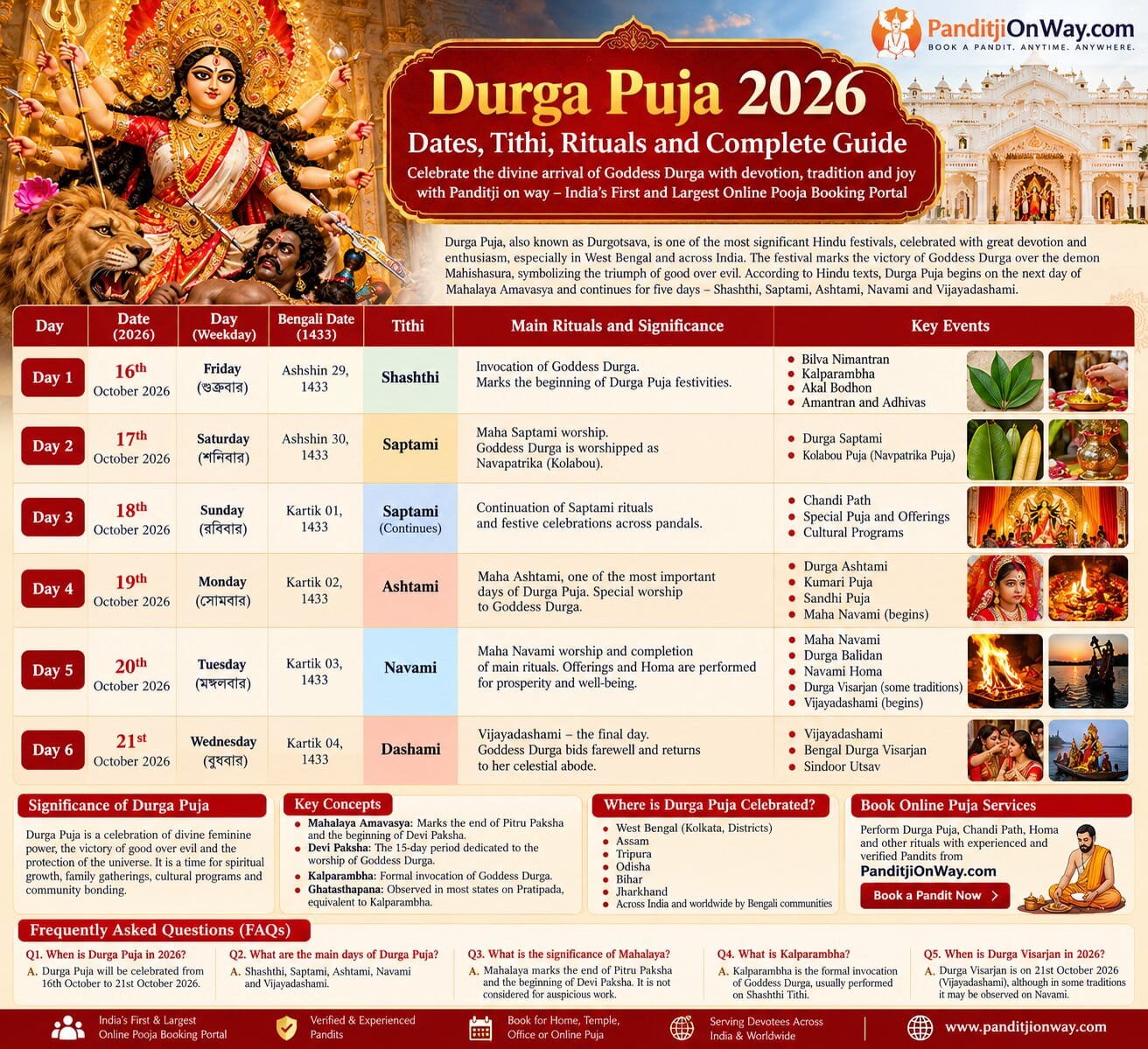
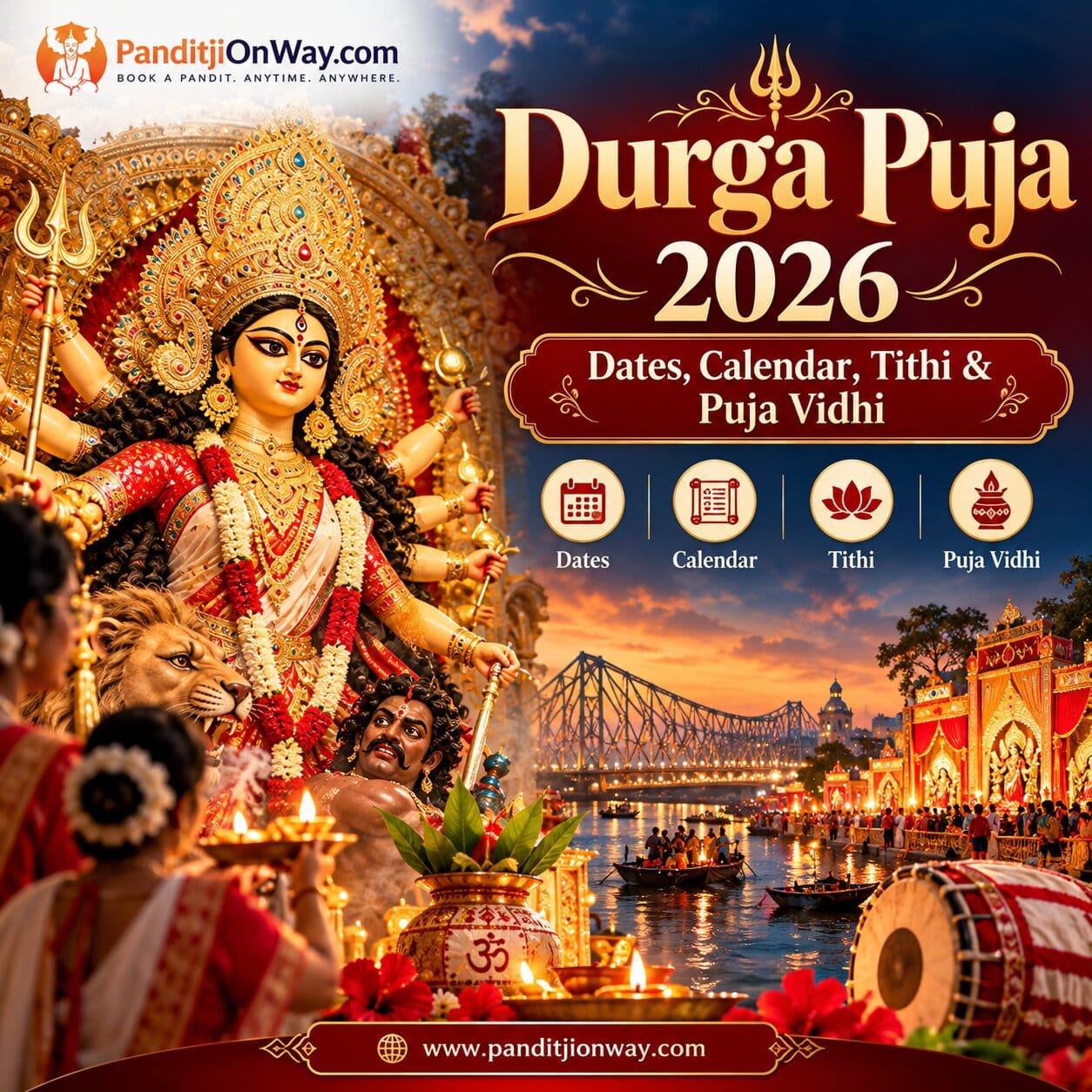
Durga Puja 2026 is one of the most significant Hindu festivals dedicated to Goddess Durga, symbolising the victory of good over evil. In 2026, the main Bengal Durga Puja celebrations are observed from 16–21 October according to one commonly used Bengali panjika, while the West Bengal Government’s festival calendar lists Maha Shashthi on 17 October and Vijayadashami on 21 October. The difference arises from regional Panchang calculations and the observance of lunar tithis.
The festival is celebrated with devotion, elaborate pandals, traditional rituals, cultural programmes, Pushpanjali, Sandhi Puja, Bhog, Sindoor Khela and Durga Visarjan. Kolkata, Howrah, Siliguri, Durgapur, Asansol, Delhi, Mumbai, Pune, Bengaluru and Hyderabad host Durga Puja celebrations of different scales.
Panditji on Way, an online pooja booking platform, helps devotees explore Hindu rituals and arrange religious services. This guide explains the Durga Puja 2026 calendar, the significance of each day, important rituals, regional celebrations, and practical information for devotees.
Durga Puja 2026: Key Dates at a Glance
| Festival or Ritual | Date in 2026 | Significance |
|---|---|---|
| Mahalaya | Saturday, 10 October | Marks the transition towards Devi Paksha and the beginning of the traditional countdown to Durga Puja |
| Bilva Nimantran | Friday, 16 October, according to the cited calendar | Invitation to Goddess Durga through the traditional Bilva ritual |
| Kalparambha | Friday, 16 October, according to the cited calendar | Ritual preparations and invocation of the Goddess |
| Akal Bodhon | Friday, 16 October, according to the cited calendar | The ceremonial awakening and invocation of Goddess Durga |
| Amantran and Adhivas | Friday, 16 October, according to the cited calendar | Invitation and ritual consecration before the main worship |
| Durga Saptami and Nabapatrika Puja | 17–18 October, depending on the local calendar | Worship involving the Nabapatrika, also known as Kola Bou |
| Durga Ashtami | Monday, 19 October, in the supplied calendar | Pushpanjali, Kumari Puja at participating temples, and Sandhi Puja |
| Maha Navami | Tuesday, 20 October, in the supplied calendar | Special worship, Navami Homa and other traditional rituals |
| Vijayadashami and Durga Visarjan | Wednesday, 21 October, in the supplied calendar | Farewell to the Goddess and celebration of the victory of good over evil |
Important date clarification: The West Bengal Government’s official Durga Puja calendar lists 17 October as Maha Shashthi, 18 October as Maha Saptami, 19 October as Maha Ashtami, 20 October as Maha Navami and 21 October as Vijaya Dashami. The supplied Drik Panchang calendar places several observances differently. Always follow the local Bengali panjika and the schedule published by your particular puja committee.
When Is Durga Puja in 2026?
Durga Puja 2026 falls in October, with the major celebrations taking place around the third week of the month. Mahalaya is observed on 10 October, while the festival’s concluding Vijayadashami is observed on 21 October in the Bengal calendar published by the West Bengal Government.
The main festival is traditionally associated with five days: Maha Shashthi, Maha Saptami, Maha Ashtami, Maha Navami and Vijayadashami. Preparations and associated religious observances may begin earlier.
Unlike festivals that have a fixed Gregorian date, Durga Puja follows the Hindu lunar calendar. Tithi calculations, sunrise, location and the regional panjika used by a temple or puja committee can affect the date assigned to an observance.
What Is Durga Puja? Meaning and Religious Significance
Durga Puja, also known as Durgotsava, is a Hindu festival dedicated to Goddess Durga, who represents divine power, courage, protection and the restoration of dharma.
According to Hindu religious tradition, Goddess Durga defeats Mahishasura, the buffalo demon, restoring balance between good and evil. Her victory is remembered through prayers, devotional music, sacred rituals and community celebrations.
In Bengal, Durga Puja is also associated with the Goddess’s annual homecoming. Beautifully crafted idols, elaborate pandals, dhak performances, traditional food and cultural programmes bring communities together. Kolkata’s Durga Puja was inscribed on UNESCO’s Representative List of the Intangible Cultural Heritage of Humanity in 2021.
Read more from the West Bengal Tourism Department’s Durga Puja guide.
Durga Puja 2026 Calendar: Day-by-Day Schedule
1. Mahalaya – 10 October 2026, Saturday
Mahalaya marks an important transition from Pitru Paksha towards Devi Paksha. Many Bengali households begin the festive season by listening to devotional recitations, particularly Mahishasuramardini, and remembering the divine power of Goddess Durga.
Traditional observances may include Tarpan for ancestors, performed according to family custom and the applicable Panchang.
Mahalaya is spiritually important because it connects ancestral remembrance with the approaching celebration of the Divine Mother.
2. Maha Shashthi – 16 or 17 October, depending on the panjika
Maha Shashthi marks the ceremonial beginning of the principal Durga Puja observances in Bengal. The supplied calendar places Bilva Nimantran, Kalparambha, Akal Bodhon, Amantran and Adhivas on Friday, 16 October.
Bilva Nimantran: A traditional ritual involving the invitation of Goddess Durga through the worship of a Bilva tree or branch, according to the prescribed custom.
Kalparambha: The ritual preparations and invocation associated with the beginning of Durga Puja.
Akal Bodhon: The ceremonial invocation or awakening of the Goddess, associated with the tradition of worshipping Durga at this time of year.
Amantran and Adhivas: Rituals of invitation and consecration performed according to the relevant puja tradition.
The exact sequence and timing should be confirmed with the priest or local puja committee.
3. Maha Saptami – 17 or 18 October, depending on the panjika
Maha Saptami is associated with the beginning of the principal worship rituals. One of its most distinctive ceremonies is Nabapatrika Puja.
Nabapatrika Puja and Kola Bou: Nine plants are ritually arranged and worshipped according to Bengali tradition. The banana plant, known as Kola Bou, is an important part of this observance.
Devotees visit pandals, participate in prayers and seek blessings for prosperity, health and well-being. Many community pujas also begin serving traditional bhog around the main festival days.
4. Maha Ashtami – Monday, 19 October, in the supplied calendar
Maha Ashtami is among the most important days of Durga Puja. Devotees offer flowers during Pushpanjali, recite prayers and participate in special worship.
Pushpanjali: Devotees offer flowers to Goddess Durga while reciting sacred mantras.
Kumari Puja: At temples and community pujas that follow this tradition, a young girl is worshipped as a manifestation of the Divine Mother.
Sandhi Puja: This ritual takes place at the junction of Ashtami and Navami tithis. Its precise time depends on the local Panchang, so devotees should not rely on a generic clock time.
Maha Ashtami is also a major day for pandal visits, family gatherings and community celebrations.
5. Maha Navami – Tuesday, 20 October, in the supplied calendar
Maha Navami is associated with special worship, offerings and, in traditions that prescribe it, Navami Homa.
Navami Homa: A sacred fire ritual performed with mantras and offerings according to the relevant religious procedure.
Durga Balidan: This is a traditional ritual observance whose form varies by community and religious custom. It should be performed only in accordance with the applicable tradition and local regulations.
Maha Navami is often the final full day of intensive worship before the concluding Vijayadashami observances.
6. Vijayadashami – Wednesday, 21 October 2026
Vijayadashami marks the conclusion of the principal Bengal Durga Puja celebrations. The day celebrates the triumph of good over evil and the symbolic farewell of Goddess Durga.
Sindoor Utsav: In Bengali communities, married women may participate in Sindoor Khela according to local custom.
Durga Visarjan: The Goddess’s idol is ceremonially immersed, marking her departure and the conclusion of the festival.
Bijoya greetings: Families and communities exchange greetings and good wishes after the celebrations.
The timing of immersion depends on the local puja committee, civic arrangements and religious schedule.
Durga Puja Rituals and Their Importance
| Ritual | Meaning | When It Is Observed |
|---|---|---|
| Bilva Nimantran | Inviting the Goddess through the traditional Bilva ritual | Before the principal worship |
| Kalparambha | Initiating the ritual preparations | Usually around Shashthi |
| Akal Bodhon | Invocation of Goddess Durga | According to the Bengali puja tradition |
| Amantran and Adhivas | Invitation and consecration | Before or during the opening observances |
| Nabapatrika Puja | Worship of the nine-plant ritual arrangement | Saptami observances |
| Pushpanjali | Offering flowers and prayers | Especially Ashtami |
| Kumari Puja | Worship of the Divine Mother in a young girl | At participating pujas |
| Sandhi Puja | Worship at the Ashtami–Navami junction | At the exact local tithi transition |
| Navami Homa | Sacred fire worship | Navami observances |
| Sindoor Khela | Traditional vermilion ritual | Commonly on Vijayadashami |
| Durga Visarjan | Ceremonial immersion of the idol | At the conclusion of the festival |
Ritual procedures can vary between families, temples, religious traditions and regions. A qualified priest or the organising puja committee can confirm the correct procedure for a particular observance.
Durga Puja 2026 in Different Cities of India
Durga Puja is celebrated across India, but the scale, rituals and cultural traditions differ by location.
Durga Puja in Kolkata, West Bengal
Kolkata is one of India’s best-known destinations for Durga Puja. The city is famous for artistic pandals, elaborate idols, traditional dhak performances, community bhog and large-scale cultural celebrations.
Popular areas for visitors include:
- North Kolkata, known for historic neighbourhood pujas and traditional styles.
- South Kolkata, known for elaborate themed pandals.
- Ballygunge and Gariahat, known for community celebrations and prominent pandals.
- Salt Lake and New Town, known for large organised pujas and modern festival installations.
- Howrah, across the Hooghly River, for additional community celebrations.
Visitors should check the latest local transport, crowd-management and access advisories before travelling.
Durga Puja in Howrah
Howrah celebrates Durga Puja through community pandals, neighbourhood rituals and traditional festivities. Its proximity to Kolkata makes it possible to explore celebrations on both sides of the Hooghly River.
Durga Puja in Siliguri and North Bengal
Siliguri and other parts of North Bengal celebrate with decorated pandals, devotional programmes and local cultural events. The festival is an important community occasion for residents and visitors alike.
Durga Puja in Delhi
Delhi hosts Bengali community pujas, temple observances and public celebrations. Organised pujas can be found in neighbourhoods such as Chittaranjan Park and other residential areas with Bengali associations. Dates, entry arrangements and cultural programmes vary by organiser.
Durga Puja in Mumbai
Mumbai’s Bengali associations and community organisations arrange Durga Puja with traditional worship, bhog, cultural performances and social gatherings. Visitors should consult individual puja committees for schedules and venue details.
Durga Puja in Pune
Pune’s Bengali communities celebrate with pandal worship, cultural programmes, Pushpanjali and community meals. The exact programme depends on the organising association.
Durga Puja in Bengaluru and Hyderabad
Both cities have Bengali community celebrations, temple worship and cultural programmes. Visitors should check local association announcements for the confirmed calendar, venue and timings.
How to Perform Durga Puja at Home
Devotees who wish to worship Goddess Durga at home can follow their family tradition or seek guidance from a qualified priest.
A simple devotional routine may include:
- Clean the place of worship and arrange the image or idol of Goddess Durga.
- Bathe and wear clean clothes before beginning the prayer.
- Light a diya and offer flowers, incense and suitable devotional offerings.
- Recite Durga mantras, the Durga Chalisa or other prayers familiar to the family.
- Offer fruit, sweets or bhog according to personal tradition.
- Conclude with Durga Aarti and prayers for the well-being of the family.
This is a general devotional outline, not a substitute for the complete prescribed ritual. Specific ceremonies such as Kalparambha, Sandhi Puja and Homa may require a trained priest and the correct tithi-based timing.
Durga Puja Samagri List
The items required depend on the ritual and the priest’s instructions. Commonly used materials include:
| Puja Item | Purpose |
|---|---|
| Image or idol of Goddess Durga | Focus of worship |
| Flowers and garlands | Devotional offerings |
| Diya and cotton wicks | Lighting the worship area |
| Ghee or suitable oil | Lighting the diya |
| Incense sticks | Traditional worship |
| Fruits and sweets | Bhog and offerings |
| Kumkum and sandalwood paste | Traditional ritual applications |
| Rice, water and sacred thread | Used in applicable ceremonies |
| Betel leaves and nuts | Traditional offerings where prescribed |
| Homa materials | Required for a prescribed fire ritual |
Not every ritual requires every item. Follow the list supplied by your priest or puja organiser.
Book a Durga Puja Priest Online with Panditji on Way

Arranging a priest for a festival or family puja involves choosing the appropriate ritual, confirming availability, understanding the samagri requirements and agreeing on the location and schedule.
Panditji on Way is an online pooja booking platform intended to help devotees find religious services and organise ceremonies.
For Durga Puja-related services, devotees can enquire about:
- Durga Puja and Devi worship.
- Navratri puja and related ceremonies.
- Havan and Homa services.
- Family puja and other Hindu rituals.
- Guidance on puja samagri and ritual preparation.
Availability depends on the city, service offered and priest’s schedule. Confirm the ritual, language preference, samagri arrangements, charges and timing before booking.
Explore: Panditji on Way
For local search visibility, the website should also provide accurate, dedicated service information for the cities it actually serves. Examples of useful city-specific landing pages include Durga Puja priest in Kolkata, Durga Puja priest in Mumbai, Durga Puja priest in Delhi and Durga Puja priest in Pune, provided each page reflects genuine service availability.
Durga Puja 2026: Travel and Visitor Tips
If you plan to visit Durga Puja pandals, especially in Kolkata, keep the following points in mind:
- Check the local puja committee’s official schedule before travelling.
- Confirm the dates against the calendar followed by your chosen pandal.
- Expect heavy crowds during evening hours and on major ritual days.
- Follow traffic restrictions, public transport advisories and designated pedestrian routes.
- Keep water, essential medicines and emergency contact details accessible.
- Respect queue systems, photography restrictions and religious customs.
- Check whether a venue has accessibility arrangements for elderly visitors and people with disabilities.
- Use official transport updates for late-night travel and immersion-day arrangements.
Frequently Asked Questions About Durga Puja 2026
1. When is Durga Puja in 2026?
The principal Bengal Durga Puja period is in October 2026. The West Bengal Government’s calendar lists Maha Shashthi on 17 October and Vijayadashami on 21 October. Some regional panjikas list associated Shashthi observances from 16 October. Follow your local calendar.
2. When is Maha Shashthi in 2026?
The date depends on the regional panjika. The supplied calendar places Bilva Nimantran and Kalparambha on Friday, 16 October, while the West Bengal Government’s festival calendar lists Maha Shashthi on Saturday, 17 October.
3. When is Maha Saptami in 2026?
Maha Saptami is observed around 17–18 October, depending on the local calendar and the tithi calculation used by the puja committee.
4. When is Durga Ashtami in 2026?
The supplied Bengal Durga Puja calendar lists Durga Ashtami on Monday, 19 October 2026. Confirm the local tithi and Sandhi Puja timing with the temple or puja organiser.
5. When is Maha Navami in 2026?
The supplied calendar lists Maha Navami on Tuesday, 20 October 2026. Some other calendars combine Ashtami and Navami observances on 19 October because of the tithi transition.
6. When is Vijayadashami in 2026?
The West Bengal Government’s calendar lists Vijaya Dashami on Wednesday, 21 October 2026. The precise observance and immersion schedule should be checked locally.
7. When is Mahalaya in 2026?
Mahalaya falls on Saturday, 10 October 2026. It marks an important transition towards Devi Paksha and the beginning of the traditional countdown to Durga Puja.
8. What is the difference between Durga Puja and Shardiya Navratri?
Shardiya Navratri is a nine-night festival dedicated to the Divine Mother and is observed across India in different forms. Bengal Durga Puja focuses particularly on the ceremonial worship of Goddess Durga over Shashthi, Saptami, Ashtami, Navami and Vijayadashami, along with associated rituals and community celebrations.
9. What is Bilva Nimantran?
Bilva Nimantran is a traditional Durga Puja ritual involving an invitation to the Goddess through the worship of a Bilva tree or branch, according to the relevant Bengali ritual tradition.
10. What is Kalparambha in Durga Puja?
Kalparambha is a preparatory ritual associated with beginning the worship of Goddess Durga. It is generally observed around Shashthi according to the Bengali Durga Puja tradition.
11. What is Nabapatrika Puja?
Nabapatrika Puja is a Bengali Durga Puja ritual involving the worship of a ceremonial arrangement of nine plants. The banana plant used in the ritual is popularly known as Kola Bou.
12. What is Sandhi Puja?
Sandhi Puja is performed at the transition between Ashtami and Navami tithis. Its timing is determined by the precise local tithi transition, rather than by a fixed time that applies throughout India.
13. Why is Sindoor Khela celebrated?
Sindoor Khela is a traditional Bengali ritual associated with Vijayadashami. Participants, particularly married women in communities that follow the custom, apply vermilion as part of the farewell to Goddess Durga and the celebration of the Goddess’s return.
14. Where can I celebrate Durga Puja in India?
Kolkata and Howrah are among the best-known destinations. Durga Puja is also celebrated in Siliguri, Delhi, Mumbai, Pune, Bengaluru and Hyderabad, as well as many other cities. Check the schedule of the local temple or Bengali association before visiting.
15. Can I book a priest for Durga Puja online?
Yes, you can enquire through online pooja booking platforms such as Panditji on Way. Confirm service availability, the ritual required, location, date, samagri arrangements and charges before finalising your booking.
16. What should I offer Goddess Durga during puja?
Common offerings include flowers, fruits, sweets, incense and other materials prescribed by the family’s tradition. Offerings vary according to the ritual and should follow the guidance of the priest or temple.
17. Is Durga Puja a public holiday in India?
Public holidays depend on the state and the relevant government notification. Check the official holiday list for your state or workplace rather than assuming that every Durga Puja observance is a nationwide public holiday.
Conclusion: Celebrate Durga Puja 2026 with Devotion
Durga Puja 2026 brings together devotion, cultural heritage, family traditions and community celebrations. From Mahalaya and the invocation of Goddess Durga to Pushpanjali, Sandhi Puja, Navami Homa and Vijayadashami, each observance has its own religious and cultural significance.
Whether you are planning to visit Kolkata’s famous pandals, attend a community puja in Mumbai or Delhi, or worship at home, confirm the dates and timings using the local panjika followed by your temple or puja committee.
Panditji on Way helps devotees explore online pooja booking services and organise religious ceremonies. Visit panditjionway.com to explore available services and make your festival preparations with greater confidence.
May Goddess Durga bless everyone with courage, wisdom, peace and prosperity.