


Dakshineswar Kali Temple Kolkata: Timings, History, Festivals & Complete Travel Guide (2026)
Explore Dakshineswar Kali Temple Kolkata timings, history, aarti, festivals, entry fees, and travel guide. Complete friendly guide for devotees.
Overview of Dakshineswar Kali Temple


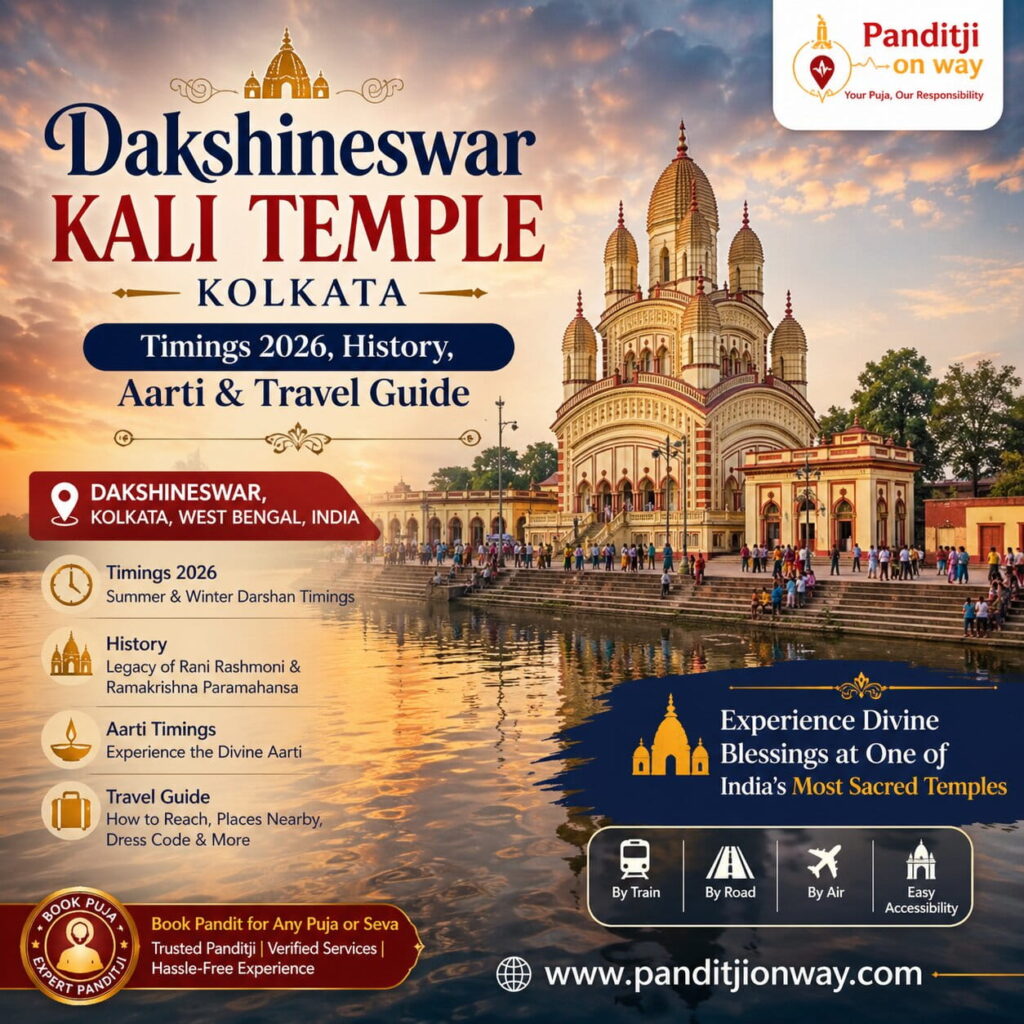
The Dakshineswar Kali Temple is one of the most sacred Hindu temples dedicated to Goddess Kali, located on the eastern banks of the Hooghly River in Kolkata.
Built in 1855 by Rani Rashmoni, this temple is a major pilgrimage destination and spiritual center associated with Ramakrishna Paramahansa and Sarada Devi.
The temple follows the traditional Navaratna (nine-spired) Bengali architecture, making it one of the most iconic landmarks in West Bengal.
Dakshineswar Kali Temple Timings (2026 Updated)
Darshan Timings Table
| Season | Morning | Afternoon Break | Evening |
|---|---|---|---|
| Summer (Apr–Sep) | 5:30 AM – 11:30 AM | 11:30 AM – 3:30 PM | 3:30 PM – 9:00 PM |
| Winter (Oct–Mar) | 6:00 AM – 12:30 PM | 12:30 PM – 3:00 PM | 3:00 PM – 8:30 PM |
Tip: Best time for peaceful darshan is early morning (5:30 AM – 7:00 AM).
Dakshineswar Kali Temple Aarti Timings
| Season | Morning Aarti | Evening Aarti |
|---|---|---|
| Summer | 4:00 AM | 7:00 PM |
| Winter | 5:00 AM | 6:30 PM |
Important Notes:
- Reach at least 15 minutes early
- Heavy crowd during weekends & festivals
- Aarti is the most spiritually powerful ritual
Detailed History of Dakshineswar Kali Temple


1. Divine Vision Behind the Temple’s Foundation
The origin of the Dakshineswar Kali Temple is deeply rooted in divine intervention. According to historical accounts, Rani Rashmoni, a wealthy zamindar and devoted follower of Goddess Kali, planned a pilgrimage to Varanasi.
However, just before her journey, she experienced a powerful vision of Goddess Kali, who instructed her to build a temple on the banks of the Ganga (Hooghly River) instead. Taking this as a divine command, she abandoned her pilgrimage and dedicated her wealth and life to constructing the temple.


2. Land Acquisition & Construction (1847–1855)
- Construction began in 1847
- Completed on 31 May 1855 (Snan Yatra day)
- Location chosen: Eastern bank of the Hooghly River
The land purchased was not considered ideal at the time—it included marshy areas and land owned by different communities, including British owners. Transforming this into a sacred temple site symbolized faith overcoming social and physical challenges.
The temple complex was designed in the Navaratna architectural style, featuring:
- 9 spires (symbolizing cosmic order)
- 12 Shiva temples along the river
- A Radha-Krishna temple
- Spacious courtyards and bathing ghats


The presiding deity, Maa Bhavatarini (Kali), meaning “the liberator of the universe,” was installed with grand rituals.
The idol:
- Made of black stone
- Depicts Kali standing over Lord Shiva
- Represents destruction of ego and liberation of the soul
This unique form made Dakshineswar one of the most spiritually powerful Kali temples in India.
4. Era of Ramakrishna Paramahansa (1855–1886)
The most transformative phase in the temple’s history began with the arrival of Sri Ramakrishna.
- Initially appointed as a priest
- Later became a revered spiritual master
- Spent nearly 30 years at Dakshineswar
His spiritual practices included:
- Deep meditation
- Bhakti (devotion) toward Kali
- Experiments with multiple religions (Hinduism, Islam, Christianity)
He taught universal spirituality and religious harmony, making Dakshineswar a global spiritual center.
5. Influence of Swami Vivekananda
One of Ramakrishna’s greatest disciples, Swami Vivekananda, was deeply influenced at Dakshineswar.
- Met Ramakrishna here as a young seeker
- Learned Vedanta and spiritual discipline
- Later introduced Hindu philosophy to the West (Chicago, 1893)
This connection elevated the temple’s importance from a regional shrine to a global spiritual landmark.
6. Role of Sarada Devi
Sarada Devi, known as the “Holy Mother,” also lived and meditated here.
- Represented purity, compassion, and motherhood
- Played a vital role in spreading Ramakrishna’s teachings
- Strengthened the spiritual legacy of Dakshineswar
7. Post-Rashmoni Era & Temple Management
After the death of Rani Rashmoni in 1861:
- The temple was managed by her descendants
- Later governed by a temple trust
Despite political changes, colonial rule, and modernization, the temple retained its sanctity and rituals.
8. Dakshineswar During British India
The temple gained prominence during British rule as:
- A center of spiritual resistance
- A symbol of Indian cultural identity
While the British focused on administrative expansion, Dakshineswar emerged as a spiritual counterforce, preserving Hindu traditions.
9. Evolution into a Major Pilgrimage Site
Over time, Dakshineswar became:
- One of the most visited temples in India
- A key spiritual destination in Kolkata
- A center for Kali worship and Vedantic philosophy
Millions of devotees visit annually to seek blessings and experience divine energy.
10. Modern-Day Significance
Today, the Dakshineswar Kali Temple stands as:
- A symbol of faith and devotion
- A hub of spiritual learning and meditation
- A bridge between ancient traditions and modern spirituality
Its connection with Ramakrishna and Vivekananda continues to inspire seekers worldwide.
Key Historical Timeline (Quick Table)
| Year | Event |
|---|---|
| 1847 | Construction begins |
| 1855 | Temple inaugurated |
| 1855–1886 | Ramakrishna’s spiritual period |
| 1861 | Death of Rani Rashmoni |
| Late 1800s | Vivekananda spreads teachings globally |
| Present | Major pilgrimage destination |
Conclusion
The history of Dakshineswar Kali Temple is not just about its construction—it is a story of divine vision, spiritual awakening, and cultural transformation. From Rani Rashmoni’s devotion to Ramakrishna’s enlightenment and Vivekananda’s global influence, the temple represents the heart of India’s spiritual heritage.
It remains a timeless destination where faith meets philosophy, and devotion transforms into realization.
Main Deity of Dakshineswar Temple
- Goddess: Bhavatarini Kali
- Idol: Black stone statue
- Depiction: Standing on Lord Shiva
- Symbolism: Destroyer of ego & protector of devotees
Major Festivals Celebrated


| Festival | Significance |
|---|---|
| Kali Puja | Biggest celebration with lights & rituals |
| Durga Puja | Grand Bengali festival |
| Shivaratri | Night-long worship at Shiva temples |
| Janmashtami | Celebration of Lord Krishna |
| Dol Yatra | Holi celebration |
| Snan Yatra | Temple foundation day |
| Ramakrishna Jayanti | Honors Ramakrishna Paramahansa |


Poojas & Sevas Offered
| Ritual | Description |
|---|---|
| Mangal Aarti | Early morning awakening ritual |
| Bhog Offering | Food offering to Goddess |
| Special Puja | Personalized rituals |
Entry Fees & Puja Charges
- Entry Fee: Free
- Puja Charges: ₹50 – ₹5,000 depending on ritual
Dress Code Guidelines
Men: Kurta, dhoti, traditional wear
Women: Saree or salwar suit
Avoid: Shorts, sleeveless clothes, western outfits
Places to Visit Near Dakshineswar
1. Kalighat Kali Temple
- One of the 51 Shakti Peethas
- Distance: ~7 km
2. Bhimnagar Park
- Peaceful green park for relaxation
3. Hangseshwari Temple
- Unique lotus-shaped architecture
4. Naba Yogini Temple
- Dedicated to 9 yoginis
How to Reach Dakshineswar Kali Temple
By Train:
- Dakshineswar Railway Station (1 km)
- Howrah Junction (~10 km)
By Air:
- Netaji Subhas Chandra Bose International Airport (~9 km)
By Road:
- Easily accessible via buses, taxis, autos
Lesser Known Facts
- Temple has 12 Shiva shrines along the river
- Devotees take holy dip in Hooghly River
- Built on reclaimed river land
- Major spiritual center of modern Hinduism
Panditji on way:
- https://www.panditjionway.com (Book Pandit for Puja, Havan & Katha)


High Authority External Links:
- https://www.incredibleindia.org (Official Tourism Website)
- https://www.wbtourism.gov.in (West Bengal Tourism)
FAQs & PAA for Dakshineswar Kali Temple
1. What are the exact timings of Dakshineswar Kali Temple?
The temple opens daily. Summer timings are 5:30 AM–11:30 AM and 3:30 PM–9:00 PM. Winter timings are 6:00 AM–12:30 PM and 3:00 PM–8:30 PM.
2. What is the best time to visit Dakshineswar Kali Temple for darshan?
Early morning (5:30 AM to 7:00 AM) is the best time to avoid crowds and experience peaceful darshan.
3. Is Dakshineswar Kali Temple open on Sundays and public holidays?
Yes, the temple is open all days including Sundays and public holidays with regular darshan timings.
4. What are the aarti timings at Dakshineswar Temple?
Morning aarti: 4:00 AM (summer), 5:00 AM (winter)
Evening aarti: 7:00 PM (summer), 6:30 PM (winter)
5. Who built Dakshineswar Kali Temple?
The temple was built by Rani Rashmoni in 1855.
6. Why is Dakshineswar Kali Temple famous?
It is famous for its spiritual significance, Navaratna architecture, and connection with Ramakrishna Paramahansa.
7. Is entry free in Dakshineswar Kali Temple?
Yes, entry is completely free for all devotees.
8. Is there any VIP darshan facility available?
No, there is no VIP darshan system. All devotees follow the same queue.
9. What is the main deity of the temple?
The main deity is Goddess Bhavatarini Kali, a powerful form of Maa Kali.
10. Can we take a bath in the Hooghly River before darshan?
Yes, devotees can take a holy dip in the Hooghly River at the temple ghats.
11. Which festivals are celebrated at Dakshineswar Temple?
Major festivals include Kali Puja, Durga Puja, Shivaratri, Janmashtami, and Ramakrishna Jayanti.
12. What is the dress code for visiting Dakshineswar Temple?
Traditional attire is recommended. Avoid shorts, sleeveless clothing, and western outfits.
13. How far is Kalighat Kali Temple from Dakshineswar?
Kalighat Kali Temple is approximately 7 km away from Dakshineswar.
14. What is the nearest railway station to Dakshineswar Temple?
Dakshineswar Railway Station is the nearest, located about 1 km away.
15. Is photography allowed inside Dakshineswar Temple?
No, photography is restricted inside the temple premises.
16. What is the complete history of Dakshineswar Kali Temple?
The Dakshineswar Kali Temple was established in 1855 by Rani Rashmoni after a divine vision of Goddess Kali. Instead of traveling to Varanasi, she was guided to build a temple on the banks of the Hooghly River. The temple was constructed in Navaratna style with nine spires and includes 12 Shiva temples and a Radha-Krishna shrine. It later became globally famous due to the spiritual teachings of Ramakrishna Paramahansa, who lived and meditated here for decades. His disciple Swami Vivekananda further spread its spiritual legacy worldwide, making Dakshineswar a key center of modern Hindu philosophy.
17. What are the darshan rules and guidelines for visitors?
Visitors must follow strict temple discipline while visiting Dakshineswar. Devotees are required to wear modest traditional attire and maintain silence inside the temple premises. Footwear must be removed before entering, and photography is strictly prohibited. Devotees should follow the queue system for darshan and avoid carrying mobile phones or large bags if possible. Taking a holy dip in the Hooghly River before darshan is considered auspicious. It is also recommended to visit during non-peak hours to avoid heavy crowd and have a peaceful spiritual experience.
18. How to reach Dakshineswar Kali Temple from Kolkata easily?
Dakshineswar Temple is well-connected by all modes of transport. The nearest railway station is Dakshineswar, just 1 km away, making it easily accessible by local trains. From Howrah Junction, one can take a taxi or bus covering around 10 km. The nearest airport is Netaji Subhas Chandra Bose International Airport, located about 9 km away. Metro connectivity has also improved access significantly, making it one of the easiest temples to reach in Kolkata.
19. What are the best places to visit near Dakshineswar Temple?
There are several important places near Dakshineswar Temple that enhance your spiritual journey. The most prominent is Kalighat Kali Temple, one of the 51 Shakti Peethas. Other nearby attractions include Belur Math, the headquarters of the Ramakrishna Mission, known for its peaceful environment and spiritual significance. Visitors can also explore local parks, ghats along the Hooghly River, and traditional Bengali temples that reflect the rich cultural heritage of Kolkata.
20. What makes Dakshineswar Kali Temple spiritually unique?
Dakshineswar Temple stands out due to its deep spiritual energy and historical importance. It is not just a temple but a center of divine awakening where Ramakrishna Paramahansa experienced profound spiritual realizations. The presence of Goddess Bhavatarini Kali symbolizes liberation and protection, while the temple’s location on the Hooghly River enhances its sacred aura. The combination of Shakti worship, Vedantic teachings, and devotional practices creates a unique spiritual environment that attracts millions of devotees every year seeking peace, blessings, and enlightenment.
Conclusion
Dakshineswar Kali Temple is not just a temple—it is a spiritual powerhouse deeply connected to India’s religious and cultural heritage. Whether you are seeking peace, devotion, or historical insight, this temple offers a transformative experience.