
Asthi Visarjan (Asthi Pravah): Meaning, Rituals, Significance & Complete Hindu Calendar Guidance
Asthi Visarjan, also known as Asthi Pravah, is one of the most sacred and emotionally significant final rites (Antim Sanskar) in Hindu dharma. It refers to the ritual immersion of the ashes and remaining bones (Asthi) of the departed soul into a holy river—most commonly the Ganga River.
This ritual symbolizes the return of the mortal body to the five elements (Panch Mahabhuta)—Earth, Water, Fire, Air, and Ether—and helps the soul attain peace, liberation (Moksha), and freedom from the cycle of rebirth.
At Panditji on Way, we understand that Asthi Visarjan is not just a ritual but a deeply personal journey. We connect you with verified, experienced Vedic Pandits who perform the rites with scriptural accuracy, compassion, and cultural authenticity across India.
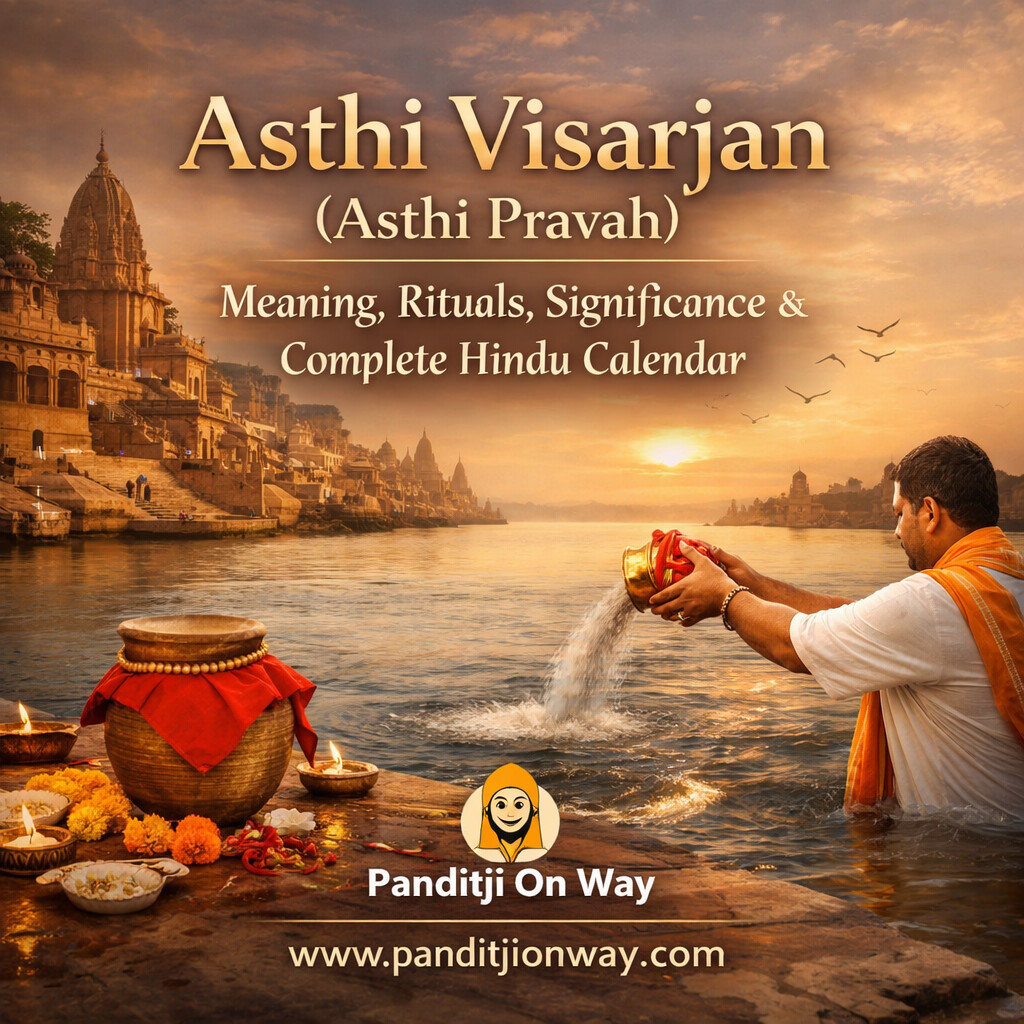
Table of Contents
- What is Asthi Visarjan?
- Why is Asthi Visarjan Performed in Hinduism?
- When is the Right Time for Asthi Visarjan? (Hindu Calendar Dates)
- Complete Procedure of Asthi Visarjan (Vidhi)
- Best Places for Asthi Visarjan in India (Locations)
- Dos and Don’ts of Asthi Visarjan (Table)
- Book a Pandit for Asthi Visarjan in Your City
- FAQs on Asthi Visarjan
- Related Hindu Ritual Services
- Contact & Booking Information
1. What is Asthi Visarjan?
Asthi Visarjan is the ritual immersion of cremation remains into a sacred water body after Antim Sanskar. According to Garuda Purana and other scriptures, the soul attains peace only after this rite is completed correctly.
2. Why is Asthi Visarjan Performed in Hinduism?
The human body is composed of five cosmic elements. During cremation, fire consumes the body, but bones remain. Immersing these remains into a sacred river:
- Completes the cycle of nature
- Liberates the soul from earthly attachments
- Grants Pitr Shanti and spiritual closure to the family
It is believed that as long as the ashes flow in holy waters, the soul enjoys divine peace and progresses toward Moksha.
3. When is the Right Time for Asthi Visarjan? (Hindu Calendar)
According to Hindu scriptures and Panchang:
| Timeframe | Scriptural Significance |
|---|---|
| Within 3 Days | Ideal time, immediately after Asthi Sanchay |
| Within 10 Days | Before Dashah (10th-day rites) |
| After 10 Days | Requires Tirth Shraddh before immersion |
Note: If delayed due to travel or unavoidable reasons, a qualified Pandit must guide the compensatory rituals.
4. Complete Procedure of Asthi Visarjan (Vidhi)
Step 1: Asthi Sanchay (Collection of Ashes)
- Ashes and bones are collected from the cremation ground
- Stored in an earthen Kalash or natural cloth bag
- Covered with a red or saffron cloth
Step 2: Journey to the Tirth Sthal
Commonly chosen holy places include:
- Haridwar
- Varanasi
- Prayagraj (Triveni Sangam)
- Nashik
The Kalash should never be placed on the floor during travel.
Step 3: Sankalp & Puja
- Pandit performs Sankalp in the deceased’s name
- Mantras from Garuda Purana are chanted
- Prayers offered to ancestors and river deity
Step 4: Visarjan (Immersion)
- The karta (ritual performer) enters the river
- Ashes are gently released into flowing water
- Final prayers seek forgiveness and liberation
5. Best Places for Asthi Visarjan in India (Locations)
| Place | River | Importance |
|---|---|---|
| Haridwar | Ganga | Most searched location |
| Varanasi | Ganga | Moksha Kshetra |
| Prayagraj | Triveni Sangam | Confluence of Ganga-Yamuna-Saraswati |
| Nashik | Godavari | Southern India preference |
| Srirangapatna | Kaveri | South Indian rituals |
For spiritual reference, see Ganga River details on Wikipedia (external authoritative source with high DA):
https://en.wikipedia.org/wiki/Ganges
6. Dos and Don’ts of Asthi Visarjan
| Do’s (Recommended) | Don’ts (Avoid) |
|---|---|
| Use earthen Kalash or cloth bag | Avoid plastic containers |
| Wear simple traditional attire | Avoid luxury or fashion wear |
| Perform with a qualified Pandit | Do not delay unnecessarily |
| Offer Brahman Bhojan | Do not keep ashes inside house |
7. Book a Pandit for Asthi Visarjan in Your City
Panditji on Way is India’s first and largest online pooja booking portal, trusted by thousands of families.
Available Cities & Languages
- Bangalore – Kannada, Hindi, Tamil
- Mumbai – Marathi, Hindi, Gujarati
- Delhi NCR – Hindi, Bhojpuri, Maithili
- Chennai – Tamil, Telugu, Hindi
- Kolkata – Bengali, Hindi, Odia
🔗 Book Now (Official Website – Panditji on way):
https://www.panditjionway.com
📞 Call for Assistance: 9454540200
8. Frequently Asked Questions (FAQs) on Asthi Visarjan
What is Asthi Visarjan in Hinduism?
Asthi Visarjan is a Hindu last rite in which the ashes and bones of the deceased are immersed in a holy river, most commonly the Ganga. This ritual symbolizes the return of the body to the five natural elements and helps the soul attain peace and Moksha (liberation).
Is Asthi Visarjan mandatory according to Hindu scriptures?
Yes. According to Garuda Purana and Dharma Shastras, Asthi Visarjan is considered essential for the completion of Antim Sanskar. Without this ritual, the soul is believed to remain in an unsettled state and may not attain spiritual liberation.
When should Asthi Visarjan be performed after cremation?
Asthi Visarjan should ideally be performed:
- Within 3 days of cremation (most auspicious)
- Before the 10th day rituals
- If delayed beyond 10 days, Tirth Shraddh must be performed before immersion
This timing is based on the Hindu Panchang and Pitru Paksha traditions.
Which river is best for Asthi Visarjan?
The Ganga River is considered the most sacred for Asthi Visarjan. Other holy rivers include:
- Yamuna
- Godavari
- Krishna
- Kaveri
- Triveni Sangam at Prayagraj
Immersion in any sacred flowing water with proper Vedic rites is considered spiritually valid.
Can Asthi Visarjan be done in any city or local river?
Yes. If traveling to a major Tirth Sthal is not possible, Asthi Visarjan can be performed in a nearby sacred river or sea with proper Sankalp and Pandit guidance. A qualified Pandit ensures scriptural correctness regardless of location.
Who is eligible to perform Asthi Visarjan?
Traditionally, the eldest son performs the ritual. However:
- Any son, daughter, or close relative may perform it
- In absence of family, a Pandit can perform the ritual on behalf of the family
Hindu scriptures allow flexibility when performed with devotion.
Can Asthi Visarjan be performed by daughters?
Yes. Modern Hindu dharma allows daughters to perform Asthi Visarjan, especially when sons are unavailable. Scriptures emphasize intention and devotion over gender.
Is it allowed to keep ashes at home before Asthi Visarjan?
It is not recommended to keep ashes inside the living area of the house. If immediate immersion is not possible, ashes may be kept:
- Outside the house
- In a clean, protected place
- Under Pandit’s guidance until Visarjan
What happens if Asthi Visarjan is delayed for months or years?
Asthi Visarjan can still be performed later, but Tirth Shraddh and Prayaschitta rituals become mandatory. A knowledgeable Pandit must guide the corrective rituals to ensure Pitru Shanti.
What are the main dos and don’ts of Asthi Visarjan?
Dos:
- Use an earthen Kalash or cloth bag
- Perform Sankalp with a qualified Pandit
- Wear simple traditional clothing
Don’ts:
- Avoid plastic containers
- Do not place Kalash on the ground
- Do not delay unnecessarily
How long does the Asthi Visarjan ritual take?
The complete ritual generally takes 30 to 60 minutes, including:
- Sankalp
- Puja
- Mantra chanting
- Immersion
Additional Shraddh rituals may extend the duration.
Can Panditji on Way arrange Asthi Visarjan Pandits at holy places?
Yes. Panditji on Way provides verified and experienced Pandits for Asthi Visarjan at:
- Haridwar
- Varanasi
- Prayagraj
- Nashik
- Major cities across India
🔗 Official Booking (Panditji on way):
https://www.panditjionway.com
Why should Asthi Visarjan be done with a qualified Pandit?
A qualified Pandit ensures:
- Correct Vedic mantras
- Proper Sankalp
- Compliance with Hindu scriptures
- Spiritual peace for the departed soul
Incorrect procedures may require repeat or corrective rituals later.
Can Asthi Visarjan be booked online in India?
Yes. Asthi Visarjan can be booked online through trusted platforms like Panditji on Way, which connects families with verified Pandits at holy rivers and cities across India. Online booking ensures availability, transparency, and ritual authenticity.
Is online Asthi Visarjan booking reliable and authentic?
When booked through a reputed platform with verified Vedic Pandits, online Asthi Visarjan is completely authentic. The rituals are performed physically at the riverbank; only the coordination and booking process is online.
Can Asthi Visarjan be performed without family presence?
Yes. If family members are unable to travel, a Pandit can perform Asthi Visarjan on behalf of the family after taking proper Sankalp with the deceased’s name, gotra, and family consent.
What details are required to book Asthi Visarjan online?
To book Asthi Visarjan online, you usually need:
- Name of the deceased
- Date of demise
- Gotra (if known)
- Preferred location (Haridwar, Varanasi, etc.)
- Contact details of the karta (ritual performer)
How much does Asthi Visarjan cost in India?
The cost of Asthi Visarjan depends on location and rituals involved. On average:
- Haridwar / Prayagraj: ₹5,000 – ₹7,000
- Varanasi: ₹5,000 – ₹10,000
- Additional Shraddh rituals may increase the cost
Prices may vary based on Pandit experience and inclusions.
Is same-day Asthi Visarjan booking possible?
Yes. Same-day or next-day Asthi Visarjan booking is possible at major Tirth Sthals like Haridwar and Prayagraj, subject to Pandit availability and travel feasibility.
Can Asthi Visarjan be done during Pitru Paksha?
Yes. Pitru Paksha is considered a highly auspicious period for Asthi Visarjan, Shraddh, and Pind Daan. Many families intentionally wait for this period for enhanced spiritual merit.
Can Asthi Visarjan be done on Amavasya or Ekadashi?
- Amavasya: Highly auspicious and recommended
- Ekadashi: Generally avoided unless guided by a Pandit
Final decision should always be based on Panchang consultation.
What if Asthi Visarjan was done incorrectly earlier?
If rituals were incomplete or incorrect, Prayaschitta and Tirth Shraddh can rectify the dosha. A knowledgeable Pandit can guide corrective rites to ensure Pitru Shanti.
Is Asthi Visarjan allowed after a long delay (years later)?
Yes. Even after years, Asthi Visarjan can be performed. However, special purification rituals are mandatory before immersion to align with scriptural guidelines.
Can Asthi Visarjan be combined with Pind Daan?
Yes. Many families combine Asthi Visarjan with Pind Daan, especially at Prayagraj or Gaya, to ensure faster spiritual liberation of the departed soul.
Is Asthi Visarjan required for children or unmarried individuals?
Yes. Asthi Visarjan is performed for all deceased individuals, regardless of age or marital status, though some rituals may be simplified.
Does Asthi Visarjan have any legal restrictions in India?
No. Asthi Visarjan is legally permitted in designated river ghats. However, plastic materials are prohibited, and local guidelines must be followed to protect river sanctity.
Why choose Panditji on Way for online Asthi Visarjan booking?
Panditji on Way offers:
- Verified and experienced Vedic Pandits
- City-wise and Tirth-wise availability
- Transparent pricing
- Scripturally accurate rituals
- Pan-India service support
This ensures peace of mind during an emotionally sensitive time.
9. Related Hindu Ritual Services
- Asthi Sanchay
- Tirth Shraddh
- Terahvin (13th Day Ceremony)
- Pind Daan at Prayagraj
- Annual Shraddh & Pitru Paksha rituals
Conclusion
Asthi Visarjan is a sacred Hindu ritual that ensures peace for the departed soul and spiritual closure for the family. Performing it at the right time, place, and with a knowledgeable Pandit is crucial. Panditji on Way offers end-to-end assistance—ritual guidance, city-wise Pandit booking, and Vedic authenticity—making this final journey dignified and spiritually complete.
For trusted Asthi Visarjan services across India, visit https://www.panditjionway.com.