Airavata – The Divine Elephant of Lord Indra | Origin, Symbolism, Powers & Temple Significance
Learn about Airavata Elephant, Indra’s divine white elephant born during Samudra Manthan. Explore his symbolism, powers, temple significance, and mentions in Ramayana & Mahabharata.
Discover the divine story of Airavata, the celestial white elephant of Lord Indra. Learn about his origin in Samudra Manthan, symbolism, powers, temple significance, and role in Ramayana, Mahabharata, Jainism, and Southeast Asian culture.
Who is Airavata?
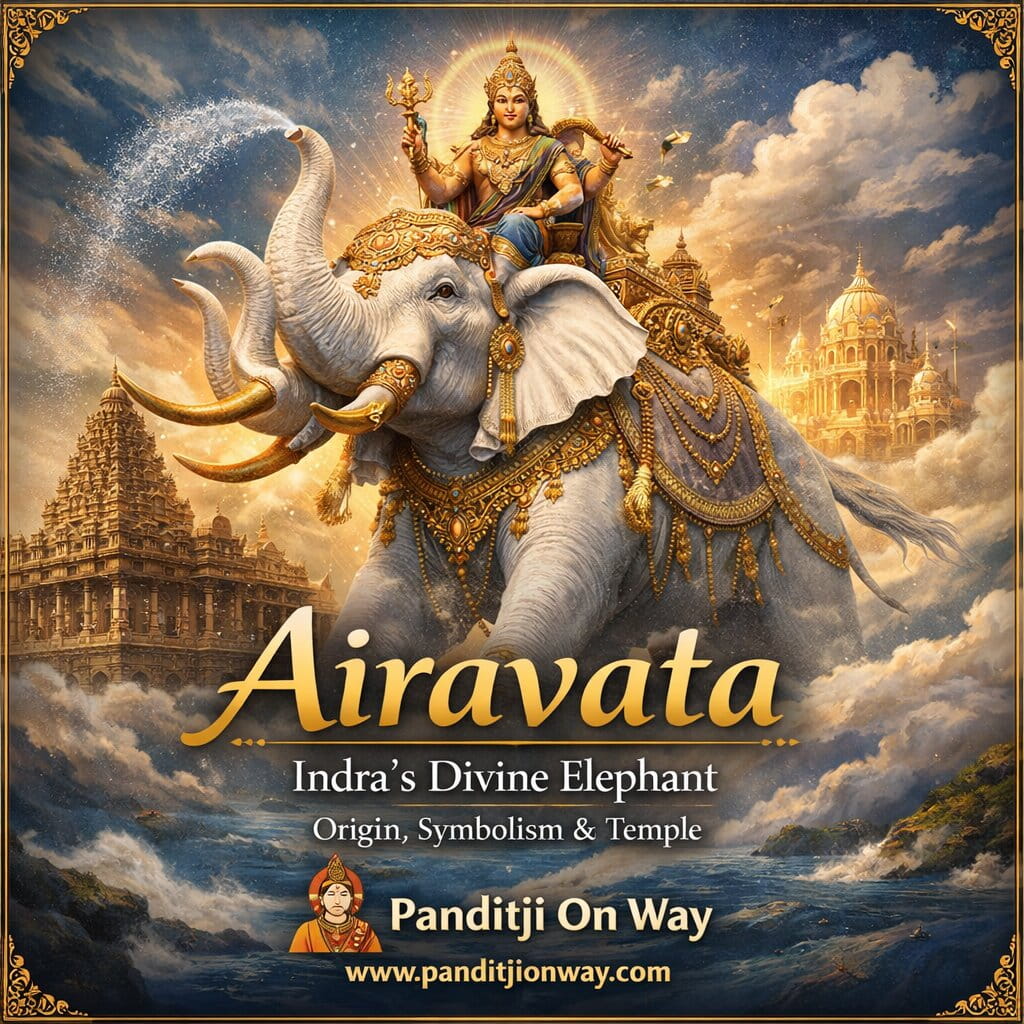
Airavata is the divine white elephant of Lord Indra, the King of Devas in Hinduism. Emerging during the Samudra Manthan (Churning of the Ocean), Airavata is considered the King of Elephants (Gajragrani) and symbolizes power, authority, rain, prosperity, and divine protection.
In Nepal and India, elephants are sacred animals representing wisdom, strength, longevity, and memory. Among them, Airavata holds the highest spiritual and mythological significance.
Airavata’s Origin in Samudra Manthan
According to Hindu scriptures, Airavata emerged as one of the 14 Ratnas (divine treasures) during the churning of the cosmic ocean by Devas and Asuras.
Key Facts About His Origin
| Aspect | Details |
|---|---|
| Event | Samudra Manthan |
| Status | One of the 14 divine jewels |
| Appearance | Pure white, gigantic elephant |
| Adopted by | Lord Indra |
| Role | Celestial vehicle (Vahana) of Indra |
| Kingdom Guarded | Swarga (Heaven) |
After seeking permission from Lord Vishnu and King Bali, Indra accepted Airavata as his divine mount and guardian of Swarga.
Authoritative Reference: For deeper understanding of Samudra Manthan, refer to Encyclopedia Britannica – Samudra Manthan (https://www.britannica.com/topic/Samudra-manthan) (External Reference).
Birth of Airavata According to Matangalila
Another legend from Matangalila states:
- Lord Brahma sang sacred Vedic hymns.
- From a golden cosmic egg emerged:
- Garuda from one half
- Airavata from the other half
- Along with Airavata, 7 male and 8 female elephants were born.
- These elephants became guardians of the eight directions (Ashta Dikpalas).
Airavata became the guardian of the East due to his supremacy.
Meaning and Nomenclature of Airavata
The word Airavata comes from Sanskrit root “Ira” meaning water (Jal). Since he emerged from the milky ocean, he was named Airavata.
Other Names of Airavata
| Name | Meaning |
|---|---|
| Abhramatanga | Creator of Clouds |
| Nagamalla | Warrior Elephant |
| Arkasodara | Brother of the Sun |
| Shwethasti | White Elephant |
| Gajragrani | King of Elephants |
| Erawan | Thai Name |
Appearance of Airavata
Scriptures describe Airavata in various forms:
- Four tusks and seven trunks
- Sometimes ten tusks and five trunks
- Three or five heads
- Completely white and radiant
He is often depicted holding the Earth, similar to Sheshnag.
Airavata in Ramayana
- Airavata’s mother is mentioned as Iravati.
- Jambavan compared Lord Hanuman’s tail to Airavata’s trunk.
- Airavata symbolizes divine strength and grandeur.
Airavata in Mahabharata
Airavata appears in multiple significant incidents:
1. Krishna’s Declaration
In Bhagavad Gita (Bhishma Parva), Lord Krishna states:
“I am Uchhaishrava among horses and Airavata among elephants.”
2. Worship in Gajalakshmi Ritual
Ved Vyasa advised King Dhritarashtra about the worship of Airavata for prosperity.
3. Arjuna Summons Airavata
When Gandhari insulted Kunti by not inviting her to worship, Arjuna summoned Airavata from heaven to restore his mother’s honor.
Airavata and Sage Durvasa’s Curse
- Sage Durvasa gifted Indra a divine garland.
- Indra insulted it by placing it on Airavata.
- Airavata dropped and trampled it.
- Durvasa cursed Indra.
- Goddess Lakshmi disappeared.
- This led to the Samudra Manthan to regain prosperity.
This event symbolizes the consequences of arrogance and the importance of humility.
Airavata in Jainism
Airavata appears during the birth celebration of Rishabha Deva, the first Tirthankara of Jainism. Indra and Airavata were present during divine celebrations.
Reference: Jain Cosmology – Encyclopedia Britannica (https://www.britannica.com/topic/Jainism) (Reference)
Power and Strength of Airavata
According to Puranas:
- His roar equals Indra’s Vajra thunder.
- Can hold the Earth on its axis.
- Produces rain by drawing water from the underworld.
- Faced Lord Krishna in Swarga.
- Confronted Garuda.
- Protects Indra in celestial wars.
Temple Dedicated to Airavata
Airavatesvara Temple – Tamil Nadu
Located near Darasuram, Tamil Nadu, this Shiva temple is dedicated to Airavata.
| Feature | Details |
|---|---|
| Location | Darasuram, Tamil Nadu |
| Builder | Raja Raja Chola II |
| Deity | Lord Shiva |
| Significance | Airavata worshipped here to remove Durvasa’s curse |
| UNESCO Status | World Heritage Site |
External Authority Link: UNESCO World Heritage – Airavatesvara Temple
https://whc.unesco.org/en/list/250 Reference)
Airavata in Southeast Asia
Thailand (Erawan)
- Depicted with three heads and wings.
- Symbol of royal authority.
- Associated with Wat Arun Temple.
- Appears in historical Thai symbolism.
Cambodia & Bali
- Symbol of rain and fertility.
- Sacred agricultural protector.
Sri Lanka (Erawana)
- Associated with prosperity and rainfall.
Symbolism and Spiritual Significance of Airavata
1. Symbol of Wealth and Abundance
Airavata represents prosperity, fertility, and divine abundance.
2. Strength and Power
Six pairs of tusks symbolize invincibility.
3. Guardian of Heaven
Protector of Swarga and Indra’s divine authority.
4. Devotion and Loyalty
Represents ideal disciple qualities in Sanatan Dharma.
5. Rain and Water Cycle
Airavata symbolizes the cosmic water cycle — linking earth, sky, and heavens.
Airavata vs Ordinary Elephants (Table)
| Feature | Airavata | Normal Elephant |
|---|---|---|
| Color | Pure White | Grey |
| Tusks | 4–10 (varies) | 2 |
| Heads | 1–5 | 1 |
| Symbolism | Divine Power | Strength |
| Role | Indra’s Vehicle | Animal |
Why Airavata is Important in Sanatan Dharma
- Represents divine kingship
- Symbol of rainfall and agriculture
- Protector of directions
- Spiritual reminder of humility
- Associated with Gajalakshmi and prosperity
Airavata elephant and Lord Ganesha Connection
Elephants symbolize wisdom and strength. Lord Ganesha, known as Gajanana, shares symbolic qualities with Airavata, reinforcing the spiritual importance of elephants in Hindu tradition.
Spiritual Significance in Modern Times
Worshipping Airavata is believed to:
- Remove financial obstacles
- Improve authority and leadership
- Increase prosperity
- Bring rainfall and agricultural success
- Protect from negative energies
For authentic Vedic rituals related to Gajalakshmi Puja, Indra Puja, or Prosperity Pujas, visit:
Panditji On Way – India’s First & Largest Online Pooja Booking Portal
https://www.panditjionway.com
Frequently Asked Questions About Airavata (Indra’s Divine Elephant)
1. Who is Airavata in Hindu mythology?
Airavata is the celestial white elephant of Lord Indra, the King of Devas. He emerged during the Samudra Manthan (Churning of the Ocean) and is considered the King of Elephants. Airavata symbolizes power, rain, prosperity, and divine authority in Sanatan Dharma.
2. How was Airavata born according to Hindu scriptures?
According to the Puranas, Airavata appeared as one of the 14 Ratnas during the Samudra Manthan. Another legend from Matangalila states that he emerged from a cosmic golden egg created by Lord Brahma along with other guardian elephants of the eight directions.
3. Why is Airavata associated with rain?
Airavata is believed to draw water from the underworld using his powerful trunk and release it into the clouds, allowing Lord Indra to create rainfall. This symbolizes the cosmic water cycle and agricultural prosperity.
4. What does Airavata symbolize in Hinduism?
Airavata represents:
- Wealth and abundance
- Strength and royal authority
- Devotion and loyalty
- Rain and fertility
- Protection of heaven (Swarga)
His white color symbolizes purity and divine power.
5. How many trunks and tusks does Airavata have?
Different scriptures describe Airavata with:
- 4 to 10 tusks
- 5 to 7 trunks
- 3 to 5 heads
These features represent cosmic directions, strength, and divine supremacy.
6. Is Airavata mentioned in the Mahabharata?
Yes. In the Bhagavad Gita (Bhishma Parva), Lord Krishna says, “Among elephants, I am Airavata.” Airavata also appears in stories involving Arjuna and King Dhritarashtra.
7. What is the connection between Airavata and Lord Indra?
Airavata is the divine vehicle (Vahana) of Lord Indra. He carries Indra into celestial battles and guards the kingdom of Swarga. His loyalty represents ideal devotion and service.
8. Where is the temple dedicated to Airavata elephant located?
The Airavatesvara Temple in Darasuram, Tamil Nadu, is associated with Airavata. It is a UNESCO World Heritage Site built by Raja Raja Chola II and dedicated to Lord Shiva.
9. What is Airavata called in Thailand and Southeast Asia?
In Thailand, Airavata is called Erawan and is depicted as a three-headed white elephant. In Cambodia, Bali, and Sri Lanka, he symbolizes rain, fertility, and royal protection.
10. What happened during Sage Durvasa’s curse involving Airavata elephant?
Sage Durvasa cursed Indra after Airavata accidentally disrespected a divine garland. As a result, Goddess Lakshmi disappeared, leading to the Samudra Manthan to restore prosperity.
11. Is Airavata elephant worshipped in modern times?
Yes. Airavata is worshipped symbolically during prosperity rituals like Gajalakshmi Puja. Devotees believe that worshipping Airavata brings wealth, authority, rainfall, and protection from negative energies.
Book authentic Vedic rituals at:
https://www.panditjionway.com
Key Points
- Airavata elephant = Indra’s celestial white elephant
- Emerged during Samudra Manthan
- Symbol of rain, prosperity, authority
- Guardian of the East direction
- Mentioned in Ramayana and Mahabharata
- Associated with Airavatesvara Temple (Tamil Nadu)
- Known as Erawan in Thailand
Conclusion
Airavata elephant is the divine white elephant of Lord Indra who emerged during Samudra Manthan as one of the 14 celestial treasures. He symbolizes rain, prosperity, strength, authority, and divine protection. Airavata is considered the King of Elephants and plays an important role in Hindu, Jain, and Southeast Asian traditions. Airavata is more than just Indra’s mount. He represents divine authority, rain, prosperity, devotion, and cosmic balance. From Samudra Manthan to Southeast Asian temples, Airavata’s presence spans religions, cultures, and civilizations.
His story teaches humility, strength, loyalty, and the importance of respecting divine gifts.
For performing authentic Airavata-related rituals, prosperity pujas, or Indra worship, book trusted Vedic Pandits at: