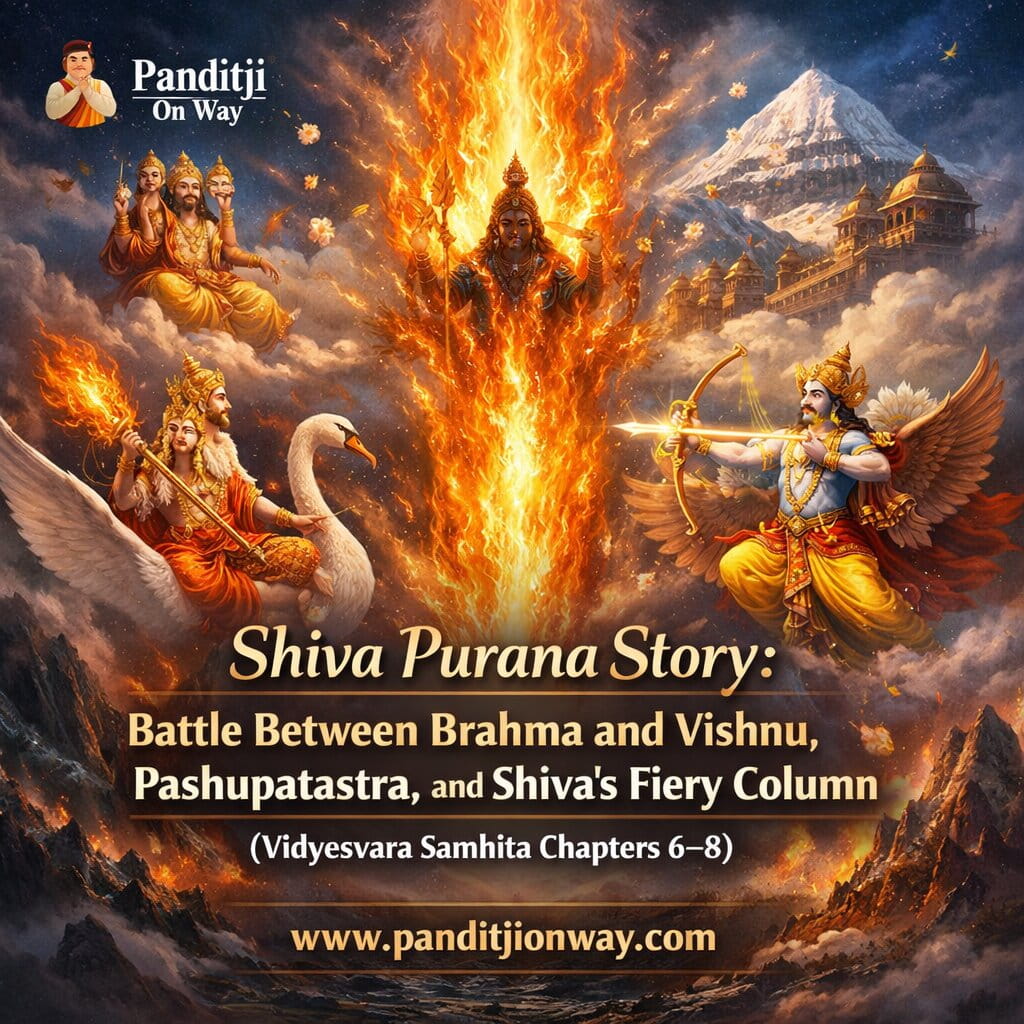
Shiva Purana Story: Battle Between Brahma and Vishnu, Pashupatastra, and Shiva’s Fiery Column (Vidyesvara Samhita Chapters 6–8)
Discover the Shiva Purana story of the Battle Between Brahma and Vishnu, Pashupatastra, and Shiva’s fiery column (Lingodbhava) with deep meaning and symbolism.
The Shiva Purana (Vidyesvara Samhita Chapters 6–8) narrates a profound cosmic event where Lord Brahma and Lord Vishnu engage in a fierce battle, leading to the use of divine weapons like the Pashupatastra and Maheshwarastra. This conflict results in Lord Shiva manifesting as an infinite column of fire (Lingodbhava), teaching the importance of truth, humility, and devotion.
Table of Contents
- Battle Between Brahma and Vishnu
- Use of Maheshwarastra and Pashupatastra
- Devas’ Journey to Kailash
- Shiva Appears as Infinite Fire Column (Lingodbhava)
- Search for the Top and Bottom
- Brahma’s Falsehood and Ketaki Flower
- Shiva’s Blessing to Vishnu
- Shiva’s Curse on Brahma
- Ketaki Flower’s Curse and Partial Redemption
- Spiritual Meaning and Symbolism
- FAQs
1. Battle Between Brahma and Vishnu
The story begins with a confrontation between Lord Brahma (creator) and Lord Vishnu (preserver).
- Brahma claims superiority as the creator of the universe.
- Vishnu counters that Brahma emerged from his navel lotus.
- Their ego-driven argument escalates into a cosmic battle.
This symbolizes the conflict of ego even among divine beings, highlighting the necessity of higher truth.
2. Use of Maheshwarastra and Pashupatastra
During the intense battle:
| Weapon | Used By | Description | Impact |
|---|---|---|---|
| Maheshwarastra | Vishnu | Divine weapon of Shiva | Extreme destructive force |
| Pashupatastra | Brahma | Supreme weapon of Shiva | Capable of cosmic destruction |
- Both weapons clashed like thousands of suns exploding simultaneously.
- The entire universe faced imminent destruction.
3. Devas’ Journey to Kailash
Terrified by the catastrophic battle, the Devas:
- Realize only Lord Shiva (Supreme Brahman) can resolve the crisis.
- Travel to Mount Kailash, the divine abode of Shiva.
There, they witness:
- Shiva seated with Goddess Parvati
- Surrounded by ganas and divine radiance
- Vedas praising Him
This reinforces Shiva as the ultimate authority beyond creation and preservation.
4. Shiva Appears as Infinite Fire Column (Lingodbhava)
To stop the destruction:
- Shiva manifests as an endless pillar of fire (Lingodbhava) between Brahma and Vishnu.
- The divine weapons dissolve into this column.
This represents:
- Infinite nature of Shiva
- Formless absolute reality (Brahman)
5. Search for the Top and Bottom
To prove superiority:
| Deity | Form Taken | Direction | Result |
|---|---|---|---|
| Vishnu | Boar (Varaha) | Downwards | Could not find base |
| Brahma | Swan (Hamsa) | Upwards | Could not find top |
- Vishnu accepts truth.
- Brahma chooses deception.
6. Brahma’s Falsehood and Ketaki Flower
Brahma encounters the Ketaki flower and persuades it to lie:
- Claims he reached the top
- Ketaki falsely supports him
This act symbolizes:
- Ego leading to dishonesty
- Misuse of authority
7. Shiva’s Blessing to Vishnu
Pleased with Vishnu’s honesty:
- Shiva grants Vishnu equal status in worship
- Vishnu receives temples, rituals, and festivals
This highlights:
- Truth leads to divine grace
- Humility is superior to ego
8. Shiva’s Curse on Brahma
Shiva punishes Brahma for lying:
- Brahma loses widespread worship
- Very few temples dedicated to him
Example:
- Brahma Temple Pushkar is one of the rare temples.
9. Ketaki Flower’s Curse and Redemption
Shiva curses Ketaki:
- Forbidden in Shiva worship
- Later allowed for decorative purposes only
This shows:
- Even small falsehood has consequences
- Redemption is possible through repentance
10. Spiritual Meaning and Symbolism
Key Teachings
| Concept | Meaning |
|---|---|
| Infinite Fire Column | Shiva as ultimate reality |
| Brahma’s Lie | Ego leads to downfall |
| Vishnu’s Truth | Honesty leads to grace |
| Pashupatastra | Destructive power of ego |
| Devas’ Fear | Need for divine intervention |
Core Lesson
Truth (Satya) and humility (Vinaya) are superior to power and ego.
For Puja and Rituals Booking
For puja and rituals related to Lord Shiva, visit:
https://www.panditjionway.com
FAQs for Shiva Purana Story: Battle Between Brahma and Vishnu, Pashupatastra, and Shiva’s Fiery Column (Vidyesvara Samhita Chapters 6–8)
1. What is the story of Brahma and Vishnu fighting in Shiva Purana?
The Shiva Purana describes a cosmic dispute where Brahma and Vishnu argue over supremacy, leading to a destructive battle that is ultimately stopped by Lord Shiva’s intervention as an infinite pillar of fire.
2. Why did Brahma and Vishnu fight?
Brahma and Vishnu fought due to ego and the desire to prove who was the supreme creator and ruler of the universe.
3. What is Lingodbhava in Shiva Purana?
Lingodbhava is the manifestation of Lord Shiva as an infinite column of fire, symbolizing His eternal, formless, and limitless nature.
4. What is the significance of the fire pillar of Shiva?
The fire pillar represents the infinite nature of Shiva, beyond time, space, and human comprehension, proving that ultimate reality cannot be measured.
5. What is Pashupatastra?
Pashupatastra is a powerful divine weapon of Lord Shiva capable of destroying the universe, used by Brahma in the battle.
6. What is Maheshwarastra?
Maheshwarastra is another divine weapon associated with Lord Shiva, used by Vishnu during the cosmic battle.
7. Why did Devas go to Mount Kailash?
The Devas went to Mount Kailash seeking Lord Shiva’s intervention to stop the destructive battle between Brahma and Vishnu.
8. What form did Vishnu take to find the fire column?
Vishnu took the form of a boar (Varaha) and went downward to find the base of the infinite column but failed.
9. What form did Brahma take during the search?
Brahma took the form of a swan (Hamsa) and flew upward to find the top but could not reach it.
10. Why did Brahma lie about finding the top?
Brahma lied due to ego and the desire to prove his superiority over Vishnu.
11. What role did the Ketaki flower play in the story?
The Ketaki flower falsely supported Brahma’s claim that he reached the top of the fire column.
12. Why is Ketaki flower not offered to Lord Shiva?
Lord Shiva cursed the Ketaki flower for supporting falsehood, banning it from His worship rituals.
13. Why did Shiva bless Vishnu?
Shiva blessed Vishnu because he remained truthful and accepted that he could not find the base of the column.
14. Why are there very few temples of Brahma?
Due to Shiva’s curse, Brahma is not widely worshipped, resulting in very few temples like Brahma Temple Pushkar.
15. What lesson does the Brahma-Vishnu story teach?
The story teaches that truth, humility, and devotion are superior to ego, pride, and falsehood.
16. What is the spiritual meaning of Lingodbhava?
Lingodbhava represents the realization that the ultimate truth (Shiva) is infinite and beyond human understanding.
17. How did Shiva stop the cosmic destruction?
Shiva appeared as an infinite fire column that absorbed the destructive energies of both divine weapons.
18. Who is Bhairava in this story?
Bhairava is a fierce manifestation of Shiva created to punish Brahma for his falsehood and arrogance.
19. What punishment did Brahma receive from Shiva?
Brahma was cursed to not be widely worshipped and to have no major temples or festivals dedicated to him.
20. Can Ketaki flower be used in any form in Shiva worship?
Ketaki flower is not used in direct worship but may be used as decoration in temple canopies as per Shiva’s partial blessing.
High Authority External Links
- Learn more about Shiva Purana: https://www.wisdomlib.org/hinduism/book/shiva-purana
- Symbolism of Lingodbhava: https://www.hindupedia.com/en/Lingodbhava
- About Mount Kailash: https://www.britannica.com/place/Kailas-Range
Conclusion
The story from Shiva Purana Vidyesvara Samhita Chapters 6–8 is not just mythology but a deep philosophical teaching. It establishes:
- Shiva as the infinite supreme consciousness
- Truth as the highest virtue
- Ego as the root of downfall
This timeless narrative continues to guide spiritual seekers toward truth, devotion, and self-realization.