
64 Forms of Lord Shiva, Meaning of Shiva and Symbolism – Complete Guide for Devotees
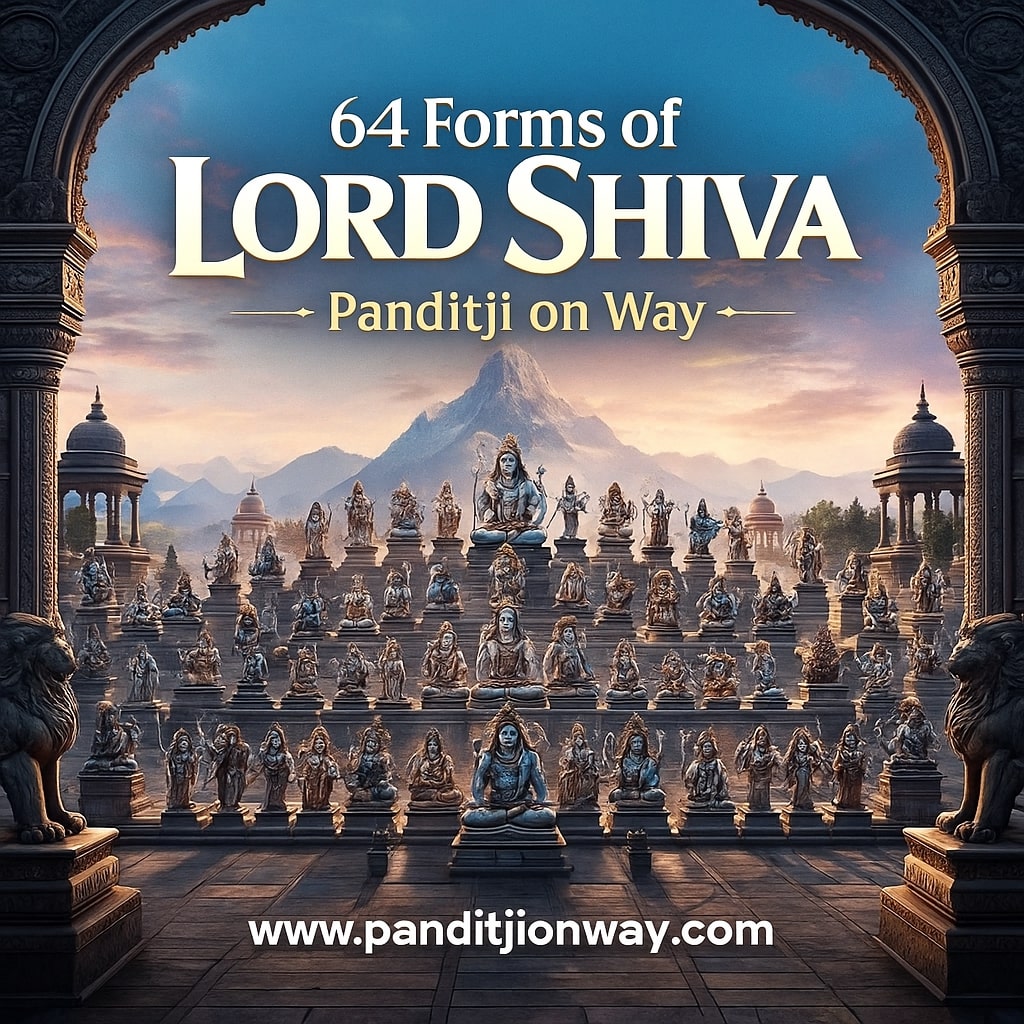
64 Forms of Lord Shiva:- Lord Shiva is one of the most profound and multifaceted deities in Sanatana Dharma. For thousands of years, seekers, yogis, rishis, and devotees have worshipped Shiva not merely as a god but as a cosmic principle—representing the source, substance, and dissolution of existence. This article presents a complete, deeply researched explanation of the meaning of Shiva, the symbolism of his divine attributes, and a comprehensive listing of the 64 Forms of Lord Shiva, as described in Shaiva Scriptures, Puranas, and Agamas
For performing Shiva Puja, Rudrabhishek, or Shivratri rituals, you may book a Pandit online through Panditji On Way – India’s first and largest online puja booking portal.
Visit: https://www.panditjionway.com
Meaning of Shiva
“Shiva” Means “That Which Is Not”
In the yogic tradition, the word Shiva literally translates to “that which is not”. It points to the formless, infinite, all-pervasive dimension of reality where creation dissolves into nothingness.
Modern cosmology increasingly supports the same idea:
Everything arises from a vast emptiness and eventually merges back into it. Galaxies, stars, planets, and living beings—all are temporary events in an infinite cosmic space. This silent, boundless nothingness is referred to in yogic science as Shiva.
Shiva refers to the eternal, unmanifest space that is the source and dissolution of the universe. Shiva is the cosmic nothingness from which everything emerges and into which everything returns.
Shiva as the Destroyer and Transformer in Trimurti
According to Vedic cosmology, the universe operates through the forces of:
- Brahma – Creation
- Vishnu – Preservation
- Shiva – Dissolution & Transformation
Lord Shiva is often called “The Destroyer”, but this destruction is not negative. It represents the removal of ignorance, ego, limitations, and outdated forms—making way for renewal, rebirth, and inner awakening.
In the Smarta and Shaiva Siddhanta traditions, Lord Shiva is worshipped as one of the five supreme deities in the Panchayatana Puja system.
Iconography and Symbols of Lord Shiva
Shiva’s divine form is rich with symbolism. Every element—from the crescent moon to the ash smeared on his body—represents cosmic principles and yogic truths.
Symbolism of Lord Shiva
1. The Damru – Symbol of Creation and Dissolution
The Damru, a small hourglass-shaped drum, symbolizes the rhythmic cycles of the universe.
Meaning of Shiva’s Damru
- Represents expansion and collapse, just like the universe’s pulsation.
- Symbolizes the ongoing dance of creation, preservation, and dissolution.
- Reflects the rhythm of the heartbeat and the vibrational nature of existence.
The hourglass shape shows the flow from manifestation → unmanifestation → manifestation, a cycle central to Tantra and Shaivism.
2. The Serpent Around Shiva’s Neck – Mastery Over Death
The serpent, often depicted as Vasuki, symbolizes:
- Power over birth and death
- Control of time (Kala)
- Fearlessness
- Protection of devotees
Puranic Background
During the Samudra Manthan, the deadly poison Halahala emerged. Lord Shiva consumed it to save existence. Vasuki, who also consumed the poison and served as the divine rope, was blessed to remain around Shiva’s neck.
Symbolic Meanings
- Represents Kundalini Shakti, the dormant energy awakened through spiritual practice.
- Signifies Shiva’s mastery over Maya, desire, and lower instincts.
- Expresses his role as Pashupatinath, the protector of all creatures.
3. The Trishul (Trident) – Mastery Over the Three States
The Trishul represents:
- The three states of consciousness: waking, dreaming, and deep sleep
- The three gunas: sattva, rajas, tamas
- The three realms: physical, astral, causal
Lord Shiva holding the Trishul signifies that he is beyond all these dimensions yet governs them effortlessly.
4. Shiva’s Blue Throat & Body
Shiva’s blue throat (Neelkanth) came from holding the Halahala poison. The blue color also symbolizes:
- Infinity (like the sky)
- All-pervasiveness
- Formless consciousness
Lord Shiva does not have a body in the human sense. His blue form is a symbolic representation of the boundless, infinite reality.
Maheshwara Murtams – The 25 Sports of Shiva
In Shaiva Siddhanta, the Maheshwara Murtams represent 25 cosmic acts of Lord Shiva. These include creation, protection, destruction, concealment, bestowing grace, and other divine pastimes.
These forms are described extensively in southern Agamic texts and temple traditions.
The 64 Forms of Lord Shiva (Ashta Shasta Murtas)
Below is the complete list of the 64 classical forms of Lord Shiva, as worshipped in various temples across India. Each form represents a unique divine action, cosmic role, or spiritual teaching.
64 Forms of Lord Shiva (Complete List)
| S.No. | Name of Lord Shiva Form | Description |
|---|---|---|
| 1 | Linga Murthy | Shiva as the formless cosmic energy represented by the Shiva Linga. |
| 2 | Lingodbhava Murthy | Shiva emerging from the infinite pillar of light, symbolizing eternity. |
| 3 | Mukhalingam | Five-faced Shiva Linga, representing omniscience and divine presence. |
| 4 | Sada Shiva Murthy | Transcendental five-faced form radiating absolute consciousness. |
| 5 | Maha Sada Shiva Murthy | Twenty-five-faced supreme form embodying full cosmic dimensions. |
| 6 | Uma Maheshvara Murthy | Shiva with Goddess Uma, symbol of divine unity and harmony. |
| 7 | Sukasana Murthy | Shiva seated peacefully with Uma, granter of calmness and joy. |
| 8 | Umesha Murthy | Shiva and Uma in blessing posture, representing compassion. |
| 9 | Somaskanda Murthy | Divine family form with Shiva, Uma, and Skanda together. |
| 10 | Vrishabhantika Murthy | Shiva standing with Nandi, symbol of dharma and loyalty. |
| 11 | Chandrashekara Murthy | Shiva adorned with the crescent moon, ruler of time cycles. |
| 12 | Bhujanga Lalita Murthy | Shiva decorated with serpent and moon, symbol of energy control. |
| 13 | Sada Nritta Murthy (Nataraja) | Shiva performing cosmic dance, dissolving ignorance and ego. |
| 14 | Gangavisarjana Murthy | Shiva releasing Ganga from his matted hair onto Earth. |
| 15 | Ardhanarishvara Murthy | Half-Shiva half-Parvati form, symbol of masculine-feminine balance. |
| 16 | Vrishabharudar | Shiva riding Nandi, representing strength and righteousness. |
| 17 | Bhujanga Trasa Murthy | Shiva holding snake, fire, damru—protector of devotees. |
| 18 | Chandra Tandava Murthy | Shiva dancing energetically with the crescent moon. |
| 19 | Tripurantaka Murthy | Destroyer of the three demon cities (Tripura). |
| 20 | Gajasura Samhara Murthy | Slayer of the powerful elephant demon, symbol of victory over ego. |
| 21 | Sandhya Nritta Murthy | Shiva performing evening dance, representing transition energies. |
| 22 | Gangadhara Murthy | Shiva receiving Ganga’s descent to Earth. |
| 23 | Kalyanasundara Murthy | Shiva’s divine wedding with Parvati, symbol of cosmic union. |
| 24 | Jvarabhagna Murthy | Destroyer of fevers and diseases; healer deity. |
| 25 | Shardhula Hara Murthy | Shiva wearing tiger skin, symbol of power over wild forces. |
| 26 | Keshavartha Murthy | Combined form of Shiva and Vishnu (Shankaranarayana). |
| 27 | Chandisha Anugraha Murthy | Blessing Sage Chandesha with divine grace. |
| 28 | Vinadhara Dakshina Murthy | Shiva holding a Veena, master of music and wisdom. |
| 29 | Lakulishvara Murthy | Ascetic teacher form holding staff and drum. |
| 30 | Vaduka Murthy (Bhairava) | Fierce hermit form worshipped for protection. |
| 31 | Agorastra Murthy | Aghora form symbolizing transformation of negative energies. |
| 32 | Guru Murthy | Shiva as the supreme teacher imparting spiritual knowledge. |
| 33 | Jalandhara Samhara Murthy | Slayer of demon Jalandhara, upholder of cosmic order. |
| 34 | Ekapada Murthy | One-legged austerity form symbolizing stability and tapas. |
| 35 | Gauri Lila Murthy | Shiva with Parvati in peaceful domestic form. |
| 36 | Brahma Shirachetha Murthy | Shiva removing Brahma’s ego by cutting his fifth head. |
| 37 | Varaha Samhara Murthy | Destroyer of Varaha demon, symbol of righteousness. |
| 38 | Shishyabhava Murthy | Shiva among disciples, teaching humility and devotion. |
| 39 | Pasupatha Murthy | Wielder of Pasupata Astra, protector of beings. |
| 40 | Bhikshatana Murthy | Mendicant form symbolizing detachment and renunciation. |
| 41 | Vyakhyana Dakshina Murthy | Shiva teaching the scriptures to sages. |
| 42 | Kalantaka Murthy | Conqueror of Yama, giver of longevity. |
| 43 | Bhairava Murthy | Fierce protector form accompanied by a dog. |
| 44 | Kshetrapala Murthy | Guardian of sacred grounds and temple regions. |
| 45 | Dakshayagyahara Murthy | Destroyer of Daksha’s ego during Yagna. |
| 46 | Ashvarudha Murthy | Shiva riding a horse, symbol of dynamic energy. |
| 47 | Ekapada Trimurthy | Shiva manifesting as Brahma, Vishnu, and Shiva in one form. |
| 48 | Gauri Varaprada Murthy | Shiva blessing Parvati with divine boons. |
| 49 | Vishapaharana Murthy | Shiva with Parvati after neutralizing poison (Neelkanth). |
| 50 | Kurma Samhara Murthy | Slayer of Kurma demon; protector of cosmic stability. |
| 51 | Prarthana Murthy | Benevolent form blessing devotees’ prayers. |
| 52 | Kankala Murthy | Shiva holding skeleton staff symbolizing impermanence. |
| 53 | Simhaghna Murthy | Destroyer of the lion demon, symbol of suppressing ego. |
| 54 | Yoga Dakshina Murthy | Meditative teacher imparting yogic wisdom. |
| 55 | Kama Dahana Murthy | Burner of Kamadeva; transcender of desires. |
| 56 | Apatuttarana Murthy | Savior during dangers and hardships. |
| 57 | Virabhadra Murthy | Fierce warrior created from Shiva’s rage during Daksha Yagna. |
| 58 | Kirata Murthy | Hunter form during Arjuna’s penance. |
| 59 | Gajantika Murthy | Shiva with elephant attributes, symbol of power. |
| 60 | Tripada Trimurthy | Three-legged divine form representing cosmic balance. |
| 61 | Chakradana Murthy | Shiva granting Sudarshana Chakra to Vishnu. |
| 62 | Garudanthika Murthy | Worshipped by Garuda and celestial beings. |
| 63 | Matsya Samhara Murthy | Slayer of aquatic demons; cosmic preserver. |
| 64 | Rakthabhiksha Pradana Murthy | Shiva offering divine blood to Vishnu in cosmic play. |
Why Shiva Worship Is Spiritually Transformative
Benefits of Worshipping Shiva
- Awakening of inner stillness
- Overcoming fear and negativity
- Dissolution of past karmas
- Activation of inner energy
- Attainment of peace, clarity, and devotion
Book a Shiva Puja Online – Panditji On Way
Panditji On Way is India’s first and largest online puja booking platform offering authentic Vedic rituals by verified Pandits.
Services Available
- Rudrabhishek
- Laghu Rudra
- Maha Rudra
- Shivratri Puja
- Pradosh Puja
- Shravan Maas Puja
- Graha Shanti and Rudra Homam
Book Now: https://www.panditjionway.com
FAQs About 64 Forms of Lord Shiva
1. What is the true meaning of Shiva in Hinduism?
Shiva means “that which is not,” referring to the infinite, formless, unmanifest cosmic reality from which creation arises and into which it dissolves. In yogic science, Shiva represents pure consciousness, stillness, and the eternal space that holds the universe.
2. Why is Lord Shiva called the Destroyer?
Shiva is called the Destroyer because he dissolves ignorance, ego, old karmas, and outdated forms to make way for renewal. In the Trimurti, Shiva governs the phase of cosmic dissolution, which is essential for new creation.
3. What do the symbols of Lord Shiva represent?
Every symbol of Shiva conveys a spiritual principle:
- Trishul: mastery over three states of consciousness
- Damru: vibration of creation and dissolution
- Serpent: control over time and death
- Crescent moon: cyclical nature of time
- Third eye: inner vision and destruction of illusion
These symbols express Shiva’s role as the supreme yogi and cosmic force.
4. Why does Lord Shiva have a third eye?
Shiva’s third eye symbolizes inner perception, truth, and the destruction of illusion. When opened, it burns ignorance and negative tendencies, revealing the reality beyond appearances.
5. Why is Lord Shiva blue in color?
Shiva’s blue color signifies infinity, vastness, and cosmic depth. Mythologically, he turned blue after holding the deadly Halahala poison in his throat during Samudra Manthan, earning the name Neelkanth.
6. What is the significance of the Shiva Linga?
The Shiva Linga represents the formless absolute, the point of origin where energy and matter merge. It symbolizes creation, dissolution, and the infinite cosmic pillar of light.
7. What are the 64 forms of Lord Shiva?
The 64 forms (Shivamurtis) are divine manifestations described in Agamas and Puranas. They represent different cosmic functions, such as creation, protection, destruction, teaching, blessing, and transformation.
8. Which form of Shiva is best to worship for peace and prosperity?
For peace, devotees worship Dakshinamurthy, Somaskanda, or Sukhasana Murthy.
For prosperity and harmony, Kalyanasundara, Ardhanarishvara, and Uma Maheshwara are highly auspicious.
9. How can worshipping Shiva help in spiritual growth?
Worshipping Lord Shiva calms the mind, dissolves ego, purifies karma, awakens inner energy (Kundalini), and supports meditation. Shiva worship strengthens fearlessness, detachment, and clarity—core aspects of spiritual growth.
10. Why does Shiva wear a serpent around his neck?
The serpent symbolizes kundalini energy, cosmic power, control over fear, and victory over death. It also signifies that Lord Shiva is beyond time and transformation, ruling over the forces of nature.
11. What is the significance of Shiva’s Trishul (Trident)?
Shiva’s Trishul represents mastery over the three states of mind (waking, dreaming, deep sleep) and the three gunas (sattva, rajas, tamas). It indicates Shiva’s supremacy over material existence.
12. What is the role of Nandi in Shiva worship?
Nandi, the sacred bull, symbolizes purity, devotion, and dharma. He is the gatekeeper of Shiva’s abode and reminds devotees to approach Shiva with humility and sincerity.
13. What does Om Namah Shivaya mean?
Om Namah Shivaya means “I bow to Shiva, the inner Self.” It is a powerful Mahamantra that purifies the mind, dissolves negativity, and aligns one with the divine consciousness within.
14. Why is Shiva worship popular during Shravan and Maha Shivaratri?
Shravan and Maha Shivaratri are considered spiritually charged periods where Shiva’s energy is most accessible. Worshipping during these times enhances blessings, purification, and inner transformation.
15. Can anyone worship Lord Shiva?
Yes. Shiva is worshipped by people of all backgrounds. In scriptures, he is called Ashutosh, meaning “the easily pleased one.” Even simple offerings made with sincerity can invoke his blessings.
16. What are the benefits of performing Rudrabhishek?
Rudrabhishek helps in:
- Removing obstacles
- Reducing planetary afflictions
- Attracting peace and prosperity
- Cleansing negative energies
- Bringing spiritual protection
Many devotees book Rudrabhishek through Panditji On Way, India’s largest online puja booking portal.
17. Why is Shiva considered the Adiyogi?
Lord Shiva is the Adiyogi because he is the first yogi who revealed 108 forms of yoga, meditation techniques, and spiritual sciences to the Sapta Rishis, making him the origin of all yogic traditions.
18. What is the significance of Shiva’s dance (Tandava)?
The Tandava represents the cycles of creation, preservation, and destruction, symbolizing the dynamic flow of the cosmos. It also reflects the inner dance of energies within every human being.
19. What does Ardhanarishvara symbolize?
Ardhanarishvara represents the union of Lord Shiva (consciousness) and Shakti (energy). It teaches that both masculine and feminine forces are essential for creation and must remain balanced.
20. How does Shiva help remove fear and negativity?
Lord Shiva dissolves emotional blocks, karmic patterns, and mental disturbances. Worshipping Shiva helps devotees overcome fear, attachment, anxiety, and negative energies, filling the mind with clarity and courage.
Conclusion
Lord Shiva is more than a deity; he is the embodiment of the cosmic truth—the nothingness from which everything originates. Understanding the symbolism of Lord Shiva and studying his 64 divine forms allows devotees to approach him not just with faith but with clarity and awareness.
May this comprehensive guide help seekers connect more deeply with the infinite presence of Mahadeva.
Panditji on Way:-
https://www.panditjionway.com


