


2026 Mahalaya Paksha Shraddha: Pitru Paksha Dates, Shraddha Vidhi, Tarpan, Pind Daan & Mahalaya Amavasya
2026 Mahalaya Paksha Shraddha Dates, Pitru Tithi, Shraddha Vidhi, Tarpan, Pind Daan, Mahalaya Amavasya Muhurat, Regional Traditions & Complete Guide – Panditji On Way
2026 Mahalaya Paksha / Pitru Paksha: 27 September 2026 to 10 October 2026
Sarva Pitru Amavasya / Mahalaya Amavasya: 10 October 2026, Saturday
Vikrama Samvata: 2083 Siddharthi
Primary lunar period: Ashwina Krishna Paksha
Important places: Gaya, Kashi, Prayagraj, Badrinath, Haridwar, Nashik, Mumbai and other Hindu pilgrimage centres
2026 Mahalaya Paksha Shraddha: Quick Answer
Mahalaya Paksha, commonly known as Pitru Paksha or Shraddha Paksha, will be observed from 27 September to 10 October 2026. The period begins with Pratipada Shraddha on 27 September and concludes with Sarva Pitru Amavasya, also called Mahalaya Amavasya, on 10 October 2026. The exact Shraddha muhurat varies according to location because sunrise, sunset and tithi timings are location-specific.
Pitru Paksha is traditionally dedicated to remembering and honouring departed ancestors through Shraddha, Tarpan, Pind Daan, food offerings, charity and prayers. If the death tithi of an ancestor is known, Shraddha is generally performed on the corresponding lunar tithi. When the death tithi is unknown, Sarva Pitru Amavasya is traditionally considered the general day for ancestral Shraddha.

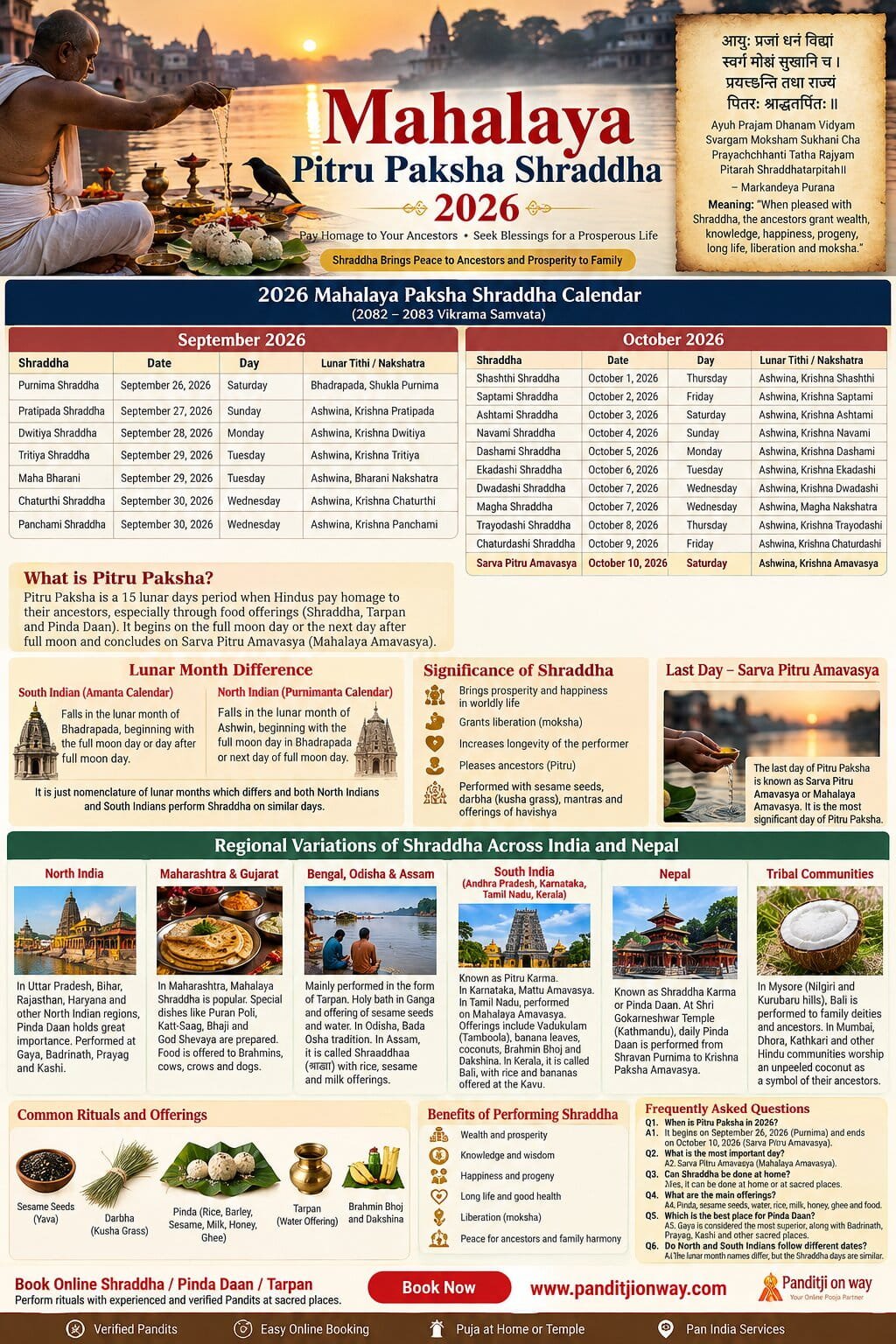
2026 Pitru Paksha Shraddha Dates: Complete Calendar
| Shraddha | Date | Day | Lunar Tithi / Nakshatra |
|---|---|---|---|
| Purnima Shraddha | 26 September 2026 | Saturday | Bhadrapada Shukla Purnima |
| Pratipada Shraddha | 27 September 2026 | Sunday | Ashwina Krishna Pratipada |
| Dwitiya Shraddha | 28 September 2026 | Monday | Ashwina Krishna Dwitiya |
| Tritiya Shraddha | 29 September 2026 | Tuesday | Ashwina Krishna Tritiya |
| Maha Bharani | 29 September 2026 | Tuesday | Bharani Nakshatra |
| Chaturthi Shraddha | 30 September 2026 | Wednesday | Ashwina Krishna Chaturthi |
| Panchami Shraddha | 30 September 2026 | Wednesday | Ashwina Krishna Panchami |
| Shashthi Shraddha | 1 October 2026 | Thursday | Ashwina Krishna Shashthi |
| Saptami Shraddha | 2 October 2026 | Friday | Ashwina Krishna Saptami |
| Ashtami Shraddha | 3 October 2026 | Saturday | Ashwina Krishna Ashtami |
| Navami Shraddha | 4 October 2026 | Sunday | Ashwina Krishna Navami |
| Dashami Shraddha | 5 October 2026 | Monday | Ashwina Krishna Dashami |
| Ekadashi Shraddha | 6 October 2026 | Tuesday | Ashwina Krishna Ekadashi |
| Magha Shraddha | 7 October 2026 | Wednesday | Magha Nakshatra |
| Dwadashi Shraddha | 7 October 2026 | Wednesday | Ashwina Krishna Dwadashi |
| Trayodashi Shraddha | 8 October 2026 | Thursday | Ashwina Krishna Trayodashi |
| Chaturdashi Shraddha | 9 October 2026 | Friday | Ashwina Krishna Chaturdashi |
| Sarva Pitru Amavasya | 10 October 2026 | Saturday | Ashwina Krishna Amavasya |
The 2026 Hindu calendar confirms the sequence from Pratipada on 27 September through Sarva Pitru Amavasya on 10 October. Some tithis overlap a civil date, which is why Chaturthi and Panchami Shraddha are both listed on 30 September.
Important Note About 26 September 2026
Bhadrapada Shukla Purnima Shraddha falls on 26 September 2026. It is important to distinguish Purnima Shraddha from the main 15-day Pitru Paksha period. According to the traditional calendar explanation, Purnima Shraddha is performed separately, while the main Pitru Paksha begins from the following day.
When Is Pitru Paksha 2026?
Pitru Paksha 2026 begins on Sunday, 27 September 2026, and ends on Saturday, 10 October 2026.
The first day is Pratipada Shraddha, while the final day is Sarva Pitru Amavasya, also called Mahalaya Amavasya. The 2026 Panchang identifies 27 September as Ashwina Krishna Pratipada and the beginning of Pitrupaksha, with Vikrama Samvata 2083.
What Is Mahalaya Paksha?
Mahalaya Paksha is the period traditionally dedicated to performing Shraddha and remembering ancestors. It is also widely known as Pitru Paksha, Shraddha Paksha or Pitru Paksha Shraddha.
The Sanskrit term Shraddha is associated with performing ancestral rites with faith, devotion and prescribed ritual procedure. Traditional sources describe Shraddha as a ritual involving offerings, mantras and appropriate materials such as sesame and Kusha/Darbha according to the particular tradition.
The period provides families an opportunity to remember deceased parents, grandparents and other ancestors and to perform customary rituals such as:
- Shraddha
- Tarpan
- Pind Daan
- Brahmin Bhoj
- Daan-Dakshina
- Food offerings
- Prayers for ancestors
- Family remembrance and charity
Why Is Pitru Paksha Important?
Pitru Paksha has an important place in Hindu ancestral traditions because it provides a specific period for Pitru Smaran, Shraddha and Tarpan.
Traditional Hindu texts and ritual manuals discuss several forms of Shraddha. The religious understanding of these rituals varies among communities and traditions, but the central theme is remembrance and offering for one’s ancestors.
Traditional descriptions associate Shraddha with faith, proper ritual procedure, sesame, Kusha grass, mantras and offerings.
A frequently cited verse from the Markandeya Purana is:
आयुः प्रजां धनं विद्यां स्वर्गं मोक्षं सुखानि च।
प्रयच्छन्ति तथा राज्यं पितरः श्राद्धतर्पिताः॥
Ayuh Prajam Dhanam Vidyam Svargam Moksham Sukhanicha
Prayachchhanti Tatha Rajyam Pitarah Shraddhatarpitah
Traditional interpretation associates satisfied ancestors with blessings such as prosperity, knowledge, progeny, longevity and spiritual welfare. These are matters of religious belief rather than scientifically measurable outcomes.
2026 Sarva Pitru Amavasya Date
Sarva Pitru Amavasya 2026
Date: 10 October 2026
Day: Saturday
Tithi: Ashwina Krishna Amavasya
Other names: Mahalaya Amavasya, Pitru Amavasya, Sarvapitra Amavasya
Sarva Pitru Amavasya is traditionally regarded as the concluding and especially significant day of Pitru Paksha.
It is commonly chosen for a general ancestral Shraddha when the exact death tithi of an ancestor is unknown. It is also associated with Shraddha for ancestors whose death anniversary falls on Amavasya and, according to the referenced traditional calendar guidance, for Purnima and Chaturdashi cases under the relevant Shraddha rules.
Mahalaya Amavasya 2026 Muhurat
The exact Shraddha muhurat must be calculated according to the city where the ritual is being performed.
For example, for Mumbai, Maharashtra, the 2026 Panchang lists:
| Muhurat | Mumbai Time |
|---|---|
| Kutup Muhurat | 12:02 PM – 12:49 PM |
| Rohina Muhurat | 12:49 PM – 1:36 PM |
| Aparahna Kaal | 1:36 PM – 3:58 PM |
| Amavasya Tithi Begins | 9:35 PM, 9 October |
| Amavasya Tithi Ends | 9:19 PM, 10 October |
These timings are specifically for Mumbai and should not be copied as universal timings for other cities.
For Tirupati, for example, the same Amavasya occurs on 10 October but the local Kutup, Rohina and Aparahna timings differ.
answer:
What is the best time for Shraddha on Mahalaya Amavasya 2026? Traditionally, Parvan Shraddha is associated with the Kutup Muhurat, Rohina Muhurat and Aparahna period, but the exact clock time should be calculated for the location of the ceremony.
2026 Pitru Paksha Shraddha Vidhi
The exact procedure may vary according to family tradition, regional custom, Sampradaya and the guidance of the family priest.
A general Shraddha ceremony may include the following stages:
1. Sankalpa
The performer takes a formal Sankalpa stating the intention of performing Shraddha for the departed ancestor.
2. Invocation and Preparation
The ritual area is cleaned and prepared. Kusha/Darbha, sesame, water and other prescribed materials may be arranged according to the tradition being followed.
3. Tarpan
Water, traditionally accompanied by sesame and Kusha where prescribed, is offered with mantras for the ancestors.
4. Pind Daan
Pindas are prepared according to the ritual tradition and offered to the ancestors.
5. Food Offering
Food is prepared according to family and regional customs. Offerings may be made as part of the Shraddha procedure.
6. Brahmin Bhoj and Daan
Many Shraddha traditions include feeding Brahmins and offering Dakshina or charity.
7. Panchabali and Other Offerings
Some traditions include offerings associated with cows, crows, dogs and other living beings. The exact practice varies by region and family tradition.
8. Tarpan and Completion
The ritual is completed with the prescribed concluding prayers and Tarpan.
Traditional Shraddha guidance identifies Tarpan as an important component and discusses offerings to ancestors along with the prescribed ritual procedure.
Pitru Paksha Puja Samagri List
The exact Samagri list depends on the ritual and regional tradition, but commonly required items may include:
| Puja Samagri | Common Use |
|---|---|
| Black Sesame / Til | Tarpan and offerings |
| Kusha / Darbha | Ritual purification and Tarpan |
| Rice | Pinda and food offerings |
| Barley | Traditional offerings |
| Milk | Pinda / ritual preparation |
| Ghee | Ritual offering |
| Honey | Traditional Pinda preparation |
| Water | Tarpan |
| Flowers | Puja |
| Fruits | Offerings |
| Banana Leaves | Regional traditions |
| Food Items | Shraddha Bhoj |
| Cloth | Daan |
| Dakshina | Traditional offering |
| Pind Material | Pind Daan |
Families should follow the Samagri list given by their Pandit because the requirements can differ according to the specific Shraddha and regional tradition.
Which Tithi Should Be Used for Shraddha?
One of the most common questions during Pitru Paksha is:
“Which day should I perform Shraddha for my ancestors?”
The traditional approach is to identify the lunar tithi on which the ancestor passed away and perform the corresponding Shraddha during Pitru Paksha.
For example:
| Ancestor’s Death Tithi | Common Shraddha Approach |
|---|---|
| Pratipada | Pratipada Shraddha |
| Dwitiya | Dwitiya Shraddha |
| Tritiya | Tritiya Shraddha |
| Chaturthi | Chaturthi Shraddha |
| Panchami | Panchami Shraddha |
| Shashthi | Shashthi Shraddha |
| Saptami | Saptami Shraddha |
| Ashtami | Ashtami Shraddha |
| Navami | Navami Shraddha |
| Dashami | Dashami Shraddha |
| Ekadashi | Ekadashi Shraddha |
| Dwadashi | Dwadashi Shraddha |
| Trayodashi | Trayodashi Shraddha |
| Chaturdashi | Chaturdashi Shraddha |
| Amavasya | Sarva Pitru Amavasya |
| Unknown Tithi | Sarva Pitru Amavasya is commonly used |
A qualified priest should be consulted where the death date, tithi, regional calendar or family tradition is unclear.
What If the Ancestor’s Death Date Is Unknown?
If the exact death tithi of an ancestor is not known, Sarva Pitru Amavasya is traditionally considered an appropriate day for general ancestral Shraddha.
In 2026, this falls on Saturday, 10 October 2026.
This makes Mahalaya Amavasya especially relevant for families who cannot establish the precise lunar tithi associated with an ancestor.
Maha Bharani Shraddha 2026
Maha Bharani Shraddha falls on Tuesday, 29 September 2026, when Bharani Nakshatra is associated with the Shraddha observance. The 2026 calendar lists Maha Bharani on this date.
Bharani Shraddha is an important Nakshatra-based ancestral observance in traditions that follow Nakshatra Shraddha.
Magha Shraddha 2026
Magha Shraddha falls on Wednesday, 7 October 2026, associated with Magha Nakshatra. It occurs on the same civil date as Dwadashi Shraddha in the 2026 calendar.
Pitru Paksha Regional Variations in India
Shraddha is not performed identically throughout India. The underlying purpose may be similar, but terminology, food, ritual sequence, pilgrimage practices and local customs can differ.
North India: Gaya, Kashi, Prayagraj and Other Sacred Places
In North India, Pind Daan is particularly prominent.
Important pilgrimage locations associated with ancestral rites include:
- Gaya Ji
- Kashi / Varanasi
- Prayagraj
- Badrinath
- Haridwar
- Ayodhya and other regional pilgrimage centres
Among these, Gaya Ji in Bihar has a particularly strong association with Pind Daan and Pitru Paksha.
The Bihar Tourism Department identifies Vishnupad Temple and the Phalgu River among the important sites associated with Pind Daan in Gaya.
Gaya Pind Daan During Pitru Paksha
Gaya Ji, Bihar, is one of India’s best-known destinations for ancestral Pind Daan.
The Bihar Tourism Department describes Gaya’s Vishnupad Temple as an important site for Pind Daan and notes several sacred locations associated with the Pitru Paksha pilgrimage, including:
- Phalgu River
- Vishnupad Temple
- Sita Kund
- Pretshila
- Ramshila
- Akshayavat
For devotees specifically researching Gaya Pind Daan, Gaya Pitru Paksha, Gaya Shraddha, Vishnupad Pind Daan and Pitru Paksha rituals in Bihar, Gaya remains a major search and pilgrimage destination.
Vishnupad Temple, Gaya
Vishnupad Temple is located in Gaya on the banks of the Phalgu River and is dedicated to Lord Vishnu.
The Bihar Tourism Department states that the temple is known for the sacred footprint of Lord Vishnu and is a major site for Pind Daan.
For visitors planning ancestral rituals, the local priest traditionally guides the family through the required procedure and locations.
Prayagraj and Kashi for Shraddha and Tarpan
Prayagraj and Kashi/Varanasi are major Hindu pilgrimage destinations and are also relevant to families looking for sacred locations for Tarpan, Shraddha and ancestral prayers.
For location-specific rituals, devotees should verify:
- The appropriate tithi.
- Local Panchang.
- Ritual requirements.
- Ghat or temple rules.
- Availability of an authorised priest.
- Any restrictions applicable on the day.
Badrinath and Ancestral Ritual Traditions
Badrinath in Uttarakhand is one of the major Hindu pilgrimage destinations. Uttarakhand Tourism identifies Badrinath as an important Char Dham pilgrimage centre situated in the Himalayas.
Devotees considering ancestral rituals at Himalayan pilgrimage sites should confirm seasonal temple access and local ritual arrangements before travelling.
Maharashtra and Mumbai: Mahalaya Shraddha Traditions
Maharashtra has its own regional customs associated with Mahalaya Shraddha.
In Mumbai and other parts of Maharashtra, families may observe ancestral rituals at home or at appropriate sacred locations according to their family tradition.
Because Mumbai Panchang timings differ from other Indian cities, the exact Shraddha muhurat should be calculated specifically for Mumbai. For 10 October 2026, the Mumbai Panchang gives the Amavasya Shraddha window and Aparahna timings cited above.
Important Maharashtra locations for this topic include:
- Mumbai
- Navi Mumbai
- Thane
- Pune
- Nashik
- Nagpur
- Aurangabad / Chhatrapati Sambhajinagar
- Kolhapur
- Nagpur
Bengal, Odisha and Assam: Tarpan Traditions
In Bengal, Mahalaya has an especially prominent cultural and religious association.
Families may perform Tarpan with water and sesame according to local traditions. Mahalaya also has an important connection with the beginning of the Durga Puja season in Bengal.
In Odisha and Assam, ancestral rites also have regional forms and terminology.
The exact ritual sequence should be followed according to local customs rather than assuming that one North Indian or South Indian procedure applies everywhere.
South India: Pitru Karma and Mahalaya Amavasya
In Andhra Pradesh, Telangana, Karnataka, Tamil Nadu and Kerala, ancestral rites are often described using terms such as Pitru Karma, Pitru Karya, Tarpanam or Bali, depending on the region and tradition.
Important locations include:
- Hyderabad
- Vijayawada
- Visakhapatnam
- Bengaluru
- Mysuru
- Chennai
- Coimbatore
- Madurai
- Kochi
- Thiruvananthapuram
Regional customs can include specific food offerings, banana leaves, Tarpanam, Brahmin Bhojanam and Dakshina.
The correct ritual should always be determined by the family’s Sampradaya and local priest.
Nepal: Shraddha and Pind Daan
Shraddha traditions are also observed in Nepal.
Gokarneshwar Temple in Kathmandu is associated with ancestral rites and Pind Daan traditions. Regional practice and local priestly guidance should be followed when performing Shraddha in Nepal.
Pitru Paksha Do’s and Don’ts
Different communities follow different rules, so these should be understood as general traditional guidance rather than a universal legal or religious rulebook.
Commonly Observed Practices
- Perform Shraddha according to the correct tithi.
- Keep the ritual area clean.
- Use prescribed ritual materials.
- Offer Tarpan according to family tradition.
- Prepare appropriate food.
- Offer charity or Dakshina where customary.
- Remember ancestors with devotion.
- Follow the guidance of the family priest.
- Observe regional customs.
Commonly Avoided Practices
Many Hindu communities traditionally avoid:
- Non-vegetarian food during Shraddha observances.
- Alcohol.
- Unnecessary celebrations.
- Certain foods prohibited by the family’s tradition.
- Major auspicious ceremonies during the relevant Pitru Paksha period, depending on local custom.
Practices differ considerably, so families should follow their own tradition rather than treating one community’s rules as universal.
Pitru Paksha Food and Shraddha Bhoj
Food has an important role in many Shraddha traditions.
Depending on the regional custom, families may prepare:
- Rice
- Dal
- Seasonal vegetables
- Kheer
- Puri
- Fruits
- Milk-based preparations
- Ghee
- Traditional regional dishes
The exact menu should follow the family’s ritual tradition.
The purpose is traditionally understood as an act of offering, remembrance and hospitality rather than simply a normal family meal.
Pind Daan During Pitru Paksha
Pind Daan refers to the ritual offering of Pindas for departed ancestors.
Gaya is particularly associated with Pind Daan. Bihar Tourism identifies the Phalgu River and Vishnupad Temple among the important sites used for ancestral rites in Gaya.
Families travelling to Gaya should plan in advance, especially during Pitru Paksha when the city receives a large number of pilgrims.
Tarpan During Pitru Paksha
Tarpan is a ritual offering, commonly involving water and traditionally sesame and Kusha/Darbha where prescribed.
Traditional Shraddha descriptions regard Tarpan as an important part of ancestral observance.
Tarpan may be performed at home, temples, rivers or other prescribed locations depending on family tradition.
Shraddha at Home vs Shraddha at a Sacred Place
Both approaches are followed in different circumstances.
| Shraddha at Home | Shraddha at Pilgrimage Place |
|---|---|
| Convenient for families | Associated with sacred pilgrimage traditions |
| Can follow family customs | Priest guidance may be available |
| Suitable for local observance | Gaya is especially associated with Pind Daan |
| No travel required | Requires travel planning |
| Local priest can guide | Local ritual procedures may differ |
The choice should depend on family tradition, location, ability to travel and guidance from a qualified priest.
How to Book a Pandit for Pitru Paksha Shraddha
For families who want assistance with Shraddha, Tarpan or related Hindu rituals, Panditji On Way provides an online platform for connecting devotees with Pandits and ritual services.
Panditji On Way’s official website describes services including Pandit booking, online puja arrangements, puja Samagri kits and Hindu ritual services.
General booking process
- Visit the official Panditji On Way website.
- Select the required ritual or Pandit service.
- Share your city and preferred date.
- Provide the ancestor’s available death-date/tithi information.
- Discuss your family or regional tradition.
- Confirm the Pandit and ritual requirements.
- Arrange the required Samagri.
- Perform the Shraddha according to the agreed procedure.
Panditji On Way states that it provides Pandit services across major Indian cities and also supports international Hindu ritual arrangements.
Panditji On Way – Online Pooja and Pandit Booking
Panditji On Way is positioned as an online Pandit and Pooja Booking Portal connecting devotees with Hindu ritual services.


Its official service information includes Pandit booking, Puja arrangements, astrology consultations, Puja Samagri and online/live-video ritual arrangements.
For families searching for:
- Pandit for Shraddha
- Pandit for Pitru Paksha
- Pandit for Tarpan
- Pandit for Pind Daan
- Pitru Karma Pandit
- Mahalaya Amavasya Puja
- Shraddha Pandit near me
- Online Pandit for Hindu rituals
the booking process can be initiated through the official website.
Official website: Panditji On Way
Best Locations for 2026 Pitru Paksha Services
| Location | Relevant Search Intent |
|---|---|
| Mumbai | Pandit for Shraddha in Mumbai |
| Navi Mumbai | Pitru Paksha Pandit in Navi Mumbai |
| Thane | Shraddha Puja Pandit in Thane |
| Pune | Pitru Paksha Shraddha in Pune |
| Nashik | Pind Daan and Shraddha in Nashik |
| Delhi | Pandit for Pitru Paksha in Delhi |
| Noida | Shraddha Pandit in Noida |
| Gurugram | Pitru Paksha Puja in Gurugram |
| Lucknow | Shraddha Pandit in Lucknow |
| Jaipur | Pitru Paksha Pandit in Jaipur |
| Ahmedabad | Shraddha Puja in Ahmedabad |
| Surat | Pitru Karma Pandit in Surat |
| Patna | Pitru Paksha and Gaya Pind Daan services |
| Gaya | Pind Daan and Pitru Paksha |
| Varanasi / Kashi | Tarpan and Shraddha |
| Prayagraj | Tarpan and ancestral rituals |
| Hyderabad | Pitru Karma Pandit |
| Bengaluru | Shraddha Pandit |
| Chennai | Mahalaya Shraddha / Tarpanam |
| Kolkata | Mahalaya Tarpan |
| Bhubaneswar | Pitru Tarpan |
| Kochi | Bali / ancestral rituals |
2026 Pitru Paksha: Important Dates at a Glance
| Question | Answer |
|---|---|
| When does Pitru Paksha 2026 start? | 27 September 2026 |
| When does Pitru Paksha 2026 end? | 10 October 2026 |
| When is Mahalaya Amavasya 2026? | 10 October 2026 |
| When is Sarva Pitru Amavasya? | 10 October 2026 |
| When is Pratipada Shraddha? | 27 September 2026 |
| When is Dwitiya Shraddha? | 28 September 2026 |
| When is Tritiya Shraddha? | 29 September 2026 |
| When is Maha Bharani? | 29 September 2026 |
| When is Magha Shraddha? | 7 October 2026 |
| When is Chaturdashi Shraddha? | 9 October 2026 |
| Which day is for unknown death tithi? | Sarva Pitru Amavasya is traditionally used |
| What is Pitru Paksha also called? | Mahalaya Paksha / Shraddha Paksha |
| Which place is especially associated with Pind Daan? | Gaya Ji |
| What are major Shraddha components? | Shraddha, Tarpan, Pind Daan, offerings and charity |
Frequently Asked Questions About Mahalaya Paksha Shraddha 2026
1. When is Pitru Paksha in 2026?
Pitru Paksha 2026 begins on 27 September 2026 and concludes on 10 October 2026 with Sarva Pitru Amavasya.
2. When is Mahalaya Amavasya in 2026?
Mahalaya Amavasya is on Saturday, 10 October 2026. It is also known as Sarva Pitru Amavasya and marks the concluding day of Pitru Paksha.
3. When does Pitru Paksha start in 2026?
Pitru Paksha starts on Sunday, 27 September 2026, with Ashwina Krishna Pratipada and Pratipada Shraddha.
4. Which day is best for Shraddha if the death date is unknown?
When the exact death tithi is unknown, Sarva Pitru Amavasya is traditionally used for general ancestral Shraddha. In 2026, it is 10 October.
5. What is the difference between Pitru Paksha and Mahalaya Amavasya?
Pitru Paksha refers to the broader ancestral observance period, while Mahalaya Amavasya/Sarva Pitru Amavasya is the concluding Amavasya day of that period.
6. What is Shraddha?
Shraddha is a traditional Hindu ancestral ritual performed with faith and prescribed offerings, prayers and procedures for departed ancestors. Traditional sources describe the use of items such as sesame, Kusha/Darbha, mantras and food offerings.
7. What is Tarpan in Pitru Paksha?
Tarpan is a traditional offering, commonly involving water and, where prescribed, sesame and Kusha/Darbha, made as part of ancestral rites.
8. What is Pind Daan?
Pind Daan is an ancestral ritual involving offerings known as Pindas. Gaya Ji is one of the best-known pilgrimage centres associated with Pind Daan and Pitru Paksha.
9. Why is Gaya famous for Pind Daan?
Gaya is associated with Vishnupad Temple, the Phalgu River and several traditional Pind Daan sites. Bihar Tourism identifies Gaya as an important destination for ancestral rites.
10. When is Maha Bharani Shraddha in 2026?
Maha Bharani Shraddha is listed on 29 September 2026, associated with Bharani Nakshatra.
11. When is Magha Shraddha in 2026?
Magha Shraddha is listed on 7 October 2026, associated with Magha Nakshatra.
12. What time should Shraddha be performed?
Traditional Parvan Shraddha is generally associated with the Kutup Muhurat, Rohina Muhurat and Aparahna period, but exact clock timings depend on the location. For example, Mumbai has different timings from Tirupati.
13. Can Shraddha be performed at home?
Yes, many families perform Shraddha at home according to their family tradition and priestly guidance. The precise procedure depends on the Sampradaya and regional customs.
14. Can Shraddha be performed in Gaya?
Yes. Gaya is a major pilgrimage destination associated with Pind Daan and Pitru Paksha rituals. Important sites include Vishnupad Temple and the Phalgu River.
15. What should be offered during Shraddha?
Traditional offerings can include rice, sesame, water, milk, ghee, fruits and prescribed food preparations. The exact requirements vary according to the ritual and regional tradition.
16. Is Brahmin Bhoj part of Shraddha?
In many Hindu traditions, feeding Brahmins is an important component of completing Shraddha. The exact practice varies according to family and regional custom.
17. What is Sarva Pitru Amavasya?
Sarva Pitru Amavasya is the final Amavasya of Pitru Paksha and is traditionally used for general ancestral Shraddha, particularly when the exact death tithi is unknown.
18. Is Mahalaya Amavasya the same as Sarva Pitru Amavasya?
Yes. The two names are commonly used for the concluding Amavasya of Pitru Paksha.
19. Can NRIs perform Pitru Paksha Shraddha?
NRIs can arrange ancestral rituals according to their family tradition and the rules applicable to the place where the ritual is performed. A priest can help determine the appropriate local timing and procedure.
20. How can I book a Pandit for Pitru Paksha Shraddha?
You can contact Panditji On Way for Pandit booking and Hindu ritual arrangements. Its official website lists Pandit booking, online puja arrangements and other Hindu ritual services.
People Also Ask: 2026 Mahalaya Paksha
When is Pitru Paksha 2026?
Pitru Paksha begins on 27 September and ends on 10 October 2026.
When is Mahalaya Amavasya 2026?
Mahalaya Amavasya is on 10 October 2026.
What is the last day of Pitru Paksha?
The last day is Sarva Pitru Amavasya, which falls on 10 October 2026.
What happens if the Pitru Tithi is unknown?
Sarva Pitru Amavasya is traditionally used for general Shraddha when the exact death tithi is unknown.
Where is Pind Daan performed?
Pind Daan is performed at home and at various sacred pilgrimage locations. Gaya Ji is particularly famous for Pind Daan.
What is the best place for Pitru Paksha Pind Daan?
Gaya Ji is one of the major pilgrimage destinations associated with Pitru Paksha and Pind Daan. Bihar Tourism identifies several important ritual sites there.
What is the meaning of Mahalaya?
Mahalaya is associated with the ancestral observance period and, in particular, the concluding Mahalaya Amavasya.
Can Shraddha be done without a Pandit?
Some families know and perform their traditional observances themselves, while others engage a priest. The choice depends on family tradition and the complexity of the ritual.
What is the difference between Tarpan and Pind Daan?
Tarpan generally refers to ritual offerings involving water and prescribed materials, while Pind Daan involves the offering of Pindas. Both are associated with ancestral rites but are not identical rituals.
What is the importance of Gaya during Pitru Paksha?
Gaya has a long-standing religious association with Pind Daan, with Vishnupad Temple, Phalgu River and other sacred sites forming part of the pilgrimage tradition.
Summary
2026 Mahalaya Paksha Shraddha Date: 27 September to 10 October 2026
Mahalaya Amavasya: 10 October 2026
Sarva Pitru Amavasya: 10 October 2026
Pratipada Shraddha: 27 September 2026
Maha Bharani: 29 September 2026
Magha Shraddha: 7 October 2026
Chaturdashi Shraddha: 9 October 2026
Primary Rituals: Shraddha, Tarpan, Pind Daan, Brahmin Bhoj and Daan
Major Pilgrimage Destination: Gaya Ji
Major Ritual Sites in Gaya: Phalgu River, Vishnupad Temple, Ramshila, Pretshila and other traditional sites
Conclusion: 2026 Mahalaya Paksha Shraddha
Mahalaya Paksha 2026 is an important period for ancestral remembrance, Shraddha, Tarpan and Pind Daan. From 27 September to 10 October 2026, families can perform ancestral rituals according to the death tithi of their departed relatives and their regional or family tradition.
The period concludes with Sarva Pitru Amavasya on 10 October 2026, which is especially significant for families whose ancestor’s exact death tithi is unknown.
For families planning Shraddha at home or travelling to sacred destinations such as Gaya, Kashi, Prayagraj, Badrinath, Haridwar or Nashik, advance planning is useful because ritual procedure and timings can vary by location.
For Pandit booking and Hindu ritual arrangements, Panditji On Way provides online access to Pandit and Puja services across India and international locations.
Book a Pandit for Shraddha, Pitru Paksha, Tarpan or Pind Daan through Panditji On Way according to your city, tithi and family tradition.
Official and Authoritative References
For readers wanting to verify the Panchang and pilgrimage information:
- Bihar Tourism – Vishnupad Temple, Gaya
- Bihar Tourism – Pitrapaksha and Gaya Pind Daan
- Uttarakhand Tourism – Badrinath
- Panditji On Way – Official Pandit Booking and Puja Services