

108 Names of Lord Vishnu: Vishnu Ashtottara Shatanamavali with Meaning, Mantra, Benefits & Significance
Discover 108 Names of Lord Vishnu with Sanskrit mantras, English transliteration, Hindi meanings, significance, chanting benefits, puja vidhi and FAQs.
108 Names of Lord Vishnu, traditionally known as Shri Vishnu Ashtottara Shatanamavali, are sacred names used in Hindu worship, Vishnu Puja, Vaishnava traditions, Ekadashi observances and daily spiritual practices. Each name describes a divine quality, form, attribute, incarnation or cosmic role of Lord Vishnu, the preserver and sustainer of the universe.
Chanting the Vishnu Ashtottara Shatanamavali is considered a devotional practice through which devotees remember the different manifestations and qualities of Lord Vishnu. The names include well-known forms such as Narayana, Vasudeva, Govinda, Keshava, Madhava, Hrishikesh, Trivikrama, Purushottama, Achyuta, Ananta, Mukunda and Damodara, as well as names associated with Vishnu’s incarnations including Matsya, Kurma, Varaha, Narasimha, Vamana, Parashurama, Rama, Krishna, Buddha and Kalki.
This detailed guide by Panditji on Way, an online pooja booking platform, presents the Vishnu Namavali in Sanskrit, transliteration and simple Hindi meaning, followed by its significance, chanting method, puja vidhi, frequently asked questions and useful related resources.

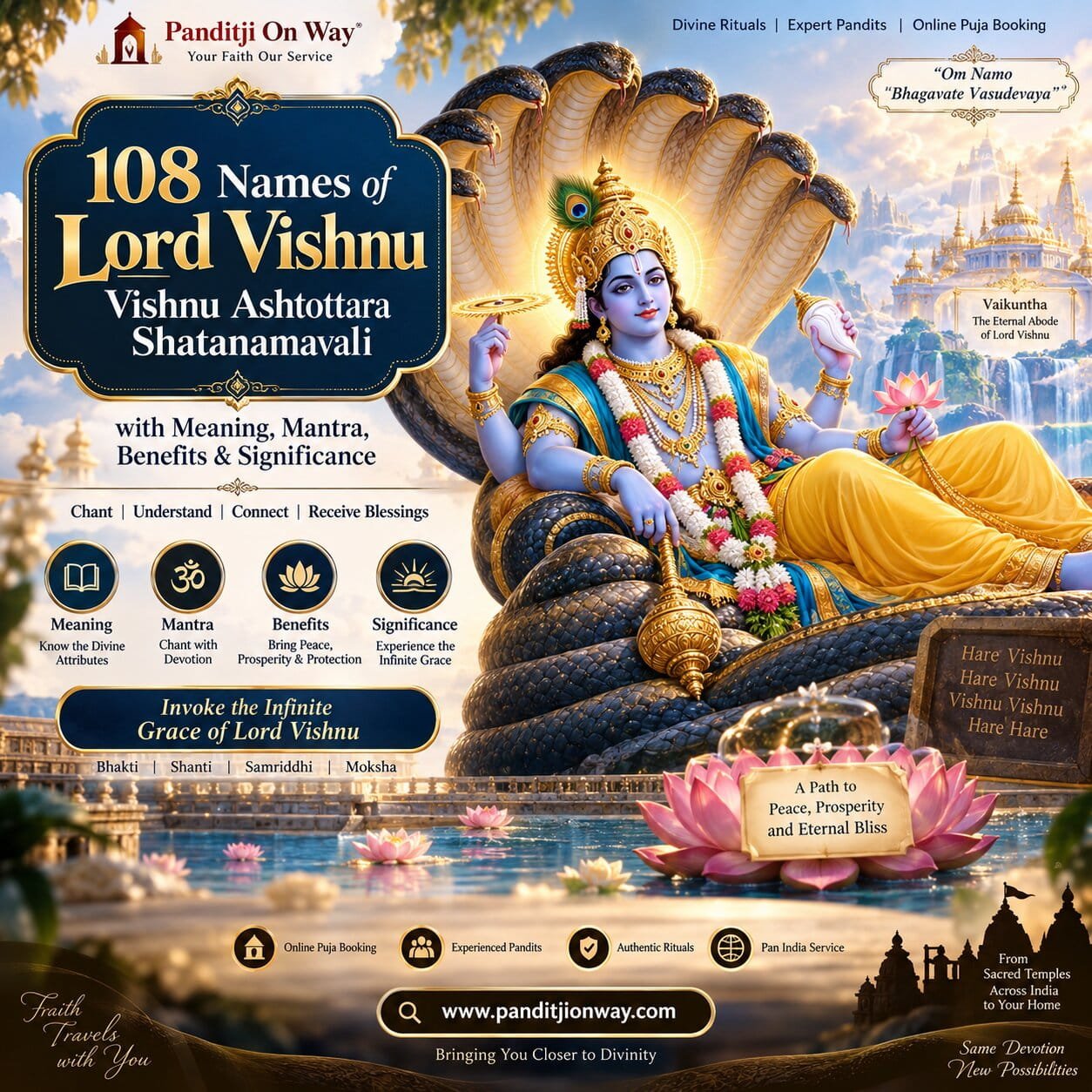
108 Names of Lord Vishnu – Quick Overview
| Information | Details |
|---|---|
| Deity | Lord Vishnu |
| Namavali | Vishnu Ashtottara Shatanamavali |
| Number of traditional names | 108 |
| Language | Sanskrit |
| Common practice | Vishnu Puja, daily chanting, Ekadashi, festivals |
| Main purpose | Devotional remembrance of Lord Vishnu |
| Important names | Narayana, Vasudeva, Govinda, Keshava, Madhava, Hari |
| Vishnu’s major forms represented | Various divine manifestations and incarnations |
| Suitable for | Daily worship, Vishnu Puja, Ekadashi and devotional practice |
| Common offering | Tulsi, flowers, water, fruits and other traditional puja offerings |
| Recommended approach | Chant with devotion, concentration and correct pronunciation |
What Is Vishnu Ashtottara Shatanamavali?
The word Ashtottara Shatanamavali refers to a collection of 108 sacred names traditionally recited in worship. “Ashtottara Shata” refers to 108, while “Namavali” means a garland or sequence of names.
The Vishnu Ashtottara Shatanamavali therefore means the sacred sequence of 108 names of Lord Vishnu.
Every name carries a particular theological or devotional significance. Some names describe Vishnu’s divine attributes, some identify His relationship with Goddess Lakshmi, some refer to His weapons and symbols, and others commemorate His different incarnations and divine activities.
For devotees, reciting these names is not simply a repetition of words. It is a form of Nama Smarana, or remembrance of the Divine.

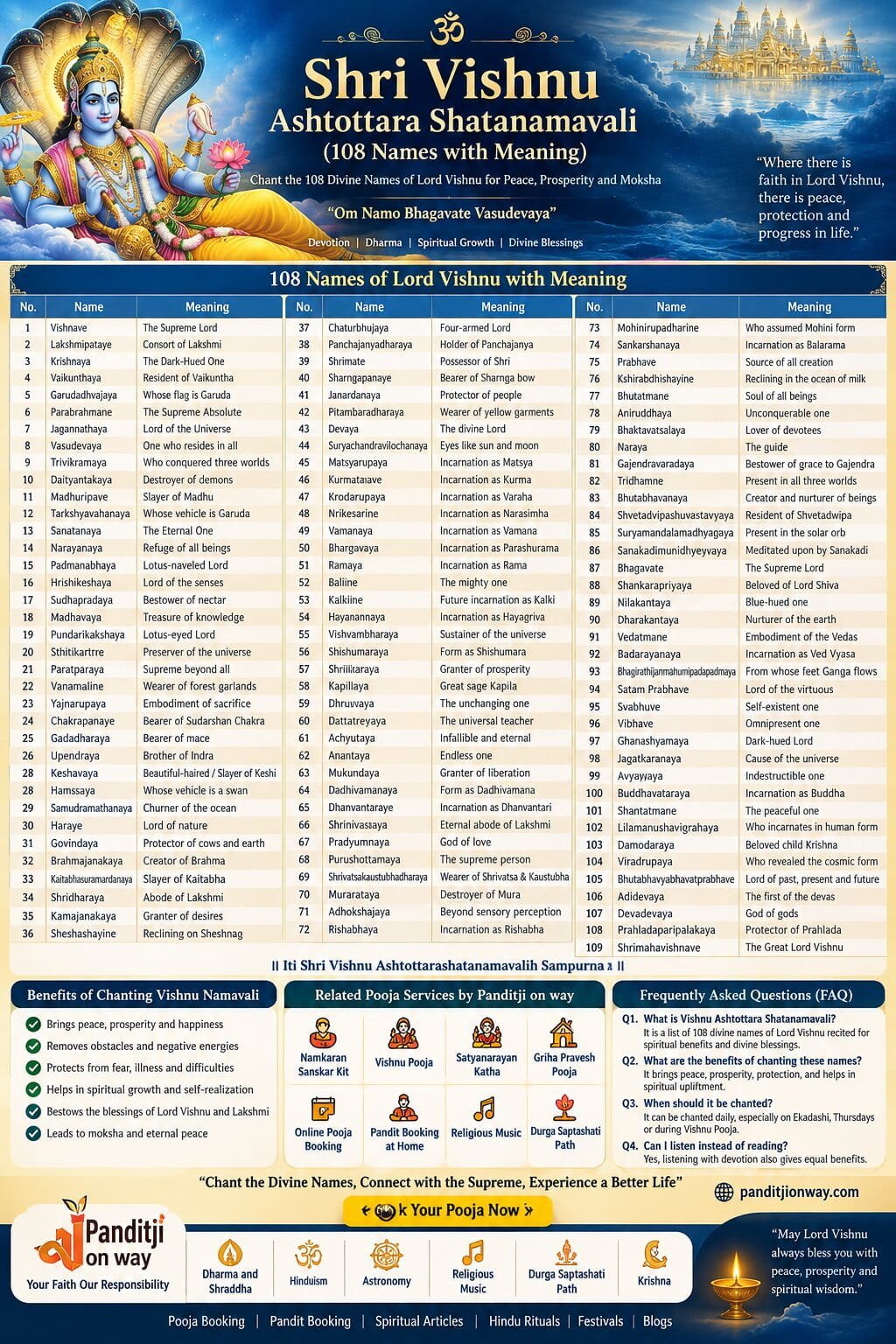
Shri Vishnu Ashtottara Shatanamavali – 108 Names of Lord Vishnu
Below is the complete list of the 108 names provided in the traditional sequence, with Sanskrit mantra, transliteration and simple meaning.
1. विष्णु — Vishnu
ॐ विष्णवे नमः।
Om Vishnave Namah.
Meaning: Salutations to Lord Vishnu, the Supreme Divine Being who pervades and sustains existence.
2. लक्ष्मीपति — Lakshmipati
ॐ लक्ष्मीपतये नमः।
Om Lakshmipataye Namah.
Meaning: Salutations to the Lord who is the husband and consort of Goddess Lakshmi.
3. कृष्ण — Krishna
ॐ कृष्णाय नमः।
Om Krishnaya Namah.
Meaning: Salutations to Lord Krishna, the divine form associated with a dark or cloud-like complexion.
4. वैकुण्ठ — Vaikuntha
ॐ वैकुण्ठाय नमः।
Om Vaikunthaya Namah.
Meaning: Salutations to the Lord who resides in or is associated with Vaikuntha, the divine abode of Vishnu.
5. गरुडध्वज — Garudadhvaja
ॐ गरुडध्वजाय नमः।
Om Garudadhvajaya Namah.
Meaning: Salutations to the Lord whose banner bears the symbol of Garuda.
6. परब्रह्म — Parabrahma
ॐ परब्रह्मणे नमः।
Om Parabrahmane Namah.
Meaning: Salutations to the Supreme Absolute Reality.
7. जगन्नाथ — Jagannatha
ॐ जगन्नाथाय नमः।
Om Jagannathaya Namah.
Meaning: Salutations to the Lord of the entire universe.
8. वासुदेव — Vasudeva
ॐ वासुदेवाय नमः।
Om Vasudevaya Namah.
Meaning: Salutations to the Lord who dwells in all beings and in whom all beings exist.
9. त्रिविक्रम — Trivikrama
ॐ त्रिविक्रमाय नमः।
Om Trivikramaya Namah.
Meaning: Salutations to the Lord who traversed the three worlds.
10. दैत्यान्तक — Daityantaka
ॐ दैत्यान्तकाय नमः।
Om Daityantakaya Namah.
Meaning: Salutations to the destroyer of destructive or demonic forces.
11. मधुरिपु — Madhuripu
ॐ मधुरिपवे नमः।
Om Madhuripave Namah.
Meaning: Salutations to the Lord who defeated the demon Madhu.
12. तार्क्ष्यवाहन — Tarkshyavahana
ॐ तार्क्ष्यवाहनाय नमः।
Om Tarkshyavahanaya Namah.
Meaning: Salutations to the Lord whose vehicle is Tarkshya, identified with Garuda.
13. सनातन — Sanatana
ॐ सनातनाय नमः।
Om Sanatanaya Namah.
Meaning: Salutations to the eternal and everlasting Lord.
14. नारायण — Narayana
ॐ नारायणाय नमः।
Om Narayanaya Namah.
Meaning: Salutations to Narayana, the divine refuge and support of all beings.
15. पद्मनाभ — Padmanabha
ॐ पद्मनाभाय नमः।
Om Padmanabhaya Namah.
Meaning: Salutations to the Lord whose navel is associated with the lotus from which Brahma is traditionally described as emerging.
16. हृषीकेश — Hrishikesha
ॐ हृषीकेशाय नमः।
Om Hrishikeshaya Namah.
Meaning: Salutations to the Lord who is the master of the senses.
17. सुधाप्रद — Sudhaprada
ॐ सुधाप्रदाय नमः।
Om Sudhapradaya Namah.
Meaning: Salutations to the giver of divine nectar.
18. माधव — Madhava
ॐ माधवाय नमः।
Om Madhavaya Namah.
Meaning: Salutations to Madhava, a revered name of Lord Vishnu associated with divine knowledge and Goddess Lakshmi.
19. पुण्डरीकाक्ष — Pundarikaksha
ॐ पुण्डरीकाक्षाय नमः।
Om Pundarikakshaya Namah.
Meaning: Salutations to the lotus-eyed Lord.
20. स्थितिकर्ता — Sthitikarta
ॐ स्थितिकर्त्रे नमः।
Om Sthitikartre Namah.
Meaning: Salutations to the Lord who sustains and maintains the universe.
21. परात्पर — Paratpara
ॐ परात्पराय नमः।
Om Paratparaya Namah.
Meaning: Salutations to the Supreme Being who is beyond all that is beyond.
22. वनमाली — Vanamali
ॐ वनमालिने नमः।
Om Vanamaline Namah.
Meaning: Salutations to the Lord adorned with a garland of forest flowers.
23. यज्ञरूप — Yajnarupa
ॐ यज्ञरूपाय नमः।
Om Yajnarupaya Namah.
Meaning: Salutations to the Lord whose divine form is identified with Yajna, the sacred offering.
24. चक्रपाणि — Chakrapani
ॐ चक्रपाणये नमः।
Om Chakrapanaye Namah.
Meaning: Salutations to the Lord who holds the Sudarshana Chakra.
25. गदाधर — Gadadhara
ॐ गदाधराय नमः।
Om Gadadharaya Namah.
Meaning: Salutations to the Lord who holds the divine mace.
26. उपेन्द्र — Upendra
ॐ उपेन्द्राय नमः।
Om Upendraya Namah.
Meaning: Salutations to Upendra, a name associated with Vishnu’s Vamana manifestation and His relationship with Indra.
27. केशव — Keshava
ॐ केशवाय नमः।
Om Keshavaya Namah.
Meaning: Salutations to Keshava, a celebrated name of Vishnu and Krishna.
28. हंस — Hamsa
ॐ हंसाय नमः।
Om Hamsaya Namah.
Meaning: Salutations to the Lord associated with the divine Hamsa form.
29. समुद्रमथन — Samudramathana
ॐ समुद्रमथनाय नमः।
Om Samudramathanaya Namah.
Meaning: Salutations to the Lord associated with the churning of the cosmic ocean.
30. हरि — Hari
ॐ हरये नमः।
Om Haraye Namah.
Meaning: Salutations to Hari, the Lord who removes suffering and spiritual bondage.
31. गोविन्द — Govinda
ॐ गोविन्दाय नमः।
Om Govindaya Namah.
Meaning: Salutations to Govinda, a revered name of Vishnu and Krishna associated with the protection of cows and the care of creation.
32. ब्रह्मजनक — Brahmajanaka
ॐ ब्रह्मजनकाय नमः।
Om Brahmajanakaya Namah.
Meaning: Salutations to the divine source associated with the origin of Brahma.
33. कैटभासुरमर्दन — Kaitabhasuramardana
ॐ कैटभासुरमर्दनाय नमः।
Om Kaitabhasuramardanaya Namah.
Meaning: Salutations to the Lord who defeated the demon Kaitabha.
34. श्रीधर — Shridhar
ॐ श्रीधराय नमः।
Om Shridharaya Namah.
Meaning: Salutations to the Lord who bears and is accompanied by Shri, Goddess Lakshmi.
35. कामजनक — Kamajanaka
ॐ कामजनकाय नमः।
Om Kamajanakaya Namah.
Meaning: Salutations to the Lord who is regarded as the source or fulfiller of righteous desires.
36. शेषशायी — Sheshashayi
ॐ शेषशायिने नमः।
Om Sheshashayine Namah.
Meaning: Salutations to the Lord who reclines upon the serpent Shesha.
37. चतुर्भुज — Chaturbhuja
ॐ चतुर्भुजाय नमः।
Om Chaturbhujaya Namah.
Meaning: Salutations to the four-armed Lord.
38. पाञ्चजन्यधर — Panchajanyadhara
ॐ पाञ्चजन्यधराय नमः।
Om Panchajanyadharaya Namah.
Meaning: Salutations to the Lord who holds the sacred Panchajanya conch.
39. श्रीमान् — Shriman
ॐ श्रीमते नमः।
Om Shrimate Namah.
Meaning: Salutations to the Lord who is eternally associated with Shri, Goddess Lakshmi.
40. शार्ङ्गपाणि — Sharngapani
ॐ शार्ङ्गपाणये नमः।
Om Sharngapanaye Namah.
Meaning: Salutations to the Lord who holds the divine Sharnga bow.
41. जनार्दन — Janardana
ॐ जनार्दनाय नमः।
Om Janardanaya Namah.
Meaning: Salutations to Janardana, the Lord who protects and guides people.
42. पीतांबरधर — Pitambaradhara
ॐ पीतांबरधराय नमः।
Om Pitambaradharaya Namah.
Meaning: Salutations to the Lord who wears yellow garments.
43. देव — Deva
ॐ देवाय नमः।
Om Devaya Namah.
Meaning: Salutations to the divine Lord who is worshipped by devotees.
44. सूर्यचन्द्रविलोचन — Suryachandravilochana
ॐ सूर्यचन्द्रविलोचनाय नमः।
Om Suryachandravilochanaya Namah.
Meaning: Salutations to the Lord whose divine eyes are compared with the Sun and Moon.
45. मत्स्यरूप — Matsyarupa
ॐ मत्स्यरूपाय नमः।
Om Matsyarupaya Namah.
Meaning: Salutations to Lord Vishnu in His Matsya, or fish, incarnation.
46. कूर्मतनु — Kurmatanu
ॐ कूर्मतनवे नमः।
Om Kurmatanave Namah.
Meaning: Salutations to Lord Vishnu in His Kurma, or tortoise, manifestation.
47. क्रोडरूप — Krodarupa
ॐ क्रोडरूपाय नमः।
Om Krodarupaya Namah.
Meaning: Salutations to Lord Vishnu in His Varaha manifestation.
48. नृकेसरि — Nrikesari
ॐ नृकेसरिणे नमः।
Om Nrikesarine Namah.
Meaning: Salutations to Lord Narasimha, the divine man-lion incarnation.
49. वामन — Vamana
ॐ वामनाय नमः।
Om Vamanaya Namah.
Meaning: Salutations to Lord Vishnu in His Vamana incarnation.
50. भार्गव — Bhargava
ॐ भार्गवाय नमः।
Om Bhargavaya Namah.
Meaning: Salutations to Parashurama, the Bhargava incarnation of Vishnu.
51. राम — Rama
ॐ रामाय नमः।
Om Ramaya Namah.
Meaning: Salutations to Lord Rama, the revered incarnation of Vishnu.
52. बली — Bali
ॐ बलिने नमः।
Om Baline Namah.
Meaning: Salutations to the supremely powerful Lord.
53. कल्कि — Kalki
ॐ कल्किने नमः।
Om Kalkine Namah.
Meaning: Salutations to Kalki, traditionally described as the future incarnation associated with the end of Kali Yuga.
54. हयानन — Hayananana
ॐ हयाननाय नमः।
Om Hayananaya Namah.
Meaning: Salutations to Lord Hayagriva, the horse-headed divine manifestation associated with Vishnu.
55. विश्वंभर — Vishvambhara
ॐ विश्वंभराय नमः।
Om Vishvambharaya Namah.
Meaning: Salutations to the Lord who sustains and nourishes the entire universe.
56. शिशुमार — Shishumara
ॐ शिशुमाराय नमः।
Om Shishumaraya Namah.
Meaning: Salutations to the divine Shishumara form associated with Vishnu.
57. श्रीकर — Shrikara
ॐ श्रीकराय नमः।
Om Shrikaraya Namah.
Meaning: Salutations to the Lord who bestows prosperity, auspiciousness and spiritual blessings.
58. कपिल — Kapila
ॐ कपिलाय नमः।
Om Kapilaya Namah.
Meaning: Salutations to the divine sage Kapila.
59. ध्रुव — Dhruva
ॐ ध्रुवाय नमः।
Om Dhruvaya Namah.
Meaning: Salutations to the Lord who is eternal, constant and unchanging.
60. दत्तात्रेय — Dattatreya
ॐ दत्तात्रेयाय नमः।
Om Dattatreyaya Namah.
Meaning: Salutations to Lord Dattatreya, revered in Hindu traditions as a divine teacher.
61. अच्युत — Achyuta
ॐ अच्युताय नमः।
Om Achyutaya Namah.
Meaning: Salutations to the unfailing and imperishable Lord.
62. अनन्त — Ananta
ॐ अनन्ताय नमः।
Om Anantaya Namah.
Meaning: Salutations to the infinite Lord who has no end.
63. मुकुन्द — Mukunda
ॐ मुकुन्दाय नमः।
Om Mukundaya Namah.
Meaning: Salutations to the Lord who grants liberation, or Mukti.
64. दधिवामन — Dadhivamana
ॐ दधिवामनाय नमः।
Om Dadhivamanaya Namah.
Meaning: Salutations to the sacred Dadhivamana form of Lord Vishnu.
65. धन्वन्तरि — Dhanvantari
ॐ धन्वन्तरये नमः।
Om Dhanvantaraye Namah.
Meaning: Salutations to Lord Dhanvantari, traditionally associated with the emergence of divine healing knowledge during the churning of the ocean.
66. श्रीनिवास — Srinivasa
ॐ श्रीनिवासाय नमः।
Om Shrinivasaya Namah.
Meaning: Salutations to the Lord who is the eternal abode of Goddess Lakshmi.
67. प्रद्युम्न — Pradyumna
ॐ प्रद्युम्नाय नमः।
Om Pradyumnaya Namah.
Meaning: Salutations to Pradyumna, a revered divine personality in Vaishnava tradition and associated with Krishna.
68. पुरुषोत्तम — Purushottama
ॐ पुरुषोत्तमाय नमः।
Om Purushottamaya Namah.
Meaning: Salutations to the Supreme Person, the highest and greatest among beings.
69. श्रीवत्सकौस्तुभधर — Shrivatsakaustubhadhara
ॐ श्रीवत्सकौस्तुभधराय नमः।
Om Shrivatsakaustubhadharaya Namah.
Meaning: Salutations to the Lord who bears the Shrivatsa mark and the Kaustubha jewel.
70. मुराराति — Murarati
ॐ मुरारातये नमः।
Om Murarataye Namah.
Meaning: Salutations to the Lord who defeated the demon Mura.
71. अधोक्षज — Adhokshaja
ॐ अधोक्षजाय नमः।
Om Adhokshajaya Namah.
Meaning: Salutations to the Lord who transcends ordinary sensory perception.
72. ऋषभ — Rishabha
ॐ ऋषभाय नमः।
Om Rishabhaya Namah.
Meaning: Salutations to the revered Rishabha manifestation.
73. मोहिनीरूपधारी — Mohinirupadhari
ॐ मोहिनीरूपधारिणे नमः।
Om Mohinirupadharine Namah.
Meaning: Salutations to the Lord who assumed the enchanting Mohini form.
74. सङ्कर्षण — Sankarshana
ॐ सङ्कर्षणाय नमः।
Om Sankarshanaya Namah.
Meaning: Salutations to Sankarshana, a celebrated divine manifestation associated with Balarama in Vaishnava traditions.
75. प्रभु — Prabhu
ॐ प्रभवे नमः।
Om Prabhave Namah.
Meaning: Salutations to the Supreme Lord and source of the entire moving and unmoving creation.
76. क्षीराब्धिशायी — Kshirabdhishayi
ॐ क्षीराब्धिशायिने नमः।
Om Kshirabdhishayine Namah.
Meaning: Salutations to the Lord who reclines upon the cosmic ocean of milk.
77. भूतात्मा — Bhutatma
ॐ भूतात्मने नमः।
Om Bhutatmane Namah.
Meaning: Salutations to the Lord who is the inner Self of all beings.
78. अनिरुद्ध — Aniruddha
ॐ अनिरुद्धाय नमः।
Om Aniruddhaya Namah.
Meaning: Salutations to the unconquerable and unobstructed Lord.
79. भक्तवत्सल — Bhaktavatsala
ॐ भक्तवत्सलाय नमः।
Om Bhaktavatsalaya Namah.
Meaning: Salutations to the Lord who is deeply affectionate toward His devotees.
80. नर — Nara
ॐ नराय नमः।
Om Naraya Namah.
Meaning: Salutations to the divine Lord who guides humanity toward righteousness.
81. गजेन्द्रवरद — Gajendrvarada
ॐ गजेन्द्रवरदाय नमः।
Om Gajendravaradaya Namah.
Meaning: Salutations to the Lord who blessed and protected Gajendra.
82. त्रिधाम — Tridhama
ॐ त्रिधाम्ने नमः।
Om Tridhamne Namah.
Meaning: Salutations to the Lord who is present throughout the three worlds.
83. भूतभावन — Bhutabhavana
ॐ भूतभावनाय नमः।
Om Bhutabhavanaya Namah.
Meaning: Salutations to the Lord who creates, nourishes and sustains living beings and the elements.
84. श्वेतद्वीपवास्तव्य — Shvetadvipavastavya
ॐ श्वेतद्वीपषुवास्तव्याय नमः।
Om Shvetadvipashuvastavyaya Namah.
Meaning: Salutations to the Lord who is described as dwelling in Shvetadvipa.
85. सूर्यमण्डलमध्यग — Suryamandalamadhyaga
ॐ सूर्यमण्डलमध्यगाय नमः।
Om Suryamandalamadhyagaya Namah.
Meaning: Salutations to the Lord associated with the center of the solar sphere.
86. सनकादिमुनिध्येय — Sanakadimunidhyeya
ॐ सनकादिमुनिध्येयाय नमः।
Om Sanakadimunidhyeyaya Namah.
Meaning: Salutations to the Lord who is meditated upon by sages such as Sanaka and others.
87. भगवान् — Bhagavan
ॐ भगवते नमः।
Om Bhagavate Namah.
Meaning: Salutations to the Supreme Lord who possesses divine fullness and auspicious qualities.
88. शङ्करप्रिय — Shankarapriya
ॐ शङ्करप्रियाय नमः।
Om Shankarapriyaya Namah.
Meaning: Salutations to the Lord who is beloved of Lord Shankara.
89. नीलकान्त — Nilakanta
ॐ नीलकान्ताय नमः।
Om Nilakantaya Namah.
Meaning: Salutations to the Lord associated with a deep blue divine radiance.
90. धराकान्त — Dharakanta
ॐ धराकान्ताय नमः।
Om Dharakantaya Namah.
Meaning: Salutations to the Lord who protects and sustains the Earth.
91. वेदात्मा — Vedatma
ॐ वेदात्मने नमः।
Om Vedatmane Namah.
Meaning: Salutations to the Lord who is identified with the essence of the Vedas.
92. बादरायण — Badarayana
ॐ बादरायणाय नमः।
Om Badarayanaya Namah.
Meaning: Salutations to Badarayana, the name traditionally associated with Vedavyasa.
93. भागीरथीजन्मभूमिपादपद्म — Bhagirathijanmabhumipadapadma
ॐ भागीरथीजन्मभूमिपादपद्माय नमः।
Om Bhagirathijanmabhumipadapadmaya Namah.
Meaning: Salutations to the Lord whose lotus feet are associated with the sacred origin of the Ganga.
94. सतां प्रभु — Satam Prabhu
ॐ सतां प्रभवे नमः।
Om Satam Prabhave Namah.
Meaning: Salutations to the Lord and protector of virtuous people.
95. स्वभु — Svabhu
ॐ स्वभुवे नमः।
Om Svabhuve Namah.
Meaning: Salutations to the self-existent Lord who sustains creation.
96. विभु — Vibhu
ॐ विभवे नमः।
Om Vibhave Namah.
Meaning: Salutations to the all-pervading Lord.
97. घनश्याम — Ghanashyam
ॐ घनश्यामाय नमः।
Om Ghanashyamaya Namah.
Meaning: Salutations to Lord Krishna, whose complexion is traditionally compared with a rain-bearing cloud.
98. जगत्कारण — Jagatkarana
ॐ जगत्कारणाय नमः।
Om Jagatkaranaya Namah.
Meaning: Salutations to the Lord who is regarded as the ultimate cause of the universe.
99. अव्यय — Avyaya
ॐ अव्ययाय नमः।
Om Avyayaya Namah.
Meaning: Salutations to the imperishable and undecaying Lord.
100. बुद्धावतार — Buddhavatara
ॐ बुद्धावताराय नमः।
Om Buddhavataraya Namah.
Meaning: Salutations to the Buddha manifestation traditionally included among Vishnu’s incarnations in several Hindu traditions.
101. शान्तात्मा — Shantatma
ॐ शान्तात्मने नमः।
Om Shantatmane Namah.
Meaning: Salutations to the peaceful and pure-hearted Lord.
102. लीलामानुषविग्रह — Lilamanushavigraha
ॐ लीलामानुषविग्रहाय नमः।
Om Lilamanushavigrahaya Namah.
Meaning: Salutations to the Lord who assumes human forms for divine purposes and pastimes.
103. दामोदर — Damodara
ॐ दामोदराय नमः।
Om Damodaraya Namah.
Meaning: Salutations to Lord Krishna, celebrated in the Damodara pastime involving Mother Yashoda.
104. विराड्रूप — Viradrupa
ॐ विराड्रूपाय नमः।
Om Viradrupaya Namah.
Meaning: Salutations to the Lord who revealed the universal or cosmic form.
105. भूतभव्यभवत्प्रभु — Bhutabhavyabhavatprabhu
ॐ भूतभव्यभवत्प्रभवे नमः।
Om Bhutabhavyabhavatprabhave Namah.
Meaning: Salutations to the Lord who encompasses the past, present and future.
106. आदिदेव — Adideva
ॐ आदिदेवाय नमः।
Om Adidevaya Namah.
Meaning: Salutations to the primordial Divine Being.
107. देवदेव — Devadeva
ॐ देवदेवाय नमः।
Om Devadevaya Namah.
Meaning: Salutations to the God of gods.
108. प्रह्लादपरिपालक — Prahladaparipalaka
ॐ प्रह्लादपरिपालकाय नमः।
Om Prahladaparipalakaya Namah.
Meaning: Salutations to the Lord who protected His devotee Prahlada.
Additional Name Listed in the Supplied Namavali
109. श्रीमहाविष्णु — Shri Mahavishnu
ॐ श्रीमहाविष्णवे नमः।
Om Shrimahavishnave Namah.
Meaning: Salutations to Shri Mahavishnu, the Supreme form of Lord Vishnu.
Important note: The supplied source material lists this as number 109 after the traditional sequence of 108 names. Therefore, for SEO accuracy, the page should retain the heading “108 Names of Lord Vishnu” for the Ashtottara Shatanamavali while identifying Shri Mahavishnu as an additional concluding name in the supplied version.
Vishnu 108 Names in Short – Quick Reference Table
| No. | Name | Sanskrit Mantra |
|---|---|---|
| 1 | Vishnu | ॐ विष्णवे नमः |
| 2 | Lakshmipati | ॐ लक्ष्मीपतये नमः |
| 3 | Krishna | ॐ कृष्णाय नमः |
| 4 | Vaikuntha | ॐ वैकुण्ठाय नमः |
| 5 | Garudadhvaja | ॐ गरुडध्वजाय नमः |
| 6 | Parabrahma | ॐ परब्रह्मणे नमः |
| 7 | Jagannatha | ॐ जगन्नाथाय नमः |
| 8 | Vasudeva | ॐ वासुदेवाय नमः |
| 9 | Trivikrama | ॐ त्रिविक्रमाय नमः |
| 10 | Daityantaka | ॐ दैत्यान्तकाय नमः |
| 11 | Madhuripu | ॐ मधुरिपवे नमः |
| 12 | Tarkshyavahana | ॐ तार्क्ष्यवाहनाय नमः |
| 13 | Sanatana | ॐ सनातनाय नमः |
| 14 | Narayana | ॐ नारायणाय नमः |
| 15 | Padmanabha | ॐ पद्मनाभाय नमः |
| 16 | Hrishikesh | ॐ हृषीकेशाय नमः |
| 17 | Sudhaprada | ॐ सुधाप्रदाय नमः |
| 18 | Madhava | ॐ माधवाय नमः |
| 19 | Pundarikaksha | ॐ पुण्डरीकाक्षाय नमः |
| 20 | Sthitikarta | ॐ स्थितिकर्त्रे नमः |
| 21 | Paratpara | ॐ परात्पराय नमः |
| 22 | Vanamali | ॐ वनमालिने नमः |
| 23 | Yajnarupa | ॐ यज्ञरूपाय नमः |
| 24 | Chakrapani | ॐ चक्रपाणये नमः |
| 25 | Gadadhara | ॐ गदाधराय नमः |
| 26 | Upendra | ॐ उपेन्द्राय नमः |
| 27 | Keshava | ॐ केशवाय नमः |
| 28 | Hamsa | ॐ हंसाय नमः |
| 29 | Samudramathana | ॐ समुद्रमथनाय नमः |
| 30 | Hari | ॐ हरये नमः |
| 31 | Govinda | ॐ गोविन्दाय नमः |
| 32 | Brahmajanaka | ॐ ब्रह्मजनकाय नमः |
| 33 | Kaitabhasuramardana | ॐ कैटभासुरमर्दनाय नमः |
| 34 | Shridhar | ॐ श्रीधराय नमः |
| 35 | Kamajanaka | ॐ कामजनकाय नमः |
| 36 | Sheshashayi | ॐ शेषशायिने नमः |
| 37 | Chaturbhuja | ॐ चतुर्भुजाय नमः |
| 38 | Panchajanyadhara | ॐ पाञ्चजन्यधराय नमः |
| 39 | Shriman | ॐ श्रीमते नमः |
| 40 | Sharngapani | ॐ शार्ङ्गपाणये नमः |
| 41 | Janardana | ॐ जनार्दनाय नमः |
| 42 | Pitambaradhara | ॐ पीतांबरधराय नमः |
| 43 | Deva | ॐ देवाय नमः |
| 44 | Suryachandravilochana | ॐ सूर्यचन्द्रविलोचनाय नमः |
| 45 | Matsyarupa | ॐ मत्स्यरूपाय नमः |
| 46 | Kurmatanu | ॐ कूर्मतनवे नमः |
| 47 | Krodarupa | ॐ क्रोडरूपाय नमः |
| 48 | Nrikesari | ॐ नृकेसरिणे नमः |
| 49 | Vamana | ॐ वामनाय नमः |
| 50 | Bhargava | ॐ भार्गवाय नमः |
| 51 | Rama | ॐ रामाय नमः |
| 52 | Bali | ॐ बलिने नमः |
| 53 | Kalki | ॐ कल्किने नमः |
| 54 | Hayananana | ॐ हयाननाय नमः |
| 55 | Vishvambhara | ॐ विश्वंभराय नमः |
| 56 | Shishumara | ॐ शिशुमाराय नमः |
| 57 | Shrikara | ॐ श्रीकराय नमः |
| 58 | Kapila | ॐ कपिलाय नमः |
| 59 | Dhruva | ॐ ध्रुवाय नमः |
| 60 | Dattatreya | ॐ दत्तात्रेयाय नमः |
| 61 | Achyuta | ॐ अच्युताय नमः |
| 62 | Ananta | ॐ अनन्ताय नमः |
| 63 | Mukunda | ॐ मुकुन्दाय नमः |
| 64 | Dadhivamana | ॐ दधिवामनाय नमः |
| 65 | Dhanvantari | ॐ धन्वन्तरये नमः |
| 66 | Srinivasa | ॐ श्रीनिवासाय नमः |
| 67 | Pradyumna | ॐ प्रद्युम्नाय नमः |
| 68 | Purushottama | ॐ पुरुषोत्तमाय नमः |
| 69 | Shrivatsakaustubhadhara | ॐ श्रीवत्सकौस्तुभधराय नमः |
| 70 | Murarati | ॐ मुरारातये नमः |
| 71 | Adhokshaja | ॐ अधोक्षजाय नमः |
| 72 | Rishabha | ॐ ऋषभाय नमः |
| 73 | Mohinirupadhari | ॐ मोहिनीरूपधारिणे नमः |
| 74 | Sankarshana | ॐ सङ्कर्षणाय नमः |
| 75 | Prabhu | ॐ प्रभवे नमः |
| 76 | Kshirabdhishayi | ॐ क्षीराब्धिशायिने नमः |
| 77 | Bhutatma | ॐ भूतात्मने नमः |
| 78 | Aniruddha | ॐ अनिरुद्धाय नमः |
| 79 | Bhaktavatsala | ॐ भक्तवत्सलाय नमः |
| 80 | Nara | ॐ नराय नमः |
| 81 | Gajendrvarada | ॐ गजेन्द्रवरदाय नमः |
| 82 | Tridhama | ॐ त्रिधाम्ने नमः |
| 83 | Bhutabhavana | ॐ भूतभावनाय नमः |
| 84 | Shvetadvipavastavya | ॐ श्वेतद्वीपषुवास्तव्याय नमः |
| 85 | Suryamandalamadhyaga | ॐ सूर्यमण्डलमध्यगाय नमः |
| 86 | Sanakadimunidhyeya | ॐ सनकादिमुनिध्येयाय नमः |
| 87 | Bhagavan | ॐ भगवते नमः |
| 88 | Shankarapriya | ॐ शङ्करप्रियाय नमः |
| 89 | Nilakanta | ॐ नीलकान्ताय नमः |
| 90 | Dharakanta | ॐ धराकान्ताय नमः |
| 91 | Vedatma | ॐ वेदात्मने नमः |
| 92 | Badarayana | ॐ बादरायणाय नमः |
| 93 | Bhagirathijanmabhumipadapadma | ॐ भागीरथीजन्मभूमिपादपद्माय नमः |
| 94 | Satam Prabhu | ॐ सतां प्रभवे नमः |
| 95 | Svabhu | ॐ स्वभुवे नमः |
| 96 | Vibhu | ॐ विभवे नमः |
| 97 | Ghanashyam | ॐ घनश्यामाय नमः |
| 98 | Jagatkarana | ॐ जगत्कारणाय नमः |
| 99 | Avyaya | ॐ अव्ययाय नमः |
| 100 | Buddhavatara | ॐ बुद्धावताराय नमः |
| 101 | Shantatma | ॐ शान्तात्मने नमः |
| 102 | Lilamanushavigraha | ॐ लीलामानुषविग्रहाय नमः |
| 103 | Damodara | ॐ दामोदराय नमः |
| 104 | Viradrupa | ॐ विराड्रूपाय नमः |
| 105 | Bhutabhavyabhavatprabhu | ॐ भूतभव्यभवत्प्रभवे नमः |
| 106 | Adideva | ॐ आदिदेवाय नमः |
| 107 | Devadeva | ॐ देवदेवाय नमः |
| 108 | Prahladaparipalaka | ॐ प्रह्लादपरिपालकाय नमः |
Most Popular Names of Lord Vishnu and Their Meanings
Although all 108 names are sacred within their respective devotional context, some names are especially familiar in daily Vishnu worship.
| Name | Meaning | Why It Is Important |
|---|---|---|
| Narayana | Divine refuge and universal support | One of the most prominent names of Vishnu |
| Vishnu | The all-pervading Lord | Represents the cosmic presence of the Divine |
| Vasudeva | The Lord who dwells in all beings | Closely associated with Krishna |
| Hari | One who removes suffering | Commonly used in devotional chanting |
| Govinda | A revered name of Vishnu/Krishna | Widely used in Vaishnava worship |
| Keshava | A celebrated name of Vishnu | Frequently used in prayers and rituals |
| Madhava | Divine name associated with Vishnu | Common in devotional traditions |
| Hrishikesh | Master of the senses | Important philosophical and devotional name |
| Achyuta | The unfailing one | Frequently used for Krishna/Vishnu |
| Ananta | The infinite one | Represents Vishnu’s limitless nature |
| Mukunda | Giver of liberation | Associated with spiritual liberation |
| Purushottama | Supreme Person | Prominent theological name |
| Janardana | Protector and guide | Common Vishnu epithet |
| Damodara | Krishna’s celebrated name | Particularly important in Damodara devotion |
| Purushottama | Supreme Being | Associated with the highest divine reality |
Significance of Chanting Vishnu Ashtottara Shatanamavali
The spiritual significance of Vishnu Namavali lies in Nama Smarana, remembrance of the Divine through sacred names.
Each name directs the mind toward a particular divine quality. Names such as Achyuta emphasize the Lord’s unfailing nature, Ananta points toward His infinite nature, Bhaktavatsala emphasizes divine affection toward devotees, and Mukunda recalls the Lord as the giver of liberation.
For many devotees, chanting the 108 names becomes a disciplined method of prayer and meditation.
The practice can be especially meaningful during:
- Vishnu Puja
- Ekadashi
- Vaikuntha Ekadashi
- Janmashtami
- Ram Navami
- Narasimha Jayanti
- Vamana Jayanti
- Dwadashi
- Vishnu-related festivals
- Personal daily prayer
- Special sankalpa or devotional observances
Benefits of Chanting 108 Names of Lord Vishnu
Devotees traditionally associate Vishnu Namavali chanting with several spiritual benefits.
1. Promotes devotional concentration
Repeating the names gives the mind a structured object of meditation and prayer.
2. Encourages remembrance of Lord Vishnu
The names describe different forms, qualities and activities of Vishnu, making the practice a form of divine remembrance.
3. Supports a peaceful devotional routine
Regular prayer and mantra recitation can become part of a disciplined spiritual routine.
4. Encourages spiritual reflection
The meanings of names such as Shantatma, Ananta, Achyuta and Purushottama provide themes for contemplation.
5. Strengthens connection with Vishnu worship
For devotees following Vaishnava traditions, Namavali can form an accessible component of regular worship.
6. Can be incorporated into Ekadashi worship
Devotees may recite Vishnu’s names during Ekadashi observances according to their family and sampradaya traditions.
Important: Spiritual benefits are matters of religious belief and devotional tradition; they should not be presented as guaranteed medical, financial or material outcomes.
How to Chant Vishnu 108 Names
A simple Vishnu Namavali practice can be performed at home.
Step 1: Clean the worship area
Choose a clean and peaceful place for your puja.
Step 2: Place an image or murti of Lord Vishnu
You may worship Lord Vishnu with Goddess Lakshmi according to your family tradition.
Step 3: Light a diya
A lamp may be offered before the deity.
Step 4: Offer water and flowers
Traditional offerings can include water, flowers, fruits and Tulsi leaves where appropriate.
Step 5: Begin with a prayer
Take a moment to calm the mind and establish your devotional intention.
Step 6: Recite the 108 names
Chant each name with:
ॐ [Name] नमः।
For example:
ॐ विष्णवे नमः।
Om Vishnave Namah.
Continue through the complete Namavali.
Step 7: Offer Tulsi
Tulsi is particularly associated with Vishnu and Krishna worship. Follow your household or sampradaya’s customary method of offering it.
Step 8: Conclude with prayer
Complete the puja with your preferred Vishnu stotra, aarti or personal prayer.
Which Day Is Best for Chanting Vishnu Namavali?
Vishnu Namavali can be recited on any day as part of devotional practice. Many devotees particularly prefer:
| Day/Occasion | Connection with Vishnu Worship |
|---|---|
| Thursday | Traditionally regarded by many devotees as auspicious for Vishnu/Guru-related worship |
| Ekadashi | A major Vaishnava fasting and devotional observance |
| Dwadashi | Traditionally connected with the completion of Ekadashi observance |
| Vaikuntha Ekadashi | Important Vishnu devotional occasion |
| Janmashtami | Celebration associated with Krishna |
| Ram Navami | Celebration associated with Lord Rama |
| Narasimha Jayanti | Celebration of Lord Narasimha |
| Vamana Jayanti | Celebration associated with Vamana |
| Daily Puja | Can be incorporated into regular worship |
There is no requirement that devotees wait for a particular day to remember Lord Vishnu.
Vishnu Mantra to Chant Along With the 108 Names
One of the simplest devotional mantras associated with Vishnu is:
ॐ नमो नारायणाय।
Om Namo Narayanaya.
Another widely known devotional formula is:
ॐ नमो भगवते वासुदेवाय।
Om Namo Bhagavate Vasudevaya.
These mantras can be incorporated into a personal prayer routine according to one’s tradition and spiritual guidance.
Vishnu Namavali and Vishnu Sahasranama – What Is the Difference?
These two devotional practices are related but not identical.
| Feature | Vishnu Ashtottara Shatanamavali | Vishnu Sahasranama |
|---|---|---|
| Number | 108 names | 1,000 names |
| Name | Ashtottara Shatanamavali | Sahasranama |
| Length | Relatively short | Considerably longer |
| Common use | Daily puja and shorter worship | Extended devotional recitation |
| Suitable for beginners | Generally easier to complete | Requires more time |
| Purpose | Remembrance through 108 names | Extensive glorification through 1,000 names |
Both are important forms of Vishnu devotion, but they serve different practical purposes.
Vishnu 108 Names in Sanskrit
For devotees searching specifically for the Sanskrit version, the central Namavali begins:
ॐ विष्णवे नमः।
ॐ लक्ष्मीपतये नमः।
ॐ कृष्णाय नमः।
ॐ वैकुण्ठाय नमः।
ॐ गरुडध्वजाय नमः।
ॐ परब्रह्मणे नमः।
ॐ जगन्नाथाय नमः।
ॐ वासुदेवाय नमः।
ॐ त्रिविक्रमाय नमः।
ॐ दैत्यान्तकाय नमः।
Continue with the complete 108-name list provided above.
Vishnu 108 Names in Hindi
भगवान विष्णु के 108 नामों का पाठ भक्त भगवान के विभिन्न स्वरूपों, गुणों और दिव्य कार्यों का स्मरण करने के लिए करते हैं। विष्णु अष्टोत्तर शतनामावली में विष्णु, नारायण, वासुदेव, गोविन्द, माधव, केशव, हरि, जनार्दन, पुरुषोत्तम, अच्युत, अनन्त, मुकुन्द, दामोदर आदि प्रमुख नाम आते हैं।
Vishnu Names Associated With His Avatars
The Namavali also contains names connected with several celebrated Vishnu manifestations.
| Vishnu Name | Associated Form |
|---|---|
| Matsyarupa | Matsya |
| Kurmatanu | Kurma |
| Krodarupa | Varaha |
| Nrikesari | Narasimha |
| Vamana | Vamana |
| Bhargava | Parashurama |
| Rama | Lord Rama |
| Ghanashyam / Krishna | Krishna |
| Buddhavatara | Buddha |
| Kalki | Kalki |
| Hayananana | Hayagriva |
| Mohinirupadhari | Mohini |
| Dhanvantari | Dhanvantari |
This makes the Namavali particularly useful for devotees who wish to understand the many forms through which Vishnu is worshipped across Hindu traditions.
Why Does Lord Vishnu Have So Many Names?
The many names of Vishnu reflect different dimensions of the Divine.
One name may describe an attribute, another a divine relationship, another a cosmic function, another a weapon, another an incarnation and another a particular divine episode.
For example:
- Chakrapani refers to the Lord holding the Sudarshana Chakra.
- Gadadhara refers to the mace-bearing Lord.
- Panchajanyadhara refers to the Lord holding the Panchajanya conch.
- Pitambaradhara describes the Lord wearing yellow garments.
- Sheshashayi refers to the Lord reclining upon Shesha.
- Bhaktavatsala emphasizes divine affection toward devotees.
- Mukunda identifies the Lord as giver of liberation.
Thus, the 108 names function like a spiritual description of Vishnu’s many divine attributes and manifestations.
Who Is Lord Vishnu?
Lord Vishnu is one of the principal deities of Hinduism and is traditionally associated with the preservation and sustenance of cosmic order.
In Vaishnava traditions, Vishnu or Narayana is worshipped as the Supreme Lord. Vishnu is commonly depicted with four arms holding or associated with the Shankha, Chakra, Gada and Padma.
His principal divine consort is Goddess Lakshmi, associated with prosperity, auspiciousness and abundance.
Vishnu is also prominently associated with His avatars, including Rama and Krishna, as well as other incarnations recognized in different Hindu traditions.
Vishnu Puja at Home – Simple Vidhi
A basic Vishnu Puja may include:
- Purification and preparation of the worship space.
- Placement of Lord Vishnu’s image or murti.
- Sankalpa or devotional intention.
- Lighting of a diya.
- Offering of water.
- Offering of flowers.
- Offering of Tulsi according to tradition.
- Recitation of Vishnu mantra.
- Chanting of Vishnu Ashtottara Shatanamavali.
- Offering of naivedya.
- Vishnu aarti or concluding prayer.
- Prayers for spiritual guidance and devotion.
For elaborate rituals, devotees may follow the procedure prescribed by their family tradition, sampradaya or qualified priest.
Tulsi and Lord Vishnu
Tulsi holds a particularly important position in Vishnu and Krishna worship.
Devotees traditionally offer Tulsi leaves to Vishnu or Krishna as part of puja. The practice is deeply established in Vaishnava devotional traditions.
When performing a formal ritual, the precise rules regarding Tulsi, flowers, offerings and mantras may vary according to regional and sampradaya traditions.
Can Vishnu 108 Names Be Chanted Daily?
Yes. Devotees can incorporate Vishnu Namavali into a daily prayer routine if it is consistent with their personal tradition.
A short daily routine may include:
ॐ नमो नारायणाय।
followed by the Vishnu Ashtottara Shatanamavali and a concluding prayer.
The emphasis should be on devotion, concentration and respectful pronunciation rather than simply completing the list quickly.
Can Vishnu Namavali Be Chanted During Ekadashi?
Vishnu is especially associated with Ekadashi observance in Vaishnava traditions. Devotees may use Vishnu names, Vishnu mantras, Bhagavad Gita recitation, Vishnu stotras and other devotional practices during Ekadashi.
The exact fasting rules and worship procedure vary among traditions and regions, so devotees should follow their family or sampradaya practice.
Panditji on Way – Online Puja Booking
Panditji on Way provides an online platform for devotees looking to arrange Hindu puja and religious services with priests.


For readers who have discovered Vishnu Namavali while searching for a Vishnu Puja, Ekadashi Puja, Satyanarayan Puja or another Hindu ritual, the website can serve as a relevant internal destination.
Suggested Puja for Panditji on Way:
- Vishnu Puja Booking
- Satyanarayan Puja
- Ekadashi Puja
- Lakshmi Vishnu Puja
- Narasimha Puja
- Janmashtami Puja
- Ram Navami Puja
- Hindu Puja Services
- Pandit Booking
- Online Puja Booking
Recommended External Resources
For Vishnu Namavali reference material, you can cite Drik Panchang – 108 Vishnu Names.
Frequently Asked Questions About 108 Names of Lord Vishnu
What are the 108 names of Lord Vishnu?
The 108 names of Lord Vishnu are collectively known as Vishnu Ashtottara Shatanamavali. They describe different divine attributes, forms, incarnations and activities associated with Lord Vishnu.
What is the most powerful name of Lord Vishnu?
There is no universally accepted single “most powerful” name for every Hindu tradition. Names such as Narayana, Vishnu, Vasudeva, Hari, Govinda, Keshava, Madhava and Mukunda are all deeply revered.
What is the Vishnu mantra?
A widely known Vishnu mantra is:
ॐ नमो नारायणाय।
Om Namo Narayanaya.
Another prominent mantra is:
ॐ नमो भगवते वासुदेवाय।
Om Namo Bhagavate Vasudevaya.
How many names are there in Vishnu Ashtottara Shatanamavali?
The traditional Ashtottara Shatanamavali contains 108 names. The supplied version of this list additionally gives Shri Mahavishnu as number 109, after the 108th name.
Can I chant Vishnu 108 names every day?
Yes. Devotees may chant Vishnu Namavali daily as part of their personal prayer and devotional routine.
Which day is best for Lord Vishnu worship?
Vishnu can be worshipped on any day. Many devotees particularly observe Ekadashi and other Vishnu-related festivals and auspicious occasions.
Can Vishnu Namavali be chanted on Ekadashi?
Yes. Vishnu Namavali can be incorporated into Ekadashi devotional practice according to one’s family or sampradaya tradition.
Why does Lord Vishnu have 108 names?
The names represent different aspects of Vishnu’s divine nature, including His attributes, cosmic functions, relationships, weapons, forms, incarnations and divine activities.
What is the difference between Vishnu Ashtottara Shatanamavali and Vishnu Sahasranama?
Vishnu Ashtottara Shatanamavali consists of 108 names, while Vishnu Sahasranama consists of 1,000 names. Both are important devotional forms of Vishnu worship.
Which Tulsi is offered to Lord Vishnu?
Tulsi is traditionally associated with Vishnu and Krishna worship. Devotees should follow the offering practices prescribed by their family tradition or sampradaya.
Can beginners chant Vishnu 108 names?
Yes. Beginners can start by learning the pronunciation and meaning of a few names and gradually complete the entire Namavali.
Is Vishnu Namavali the same as Vishnu Sahasranama?
No. They are different collections. Ashtottara Shatanamavali = 108 names, whereas Sahasranama = 1,000 names.
Key Takeaways
- Vishnu Ashtottara Shatanamavali is a traditional collection of 108 sacred names of Lord Vishnu.
- The names describe Vishnu’s qualities, forms, manifestations and divine activities.
- Important names include Narayana, Vasudeva, Govinda, Hari, Keshava, Madhava, Achyuta, Ananta, Mukunda and Purushottama.
- The Namavali includes names associated with several Vishnu incarnations.
- It can be incorporated into daily Vishnu Puja and devotional practice.
- Many devotees especially recite Vishnu names during Ekadashi and Vishnu-related festivals.
- Vishnu Namavali is different from the Vishnu Sahasranama, which contains 1,000 names.
- The supplied list contains 108 traditional entries plus Shri Mahavishnu as an additional 109th entry.
Conclusion
The 108 Names of Lord Vishnu, or Shri Vishnu Ashtottara Shatanamavali, provide devotees with a structured way to remember the many divine qualities and manifestations of Lord Vishnu.
From Vishnu, Narayana and Vasudeva to Govinda, Keshava, Madhava, Hari, Achyuta, Ananta, Mukunda and Purushottama, each name represents a particular dimension of Vishnu devotion. The inclusion of names associated with Matsya, Kurma, Varaha, Narasimha, Vamana, Parashurama, Rama, Krishna, Buddha and other manifestations further demonstrates the breadth of Vishnu’s worship across Hindu traditions.
Whether recited during daily puja, Ekadashi, a Vishnu festival or personal prayer, the Namavali can serve as a meaningful practice of devotion, remembrance and spiritual contemplation.
For devotees wishing to arrange a traditional Hindu puja or priest service, Panditji on Way provides an online platform for exploring and booking religious services.
॥ इति श्री विष्णु अष्टोत्तर शतनामावलिः सम्पूर्णा ॥