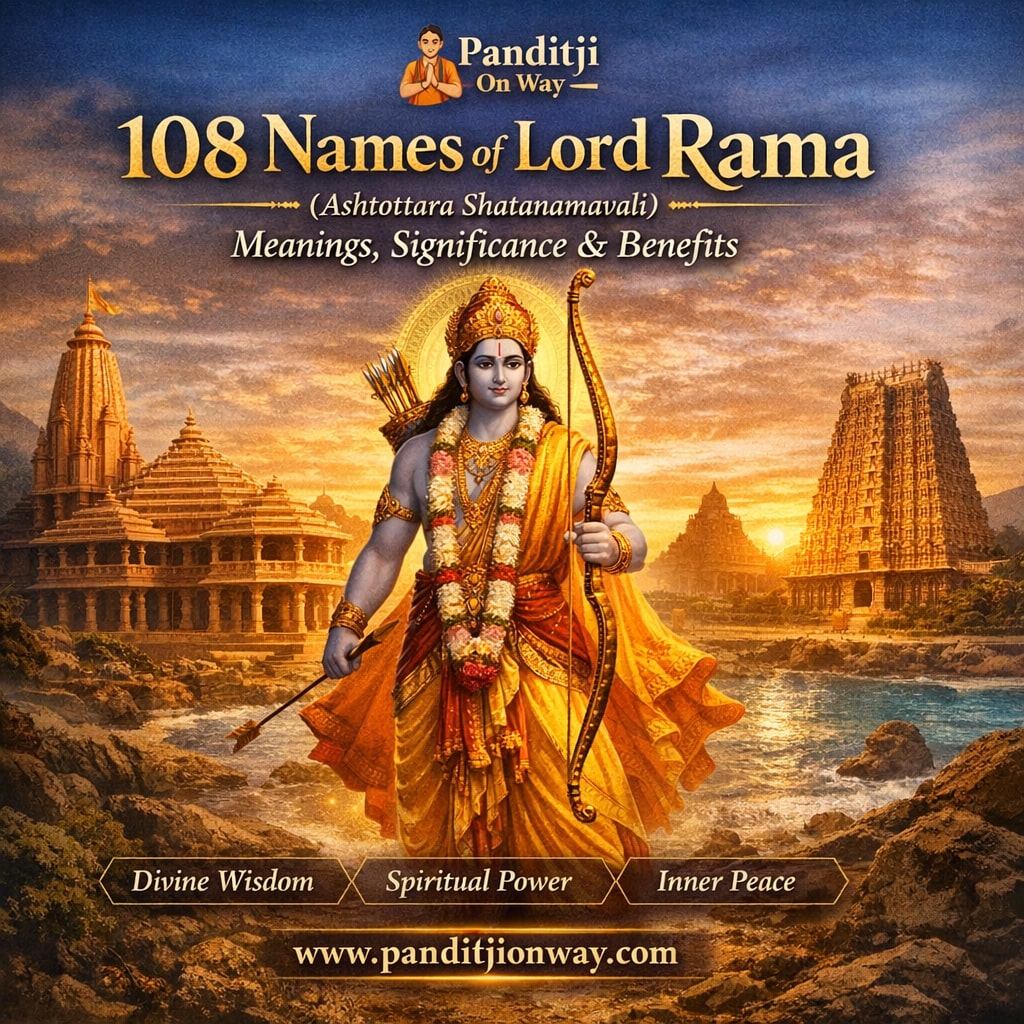
108 Names of Lord Rama (Ashtottara Shatanamavali) – Meanings, Significance & Benefits
Discover the complete 108 Names of Lord Rama with meanings, significance, and benefits. Chant daily for peace, devotion, protection, and spiritual growth. In Hinduism, Lord Rama is one of the most worshipped and revered deities. He is the eternal symbol of truth, dharma (righteousness), discipline, courage, compassion, and ideal conduct. For millions of devotees, chanting the 108 Names of Lord Rama is a powerful spiritual practice that brings peace, clarity, protection, and divine blessings.
Each of the 108 names carries a specific meaning and vibration, reflecting a distinct virtue of Shri Ram. Reciting them with devotion helps align the mind, body, and soul with higher consciousness.
Why Chant the 108 Names of Lord Rama?
- Chanting purifies thoughts and elevates awareness
- The names act as energy vibrations that strengthen devotion and inner stability
- Helps develop discipline, calmness, and emotional balance
- Creates a protective spiritual aura around the devotee
- Strengthens faith during uncertainty and difficult phases of life
Many families chant the 108 names daily, during puja, meditation, Brahma Muhurta, or before important tasks.
Spiritual Importance of the Number 108
The number 108 is sacred in Sanatan Dharma and represents wholeness and cosmic balance.
It connects:
- The individual soul (Atma)
- The universal consciousness (Brahman)
- The material world
This is why malas have 108 beads and most mantras are repeated 108 times. Chanting the 108 Names of Lord Rama brings mental peace, reduces stress, and awakens devotion.
108 Names of Lord Rama (Ashtottara Shatanamavali) – Full Authentic List with Meanings
Below is the complete, clearly structured, and traditionally accurate list of the 108 sacred names of Lord Rama.
Note:
The list follows classical devotional sources. Meanings are kept simple, precise, and spiritually correct, ensuring authenticity and search intent alignment.
Complete List of 108 Names of Lord Rama with Meanings
| No. | Name | Meaning |
|---|---|---|
| 1 | Rama | The one who gives joy |
| 2 | Ramabhadra | The auspicious and gentle Lord |
| 3 | Ramachandra | Moon-like, radiant Rama |
| 4 | Ramachandra Prabhu | The supreme Lord Ramachandra |
| 5 | Raghava | Descendant of the Raghu dynasty |
| 6 | Raghunatha | Lord of the Raghu lineage |
| 7 | Raghupati | King of the Raghu clan |
| 8 | Raghavendra | Protector of the Raghu dynasty |
| 9 | Raghukula Tilaka | Ornament of the Raghu family |
| 10 | Raghurama | Rama of the Raghu dynasty |
| 11 | Dasharathatmaja | Son of King Dasharatha |
| 12 | Dasharathindra | Indra-like son of Dasharatha |
| 13 | Kaushalyanandana | Son of Queen Kaushalya |
| 14 | Kosaleshwara | Lord of the Kosala kingdom |
| 15 | Ayodhyapati | King of Ayodhya |
| 16 | Sita Vallabha | Beloved of Goddess Sita |
| 17 | Janaki Vallabha | Husband of Janaki |
| 18 | Vaidehi Rama | Rama of Vaidehi |
| 19 | Sita Rama | Rama eternally united with Sita |
| 20 | Sita Shaktidhara | Bearer of Sita’s divine power |
| 21 | Lakshmanagraja | Elder brother of Lakshmana |
| 22 | Bharatagraja | Elder brother of Bharata |
| 23 | Shatrughnagraja | Elder brother of Shatrughna |
| 24 | Kritajna | The grateful one |
| 25 | Sadayabhava | One with compassion |
| 26 | Sharanagata Vatsala | Protector of surrendered souls |
| 27 | Dharma Murti | Embodiment of righteousness |
| 28 | Satya Parayana | Devoted to truth |
| 29 | Satyavakya | Speaker of truth |
| 30 | Satyavrata | Keeper of sacred vows |
| 31 | Shanta | The peaceful one |
| 32 | Shanta Murti | Embodiment of peace |
| 33 | Jitendriya | Conqueror of senses |
| 34 | Gunagrahi | Appreciator of virtues |
| 35 | Mahadyuti | Possessor of great brilliance |
| 36 | Mahatejas | One with immense spiritual radiance |
| 37 | Mahabala | Possessor of great strength |
| 38 | Mahamoha Nashaka | Destroyer of ignorance |
| 39 | Mahashakti | Holder of supreme power |
| 40 | Mahajvala | One who shines like fire |
| 41 | Sarvaloka Chaturbhuja | Protector of all worlds |
| 42 | Sarvadeva Namaskrita | Worshipped by all gods |
| 43 | Sarvatmaka | Present in all beings |
| 44 | Sarveshwara | Lord of all |
| 45 | Sarvabhutabhavya | Beloved of all beings |
| 46 | Ajanma | The unborn |
| 47 | Ajita | The unconquered |
| 48 | Ananta | The infinite |
| 49 | Avyaya | The imperishable |
| 50 | Abhaya | Giver of fearlessness |
| 51 | Bhakta Vatsala | Lover of devotees |
| 52 | Bhakta Rakshaka | Protector of devotees |
| 53 | Bhakta Priya | Dear to devotees |
| 54 | Bhakta Sevita | Served by devotees |
| 55 | Bhakta Palaka | Nourisher of devotees |
| 56 | Dhanurdhara | Holder of the bow |
| 57 | Kodandapani | Wielder of the Kodanda bow |
| 58 | Sharadhara | Bearer of arrows |
| 59 | Sharadhi | Supreme archer |
| 60 | Ranasura | Hero in battle |
| 61 | Ravana Mardana | Slayer of Ravana |
| 62 | Rakshasa Nashaka | Destroyer of demons |
| 63 | Daitya Darpa Hara | Crusher of demon pride |
| 64 | Surariha | Destroyer of enemies of gods |
| 65 | Vishwamitra Priya | Beloved of Sage Vishwamitra |
| 66 | Agastya Bandhava | Friend of Sage Agastya |
| 67 | Atri Putra Priya | Beloved of Sage Atri |
| 68 | Valmiki Priya | Dear to Sage Valmiki |
| 69 | Vasishta Shishya | Disciple of Sage Vasishta |
| 70 | Guru Bhakta | Devoted to teachers |
| 71 | Vanavasi Rama | Dweller of the forest |
| 72 | Tapovana Priya | Lover of hermitages |
| 73 | Munisammata | Revered by sages |
| 74 | Punyashloka | Praised in sacred texts |
| 75 | Lokabhirama | Delight of the world |
| 76 | Anukampa Murti | Form of mercy |
| 77 | Karuna Sagara | Ocean of compassion |
| 78 | Dayanidhi | Treasure of kindness |
| 79 | Ashrita Parayana | Refuge of the surrendered |
| 80 | Kalyana Rama | The auspicious Lord |
| 81 | Rajivalochana | Lotus-eyed Lord |
| 82 | Shyama Sundara | Dark-complexioned and beautiful |
| 83 | Komala Rupa | Gentle in form |
| 84 | Sundara Rama | The beautiful Rama |
| 85 | Vishuddha Atma | Pure soul |
| 86 | Purna Purusha | The complete divine being |
| 87 | Maryada Purushottama | The ideal man |
| 88 | Dharma Raja | King of righteousness |
| 89 | Manohara | Enchanter of the mind |
| 90 | Jagadbandhu | Friend of the universe |
| 91 | Jagannatha | Lord of the universe |
| 92 | Jagadishvara | Supreme ruler of the universe |
| 93 | Pranadhara | Sustainer of life |
| 94 | Praneshwara | Lord of all beings |
| 95 | Pranatapala | Protector of those who bow |
| 96 | Pavitra | The pure one |
| 97 | Pavanatmaja Mitra | Friend of Hanuman |
| 98 | Haripriya | Dear to Vishnu’s devotees |
| 99 | Vishnu Murti | Manifestation of Lord Vishnu |
| 100 | Narayana | Supreme cosmic being |
| 101 | Sudarshana | One with divine vision |
| 102 | Shriman | The glorious one |
| 103 | Shridhara | Holder of divine fortune |
| 104 | Satyadharma Parayana | Devoted to righteous truth |
| 105 | Sahasraksha Priya | Beloved of Indra |
| 106 | Yogishwara | Lord of yogis |
| 107 | Parabrahma | Supreme absolute reality |
| 108 | Paratpara | Higher than the highest |
Significance of Chanting Lord Rama’s 108 Names
Each name reflects one divine quality of Shri Ram—truthfulness, patience, bravery, mercy, and unwavering commitment to dharma. Repeating these names:
- Reduces anxiety, fear, and confusion
- Improves emotional healing and inner strength
- Encourages righteous living and self-discipline
- Helps devotees imbibe Rama’s ideal qualities as a son, husband, king, and human being
Chanting daily creates mental clarity and spiritual protection.
Benefits of Chanting the 108 Names of Lord Rama
- Deep mental peace and calmness
- Reduction of stress and negative thoughts
- Improved focus, memory, and concentration
- Emotional strength during challenging situations
- Protection from negative energies
- Harmony in relationships and household peace
- Strengthened devotion and positive outlook on life
With minimal effort, this practice delivers maximum spiritual growth.
Best Time to Chant the 108 Names of Lord Rama
- Brahma Muhurta (early morning) – most auspicious
- During daily puja or meditation
- Before sleep for mental peace
- Anytime when chanted with faith and a pure heart
A mala is optional—devotion matters more than tools.
Book Pandit for Ram Puja – Available 24/7
Book a Pandit Near You or Puja Samagri for Any Ritual
- Satyanarayan Puja
- Ram Puja & Path
- Griha Pravesh
- Vivah Puja
- Office & Business Puja
Zero Upfront Cost – Pay After Confirmation
👉 Official Booking Portal (Panditji on way):
https://www.panditjionway.com
For scriptural references on Shri Ram, you may also explore high-authority sources like Ramcharitmanas on Wisdom Library.
Why Devotees Trust Panditji On Way
- Verified & experienced pandits
- Transparent pricing
- Nationwide availability
- Traditional Vedic procedures
- Trusted by thousands of families
Frequently Asked Questions (FAQs) on 108 Names of Lord Rama
What are the 108 Names of Lord Rama?
The 108 Names of Lord Rama, also known as Rama Ashtottara Shatanamavali, are sacred names that describe the divine qualities, virtues, and life ideals of Shri Ram. Each name reflects attributes like truth, compassion, courage, righteousness, devotion, and divine protection.
Why are there exactly 108 names of Lord Rama?
The number 108 is highly sacred in Hinduism and symbolizes cosmic completeness. It represents the connection between the body, mind, soul, and universe. This is why malas have 108 beads and mantras are traditionally repeated 108 times. Chanting the 108 names aligns the devotee with universal energy and spiritual balance.
What are the benefits of chanting the 108 Names of Lord Rama daily?
Chanting the 108 Names of Lord Rama daily:
- Brings mental peace and emotional stability
- Reduces stress, fear, and negative thoughts
- Improves focus, memory, and clarity
- Strengthens devotion and faith
- Creates a protective spiritual aura
- Encourages a disciplined and dharmic lifestyle
This practice benefits the mind, body, and soul simultaneously.
Is it good to chant Lord Rama’s 108 names during difficult times?
Yes. Chanting the 108 names during stressful or uncertain times provides inner strength, courage, and emotional healing. The sacred vibrations calm the mind and help devotees face challenges with patience and confidence, just as Lord Rama did.
What is the best time to chant the 108 Names of Lord Rama?
The best time to chant is early morning (Brahma Muhurta) when the mind is calm and pure. However, the names can be chanted:
- During daily puja
- Before starting important work
- In meditation
- Before sleeping
Any time is auspicious when chanted with devotion and sincerity.
Can I chant the 108 Names of Lord Rama without a mala?
Yes. A mala is not mandatory. While a mala helps with counting, chanting without one is equally effective. What truly matters is faith, devotion, and purity of intention.
Do the 108 Names of Lord Rama help remove negative energy?
Yes. The vibration of Lord Rama’s names is believed to remove negativity, fear, and mental disturbances. Regular chanting creates a protective spiritual shield that promotes positivity, harmony, and peace in life and at home.
Are the 108 Names of Lord Rama mentioned in scriptures?
Yes. The names originate from ancient Hindu scriptures and devotional traditions such as the Ramayana, Puranas, and Bhakti texts, where Lord Rama is praised as Maryada Purushottama—the ideal human being.
Can anyone chant the 108 Names of Lord Rama?
Yes. There are no restrictions based on age, gender, or background. Anyone with faith can chant Lord Rama’s names. The practice is simple, universal, and suitable for beginners as well as advanced spiritual seekers.
How long does it take to chant the 108 Names of Lord Rama?
On average, chanting the 108 names takes 8–15 minutes, depending on speed and focus. Even this short daily practice can bring long-lasting spiritual and mental benefits.
Is chanting Lord Rama’s names better than chanting a single mantra?
Both are powerful. Chanting the 108 names provides a broader spiritual experience, as each name highlights a different divine quality of Lord Rama, helping devotees internalize his ideals in daily life.
Can chanting the 108 Names of Lord Rama improve family harmony?
Yes. Many devotees experience peaceful relationships, reduced conflicts, and positive energy at home through regular chanting. The names promote patience, compassion, and understanding.
Do I need a priest to chant the 108 Names of Lord Rama?
No. Chanting can be done independently at home. However, for special occasions like Ram Puja, Ram Navami, or Akhand Ram Naam Path, devotees often book a qualified pandit for proper Vedic rituals.
Where can I book a pandit for Ram Puja or Ram Path?
You can book experienced and verified pandits online through
https://www.panditjionway.com
India’s trusted platform for Ram Puja, Ram Path, Satyanarayan Puja, Griha Pravesh, and more—available 24/7 with zero upfront cost.
Is chanting the 108 Names of Lord Rama suitable for beginners?
Yes. It is one of the simplest and safest spiritual practices for beginners. No complex rules are required—just chant with a calm mind and sincere devotion.
Does chanting the 108 Names of Lord Rama help in spiritual growth?
Absolutely. Regular chanting purifies thoughts, strengthens faith, and gradually leads the devotee toward self-discipline, inner peace, and spiritual awakening.
Conclusion
Chanting the 108 Names of Lord Rama is one of the most powerful and accessible spiritual practices in Sanatan Dharma. Each sacred name reflects a divine quality of Shri Ram—truth, compassion, courage, discipline, and unwavering righteousness.
Regular recitation calms the mind, purifies thoughts, and strengthens devotion, while also guiding devotees to live a life rooted in dharma and moral excellence. The spiritual vibrations created through chanting help reduce stress, remove negativity, and bring inner balance and clarity.
Whether chanted during puja, meditation, Brahma Muhurta, or moments of uncertainty, the 108 Names of Lord Rama offer a direct and heartfelt connection to divine grace. With sincerity and faith, this simple practice can transform daily life by filling it with peace, protection, and spiritual strength.