

Durga Ashtottara Shatanamavali: 108 Names of Goddess Durga with Meaning in Hindi, Sanskrit & English
Read Durga Ashtottara Shatanamavali with all 108 names of Goddess Durga, Sanskrit mantras, Hindi meanings, chanting procedure, benefits, and FAQs.
Published by Panditji on Way | Devotional Guide
Introduction: What Is Durga Ashtottara Shatanamavali?
Durga Ashtottara Shatanamavali is a sacred devotional list of 108 names of Goddess Durga. In Sanskrit, Ashtottara Shatanamavali refers to a collection of 108 divine names, traditionally recited as an act of worship, meditation, and devotion.
Goddess Durga is revered in Hinduism as the embodiment of Shakti, the divine feminine power that protects righteousness, removes obstacles, and destroys negative forces. Her different names describe her compassion, courage, wisdom, beauty, motherly nature, and supreme cosmic power.
Devotees recite the 108 names of Goddess Durga with the mantra “Om [Name]yai Namah” during daily puja, Navratri worship, Durga Ashtami, Maha Ashtami, and other auspicious occasions. Each name offers a different way to contemplate the Divine Mother.
Panditji on Way, an online pooja booking portal, presents this guide to help devotees understand the names, their commonly understood meanings, the traditional method of chanting, and the places associated with Goddess Durga worship.
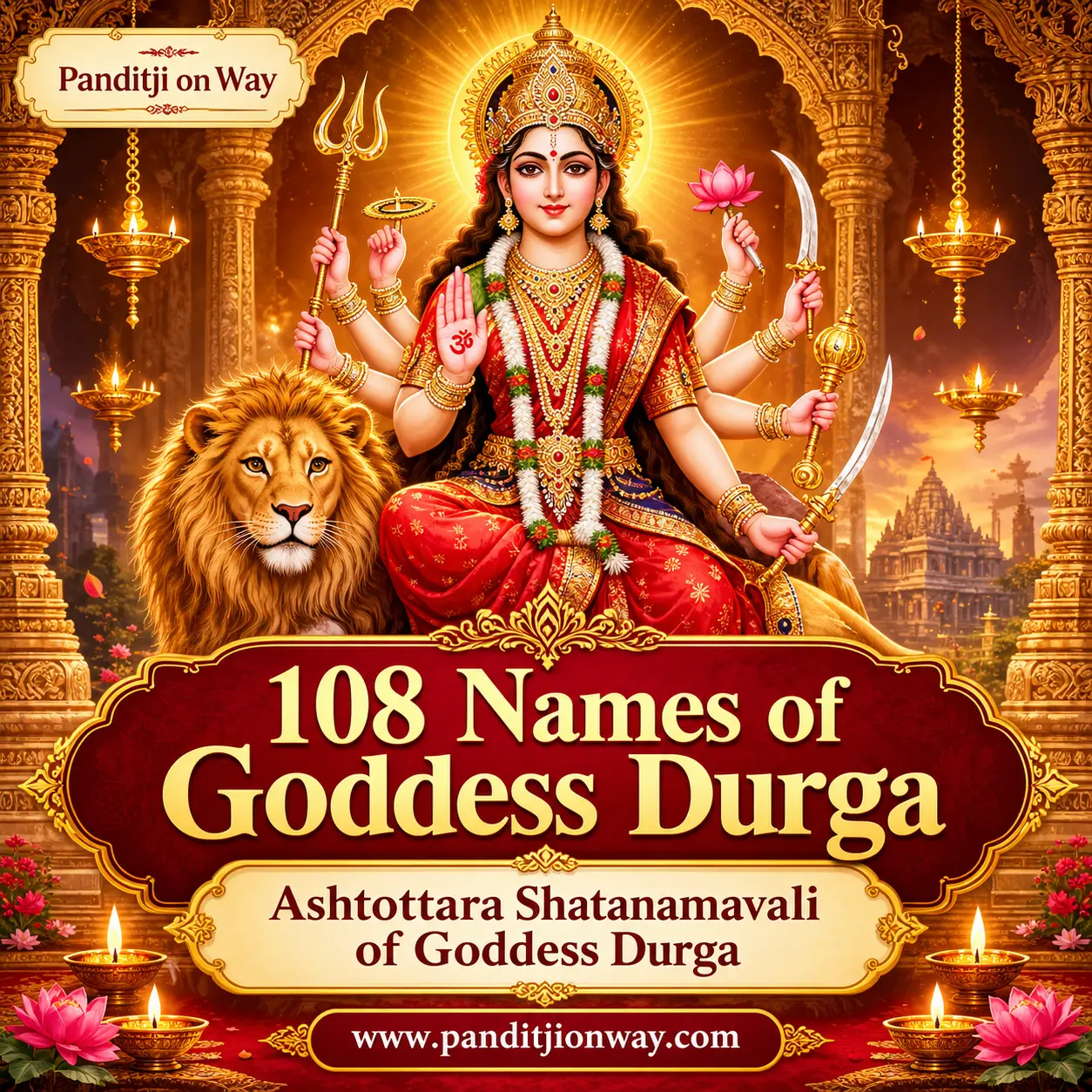

Quick answer: Why are 108 names of Goddess Durga chanted?
The 108 names of Goddess Durga are chanted to express devotion to the Divine Mother and remember her many forms and qualities. Devotees traditionally associate this practice with spiritual focus, inner strength, peace of mind, courage, and auspiciousness. The practice is especially popular during Navratri and Durga Puja, although it may also be performed as part of daily worship.
| Detail | Information |
|---|---|
| Name of the prayer | Durga Ashtottara Shatanamavali |
| Number of names | 108 |
| Presiding deity | Goddess Durga |
| Language | Sanskrit, with Hindi meanings and Roman transliteration |
| Main mantra format | Om [Deity’s name in the dative form] Namah |
| Common occasions | Navratri, Durga Ashtami, Maha Ashtami, Durga Puja and daily puja |
| Common offerings | Flowers, kumkum, incense, a diya and fruits, according to tradition |
| Suitable for | Devotees wishing to worship and meditate on Goddess Durga |
Durga Ashtottara Shatanamavali in Sanskrit: How to read this list
The mantra accompanying each name is a form of namah, meaning a respectful salutation or offering of reverence. For example:
-
Sanskrit: ॐ उमायै नमः।
-
Roman transliteration: Om Umayai Namah.
-
Hindi meaning: देवी उमा को नमस्कार।
Different scriptures, regional traditions, and puja paddhatis may contain different versions of Durga’s 108 names. The list below follows the names and order supplied for this guide, with explanations presented in accessible Hindi. Some traditional spellings and mantra endings should be verified against the specific Sanskrit source used by the officiating priest before publication as a definitive liturgical text.
108 Names of Goddess Durga with Mantra and Meaning in Hindi
The following table is the main reference section of this article. It includes the 108 names, the associated Sanskrit mantra, its Roman transliteration, and the meaning provided in Hindi.
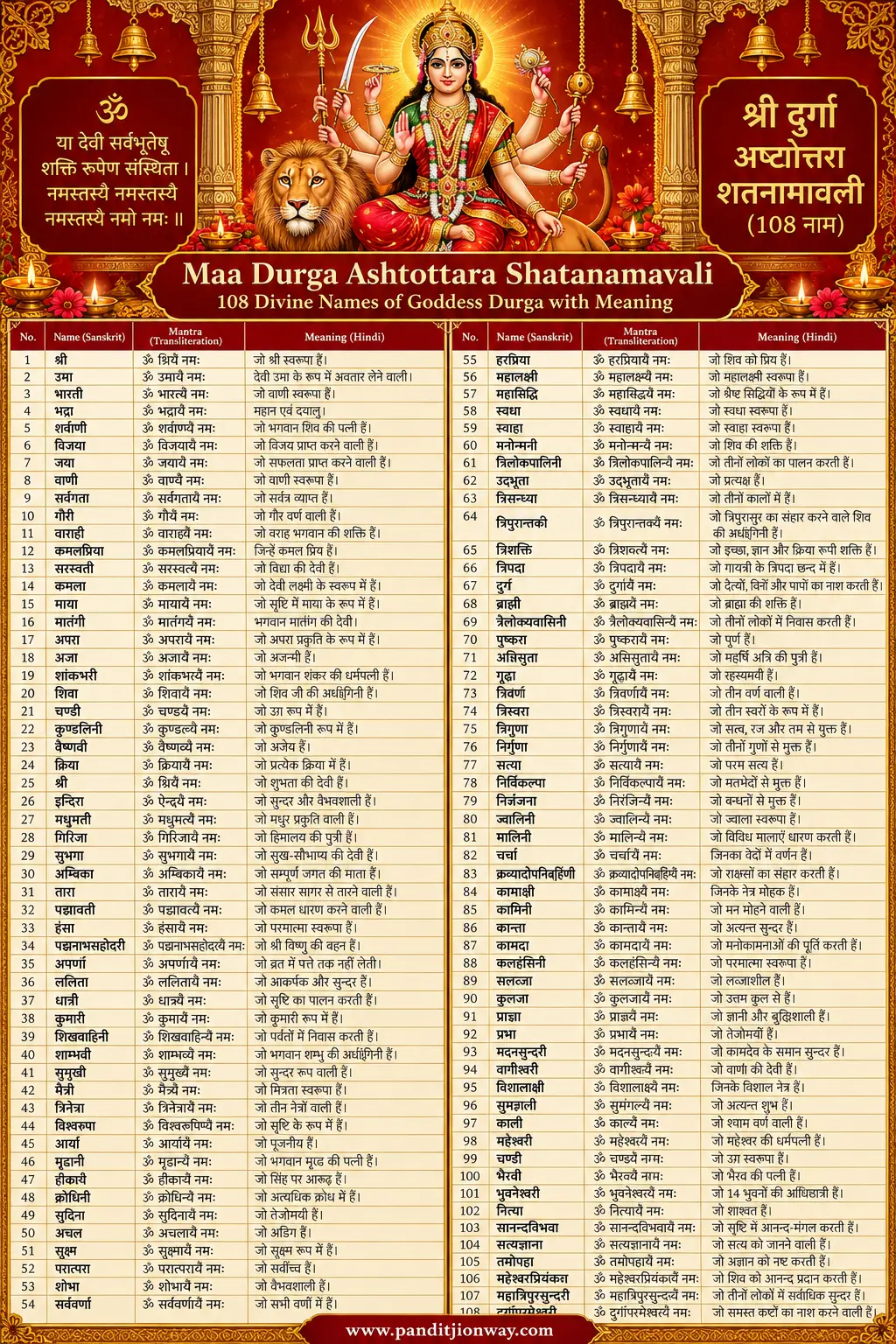

Names 1–27: Divine beauty, wisdom and auspiciousness
| No. | Name of Goddess Durga | Sanskrit mantra | Meaning in Hindi |
|---|---|---|---|
| 1 | श्री (Shri) | ॐ श्रियै नमः। | श्री, समृद्धि और शुभता का स्वरूप। |
| 2 | उमा (Uma) | ॐ उमायै नमः। | देवी उमा का दिव्य स्वरूप। |
| 3 | भारती (Bharati) | ॐ भारत्यै नमः। | वाणी, ज्ञान और विद्या का स्वरूप। |
| 4 | भद्रा (Bhadra) | ॐ भद्रायै नमः। | कल्याणकारी और मंगलमयी देवी। |
| 5 | शर्वाणी (Sharvani) | ॐ शर्वाण्यै नमः। | भगवान शिव की अर्धांगिनी। |
| 6 | विजया (Vijaya) | ॐ विजयायै नमः। | विजय प्रदान करने वाली। |
| 7 | जया (Jaya) | ॐ जयायै नमः। | जय और सफलता का स्वरूप। |
| 8 | वाणी (Vani) | ॐ वाण्यै नमः। | वाणी और अभिव्यक्ति की शक्ति। |
| 9 | सर्वगता (Sarvagata) | ॐ सर्वगतायै नमः। | सर्वत्र व्याप्त रहने वाली। |
| 10 | गौरी (Gauri) | ॐ गौर्यै नमः। | उज्ज्वल और पवित्र स्वरूप वाली। |
| 11 | वाराही (Varahi) | ॐ वाराह्यै नमः। | वाराही शक्ति का स्वरूप। |
| 12 | कमलप्रिया (Kamalapriya) | ॐ कमलप्रियायै नमः। | कमल पुष्प प्रिय रखने वाली। |
| 13 | सरस्वती (Saraswati) | ॐ सरस्वत्यै नमः। | विद्या, ज्ञान और वाणी की देवी। |
| 14 | कमला (Kamala) | ॐ कमलायै नमः। | कमल और लक्ष्मी से जुड़ा दिव्य स्वरूप। |
| 15 | माया (Maya) | ॐ मायायै नमः। | सृष्टि की दिव्य माया का स्वरूप। |
| 16 | मातंगी (Matangi) | ॐ मातंग्यै नमः। | मातंगी देवी का स्वरूप। |
| 17 | अपरा (Apara) | ॐ अपरायै नमः। | अपरा प्रकृति से संबंधित शक्ति। |
| 18 | अजा (Aja) | ॐ अजायै नमः। | अजन्मी और शाश्वत देवी। |
| 19 | शांकभरी (Shankabhari) | ॐ शांकभर्यै नमः। | परंपरागत नाम; मूल पाठ के अनुसार अर्थ सत्यापित करें। |
| 20 | शिवा (Shiva) | ॐ शिवायै नमः। | कल्याणकारी और शिवशक्ति स्वरूपा। |
| 21 | चण्डी (Chandi) | ॐ चण्ड्यै नमः। | दुष्ट शक्तियों का संहार करने वाली उग्र देवी। |
| 22 | कुण्डलिनी (Kundalini) | ॐ कुण्डलिन्यै नमः। | शरीर में स्थित मानी जाने वाली दिव्य चेतना-शक्ति। |
| 23 | वैष्णवी (Vaishnavi) | ॐ वैष्णव्यै नमः। | भगवान विष्णु की शक्ति का स्वरूप। |
| 24 | क्रिया (Kriya) | ॐ क्रियायै नमः। | कर्म और क्रिया की दिव्य शक्ति। |
| 25 | श्री (Shri) | ॐ श्रियै नमः। | समृद्धि, ऐश्वर्य और मंगल का स्वरूप। |
| 26 | इन्दिरा (Indira) | ॐ इन्दिरायै नमः। | सौंदर्य, ऐश्वर्य और लक्ष्मी से संबंधित नाम। |
| 27 | मधुमती (Madhumati) | ॐ मधुमत्यै नमः। | मधुरता और सौम्यता का स्वरूप। |
Names 28–54: Motherhood, cosmic power and divine protection
| No. | Name of Goddess Durga | Sanskrit mantra | Meaning in Hindi |
|---|---|---|---|
| 28 | गिरिजा (Girija) | ॐ गिरिजायै नमः। | पर्वतराज हिमालय की पुत्री। |
| 29 | सुभगा (Subhaga) | ॐ सुभगायै नमः। | सौभाग्य और मंगल प्रदान करने वाली। |
| 30 | अम्बिका (Ambika) | ॐ अम्बिकायै नमः। | समस्त जगत की माता। |
| 31 | तारा (Tara) | ॐ तारायै नमः। | संसार-सागर से पार लगाने वाली। |
| 32 | पद्मावती (Padmavati) | ॐ पद्मावत्यै नमः। | कमल से संबंधित दिव्य स्वरूप। |
| 33 | हंसा (Hamsa) | ॐ हंसायै नमः। | परम चेतना और आध्यात्मिक विवेक का प्रतीक। |
| 34 | पद्मनाभसहोदरी (Padmanabhasahodari) | ॐ पद्मनाभसहोदर्यै नमः। | पद्मनाभ भगवान विष्णु की बहन के रूप में पूजित। |
| 35 | अपर्णा (Aparna) | ॐ अपर्णायै नमः। | कठोर तपस्या में पत्ते तक ग्रहण न करने वाली। |
| 36 | ललिता (Lalita) | ॐ ललितायै नमः। | सुंदर, मनोहर और सौम्य स्वरूप वाली। |
| 37 | धात्री (Dhatri) | ॐ धात्र्यै नमः। | सृष्टि का धारण और पालन करने वाली। |
| 38 | कुमारी (Kumari) | ॐ कुमार्यै नमः। | कन्या रूप में पूजित देवी। |
| 39 | शिखवाहिनी (Shikhavahini) | ॐ शिखवाहिन्यै नमः। | दिए गए नाम-पाठ का अर्थ मूल स्रोत से सत्यापित करें। |
| 40 | शाम्भवी (Shambhavi) | ॐ शाम्भव्यै नमः। | भगवान शम्भु की शक्ति। |
| 41 | सुमुखी (Sumukhi) | ॐ सुमुख्यै नमः। | सुंदर और मंगलमय मुख वाली। |
| 42 | मैत्री (Maitri) | ॐ मैत्र्यै नमः। | मित्रता और सद्भाव का स्वरूप। |
| 43 | त्रिनेत्रा (Trinetra) | ॐ त्रिनेत्रायै नमः। | तीन नेत्रों वाली देवी। |
| 44 | विश्वरूपा (Vishvarupa) | ॐ विश्वरूपिण्यै नमः। | संपूर्ण ब्रह्मांड में व्याप्त स्वरूप। |
| 45 | आर्या (Arya) | ॐ आर्यायै नमः। | पूजनीय, श्रेष्ठ और सम्माननीय। |
| 46 | मृडानी (Mridani) | ॐ मृडान्यै नमः। | भगवान मृड अर्थात शिव की शक्ति। |
| 47 | हींकार्या (Hinkarya) | ॐ हींकार्यै नमः। | दिए गए पाठ में प्रयुक्त नाम; उच्चारण और अर्थ मूल स्रोत से मिलाएँ। |
| 48 | क्रोधिनी (Krodhini) | ॐ क्रोधिन्यै नमः। | अधर्म के विरुद्ध उग्र शक्ति धारण करने वाली। |
| 49 | सुदिना (Sudina) | ॐ सुदिनायै नमः। | शुभता और उज्ज्वलता से संबंधित नाम। |
| 50 | अचला (Achala) | ॐ अचलायै नमः। | अडिग और स्थिर शक्ति। |
| 51 | सूक्ष्मा (Sukshma) | ॐ सूक्ष्मायै नमः। | सूक्ष्म रूप में विद्यमान दिव्य शक्ति। |
| 52 | परात्परा (Paratpara) | ॐ परात्परायै नमः। | सर्वोच्च से भी परे परम शक्ति। |
| 53 | शोभा (Shobha) | ॐ शोभायै नमः। | सौंदर्य, तेज और आभा का स्वरूप। |
| 54 | सर्ववर्णा (Sarvavarna) | ॐ सर्ववर्णायै नमः। | विभिन्न वर्णों और रूपों में प्रकट होने वाली। |
Names 55–81: Shakti, spiritual wisdom and the three worlds
| No. | Name of Goddess Durga | Sanskrit mantra | Meaning in Hindi |
|---|---|---|---|
| 55 | हरप्रिया (Harapriya) | ॐ हरप्रियायै नमः। | भगवान हर अर्थात शिव को प्रिय। |
| 56 | महालक्ष्मी (Mahalakshmi) | ॐ महालक्ष्म्यै नमः। | धन, ऐश्वर्य और समृद्धि की महाशक्ति। |
| 57 | महासिद्धि (Mahasiddhi) | ॐ महासिद्धयै नमः। | महान सिद्धियों से संबंधित दिव्य शक्ति। |
| 58 | स्वधा (Svaha/Svadha) | ॐ स्वधायै नमः। | पितृयज्ञ में प्रयुक्त स्वधा की दिव्य शक्ति। |
| 59 | स्वाहा (Svaha) | ॐ स्वाहायै नमः। | यज्ञ में आहुति अर्पित करने से संबंधित शक्ति। |
| 60 | मनोन्मनी (Manonmani) | ॐ मनोन्मन्यै नमः। | मन से परे चेतना और शिवशक्ति का स्वरूप। |
| 61 | त्रिलोकपालिनी (Trilokapalini) | ॐ त्रिलोकपालिन्यै नमः। | तीनों लोकों का पालन करने वाली। |
| 62 | उद्भूता (Udbhuta) | ॐ उद्भूतायै नमः। | प्रकट होने वाली या अभिव्यक्त दिव्य शक्ति। |
| 63 | त्रिसन्ध्या (Trisandhya) | ॐ त्रिसन्ध्यायै नमः। | तीनों संध्याकालों से संबंधित देवी। |
| 64 | त्रिपुरान्तकी (Tripurantaki) | ॐ त्रिपुरान्तक्यै नमः। | त्रिपुरान्तक शिव की शक्ति। |
| 65 | त्रिशक्ति (Trishakti) | ॐ त्रिशक्त्यै नमः। | इच्छा, ज्ञान और क्रिया की तीन शक्तियाँ। |
| 66 | त्रिपदा (Tripada) | ॐ त्रिपदायै नमः। | तीन पदों या चरणों से संबंधित दिव्य स्वरूप। |
| 67 | दुर्गा (Durga) | ॐ दुर्गायै नमः। | संकटों और बाधाओं से रक्षा करने वाली। |
| 68 | ब्राह्मी (Brahmi) | ॐ ब्राह्म्यै नमः। | ब्रह्मा की शक्ति का स्वरूप। |
| 69 | त्रैलोक्यवासिनी (Trailokyavasini) | ॐ त्रैलोक्यवासिन्यै नमः। | तीनों लोकों में निवास करने वाली। |
| 70 | पुष्करा (Pushkara) | ॐ पुष्करायै नमः। | पवित्रता, पूर्णता और पोषण से संबंधित नाम। |
| 71 | अत्रिसुता (Atrisuta) | ॐ अत्रिसुतायै नमः। | नाम के शाब्दिक अर्थ में महर्षि अत्रि की पुत्री। |
| 72 | गूढ़ा (Gudha) | ॐ गूढ़ायै नमः। | गूढ़ और रहस्यमयी दिव्य शक्ति। |
| 73 | त्रिवर्णा (Trivarna) | ॐ त्रिवर्णायै नमः। | तीन वर्णों या रंगों से संबंधित स्वरूप। |
| 74 | त्रिस्वरा (Trisvara) | ॐ त्रिस्वरायै नमः। | तीन वैदिक स्वरों से संबंधित। |
| 75 | त्रिगुणा (Triguna) | ॐ त्रिगुणायै नमः। | सत्त्व, रजस और तमस तीनों गुणों से संबंधित। |
| 76 | निर्गुणा (Nirguna) | ॐ निर्गुणायै नमः। | तीनों प्रकृतिगत गुणों से परे परम शक्ति। |
| 77 | सत्या (Satya) | ॐ सत्यायै नमः। | सत्य और शाश्वत वास्तविकता का स्वरूप। |
| 78 | निर्विकल्पा (Nirvikalpa) | ॐ निर्विकल्पायै नमः। | भेद और विकल्प से परे चेतना। |
| 79 | निरञ्जना (Niranjana) | ॐ निरञ्जनायै नमः। | निर्मल और निष्कलंक स्वरूप। |
| 80 | ज्वालिनी (Jvalini) | ॐ ज्वालिन्यै नमः। | अग्नि और ज्वाला के समान तेजस्विनी। |
| 81 | मालिनी (Malini) | ॐ मालिन्यै नमः। | माला धारण करने वाली देवी। |
Names 82–108: Divine grace, beauty and supreme Goddess Durga
| No. | Name of Goddess Durga | Sanskrit mantra | Meaning in Hindi |
|---|---|---|---|
| 82 | अर्च्या (Archya) | ॐ अर्च्यायै नमः। | पूजनीय और अर्चना के योग्य। |
| 83 | क्रव्यादोपनिबर्हिणी (Kravyadop Nibarhini) | ॐ क्रव्यादोपनिबर्हिण्यै नमः। | दुष्ट और हिंसक शक्तियों का नाश करने वाली। |
| 84 | कामाक्षी (Kamakshi) | ॐ कामाक्ष्यै नमः। | मनोहर नेत्रों वाली; कांची की प्रसिद्ध देवी का नाम। |
| 85 | कामिनी (Kamini) | ॐ कामिन्यै नमः। | आकर्षक और मन को मोह लेने वाली। |
| 86 | कान्ता (Kanta) | ॐ कान्तायै नमः। | सुंदर और मनोहर स्वरूप वाली। |
| 87 | कामदा (Kamada) | ॐ कामदायै नमः। | शुभ मनोकामनाओं को पूर्ण करने वाली। |
| 88 | कलहंसिनी (Kalahamsini) | ॐ कलहंसिन्यै नमः। | हंस से संबंधित दिव्य नाम; विशिष्ट अर्थ मूल पाठ पर निर्भर है। |
| 89 | सलज्जा (Salajja) | ॐ सलज्जायै नमः। | विनम्रता और लज्जा से युक्त। |
| 90 | कुलजा (Kulaja) | ॐ कुलजायै नमः। | श्रेष्ठ कुल में उत्पन्न या कुल की मर्यादा से जुड़ी। |
| 91 | प्राज्ञा (Prajna) | ॐ प्राज्ञायै नमः। | बुद्धिमती और ज्ञान से संपन्न। |
| 92 | प्रभा (Prabha) | ॐ प्रभायै नमः। | प्रकाश और तेज से युक्त। |
| 93 | मदनसुन्दरी (Madanasundari) | ॐ मदनसुन्दर्यै नमः। | अनुपम सौंदर्य वाली। |
| 94 | वागीश्वरी (Vagishwari) | ॐ वागीश्वर्यै नमः। | वाणी और अभिव्यक्ति की अधिष्ठात्री। |
| 95 | विशालाक्षी (Vishalakshi) | ॐ विशालाक्ष्यै नमः। | विशाल और सुंदर नेत्रों वाली। |
| 96 | सुमंगली (Sumangali) | ॐ सुमंगल्यै नमः। | शुभता और मंगल की प्रतीक। |
| 97 | काली (Kali) | ॐ काल्यै नमः। | काल और परिवर्तन की शक्तिशाली देवी। |
| 98 | महेश्वरी (Maheshwari) | ॐ महेश्वर्यै नमः। | महेश्वर शिव की शक्ति। |
| 99 | चण्डी (Chandi) | ॐ चण्ड्यै नमः। | दुष्ट शक्तियों का संहार करने वाला उग्र रूप। |
| 100 | भैरवी (Bhairavi) | ॐ भैरव्यै नमः। | भैरवी नाम से पूजित शक्तिशाली देवी। |
| 101 | भुवनेश्वरी (Bhuvaneshwari) | ॐ भुवनेश्वर्यै नमः। | भुवनों की अधिष्ठात्री देवी। |
| 102 | नित्या (Nitya) | ॐ नित्यायै नमः। | शाश्वत और सनातन स्वरूप। |
| 103 | सानन्दविभवा (Sanandavibhava) | ॐ सानन्दविभवायै नमः। | आनंद और दिव्य वैभव से संबंधित। |
| 104 | सत्यज्ञाना (Satyajnana) | ॐ सत्यज्ञानायै नमः। | सत्य और ज्ञान का स्वरूप। |
| 105 | तमोपहा (Tamopaha) | ॐ तमोपहायै नमः। | अज्ञान और अंधकार दूर करने वाली। |
| 106 | महेश्वरप्रियंकरी (Maheshvarapriyankari) | ॐ महेश्वरप्रियंकर्यै नमः। | भगवान महेश्वर को प्रिय और आनंद प्रदान करने वाली। |
| 107 | महात्रिपुरसुन्दरी (Mahatripurasundari) | ॐ महात्रिपुरसुन्दर्यै नमः। | महात्रिपुरसुंदरी के रूप में पूजित परम देवी। |
| 108 | दुर्गापरमेश्वरी (Durgaparameshwari) | ॐ दुर्गापरमेश्वर्यै नमः। | दुर्गा के सर्वोच्च और परमेश्वरी स्वरूप की आराधना। |
Important editorial note: The table above preserves the supplied sequence, but several entries in the original list appear to have spelling, grammatical-ending, or interpretation inconsistencies. In particular, names 19, 39, 47, 71, 82 and 88 deserve comparison with the exact Sanskrit edition before the article is published as a canonical recitation text. The 108-name collections listed by Sanskrit Documents include multiple versions of Durga Ashtottara Shatanamavali, which can be used for verification.
Spiritual significance of chanting Durga Ashtottara Shatanamavali
Each name in Durga Ashtottara Shatanamavali highlights a different aspect of the Divine Mother. Some names describe her compassionate and nurturing nature, while others represent courage, knowledge, protection, and the power to overcome ignorance.
The spiritual significance of this practice can be understood through the following themes.
| Spiritual theme | Names to contemplate | Traditional significance |
|---|---|---|
| Courage and protection | Durga, Chandi, Vijaya | Remembering the strength to face difficulties and resist injustice. |
| Knowledge and wisdom | Saraswati, Bharati, Prajna | Honouring learning, discernment and the power of speech. |
| Peace and auspiciousness | Uma, Gauri, Bhadra | Cultivating calmness, purity and a positive outlook. |
| Prosperity and abundance | Shri, Kamala, Mahalakshmi | Expressing gratitude for resources, well-being and abundance. |
| Cosmic consciousness | Vishvarupa, Nirguna, Paratpara | Reflecting on the Divine as universal and beyond ordinary limitations. |
| Motherly compassion | Ambika, Dhatri, Kamada | Remembering the nurturing and supportive aspect of the Divine Mother. |
Benefits of chanting the 108 names of Goddess Durga
Devotees traditionally chant Durga Namavali for spiritual focus and to strengthen their connection with the Divine Mother. Commonly understood benefits include:
-
Spiritual concentration: Repeating the names can provide a structured focus for prayer and meditation.
-
A sense of inner courage: Reflecting on Durga’s protective forms can remind devotees to face challenges with determination.
-
Devotional discipline: Regular chanting can help establish a consistent daily worship routine.
-
Gratitude and positivity: The names associated with auspiciousness, wisdom and compassion encourage reflection on these qualities.
-
Participation in traditional worship: The Namavali can be included in Navratri puja, Durga Ashtami observances and family prayers.
These are devotional and reflective benefits, not guaranteed medical, financial, or other measurable outcomes. The spiritual experience varies from person to person.
How to chant Durga Ashtottara Shatanamavali at home
Devotees can recite the 108 names during their regular puja or on special occasions. The following is a simple procedure; the exact sequence may vary according to family customs and the priest’s prescribed puja paddhati.


Step 1: Prepare the puja space
Clean the worship area and place an image or murti of Goddess Durga on a clean altar. Sit comfortably and take a moment to settle your attention.


Keep flowers, kumkum, a diya, incense and fruit ready if they are part of your tradition. Simple worship with sincere devotion is also appropriate.
Step 3: Begin with a prayer
Offer your salutations to Goddess Durga and make a personal sankalpa, or devotional intention, if customary.


Step 4: Recite all 108 names
Read each name and its associated mantra slowly and clearly. You may offer a flower or a little kumkum with each name if your puja tradition prescribes it.

Conclude with a prayer, aarti or customary closing mantra. Offer gratitude and distribute prasad if prepared.
Which day is best for chanting Durga Namavali?
There is no single day on which all devotees must chant the 108 names. Common choices include:
-
Daily puja: For a regular devotional routine.
-
Tuesday and Friday: Days many devotees associate with Goddess worship, depending on regional customs.
-
Navratri: A major period of worship dedicated to the forms of the Divine Mother.
-
Durga Ashtami and Maha Ashtami: Important occasions during Navratri in many traditions.
-
Sharad Navratri and Chaitra Navratri: Seasonal festivals observed across India with regional variations.
Devotees should follow their family tradition or consult a knowledgeable priest when a specific vrata or formal ritual is involved.
Famous Goddess Durga temples and Shakti worship places in India
For devotees interested in visiting sacred places associated with the Divine Mother, India has many important temples and pilgrimage centres. The following locations are useful additions to a devotional guide, particularly for readers searching for Durga temples, Shakti Peethas and Navratri pilgrimage destinations.


Katra, Jammu and Kashmir
One of India’s most visited pilgrimage destinations dedicated to Mata Vaishno Devi. Pilgrims undertake the journey to the holy cave shrine.
Official information: Shri Mata Vaishno Devi Shrine Board.


2. Kamakhya Temple
Nilachal Hill, Guwahati, Assam
A major Shakti worship centre associated with the Goddess and the Tantric traditions of Assam. The Ambubachi festival is a prominent annual observance.


Kolkata, West Bengal
A renowned temple dedicated to Goddess Kali, a powerful form of the Divine Mother. It is an important destination for devotees visiting Kolkata.


4. Jwala Ji Temple
Kangra district, Himachal Pradesh
Known for its naturally occurring sacred flames and its long-standing association with Goddess worship.


Kolhapur, Maharashtra
A prominent temple of Goddess Mahalakshmi, also known locally as Ambabai, visited throughout the year and during important Hindu festivals.
These temples represent different regional forms and traditions of Goddess worship; they are not all dedicated to an identical manifestation of Durga. Check official temple information before travelling, particularly for darshan timings, registration requirements, festivals and local customs.
Durga Ashtottara Shatanamavali during Navratri
Navratri is one of the most widely observed Hindu festivals dedicated to Goddess Durga and her manifestations. During the festival, devotees may perform daily puja, read devotional texts, chant mantras, observe a fast according to their customs, and participate in aarti.
Durga Ashtottara Shatanamavali can be incorporated into these observances as a focused prayer. Some households recite the 108 names each day, while others include them on Ashtami or another auspicious day. The choice depends on family tradition and the specific ritual being performed.
The nine-day observance is associated with different forms of the Goddess in many traditions. If you are undertaking a formal Navratri puja, consult a qualified priest for the appropriate sankalpa, offerings, fasting rules and concluding rituals.
How Panditji on Way can help with Durga Puja
Panditji on Way is an online pooja booking portal intended to connect devotees with pooja-related services. Readers who want to arrange a Durga Puja, Navratri puja, Durga Ashtami ritual or a related ceremony can explore the services available on the website.
Start here: Panditji on Way — Online Pooja Booking.
Before booking, confirm the ritual requirements, location, language preference, date, offerings, priest’s experience and the services included. Availability and service coverage should be checked directly with the portal.
Frequently asked questions about Durga Ashtottara Shatanamavali
1. What is Durga Ashtottara Shatanamavali?
Durga Ashtottara Shatanamavali is a devotional collection of 108 names of Goddess Durga. Each name expresses a divine quality, manifestation, power or attribute of the Goddess.
2. How many names are there in Durga Ashtottara Shatanamavali?
There are 108 names in the Ashtottara Shatanamavali tradition. However, different textual traditions may use different sequences and spellings.
3. What is the mantra for chanting the 108 names of Goddess Durga?
The general format is “Om [Name in its appropriate Sanskrit form] Namah.” For example, the mantra for Goddess Durga is ॐ दुर्गायै नमः। — Om Durgayai Namah.
4. What are the benefits of chanting Durga Ashtottara Shatanamavali?
Devotees traditionally associate chanting with spiritual focus, devotion, courage, inner peace and auspiciousness. Individual experiences vary, and the practice should not be treated as a guarantee of specific material outcomes.
5. Can I chant Durga Ashtottara Shatanamavali every day?
Yes. Devotees may include the 108 names in their daily puja. You can choose a convenient time and follow the pronunciation and worship practices of your tradition.
6. Is Durga Ashtottara Shatanamavali suitable for Navratri?
Yes. It is suitable for devotional recitation during Navratri, including Chaitra Navratri and Sharad Navratri. Many devotees also include it in Durga Ashtami worship.
7. Can women chant the 108 names of Goddess Durga?
Women may chant Durga Namavali as part of their personal or family worship. Specific ritual requirements can vary by tradition, so formal ceremonies should follow the relevant puja paddhati.
8. Is it necessary to offer 108 flowers while chanting?
Not universally. Some puja traditions prescribe offering a flower or another offering with each name, while others permit recitation without 108 separate offerings. Follow the instructions of your chosen tradition or priest.
9. Can I chant Durga Namavali without knowing Sanskrit?
Yes. You can learn the pronunciation using a reliable transliteration and follow the meanings in Hindi. If the recitation is part of a formal ritual, a knowledgeable priest can help verify the Sanskrit text.
10. What is the difference between Durga Ashtottara Shatanamavali and Durga Chalisa?
Durga Ashtottara Shatanamavali is a list of 108 divine names, generally recited one by one. Durga Chalisa is a devotional hymn consisting of forty chaupais, traditionally recited as a continuous prayer.
11. What is the difference between Durga Ashtottara Shatanamavali and Durga Saptashati?
Durga Ashtottara Shatanamavali focuses on 108 names of the Goddess. Durga Saptashati, also known as Devi Mahatmya or Chandi Path, is a larger scriptural text comprising thirteen chapters that narrate the glory and victories of the Goddess.
12. Where can I find a Sanskrit reference for Durga Ashtottara Shatanamavali?
Sanskrit Documents provides an online collection of devotional Sanskrit texts, including multiple versions of Durga Ashtottara Shatanamavali. Compare the relevant edition with your family tradition before using a version for formal ritual recitation.
Conclusion
Durga Ashtottara Shatanamavali offers devotees a meaningful way to remember the many qualities of Goddess Durga through 108 sacred names. From Uma, Gauri and Ambika to Chandi, Mahalakshmi and Mahatripurasundari, the names describe different dimensions of divine compassion, knowledge, strength and spiritual power.
Whether recited during daily puja, Navratri, Durga Ashtami or a family prayer, the Namavali can form a valuable part of a devotional routine. Devotees should use a reliable Sanskrit text, learn the correct pronunciation and follow the customs appropriate to their worship tradition.
For information about pooja services and priest booking, visit Panditji on Way, an online pooja booking portal for devotees seeking assistance with Hindu rituals.
Recommended external references
-
Google Search Central — SEO Starter Guide. Use it for your publishing and indexing practices.
Google for Developers -
Sanskrit Documents — Ashtottara Shatanamavali collection. Use it to verify which textual version is being published.
Sanskrit Documents -
Shri Mata Vaishno Devi Shrine Board — Official website. Use it for authoritative pilgrimage information.
Shri Mata Vaishno Devi Shrine Board